
How to Drain a Husky Air Compressor: Practical Guide
How to drain husky air compressor tanks safely, reduce moisture buildup, and choose a suitable drain valve. Updated for November 2026.
 By Glenda Taylor
Updated November 10, 2026


Water in a compressor tank is normal: moisture in incoming air condenses as the compressor runs, and the collected water needs a way out. If the drain is hard to reach, stiff, or leaking, routine maintenance can become easy to put off. This guide explains how to drain husky air compressor tanks, what to check before opening a valve, and how to decide whether a replacement drain fitting or extended hose assembly suits the setup.
The exact valve location and operating details can differ by Husky compressor model, so use the owner’s manual as the authority for your particular tank. Product listings here describe several manual petcocks, ball valves, extended drain assemblies, and automatic timed valves, but their thread sizes and connections are not universal. Moisture management also involves the air downstream of the tank; our compressed air dryer comparison explains how dryers address moisture beyond routine tank draining.
| Award | Product | ACR Score About ACR ScoreThe ACR Score is our own rating from 0 to 10, based on performance, design and build, ease of use, and value. It reflects independent research and is never influenced by manufacturers, retailers, or affiliate commissions. Learn more › | |
|---|---|---|---|
| Best Overall |
HK 10-Inch Air Compressor Drain Kit
|
9.2/10 | Buy |
| Best Value |
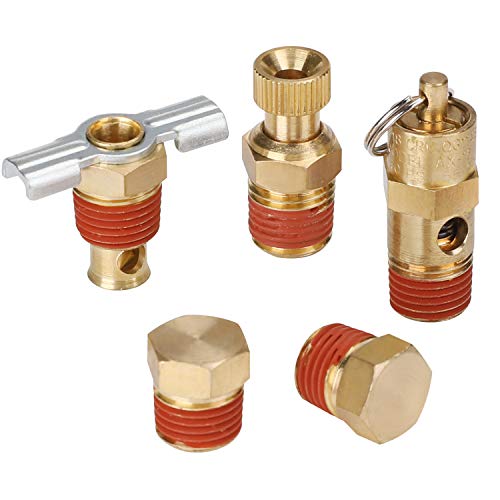 Hromee 5-Piece 1/4-Inch Drain Valve Kit |
8.9/10 | Buy |
| Best Premium |
 Hromee 10-Inch Extended Tank Drain Valve Kit |
8.9/10 | Buy |
 UNOX Automatic Electronic Air Compressor Drain |
8.9/10 | Buy | |
| Best Budget |
 PROSOCOOL N286039 1/4" NPT Air Compressor Tank |
8.8/10 | Buy |
 Reluen 1/4-Inch Male NPT Brass Air Compressor |
8.6/10 | Buy | |
 Aienxn 1/4" NPT Air Compressor Drain Valve |
8.6/10 | Buy | |
 SUNROAD 10-Inch Compressor Tank Drain Kit |
8.3/10 | Buy | |
 SUNROAD Automatic Electronic Air Compressor Tank |
8.3/10 | Buy | |
 SUNROAD 1/4" NPT Brass Drain Ball Valve (2-Pack) |
8.1/10 | Buy |
HK 10-Inch Air Compressor Drain Kit
This assembly kit relocates hard-to-reach compressor drain valves using a flexible 10-inch braided stainless steel line for easier moisture draining. Pre-coated sealant and an included brass adapter help secure airtight connections up to 175 PSI.
Pros
- Durable stainless steel braided hose construction
- Pre-coated thread sealant minimizes air leaks
- Includes adapter for 3/8-inch and 1/4-inch fittings
- Shut-off valve allows connecting additional extensions
Cons
- Working pressure capped at 175 PSI
- 10-inch length may be short for taller tanks
- Maximum temperature limit of 200 degrees Fahrenheit
Hromee 5-Piece 1/4-Inch Drain Valve Kit
This brass fitting assortment provides essential replacement valves and plugs for routine compressor tank maintenance. It pairs winged and knurled drain petcocks with a 140 PSI safety relief valve for dependable pneumatic management.
Pros
- Solid brass body provides corrosion and heat resistance
- Two petcock styles offer flexible moisture draining options
- Integrated safety valve handles up to 55 SCFM flow
- Stainless steel relief components resist rust over time
Cons
- Requires separate thread sealant for proper sealing
- Safety valve maximum pressure is capped at 140 PSI
- Winged drain handle has a 12-pound torque limit
Hromee 10-Inch Extended Tank Drain Valve Kit
Draining air compressor moisture is significantly easier with this extended kit, which relocates awkward underside petcocks to an accessible position. Built with a flexible braided steel line and a chrome-plated brass shutoff valve, it suits workshop owners seeking hassle-free daily maintenance.
Pros
- Braided steel hose resists kinking and physical wear
- Chrome-plated brass valve resists moisture corrosion
- Rubber-wrapped lever handle provides comfortable grip
- Includes adapters and thread tape for easy setup
Cons
- 10-inch reach may be short for large upright tanks
- 175 PSI hose limit restricts higher-pressure compressors
UNOX Automatic Electronic Air Compressor Drain
The UNOX Electronic Drain Valve is a heavy-duty brass timed solenoid assembly engineered to automatically purge tank condensation up to 232 PSI. Featuring adjustable cycle timers, an integrated strainer, and a 6-foot 110/120V power cord, it provides dependable moisture management for garage workshops and busy jobsite compressors.
Pros
- Automates moisture purging to help reduce internal tank corrosion and downstream water in pneumatic air lines
- Solid brass valve body is rated for demanding high-pressure workshop systems up to 232 PSI
- Flexible dual timer controls make it easy to tune purge frequency based on local ambient humidity
- Integrated strainer helps catch rust debris and oily sludge before it can jam the solenoid valve
- Includes both 1/2-inch and 1/4-inch NPT fitting options and a standard 120V grounded power cord
Cons
- Requires an accessible 110/120V electrical outlet located near the base of the compressor receiver tank
- High-pressure moisture discharge can produce a loud hiss that may startle users in quiet residential garages if not plumbed to a catch container
- Not intended for unheated sub-freezing storage environments below 32°F where standing moisture can freeze
PROSOCOOL N286039 1/4" NPT Air Compressor Tank
The PROSOCOOL N286039 is a direct-replacement 1/4-inch NPT manual air tank drain valve designed for Porter Cable compressors using part numbers A17038 and A06891. Its manual thumb screw design lets garage DIYers and contractors quickly drain accumulated moisture to help protect air receiver tanks from internal rust.
Pros
- Exact fit replacement for common OEM numbers N286039, A17038, and A06891
- Standard 1/4-inch NPT male threading ensures straightforward installation
- Tool-free thumb screw operation makes daily tank purging fast and simple
- Aids in extending air receiver life by making condensation removal hassle-free
Cons
- Requires manual opening after every work session rather than providing hands-free automatic draining
- Thread seal tape or pipe paste is not included and must be sourced separately for installation
- Limited strictly to compressor tanks with 1/4-inch NPT threaded ports
Reluen 1/4-Inch Male NPT Brass Air Compressor
The Reluen 1/4-inch male NPT hand-turn petcock is a solid brass drain valve rated up to 150 PSI, built for manual moisture drainage on compressed air tanks. It provides garage DIYers and mechanics with a reliable, corrosion-resistant replacement for stuck or leaking factory drain plugs.
Pros
- Solid brass body resists rust and corrosion caused by internal tank water buildup
- Standard 1/4-inch male NPT threading fits common compressor female drain bungs
- Rated up to 150 PSI to match common homeowner and garage compressor tanks
- Winged petcock head enables manual draining without searching for hand tools
- Compact overall footprint fits low ground-clearance compressor configurations
Cons
- Manual hand-turn operation requires reaching under the tank compared to extended ball-valve kits
- Over-torquing the winged petcock handle with pliers can bend or damage the shutoff wings
- Requires proper application of thread sealant tape during install to avoid slow seeps
Aienxn 1/4" NPT Air Compressor Drain Valve
Built from corrosion-resistant brass, this Aienxn drain valve features standard 1/4-inch male NPT threads and an integrated lever handle. It provides a full flow passage for compressor tanks, water tanks, and pneumatic setups.
Pros
- Corrosion-resistant solid brass construction
- Manual lever handle enables swift shutoff
- Full flow design maintains steady passage
- Compatible with air, gas, and liquid systems
Cons
- Restricted to 1/4-inch NPT ports
- Requires manual operation rather than automatic drainage
- Package contains only a single valve
SUNROAD 10-Inch Compressor Tank Drain Kit
Draining moisture prevents compressor tank rust, and this SUNROAD kit simplifies routine maintenance with a flexible braided steel line and an accessible quarter-turn shutoff. It provides a practical upgrade for standard 1/4-inch and 3/8-inch drain ports operating under 175 PSI.
Pros
- Durable braided steel hose prevents kinks
- Corrosion-resistant chrome-plated brass valve
- Complete installation kit with clamps and tape
- Rubber-coated handle allows easy quarter-turn operation
Cons
- 10-inch hose may be short for large tanks
- Working pressure is limited to 175 PSI
- Requires manual operation after every compressor use
SUNROAD Automatic Electronic Air Compressor Tank
The SUNROAD Automatic Electronic Tank Drain Kit automates compressor moisture maintenance by purging water and oily sludge on an adjustable 0.5-50 minute cycle. Powered by standard 110V-120V current and equipped with an inline isolation ball valve and strainer, it is an essential upgrade for garage mechanics and woodworkers seeking to protect their pressure vessels from internal rust.
Pros
- Automates daily tank draining with easily adjustable cycle interval and purge duration dials
- Built-in ball valve and strainer allow quick isolation and screen cleanout without emptying the air system
- Supplied with a flexible braided stainless steel discharge tube and multiple brass plumbing adapters
- Plugs into standard 110V-120V household wall outlets with an IP65 rated timer enclosure
Cons
- Requires an accessible 110V-120V electrical outlet positioned near the bottom of the compressor tank
- Sudden discharge bursts create a sharp air hiss that can be startling in quiet, enclosed home garages
- Minimum operating ambient temperature of 32°F means condensation can freeze in unheated winter shops
SUNROAD 1/4" NPT Brass Drain Ball Valve (2-Pack)
Designed for fast compressor maintenance, this brass ball valve set replaces fiddly screw-style drain cocks with a straightforward quarter-turn aluminum lever. Rated for 150 PSI and broad temperature swings, it provides a dependable upgrade for expelling tank moisture and oil.
Pros
- Corrosion-resistant solid brass construction
- Quick 90-degree quarter-turn operation
- Durable design without internal O-rings
- Wide temperature tolerance up to 250°F
- Includes thread seal tape and storage case
Cons
- Unthreaded outlet prevents attaching drain hoses
- Limited to a maximum working pressure of 150 PSI
Draining a Husky Compressor Tank and Choosing a Valve
The practical goal is to release accumulated condensate through the tank’s drain without exposing yourself to uncontrolled pressure or compromising the vessel. Drain after use according to the compressor manual, and do not remove a fitting while the tank is pressurized. A valve that opens predictably and can be reached without awkwardly tipping or lifting the compressor makes the routine easier to perform consistently.
Find the tank drain and identify its type
On many portable compressors, the drain is at the lowest part of the air tank, where condensed water can collect. The owner’s manual for the specific Husky model should confirm the drain location and the manufacturer’s draining procedure. Look at the fitting before turning it: a small threaded petcock, a wing-style cock, and a lever-operated ball valve have different operating motions.
Do not assume a valve is a drain simply because it is near the bottom of the compressor. Confirm that it is the tank drain, not a separate fitting, pressure relief device, or other component. If the location is obscured by a frame or the identification is unclear, consult the manual or the manufacturer’s support information rather than loosening an uncertain fitting.
Release pressure safely before opening the drain
Switch off and unplug the compressor before maintenance, then follow the model’s instructions for relieving stored air and verifying the tank is fully depressurized. Wear suitable eye protection because condensate and air can discharge from the opening. Keep your face, hands, and other people clear of the outlet, and do not try to restrain a valve or fitting while pressure is escaping.
Never treat a regulator reading as proof that the tank itself is empty: tank and regulated line pressure are not necessarily the same. Use the compressor’s specified procedure and check the tank pressure gauge as directed. Do not remove or adjust a safety relief valve to drain the tank; it is a safety component, not a substitute for the designated drain.
Open the valve and let condensate escape
Once the unit is off and the tank has been depressurized according to its manual, position yourself away from the outlet and open the drain using the motion appropriate to the installed valve. A petcock generally opens by turning its handle, while a ball valve uses a lever; confirm the particular valve’s direction rather than forcing it. Allow water and remaining condensate to flow into a suitable container or a location where discharge will not create a slip hazard.
Keep the opening clear and let the tank drain fully as directed by the manufacturer. If the drain is accessible only when the compressor is tilted, do not lift or tip a pressurized unit; follow Husky’s instructions for that model and use a stable position. Avoid putting fingers or tools into the opening, and do not apply excessive force to a stuck valve.
After the condensate has stopped flowing, close the drain snugly without overtightening it. A valve that is left open can prevent the compressor from building pressure, while an over-tightened or damaged fitting may leak or become difficult to operate later. Restore the compressor to service only as described in its manual, and check for an obvious leak during normal operation from a safe distance.
Recognize a blocked, damaged, or leaking drain
A drain that will not turn, releases little or no condensate when the tank should contain moisture, or continues to leak after closing deserves attention. Sediment, corrosion, a damaged seat, or a worn fitting could be involved, but the symptom alone does not establish which cause is present. Do not probe a pressurized drain or use a flame, power tool, or improvised method to clear it.
First stop the compressor and follow the manual’s complete depressurization process before inspecting the valve. If the valve remains seized, its threads appear damaged, or leakage continues, identify the compressor model and seek an appropriate replacement or service advice. Never operate a compressor with a drain that cannot be closed securely or with a tank that appears compromised.
Making a Difficult Tank Drain Easier to Maintain
Match replacement threads and pressure ratings
A replacement drain must match the compressor’s port, thread type, available clearance, and operating requirements. The product listings include several 1/4-inch NPT valves and assemblies, but that does not establish that a particular Husky tank uses that connection. Check the compressor manual, existing fitting information, and product specifications before ordering. Do not force a mismatched fitting into a tank port.
Some listings describe brass manual valves, while others provide petcocks or a hose assembly with a ball valve. A small hand-turn petcock is a direct replacement style for a compatible port, whereas a lever valve can offer a different way to open and close the drain. The most convenient control is not automatically the correct one: the connection and pressure rating still need to suit the compressor.
For example, the Reluen air blow gun guide covers a separate downstream accessory, not a tank drain. That distinction matters because blowing out a hose or tool does not empty condensate from the compressor tank. Choose a drain part based on the tank connection, and choose air-line accessories based on their own connections and intended use.
When an extended drain hose can help
An extended assembly routes the drain outlet to a more accessible position, which may reduce the need to reach beneath a low tank. The HK and Hromee assemblies in the supplied product data each describe a 10-inch braided steel hose with 1/4-inch NPT connections, and the SUNROAD extended kit also lists a 10-inch hose and routing hardware. Those listed dimensions and connections describe the kits, not the port size of every Husky compressor.
Before buying an extension, verify that the tank port, adapters, and valve can be assembled without interfering with the compressor frame, wheels, or floor. A routed hose should be secured as its instructions specify and should not be kinked, pinched, or exposed to damage during movement. Check the individual assembly’s maximum working pressure and temperature information against the intended system and its manual.
An extension adds joints, so installation quality matters. Use sealant only where appropriate for the fitting and as directed by the component instructions; do not assume every connection uses the same sealing method. With the tank fully depressurized during installation, tighten fittings appropriately without forcing threads, then follow the compressor instructions when returning it to operation and check for leaks safely.
Manual versus automatic drain options
A manual valve keeps the routine simple, but it still depends on someone opening and closing it at suitable intervals. The listed Hromee and HK extended assemblies use a manual ball valve, while other listed products include brass petcocks and ball-style drain cocks. These are options to evaluate only after confirming compatibility; the product listing names alone do not prove they fit a particular Husky model.
Automatic timed drains can be useful in a system where a compatible powered drain is appropriate and condensate management needs automation. The supplied UNOX listing describes a 110/120-volt timed valve with adjustable on-time and interval, and the SUNROAD automatic kit also describes a timer-operated drain with a strainer. These systems involve electrical components and specific connections, so installation should follow the compressor and drain-valve instructions, with qualified help where needed.
An automatic unit does not remove the need to inspect the drain path, verify the settings, and maintain the system. A blocked outlet or unsuitable installation could prevent effective drainage, and an automatic valve should not be treated as a safety device. For a portable compressor used intermittently, a correctly matched manual drain may be more straightforward than adding a powered accessory.
What Routine Draining Does, and What It Does Not Do
Protect the tank and downstream air system
Condensate left in a steel tank can contribute to corrosion over time, which is why manufacturers commonly include draining in compressor maintenance instructions. Water can also travel downstream and affect air tools or work where dry air matters. Draining the tank removes collected liquid from that vessel, but it does not guarantee that all moisture has been removed from the air delivered to a hose or tool.
For paint work, sensitive finishes, or equipment that needs drier air, a tank drain is only one part of moisture control. Appropriate filtration, water separation, or an air dryer may be required for the application, selected to match system conditions. Do not infer that a compressor is delivering moisture-free air simply because its tank has been drained.
Keep the drain valve accessible and include it in routine care at the interval specified by Husky. A valve that becomes hard to operate should be addressed rather than left until it fails. Use suitable eye and hearing protection when operating air equipment, and follow the compressor’s operating and maintenance guidance every time.
Choose the product type around the actual problem
If the original valve works and the main frustration is reaching it, an extended assembly may address access, provided its fittings match. If a worn valve needs replacement, a compatible manual petcock or ball valve may be the simpler route. If the compressor operates in a fixed installation and regular manual draining is impractical, a suitable automatic drain could be considered, but it brings added compatibility and electrical requirements.
The products in the supplied list illustrate those differences rather than establishing a universal best choice. The Hromee five-piece fitting kit includes multiple tank-port fittings and a safety valve, while the individual valve listings focus on a replacement drain component. The safety valve included in a kit is not a reason to replace or modify the compressor’s factory safety system without following the manufacturer’s instructions.
Compare listed thread sizes, materials, pressure limits, included adapters, and installation requirements. Product descriptions can help narrow options, but the compressor’s model documentation determines what the tank accepts. If the manual is unavailable or the existing connection is damaged, contact Husky support or an appropriate service provider before altering a pressure vessel.
Common mistakes to avoid during maintenance
Opening the drain while the tank is pressurized can send air and condensate out suddenly, so do not skip the model-specific depressurization procedure. Removing a drain fitting under pressure is especially unsafe and can turn a small maintenance job into a serious hazard. Do not use the safety relief valve as a routine drain or tamper with the pressure switch to make draining easier.
Another avoidable mistake is ordering by appearance alone. Similar-looking fittings may use different thread types, and an adapter that appears close may still be incompatible. Verify the exact port and every component in an extended assembly, and stop if threads do not engage smoothly rather than forcing them.
Finally, do not confuse an air-line purge with tank drainage. Releasing air from a hose or operating a blow gun may clear the line, but it does not necessarily remove liquid collected at the bottom of the tank. Follow the Husky manual for the tank itself, close the drain after the water has discharged, and address recurring leaks or a valve that cannot be operated safely.
In practice, drain the tank using the exact Husky model’s instructions, confirm it is depressurized before servicing, and select replacement parts only after checking the port and specifications. An accessible, correctly matched valve can make routine moisture removal easier, but it cannot replace safe operation or downstream moisture treatment when the application requires it.
About the author
Glenda Taylor has extensive experience in residential construction, remodeling, home improvement, and tool use. Her practical approach to equipment evaluation focuses on usability, performance, safety, and value—helping DIYers and workshop users make better-informed decisions about compressors and related tools.