
How to Buy a Good Air Compressor: A Practical Guide
How to buy a good air compressor starts with matching airflow, power, and portability to the job. Compare practical options for November 2026.
 By Tony Carrick
Updated November 10, 2026


A compressor that can reach a high PSI may still struggle with a tool that needs steady airflow. Tank size, air delivery, power source, noise, and the kind of work you plan to do all affect whether a machine suits your garage, vehicle, or hobby bench. Knowing how to buy a good air compressor means looking past a single headline specification and checking how each detail fits your actual jobs.
The products here cover very different tasks, from topping up tires to running an airbrush or supplying air from a larger portable unit. Their listed specifications include details such as maximum pressure, airflow, tank capacity, and power arrangements, but they do not provide every figure a buyer might want, such as CFM at 90 PSI for every model. For more specialized choices, see our guides to portable tire inflators and portable air compressors.
Top Products
| Award | Product | ACR Score About ACR ScoreThe ACR Score is our own rating from 0 to 10, based on performance, design and build, ease of use, and value. It reflects independent research and is never influenced by manufacturers, retailers, or affiliate commissions. Learn more › | |
|---|---|---|---|
| Best Overall |
Ipflin 160 PSI Portable Tire Inflator and Air
|
8.9/10 | Buy |
| Best Premium |
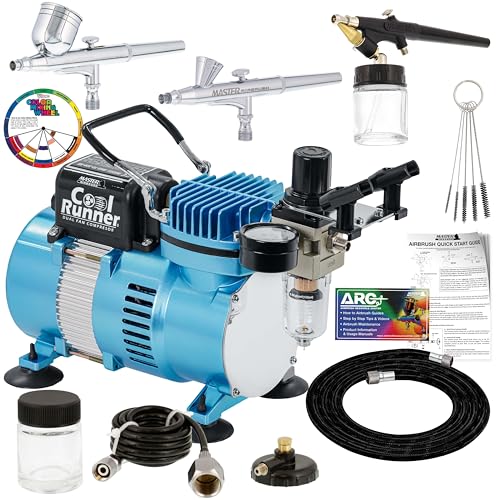 Master Airbrush Cool Runner II 3-Airbrush Kit |
8.9/10 | Buy |
 ALL-TOP 12V Dual-Cylinder Air Compressor |
8.8/10 | Buy | |
 MZB MZB-900H-24 6.4-Gallon Air Compressor |
8.6/10 | Buy | |
| Best Value |
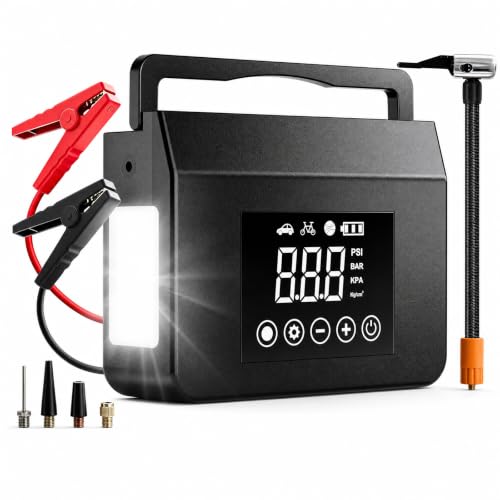 PASLDA Eco 150 PSI Portable Tire Inflator Air |
8.4/10 | Buy |
 VIAIR 88P 12V Portable Air Compressor |
8.4/10 | Buy | |
| Best Budget |
 Tire Inflator Portable Air Compressor |
8.1/10 | Buy |
 Craftsman CMCE521B V20 150 PSI Tire Inflator |
7.8/10 | Buy |
Ipflin 160 PSI Portable Tire Inflator and Air
The Ipflin portable air compressor provides up to 160 PSI and 30 L/min airflow with a built-in 9600mAh battery and 12V DC vehicle backup. It is an ideal emergency inflator for motorists, garage DIYers, and cyclists who need quick tire pressure adjustments without hauling a heavy air tank.
Pros
- True dual-power flexibility allows cordless battery operation or direct 12V DC automotive corded power during roadside emergencies
- High 160 PSI maximum pressure rating handles high-pressure bike tires, trailer tires, and passenger vehicle inflation
- Automatic shutoff system prevents over-inflation by stopping airflow as soon as the preset pressure target is reached
- Built-in 9600mAh battery eliminates the need for separate external power tool batteries or standalone chargers
Cons
- High-pressure tire inflator design is strictly intended for inflation and cannot operate pneumatic tools like brad nailers or air ratchets
- Cordless lithium-ion battery requires periodic top-off charging during storage to maintain emergency readiness
- Continuous inflation runtime is capped at 30 minutes before requiring a short cool-down period
Master Airbrush Cool Runner II 3-Airbrush Kit
Equipped with three specialized airbrushes and a dual-fan compressor, this comprehensive set provides steady airflow for extended creative sessions. It is well suited for hobbyists, decorators, and crafters needing versatile nozzle sizes for both broad coverage and fine detail.
Pros
- Dual cooling fans reduce heat during long sessions
- Versatile selection of three distinct nozzle sizes
- Includes helpful accessories like cleaning brushes and guide
- Built-in holder keeps airbrushes secure while working
Cons
- Relatively bulky setup requires considerable workspace
- Single-piston 1/5 HP motor limits heavy industrial use
ALL-TOP 12V Dual-Cylinder Air Compressor
The ALL-TOP 12V Dual-Cylinder Air Compressor delivers a manufacturer-rated 12.35 CFM airflow and 150 PSI maximum pressure with an integrated digital LCD auto-stop controller. Powered via direct battery alligator clamps, this heavy-duty portable pump is built for overlanders, off-road enthusiasts, and truck owners needing rapid tire reinflation on remote trails.
Pros
- High rated airflow output of 12.35 CFM (350 L/min) significantly speeds up multi-tire trail reinflation
- Accurate digital auto-stop feature prevents over-inflation without requiring manual gauge checks
- Robust dual-cylinder motor with 221-degree Fahrenheit thermal shutdown and 120A circuit protection
- Anti-vibration metal base can be left portable or permanently bolted into an overland rig
Cons
- Substantial 26.5-pound weight makes it bulkier to stow than compact emergency inflators
- High current draw requires hooking directly to vehicle battery terminals with the engine running
- Normal 2 to 4 pause intervals during the digital inflation cycle may surprise unfamiliar users
MZB MZB-900H-24 6.4-Gallon Air Compressor
Delivering 5.65 CFM at 115 psi, this 1.2 HP oil-free unit rapidly pressurizes its 6.4-gallon tank in about one minute while maintaining a low 70-decibel noise output. It serves well for home garages and workshops handling nail guns, air tools, and light painting.
Pros
- Quiet 70 dB operating volume
- Fast tank recovery under 65 seconds
- Generous 5.65 CFM output at 115 psi
- Low-maintenance oil-free motor design
- Integrated wheels assist mobility
Cons
- Steel construction adds significant carrying weight
- Tank capacity limits continuous heavy spraying sessions
- Corded operation requires standard electrical outlet
PASLDA Eco 150 PSI Portable Tire Inflator Air
This 2.6 lb cordless multi-function air compressor provides up to 150 PSI and 25 L/min airflow alongside a 4000A jump starter, real-time digital pressure readout, and auto-stop shutoff. It is an ideal emergency trunk tool for commuters, DIY drivers, off-road enthusiasts, and garage mechanics needing reliable mobile tire maintenance.
Pros
- Compact 2.6 lb all-in-one chassis combines high-pressure mobile tire inflation with a 4000A emergency engine jump starter
- Cordless 29.6 Wh battery design allows quick roadside tire top-offs without wrestling long power cords or requiring vehicle battery hookups
- Digital display with auto-shutoff protects tires, bicycle tubes, and sports equipment from accidental overpressurization
- Comprehensive built-in electrical protections prevent sparks, short circuits, reverse polarity, and motor overheating
Cons
- Tankless mobile inflator design does not provide the sustained CFM output required to operate pneumatic workshop tools
- Continuous inflation runtime is limited to approximately six minutes before requiring a motor cool-down period
- Lacks an AC wall outlet adapter for direct corded household plug-in operation without recharging the battery
VIAIR 88P 12V Portable Air Compressor
Designed for passenger cars and light trucks with tires up to 33 inches, the VIAIR 88P delivers dependable 120 PSI output directly from a vehicle battery. Its generous 26-foot total reach, built-in gauge, and integrated work light make it a practical emergency companion for road trips and camping.
Pros
- Solid 1.47 CFM flow rate provides brisk inflation
- Generous 26-foot reach easily accesses all four tires
- Built-in LED work light aids dark roadside repairs
- Compact body weighs under five pounds for convenient storage
Cons
- Requires direct battery connection instead of standard 12V outlet
- Limited to a 25-minute duty cycle before cooling
- Not designed for tires larger than 33 inches
Craftsman CMCE521B V20 150 PSI Tire Inflator
Powered by the Craftsman V20 battery platform, the CMCE521B inflator provides up to 150 PSI for various automotive inflation tasks. Weighing just two pounds, it combines an ergonomic D-handle grip with a digital gauge for straightforward, portable operation.
Pros
- Lightweight two-pound design enhances portability
- High pressure output reaches up to 150 PSI
- Clear digital gauge simplifies pressure monitoring
- Ergonomic D-handle provides balanced, comfortable grip
Cons
- Battery and charger are not included
- Requires Craftsman V20 platform batteries to run
How to Match a Compressor to the Job
The right compressor is the one that can supply the air your task needs, with a power source and form factor that make sense for where you will use it. A small cordless tire inflator and a tank-style workshop compressor are not interchangeable just because both are called air compressors. Start by writing down the tools or items you need to inflate, how often you will use them, and whether the work happens at home, in a vehicle, or at a bench.
Separate tire inflation from pneumatic tool work
Portable tire inflators are built around convenient tire and accessory inflation, not a large reserve of compressed air for continuous shop tools. The MUMAPI inflator is listed with a maximum pressure of 150 PSI and airflow of 15 L/min, while its description gives an example of filling a specified passenger-car tire from zero to 35 PSI in about five minutes. Those figures can help you judge its intended role, but they do not establish that it can run an impact wrench, sander, or spray gun.
The Ipflin model is described as a cordless and 12V DC-powered inflator with a maximum pressure of 160 PSI and airflow of 30 L/min. Its built-in battery, preset modes, automatic shutoff, and emergency light are useful features to weigh for roadside or household inflation. Check the manufacturer’s instructions for the intended operating time and cooling requirements rather than assuming a tire inflator can run continuously.
Some compact devices combine inflation with other roadside functions. The PASLDA Eco is listed as combining a tire inflator, jump starter, power bank, and light, while the CRAFTSMAN V20 inflator is designed to work with the CRAFTSMAN V20 system and is sold as a tool-only product. If you already own compatible batteries, platform compatibility may matter; confirm what is included before buying.
Use air delivery, not maximum PSI alone, to size tools
Maximum PSI describes a pressure limit, not how much air a compressor can deliver while a tool is running. Tool compatibility depends on the tool’s air consumption and the compressor’s delivered airflow at the working pressure, often expressed as CFM at 90 PSI for shop equipment. A high maximum PSI number cannot make up for inadequate airflow when a tool draws air continuously.
Look for the air consumption information in each tool’s manual or manufacturer specifications, then compare it with the compressor’s stated air delivery at the relevant pressure. The supplied information does not list CFM at 90 PSI for every product here, so it is not possible to confirm that each is suited to a particular pneumatic tool. If the compressor’s documentation gives only maximum pressure or a free-flow figure, ask the manufacturer for the working-pressure delivery rate before relying on it for a sustained application.
Airbrush work is a distinct use case. The Master Airbrush Cool Runner II is described as a 1/5 HP single-piston compressor and includes three airbrushes with different feed and tip arrangements. That package is aimed at airbrushing applications such as crafts, fine art, and graphics, but its listed details do not establish suitability for conventional spray guns, sanding tools, or other high-demand equipment.
For intermittent tasks, the tool’s usage pattern matters as much as its air demand. A tool used briefly and then allowed to rest gives a compressor time to recover; continuous use can drain a tank and make the pump run for longer periods. Verify the compressor’s rated duty cycle and recovery information in its manual, since those details are not supplied for all the listed options.
If this topic is part of a bigger decision, cfm cycling refrigerated air dryer for 60 hp air compressor nxc 0325 is a useful related read.
Tank Size, Airflow, and Work Rhythm
A tank stores compressed air, giving the system a reserve between pump cycles, while the pump replenishes that reserve. A larger tank may provide more stored air for short bursts, but it does not by itself prove that a compressor can keep up with a continuous air draw. The pump’s delivery rate and duty limits still matter.
What tank capacity can and cannot tell you
The MZB model is listed with a 6.4-gallon steel tank, a 115 PSI working pressure, and air delivery stated as 5.65 CFM at that pressure. That is more relevant to tank-style workshop use than the specifications for small cordless tire inflators, but buyers should still compare the stated delivery with their tools’ requirements. The product description also lists an oil-free motor and a 70 dB noise level; treat those as manufacturer-provided specifications, not as a substitute for checking how the compressor fits your workspace and workload.
A larger air reservoir can help cover short bursts of demand, but tank capacity alone does not indicate how fast pressure will recover. Ask for the compressor’s cut-in and cut-out pressures, tank-fill time, and recovery time if you need to plan repeated work cycles. Those figures are not provided for every product in this selection, so consult its manual or manufacturer documentation rather than estimating from tank volume alone.
The ALL-TOP 12V unit takes a different approach: its listed features include dual cylinders, 12.35 CFM, a maximum pressure of 150 PSI, battery-clamp connections, and an LCD pressure control with an automatic stop setting. The description identifies it for vehicle tires and overlanding, not as a general-purpose shop compressor with a storage tank. Its high listed airflow should not be read as a verified CFM-at-90-PSI figure or proof of compatibility with a continuous-use shop tool.
Check exactly what a published airflow rating represents. Free-flow output, airflow at a particular pressure, and a tool’s average consumption are not equivalent measures. If the tool and compressor specifications use different conditions, request comparable figures before making a purchase decision.
Consider recovery pauses and heat
A compressor that cycles frequently may be struggling to match the air being used, or it may simply be operating as designed for a brief task. Long stretches of pump operation can add heat, so the manufacturer’s duty-cycle instructions should guide how long the machine runs before a rest. Do not assume a unit can operate continuously unless the manufacturer explicitly rates it for that use.
Match work rhythm to the equipment. Tire inflation typically involves connecting the hose, setting or checking pressure, and allowing the inflator to work on an individual tire. Airbrushing involves a different pattern and demands compatible regulated airflow, while tools such as sanders or grinders can draw air for extended periods.
For a spray finish, airflow is only one part of the setup. Follow the spray gun and compressor manufacturers’ guidance for pressure, filtration, and moisture management, and consider whether oil or water in the air line could affect the finish. The supplied product details do not establish that every listed compressor includes the filtration needed for paint work.
Power, Noise, and Portability in Real Spaces
Power requirements and location can narrow the choice before tank size or accessories do. A compressor may be convenient to store in a vehicle but unsuitable for a fixed shop task, while a wheeled tank model may be awkward to carry but more practical to move around a garage. Check the product label and manual for the electrical supply it requires before connecting it.
Match the power source to where you work
The Ipflin inflator is described as operating from its internal battery or a 12V DC power cord, and the VIAIR 88P uses battery clamps for 12V power. The ALL-TOP model also uses heavy-duty battery clamps, while the CRAFTSMAN V20 inflator uses a compatible V20 battery. These arrangements offer different ways to get power, but they are not interchangeable, and an included battery should never be assumed unless the listing says so.
The MZB tank compressor is listed as a 110V, 60 Hz unit. Check whether your outlet and circuit meet the manufacturer’s requirements, especially if other equipment shares the circuit. The supplied information does not state starting current or running amperage, so it would be misleading to promise that the compressor will or will not trip a household breaker.
Do not choose an extension cord based on guesswork. Follow the compressor manual’s instructions for power connections and permitted cord use, and avoid undersized or damaged cords. If the motor struggles to start, a breaker trips, or a plug or cord becomes unusually warm, stop using the setup and seek guidance from the manufacturer or a qualified electrician.
Account for sound, storage, and handling
Noise can matter in a basement, attached garage, or shared work area. The MZB product description lists an operating noise level of 70 dB, and the Master Airbrush description highlights two cooling fans intended to help the compressor run cooler during longer continuous use. Those details are specific to their products; they do not provide a comparable noise measurement for the other options.
Portability is not one feature. A cordless inflator can be easy to store but still needs charging and appropriate care between uses. The VIAIR 88P is listed with a carry bag, a 16-foot air hose, a 10-foot power cord, and a vehicle-battery connection, while the ALL-TOP unit includes a carrying bag and insulated handle.
The MZB compressor is described as having wheels, which may help move its tank around a shop. Still, the supplied information does not state its weight or dimensions, so measure your storage space and check the full product details before purchase. A carry handle, wheels, or compact housing only helps if the machine can be moved safely and stored where its manual permits.
For more detail on matching airflow to pneumatic tools, use our guide to portable compressors for air tools. It can help frame the difference between a tool that draws air in short bursts and one that needs a sustained supply. Confirm the actual requirements for your own tools rather than relying on a product category label.
Oil-Free Convenience, Care, and Safer Ownership
Pump design affects maintenance, but the available models do not support a broad claim that one design always lasts longer or performs better. The MZB unit is described as oil-free, and the Master Airbrush package lists a single-piston compressor. Check the operating and maintenance instructions for the exact model you are considering, since the product descriptions do not provide service intervals or lifespan comparisons.
Read the maintenance details before committing
Oil-free construction can remove the need to check and change pump oil, but it does not mean the compressor requires no care. Filters, hoses, fittings, cooling needs, and any tank moisture still need attention as directed by the manufacturer. Follow the manual’s maintenance schedule rather than assuming a particular component is maintenance-free.
Tank-style compressors collect moisture from compressed air, and the manufacturer’s instructions should explain whether and how to drain the tank. Depressurize the tank completely before servicing or transporting the compressor, and do not remove fittings while pressure remains. Keep the drain accessible so routine care is practical, but do not modify a drain or pressure component without manufacturer guidance.
Inspect hoses and connectors for wear or leaks as part of ordinary care, and use fittings that are compatible with the compressor and tool. A regulator controls downstream working pressure, while the tank’s stored pressure is a separate value. Set pressure only within the limits specified for the tool and compressor, and never adjust factory pressure-switch settings or disable safety devices.
Plan for safe operation, not just purchase day
Read the compressor and tool manuals before first use. Follow their instructions for setup, pressure limits, ventilation, electrical supply, cooling periods, and any required initial procedure. Use suitable eye and hearing protection when operating air equipment, and keep bystanders clear of pressurized hoses and fittings.
Never use a tank or hose beyond its rated pressure, and do not bypass a pressure switch, thermal protection, or safety relief valve. If a safety device operates repeatedly, the tank is damaged, or a connection leaks, stop and consult the manufacturer or a qualified service provider. The product descriptions do not list every certification or safety feature, so verify those details in the complete documentation when they matter to your installation.
A useful purchase checklist is straightforward: identify the task, compare the tool’s air demand with verified compressor delivery at the working pressure, confirm the power source, and check tank, noise, and maintenance details against your space. Choose a tire inflator for portable inflation, an airbrush system for compatible airbrush work, or a tank compressor only when its documented output suits the intended tools. If a key specification is missing, get it from the manufacturer before buying rather than filling the gap with an assumption.
About the author
Tony Carrick is an experienced product researcher and writer specializing in tools, home improvement, automotive maintenance, and consumer equipment. With extensive experience reviewing tools and tackling hands-on renovation projects, he brings a buyer-focused perspective to compressor performance, usability, and overall value.