
How Much Is a Campbell Hausfeld Air Compressor?
How much is a Campbell Hausfeld air compressor? Compare portable, quiet, and stationary options, plus accessories, for November 2026.
 By Bob Beacham
Updated November 10, 2026

A small compressor for tire inflation and a permanently installed shop unit solve very different problems, so their prices can sit far apart. If you’re asking how much is a campbell hausfeld air compressor, the useful answer depends on whether you need a compressor, a replacement part, or an accessory, and on the air delivery and power the job requires. The listings covered here include compact portable and quiet models, larger stationary compressors, and supporting equipment from Campbell Hausfeld and CRAFTSMAN. Exact prices change, so check the current listing for the specific item rather than assuming every result is a complete compressor.
Start by separating the purchase into its role: light household inflation, quieter indoor work, intermittent pneumatic tools, or sustained shop use. Tank capacity and maximum PSI are useful specifications, but CFM at the working pressure is often more important when a tool draws air continuously. The available products range from a 2-gallon portable compressor to large 60- and 80-gallon, two-stage stationary units, with accessories and service parts also appearing in the results. If you’re considering a fixed garage setup, this guide to stationary workshop compressor options offers another point of reference for thinking about tank size and shop space.
Top Products
| Award | Product | ACR Score About ACR ScoreThe ACR Score is our own rating from 0 to 10, based on performance, design and build, ease of use, and value. It reflects independent research and is never influenced by manufacturers, retailers, or affiliate commissions. Learn more › | |
|---|---|---|---|
| Best Overall |
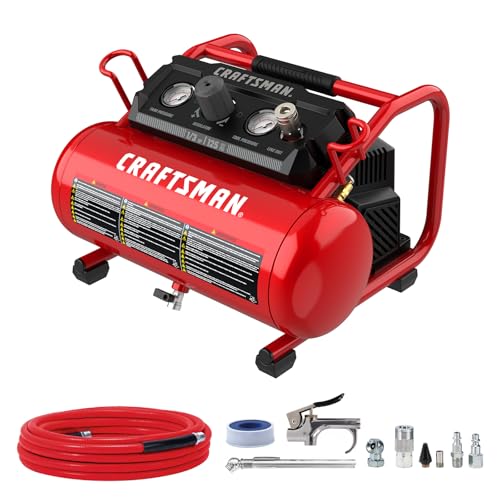
CRAFTSMAN 2-Gallon Portable Air Compressor
|
9.1/10 | Buy |
| Best Value |
 Campbell Hausfeld DC020500 2-Gallon Compressor |
8.9/10 | Buy |
| Best Premium |
 Campbell Hausfeld 60-Gallon Air Compressor |
8.9/10 | Buy |
 Campbell Hausfeld C151CH 15-Gal Air Compressor |
8.8/10 | Buy | |
 Campbell Hausfeld CE7051 80-Gal Air Compressor |
8.8/10 | Buy | |
| Best Budget |
 Campbell Hausfeld ST1253 Compressor Oil (16 oz) |
8.6/10 | Buy |
 Campbell Hausfeld Cast Iron |
8.3/10 | Buy | |
 Campbell Hausfeld Air Cleaner/Air Dryer for Air |
8.1/10 | Buy | |
 Campbell Hausfeld 80 Gallon 2‑Stage Vertical Air |
8.1/10 | Buy | |
 Campbell Hausfeld MP284701AV 17-Piece Kit |
8.0/10 | Buy |
CRAFTSMAN 2-Gallon Portable Air Compressor
This CRAFTSMAN 2-gallon portable compressor package pairs a max 125 PSI oil-free pump with a versatile 10-piece pneumatic accessory kit using standard 1/4-inch NPT fittings. It is a practical, lightweight solution for DIYers and homeowners tackling tire inflation, air dusting, and light fastening.
Pros
- Complete out-of-the-box pneumatic package with air hose, blow gun, tire chuck, and 1/4-inch NPT quick-connect hardware
- Lightweight 19-pound carry weight makes moving between the garage, driveway, and workbench effortless
- Oil-free pump eliminates crankcase oil checks and prevents oil aerosol contamination in downstream air lines
- Dual quick couplings allow quick hookups without needing additional brass splitters
Cons
- Small 2-gallon receiver tank and 1/3 HP motor are limited to light-duty pneumatic tasks rather than continuous air-hungry tools
- The included starter air hose and accessories are entry-level components that high-volume shops may eventually want to upgrade
- Fittings utilize standard 1/4-inch auto profile plugs which require matching couplers if your shop uses alternate pneumatic profiles
Campbell Hausfeld DC020500 2-Gallon Compressor
Built for garage and home DIYers who value peace and quiet, this compressor operates at a low 65 dBA while delivering up to 125 PSI. Its oil-free dual-piston pump and protective roll cage make it a clean, durable choice for everyday pneumatic tasks.
Pros
- Quiet 65 dBA operation minimizes garage noise
- Maintenance-free oil-less double-piston pump design
- Protective roll cage shields motor and pump components
- Convenient top-mounted gauges and oversized adjustment knob
Cons
- Small two-gallon tank requires frequent motor cycling
- Relatively heavy for its size at 38 pounds
- Modest air delivery limits continuous high-demand tool use
Campbell Hausfeld 60-Gallon Air Compressor
Built for demanding garage and workshop tasks, this stationary compressor combines a 3.7 HP motor with a two-stage cast-iron pump reaching 175 PSI. It provides steady airflow to support high-demand air tools like sprayers, grinders, and sanders.
Pros
- High 175 PSI maximum output pressure
- Durable cast-iron pump rated for longevity
- Large 60-gallon capacity supports sustained pneumatic tool use
- Vertical tank design saves workshop floor space
Cons
- Requires a dedicated 230V to 240V electrical connection
- Heavy 255-pound stationary build is difficult to move
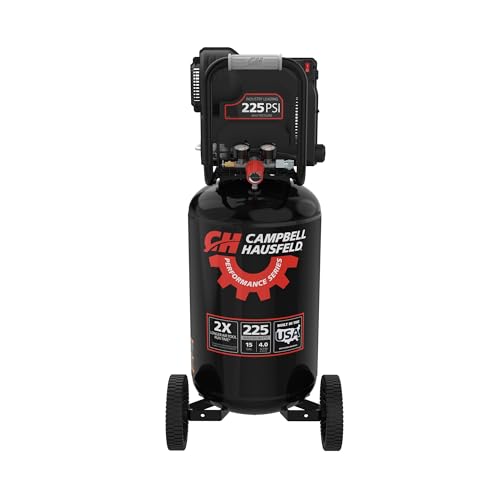
Campbell Hausfeld C151CH 15-Gal Air Compressor
Built for workshops needing reliable airflow without sacrificing floor space, this unit pairs a 225 PSI maximum pressure tank with a cold-weather-ready oil-free pump. Its wheeled vertical configuration and protective handle suit DIYers running nailers, inflators, and intermittent fastening tools.
Pros
- High 225 PSI tank extends intermittent tool runtime
- Maintenance-free pump starts in freezing conditions
- Vertical tank footprint saves valuable garage floor space
- Protective frame shields sensitive gauges and controls
- Wheeled base enables smooth workshop repositioning
Cons
- Relatively heavy at 75 pounds to lift into vehicles
- Output limits use with continuous high-demand air tools
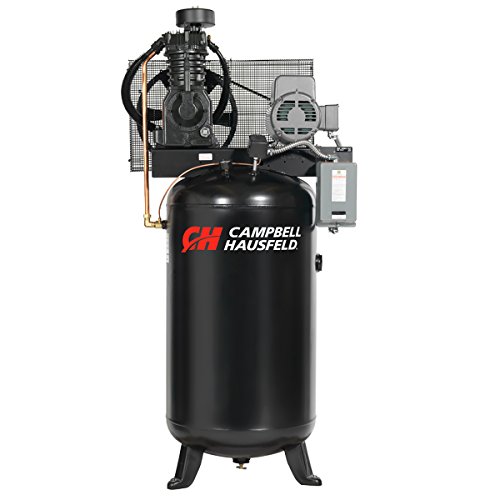
Campbell Hausfeld CE7051 80-Gal Air Compressor
Engineered for commercial workshops, this stationary compressor pairs an 80-gallon ASME tank with a durable two-stage cast-iron pump. It supplies dependable high-volume airflow rated at 17.2 CFM at 90 PSI to run demanding pneumatic systems.
Pros
- High airflow output for demanding pneumatic tools
- Durable cast-iron pump rated for 15,000+ hours
- Vertical tank design saves valuable floor space
- Includes pre-wired industrial motor starter
Cons
- Requires dedicated three-phase electrical service
- Extremely heavy unit at 540 pounds
- Tall 78-inch height requires substantial vertical clearance
Campbell Hausfeld ST1253 Compressor Oil (16 oz)
Formulated for workshop and industrial setups, this 30-weight lubricant protects compressor pumps against rust, sludge, and component wear. The compact 16-ounce bottle makes routine top-offs and crankcase servicing straightforward.
Pros
- Formulated specifically for compressor pumps and motors
- 30-weight viscosity helps minimize component wear
- Inhibits rust, sludge, and internal corrosion
- Compact bottle enables controlled, mess-free pouring
Cons
- 16-ounce volume may require multiple bottles for large units
- Single 30-weight viscosity is not suitable for all models
Campbell Hausfeld MP284701AV 17-Piece Kit
Equipping a new air compressor with standard hookups is straightforward with this 17-piece starter bundle. It supplies the essential hardware needed for routine inflation and basic pneumatic tool connections in a compact format.
Pros
- Includes 17 pieces for general compressor setup
- Supports both inflation needs and tool connection
- Extremely lightweight at half a pound
- Compact size stores easily in small spaces
What Determines the Cost of a Campbell Hausfeld Compressor?
The price you see depends first on what the listing actually sells. A compressor is a powered machine with a tank and pump, while oil, a pump assembly, an air dryer, and an accessory kit are separate items that may appear in the same search. Don’t compare those listings as though they were equivalent machines. Check the product name, model number, included equipment, and whether the item is a complete compressor before judging its value.
Among complete compressors, size and intended workload make a substantial difference. A portable unit with a small tank has a different role from a tall stationary compressor with a two-stage pump and a large reservoir. Larger systems also have installation considerations, including available floor space and electrical supply. A higher purchase cost may reflect a different class of equipment rather than a like-for-like upgrade for basic home tasks.
Pressure rating alone doesn’t explain either cost or usefulness. A maximum PSI figure describes the stated pressure limit, while CFM or SCFM at a specified pressure describes air delivery at that condition. For tools that run continuously, airflow is crucial; a large tank can store a buffer but cannot make an undersized pump produce air indefinitely. Compare these figures with the tool maker’s requirements before deciding whether a more expensive compressor solves your actual problem.
Portable and quiet options serve different jobs
The listed CRAFTSMAN unit has a 2-gallon tank, a 1/3 HP motor, oil-free pump, and maximum pressure of 125 PSI. Its product information gives a weight of 19 pounds and says an accessory kit is included, making it a compact option to consider for occasional inflation or portable tasks. Those details don’t establish its delivered CFM at 90 PSI, so they aren’t enough to confirm compatibility with an air-hungry tool. Review the full listing and the tool’s stated airflow needs before buying.
The Campbell Hausfeld 2-gallon quiet compressor is a different small-format choice. Its listed 65 dBA operating rating, oil-free double-piston pump, and output of 2.2 CFM at 90 PSI and 3.2 CFM at 40 PSI provide more specific information for assessing indoor use and compatible applications. The listing also gives a 2 HP motor and a weight of 38 pounds. Noise ratings and delivered airflow can help narrow the field, but placement, room acoustics, hose layout, and the tool’s demand still affect the experience.
A 15-gallon vertical compressor occupies another position between small portable and large stationary equipment. The listed Campbell Hausfeld C151CH is rated for 225 PSI and delivers 4.0 SCFM at 90 PSI and 5.2 SCFM at 40 PSI, with an oil-free pump and 120V single-phase power listed. Its vertical shape may suit a space-conscious workshop better than a broad horizontal tank, though the tank still takes up floor area and the unit needs safe clearance. Compare the specified airflow at the pressure your tool uses, not just the tank’s maximum PSI.
Stationary two-stage systems cost more to own and install
The 60-gallon Campbell Hausfeld model is a two-stage, oil-lubricated compressor with a vertical tank and a listed 175 PSI maximum. Product information specifies 7.6 SCFM at 90 PSI and a 230V motor, which makes electrical planning part of the purchase decision. This is not simply a larger portable compressor: it is a stationary shop machine that needs an appropriate location and supply. Confirm electrical requirements with the manufacturer’s documentation and a qualified electrician when installation work is needed.
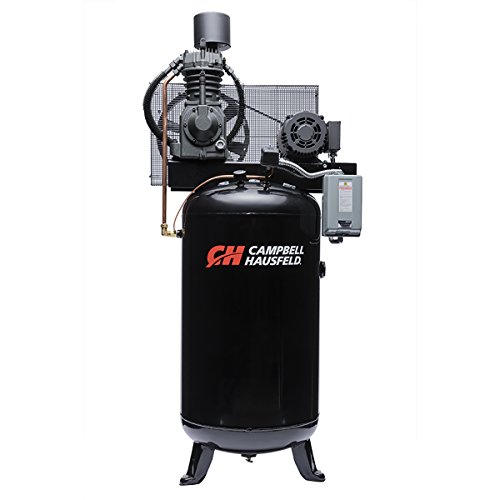
The 80-gallon choices are also stationary two-stage machines, but their specifications differ. One listing describes a 5 HP, three-phase compressor with 18.4 CFM at 40 PSI and 17.2 CFM at 90 PSI; it requires three-phase electrical service. Another lists a 7.5 HP motor, up to 25 CFM at 90 PSI, a 175 PSI maximum, and a 230V supply. Those distinctions matter more than tank volume alone: an 80-gallon tank does not tell you whether the motor and electrical service will suit your shop.
Two-stage, oil-lubricated construction and a large tank can be relevant to demanding workshop applications, but buyers should account for installation, maintenance, and service access. The listed stationary products are not interchangeable on power requirements, even where their tank capacities match. A residential garage may not have the necessary supply, and electrical service should never be improvised to accommodate a compressor. Read the manufacturer’s installation requirements before purchase and obtain qualified help for wiring or permanent installation.
Accessories and parts are not compressor substitutes
Search results can also include items that support an existing compressor. The Campbell Hausfeld 17-piece accessory kit is intended for inflation and tool connections, while the ST1253 listing is 16 ounces of compressor oil. Neither item includes a compressor. Check the contents and application details carefully, especially if you’re replacing a part or trying to assemble a complete air setup.
The cast-iron pump listing is identified as a replacement pump for specified Campbell Hausfeld VTXXX units rated at 3 HP and above. That product is not a standalone air compressor with a tank, motor, controls, and complete installation package. Before purchasing a replacement pump, compare the model and compatibility information with the existing equipment and manufacturer documentation. A similar appearance or brand name alone is not enough to establish that a part is suitable.
The air cleaner and dryer is another accessory, described as a point-of-use treatment unit with 3/8-inch ports and a desiccant moisture-removal system. It may be relevant to applications requiring cleaner, drier air, but it doesn’t change the compressor’s production capacity. Buyers planning spray work should distinguish air treatment from airflow: filtering or drying the supply doesn’t make a compressor capable of meeting a spray gun’s CFM demand. Check the tool and treatment equipment requirements together.
Match the Cost to the Air You Need
Use CFM at pressure to judge tool compatibility
Air delivery is the practical bridge between a compressor’s specifications and the job. A tool may state consumption at a particular operating pressure, so compare that demand with the compressor’s listed delivery at the same or a relevant pressure. The supplied product details include figures at 90 PSI for several models, but not for every compressor in the list. Don’t fill missing specifications with assumptions or treat a maximum PSI rating as an airflow figure.
Intermittent tools and continuous-draw tools place different demands on a compressor. A nailer typically consumes air in short bursts, leaving some time for the pump to refill the tank between operations. A grinder, sander, or spray gun may draw air for longer stretches, which can expose a mismatch between tool consumption and pump output. Confirm the exact tool’s airflow requirement in its manual; if the compressor’s published output is lower, a large tank may delay a pressure drop but won’t correct the ongoing shortfall.
Hoses, couplers, regulators, and air treatment equipment are also part of the delivery path. A restriction or leak can reduce usable pressure at the tool, even if the compressor has an adequate specification on paper. Use connections rated for the equipment and inspect them for leaks, following manufacturer guidance. For a broader look at safe operating pressure and related setup decisions, see this guide to air compressor pressure safety.
Tank size provides reserve, not unlimited runtime
A tank stores compressed air and provides a reserve for short demand peaks. A larger tank can reduce how quickly pressure falls during a burst of air use, but pump output and recovery still determine how the system behaves over a longer task. The 2-gallon quiet model and the 60- or 80-gallon stationary machines are designed around very different storage and installation needs. Neither tank capacity nor maximum PSI should be considered in isolation from delivered airflow.
For a buyer, the useful question is whether the work is brief and intermittent or sustained. Tire inflation, occasional blow-off, and intermittent fastening may not need the same equipment as continuous sanding or spray application. Look for the tool’s airflow and pressure requirements, then check whether the compressor publishes output at the operating pressure. If those details are absent, ask the manufacturer or seller rather than treating tank size as proof of compatibility.
Recovery time would help compare how quickly a tank returns to operating pressure, but it isn’t supplied for these listings. Avoid assuming a recovery speed from horsepower or tank size. Actual operation depends on the system and working conditions, and the product’s rated duty limits should guide how long it runs. If a pump cycles continuously or cannot keep up, stop and reassess the demand instead of expecting a bigger tank to solve an airflow mismatch.
Check power before paying for a larger model
Electrical supply can be a deciding cost because stationary compressors may need service that a typical outlet does not provide. The 60-gallon model is listed for 230V, and one 80-gallon model is specified for 208-230/460V three-phase power. The other 80-gallon listing specifies 230V. These are meaningful differences, not minor options, and a buyer should verify the exact model’s electrical plate and installation instructions before ordering.
The 15-gallon C151CH is listed for 120V single-phase power with a 15A rating. That information is useful, but it does not establish startup inrush current or guarantee that any shared household circuit will operate it without interruption. Other loads on the circuit, wiring condition, and manufacturer requirements matter. Don’t use an undersized extension cord or alter wiring as a workaround; consult the manual and a qualified electrician if the outlet or circuit is uncertain.
Portable models can be easier to place and move, but portability doesn’t remove the need for suitable power. Check the required voltage and circuit information for the particular unit, and don’t generalize from one compressor to another. For stationary equipment, include installation and electrical work in the overall ownership budget rather than looking only at the product listing. A machine that cannot be connected safely is not a good value for the intended location.
Oil-Free Convenience, Maintenance, and Air Quality
Several listed portable models use oil-free pumps, while the larger two-stage stationary models are oil-lubricated. Oil-free construction can simplify pump lubrication maintenance, but it doesn’t mean the whole compressor is maintenance-free. Tank moisture, air filters, connections, and other parts still need attention as specified by the manufacturer. Read the specific manual for service intervals and approved procedures rather than applying a schedule from a different model.
Oil-lubricated pumps require the correct oil and level checks according to their instructions. The ST1253 product is listed as compressor oil, but buyers should verify that it is appropriate for their exact pump before use. Don’t substitute automotive engine oil or infer a viscosity or change interval from the product name alone. Follow the manual, and fully depressurize the tank before servicing fittings or moving equipment where the manufacturer requires it.
Compressed air can carry moisture, and tank condensation should be managed according to the manufacturer’s safety and maintenance guidance. Drain only as directed, keep the outlet pointed safely, and use eye protection; depressurize the tank completely before servicing or transport. The air cleaner/dryer listing describes desiccant that removes water vapor, but a treatment accessory doesn’t replace tank care. Buyers using air for finishing should also confirm the complete system provides air quality appropriate to the coating and spray equipment.
Quiet operation has a practical, limited role
The Campbell Hausfeld quiet model’s listed 65 dBA rating is a concrete distinction for buyers who expect to work near the compressor indoors. It is not a rating supplied for the other models, so avoid assuming that all Campbell Hausfeld compressors are similarly quiet. Even a lower listed sound rating doesn’t mean silent operation, and the room, distance, and operating conditions affect perceived noise. Use suitable hearing protection around operating air equipment.
Noise can influence where a compressor is placed, particularly in a home garage or a shared workspace. A quiet small unit may suit occasional work where sound matters, but its listed 2.2 CFM at 90 PSI still sets an airflow limit. A larger stationary compressor may offer substantially different listed airflow, yet its noise rating is not provided here. Compare documented sound and air delivery rather than paying extra based on a general assumption about size or brand.
Placement also affects practical ownership. Keep the compressor in a location allowed by the manual, with adequate ventilation and access for inspection and maintenance. Don’t enclose a machine in a way that blocks airflow or makes service unsafe. For any model, the operating sound specification, where available, should be only one part of the decision alongside the tool demand, power supply, and intended work schedule.
How to Judge the Listing and Make a Sound Purchase
Prices can change with seller, stock, shipping, and configuration, so treat any displayed amount as a current listing detail rather than a permanent manufacturer price. Compare the exact model and what is included, not just the brand name or tank size. The products here include compressors, a replacement pump, oil, an air treatment device, and an accessory kit. A low-priced accessory listing is not evidence that a complete compressor is inexpensive, and a high-capacity machine may require additional installation spending.
Check that the listing’s model number matches the machine you intend to buy. Verify tank volume, maximum pressure, airflow at the relevant pressure, motor and voltage information, and pump lubrication type. Then confirm included accessories, warranty terms, shipping arrangements, and return conditions on the seller’s page. For a replacement part, consult the compressor’s manual or manufacturer support to verify the specified application before placing an order.
Product ratings and review totals can change, so they shouldn’t replace checking specifications and current seller details. A rating doesn’t tell you whether a compressor can supply enough air for a particular sander or whether your shop has the right circuit. Similarly, a horsepower label by itself doesn’t provide a complete picture of delivered airflow. Give priority to manufacturer-listed CFM or SCFM at the working pressure and documented electrical requirements.
Choose by workload, then confirm the full cost
For occasional inflation and light portable tasks, a compact oil-free unit may be a reasonable category to compare, provided its airflow suits the job. For indoor use where noise is a concern, the quiet model has a published sound rating and airflow specification to assess. For a stationary workshop with sustained demand, the larger two-stage compressors offer a different level of listed air delivery, but power supply and installation become central considerations.
Include the practical costs beyond the machine: an appropriate hose and fittings, air treatment where required, routine maintenance, and any electrical or installation work. A complete accessory kit may be convenient, but confirm the included fittings match the task. A dryer may be valuable for an application sensitive to moisture, while it cannot compensate for inadequate CFM. Decide which needs are essential now and which accessories can be added later.
Before checkout, compare the tool’s operating pressure and air consumption with the compressor’s documented output, verify the electrical supply, and confirm the item is a complete machine if that is what you intend to buy. For replacement components, check model compatibility through the manufacturer’s documentation. Those checks make the price meaningful: they help distinguish a suitable compressor from an attractive listing that doesn’t fit the job.
So, there isn’t one single cost for a Campbell Hausfeld air compressor: the range depends on whether you’re buying a compact portable unit, a quiet model, a high-capacity stationary system, or an accessory or replacement part. Match the price to verified airflow, pressure, tank capacity, maintenance, and electrical needs. Then confirm the current seller listing and installation requirements for the exact model before making the purchase.
About the author
Bob Beacham is an experienced tools and workshop writer with deep knowledge of power equipment, mechanical systems, and practical DIY applications. His coverage of air compressors, welding equipment, saws, and workshop tools helps translate technical specifications into useful guidance for homeowners and serious DIYers.