
How Does a Portable Air Compressor Work: Practical Guide for 2026
Learn how does a portable air compressor work for October 2026. See how electric motors, pistons, and valves generate reliable portable pneumatic power.
 By Glenda Taylor
Updated October 7, 2026
By Glenda Taylor
Updated October 7, 2026

Understanding pneumatic tools or preparing for roadside tire emergencies often starts with a simple mechanical question. Many drivers and workshop hobbyists rely on pressurized air daily, yet the internal physics of transforming ambient air into high-pressure power remains unfamiliar to most users. When learning how does a portable air compressor work, the basic principle centers on atmospheric air intake, mechanical reduction of volume, and controlled release through specialized valves. Whether you are selecting a portable air compressor for garage workshops or packing a compact direct-drive unit in a vehicle trunk, grasping the core mechanics ensures better tool performance and equipment longevity.
The process relies on electric motors driving reciprocating pistons, flexible diaphragms, or dual cylinders to compress air molecules inside a confined cylinder bore. Once compressed, this pressurized air either collects inside a welded pressure vessel or routes directly toward a tire valve stem through a regulated delivery hose. Knowing how pressure regulators, check valves, and auto-shutoff sensors function helps avoid motor strain while matching compressor output to pneumatic tools. By learning how these compact machines manage heat, current, and airflow, you can prevent overheating and extend the working life of your portable gear.
| Award | Product | ACR Score About ACR ScoreThe ACR Score is our own rating from 0 to 10, based on performance, design and build, ease of use, and value. It reflects independent research and is never influenced by manufacturers, retailers, or affiliate commissions. Learn more › | |
|---|---|---|---|
| Best Overall |
CRAFTSMAN 12V Portable Tire Inflator with
|
9.2/10 | Buy |
| Best Premium |
 DEWALT Cordless Tire Inflator Portable Air
|
9.1/10 | Buy |
| Best Budget |
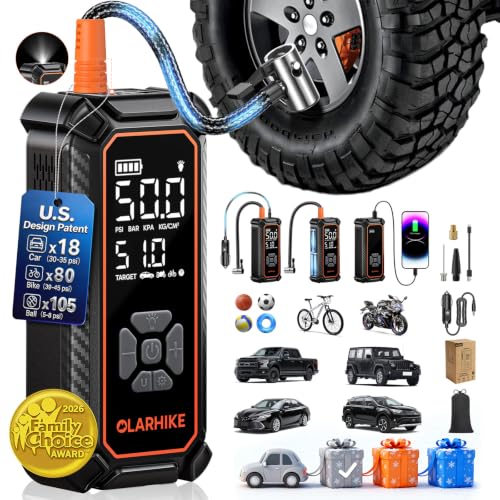 OlarHike Portable Tire Inflator Air Compressor
|
8.8/10 | Buy |
 GSPSCN 12V Portable Tire Inflator
|
8.8/10 | Buy | |
 CARSUN 12V DC Portable Tire Inflator
|
8.6/10 | Buy | |
 AstroAI AIRUN H 12V DC Portable Air Compressor
|
8.4/10 | Buy | |
 OlarHike 12000mAh Cordless Tire Inflator
|
8.3/10 | Buy | |
| Best Value |
 AstroAI Portable Tire Inflator Air Compressor
|
8.1/10 | Buy |
 AstroAI L7 Cordless Tire Inflator Portable Air
|
8.0/10 | Buy | |
 AstroAI AIRUN H 12V DC Tire Inflator Portable Air
|
7.8/10 | Buy |
CRAFTSMAN 12V Portable Tire Inflator with
The CRAFTSMAN 12V Portable Tire Inflator is an ultra-compact 1.9-pound roadside unit delivering up to 150 PSI with digital auto shut-off and built-in cord storage. Powered via a standard 12V car accessory plug, it offers fast tire top-offs and dependable emergency inflation without crowding trunk space.
Pros
- Weighs only 1.9 pounds for effortless glove box, under-seat, or trunk storage during road trips
- Digital auto shut-off prevents accidental over-inflation without requiring constant manual gauge monitoring
- Bright three-mode LED light provides critical illumination during nighttime roadside emergencies
- Comes fully equipped with multi-valve adapters, a replacement fuse, and a tailored carry pouch
Cons
- Requires a 12V DC vehicle accessory socket and does not include a 120V AC household outlet adapter
- Compact tankless pump is built strictly for tire inflation and cannot drive pneumatic nailers or air tools
- The 2.17-foot air hose length means the compressor must sit on the ground adjacent to the wheel valve stem
DEWALT Cordless Tire Inflator Portable Air
This compact DEWALT portable tire inflator delivers up to 150 PSI with smart auto shut-off, powered by an internal rechargeable battery or an included 10-foot 12V car plug. It provides an efficient, pocket-sized solution for vehicle owners, cyclists, and DIYers wanting rapid roadside top-offs without hauling a bulky tank compressor.
Pros
- True cordless freedom with an internal rechargeable battery plus a 10-foot 12V DC vehicle plug backup
- Accurate digital pressure gauge with 5 smart presets and automatic shut-off to eliminate overinflation
- Ultra-compact handheld design weighing just 0.63 kg for easy storage in glove boxes or saddlebags
- Integrated LED work light and emergency USB power bank functionality for travel safety
- Generous accessory bundle backed by a 3-year limited warranty
Cons
- Engineered exclusively for high-pressure inflation rather than operating pneumatic air tools or nailers
- Does not include a 120V AC residential wall outlet power adapter
- Compact tankless pump requires periodic cooling breaks during heavy multi-tire inflation runs
OlarHike Portable Tire Inflator Air Compressor
The OlarHike Portable Tire Inflator combines dual-power versatility via a 12V DC vehicle plug or built-in rechargeable battery with an automatic shut-off digital display. It provides dependable roadside tire top-offs and inflation for passenger cars, crossovers, motorcycles, and bicycles.
Pros
- Dual-power design allows cordless field operation or continuous power through any standard vehicle 12V DC port
- Automatic shut-off technology stops the motor precisely at preset pressure to prevent over-inflation
- Integrated 6000mAh battery reserve doubles as an emergency phone charger and includes an LED work light
- Pocket-sized footprint weighs well under two pounds for convenient transport in center consoles or backpacks
Cons
- Maximum vehicle pressure rating of 51 PSI is not suitable for heavy-duty commercial trucks, RVs, or high-pressure trailer tires
- Compact tankless inflator mechanism cannot power workshop pneumatic tools such as nail guns or air ratchets
- Recharging requires a standard 5V 2A or 5V 3A adapter and is not compatible with high-wattage fast chargers
GSPSCN 12V Portable Tire Inflator
The GSPSCN 12V Heavy Duty Tire Inflator delivers a robust 70 L/min airflow with its direct-drive dual-cylinder metal pump and 150 PSI maximum pressure rating. Built for pickup trucks, SUVs, and trailer owners, it operates at a manageable 70 dB and includes battery clamps for reliable 12V direct connection.
Pros
- Fast 70 L/min air volume output powered by a dual-cylinder direct-drive metal pump mechanism
- Generous 23-foot total working reach across the 11.5-foot 12V power cord and 11.5-foot air hose
- Direct battery clamps deliver dependable 12V DC power without risking internal vehicle fuse blowouts
- Remarkably manageable 70 dB sound level compared to standard high-pitch emergency tire pumps
Cons
- Requires direct 12V car battery terminal connection, which necessitates opening the vehicle hood
- Lacks an integrated air storage tank, so it is strictly intended for direct inflation rather than air tools
- No built-in digital automatic shutoff target pressure stop, requiring manual gauge monitoring
CARSUN 12V DC Portable Tire Inflator
The CARSUN 12V DC portable tire inflator delivers a listed 35 L/min airflow with automatic digital shut-off up to 150 PSI. It is an ideal, budget-friendly roadside emergency pump for passenger car owners, cyclists, and weekend campers.
Pros
- Automatic shut-off prevents accidental tire over-inflation by cutting power at the preset target pressure
- Lightweight 1.9-pound frame and compact dimensions fit neatly into vehicle trunks or roadside emergency kits
- Capable 35 L/min air volume airs up standard passenger tires quickly during routine seasonal pressure top-offs
- Bright integrated LED lighting assists with safe valve connection along dark roadways and unlit driveways
- Four included adapter nozzles expand utility across bicycles, sporting balls, and recreational air mattresses
Cons
- Powered exclusively via 12V DC vehicle sockets and does not include a 120V AC household electrical plug
- Manufacturer explicitly notes the unit is not suitable for heavy commercial trucks or large motor lorries
- Tankless high-pressure inflator design is not engineered to operate pneumatic workshop air tools
AstroAI AIRUN H 12V DC Portable Air Compressor
The AstroAI AIRUN H is a compact 12V DC tire inflator delivering up to 35 L/min airflow with automatic shut-off and digital pressure presets. It is an ideal portable emergency compressor for drivers, commuters, and garage hobbyists seeking fast tire top-offs.
Pros
- Automatic shut-off stops pumping reliably once target PSI is reached
- High-airflow 120W motor provides rapid top-offs for daily driver tires
- Long 9.84-foot power cord reaches all passenger vehicle wheels with ease
- Bright built-in LED flashlight and backlit display assist during night repairs
- Lightweight 2.2-pound form factor stores neatly in glove boxes and trunks
Cons
- Requires a 12V DC vehicle outlet and does not include a 120V AC household plug
- Mandates a 10-minute cool-down interval after 15 minutes of continuous operation
- Not intended for high-volume inflatables like large pool floats or air mattresses
OlarHike 12000mAh Cordless Tire Inflator
The OlarHike Heavy Duty Tire Inflator is a compact 3.2-pound mobile air compressor featuring a twin-cylinder motor, integrated 12,000mAh battery, and 12V DC vehicle adapter. It provides rapid roadside inflation with auto-shutoff convenience, making it a dependable emergency tool for drivers, mechanics, and off-roaders.
Pros
- Twin-cylinder pump configuration delivers faster inflation times than typical single-piston mini inflators
- True dual-power flexibility prevents downtime by running via battery or vehicle 12V DC outlet
- Compact, lightweight 3.2-pound body offers exceptional portability without eating up cargo space
- 45W USB-C Power Delivery port provides practical utility beyond tire maintenance
- Auto-stop feature eliminates pressure guessing and prevents dangerous over-inflation
Cons
- Tankless mobile design is strictly intended for inflation and cannot operate continuous-draw pneumatic air tools
- Extended continuous runtime on large truck or RV tires will cause heat buildup that requires brief cool-down intervals
- Does not include a standard 120V AC household wall plug for direct residential outlet use
AstroAI Portable Tire Inflator Air Compressor
The AstroAI Dual Power Tire Inflator combines a 12V DC vehicle plug and 120V AC household cord, delivering up to 150 PSI for car tires and a 350 L/min high-volume mode for rafts and mattresses. It is a dependable, compact choice for garage mechanics, road-trippers, and homeowners wanting versatile inflation without needing a bulky air tank.
Pros
- Dual 12V DC and 120V AC power cords offer genuine versatility for garage benches, driveways, and roadside emergencies
- Two dedicated inflation modes handle high-pressure tires up to 150 PSI as well as high-volume camping gear at 350 L/min
- Digital auto-shutoff stops pumping once target pressure is reached, preventing accidental over-inflation
- Integrated cord and air hose storage compartments maintain a clean, compact footprint in vehicle trunks
- Dual metal motor build provides reliable output with up to 15 minutes of continuous run time per cycle
Cons
- Not designed to support heavy-duty commercial truck tires or high-volume commercial vehicle applications
- Requires a mandatory 10-minute cooling rest after 15 minutes of continuous high-pressure pumping
- Tankless electric inflator design cannot drive pneumatic air tools such as brad nailers or impact wrenches
AstroAI L7 Cordless Tire Inflator Portable Air
The AstroAI L7 is a lightweight, handheld cordless air compressor delivering up to 150 PSI with an integrated 4000mAh rechargeable battery and precise auto-shutoff. It provides dependable, pocket-sized inflation performance for motorists, cyclists, and DIYers needing quick roadside tire top-offs.
Pros
- Weighs only 0.96 pounds for effortless storage in vehicle consoles, toolbags, or cycling packs
- High-speed digital sensor samples tire pressure at 200 times per second to prevent over-inflation
- Internal 4000mAh battery provides cordless freedom without tangling 12V cigarette lighter cords
- Versatile secondary utility as an emergency LED flashlight and portable USB power bank
Cons
- Not intended for heavy-duty truck tires or commercial tires larger than 25 inches in diameter
- Duty cycle requires allowing the unit to cool for 10 minutes after 15 minutes of continuous run time
- Tankless micro-compressor design cannot power workshop pneumatic air tools
AstroAI AIRUN H 12V DC Tire Inflator Portable Air
The AstroAI AIRUN H is an ultra-compact 12V DC tire inflator delivering 35 L/min airflow with digital target presetting and automatic shut-off. It is an ideal emergency roadside tool for car owners, commuters, and garage hobbyists needing quick tire pressure top-offs.
Pros
- Fast tire top-offs with manufacturer-rated 35 L/min airflow powered by a 120W motor
- Accurate digital target presetting with auto shut-off eliminates over-inflation guesswork
- Generous 9.84-foot 12V DC cord easily stretches to all four passenger car tires
- Lightweight, highly packable footprint stashes effortlessly in a glove box or trunk
- Includes adapters for bicycle Presta valves and sports equipment alongside a bright LED work light
Cons
- Strictly 12V DC powered, meaning it cannot plug into standard 120V AC household outlets without an external adapter
- Requires a 10-minute cool-down period after 15 minutes of continuous use to prevent motor overheating
- Not designed for pneumatic nailers or high-volume inflatables such as air mattresses and pool rafts
How Portable Air Compressors Generate and Regulate Pressurized Air
A portable air compressor works by capturing ambient atmospheric air, mechanically reducing its volume through an electric pump, and releasing it as pressurized pneumatic energy. Inside the pump housing, a compact motor rotates an eccentric crankshaft that drives one or more pistons inside machined cylinders. Precision one-way valves ensure that air moves inward during the intake stroke and outward toward a storage tank or delivery hose during compression. Managing this mechanical sequence allows portable compressors to inflate vehicle tires, operate finish nailers, or blow away workshop debris efficiently.
The Physics of Gas Compression and Atmospheric Air Intake
The core mechanism of any air compressor relies on established thermodynamic principles governing gas behavior under physical confinement. Ambient air at sea level sits at roughly 14.7 pounds per square inch, with gas molecules floating loosely throughout the surrounding atmosphere. When the compressor motor rotates, the downward motion of a piston creates a localized low-pressure zone beneath the cylinder head. Surrounding atmospheric air immediately flows through an intake filter to equalize this pressure difference, filling the expanding cylinder chamber.
Once the piston reaches the lowest point of its stroke, the compression phase begins as the piston reverses direction. Under Boyle’s law, gas pressure increases proportionately as the physical volume of its container decreases at a constant temperature. As the rising piston pushes upward, it confines the trapped air molecules into a tiny fraction of their previous volume. This rapid mechanical compaction forces the molecules into dense collisions, converting electrical motor power into concentrated pneumatic energy.
Valving Dynamics: How Reed and Flapper Valves Direct Airflow
Directional airflow control is essential to prevent compressed air from blowing back through the intake opening. Modern portable compressors achieve this control using flexible spring-steel reed valves or stainless flapper plates mounted on a precision valve plate. During the downward intake stroke, the vacuum formed in the cylinder pulls the intake reed valve downward away from its seat. Clean atmospheric air enters through the intake port, filling the cylinder bore until the piston reaches bottom dead center.
As soon as the piston moves upward, the rapidly building pressure forces the intake reed tightly closed against its port. With nowhere else to escape, the dense compressed air pushes the separate exhaust reed valve open against a mechanical stop plate. The pressurized charge rushes through the cylinder head into the discharge line without leaking backward. Understanding these essential air compressor components and replacement parts makes it easier to diagnose slow pumping cycles caused by warped reeds or carbon buildup. Once the compression stroke completes, the discharge valve snaps shut to seal the line for the next cycle.
Tank-Based Pressure Vessels versus Direct-Drive Inflators
Portable air compressors generally utilize two different delivery formats based on whether they include a storage tank or provide continuous direct flow. Traditional jobsite compressors, such as pancake and twin-stack models, store pressurized air inside a welded steel or aluminum tank. The vessel acts as an energy accumulator, holding air at pressures up to 150 PSI so the motor does not need to run continuously during light tool use. An automatic pressure switch monitors tank pressure, shutting down the motor once full and restarting it when air pressure drops below a cut-in threshold.
Compact tire inflators take a different mechanical path by eliminating the pressure tank to reduce weight and bulk. Instead of building a pressurized reserve, the electric motor runs continuously, sending each stroke of compressed air straight through the hose into the tire valve. While direct-drive units lack the high instantaneous airflow required for pneumatic tools, their tankless layout makes them remarkably compact. Drivers can easily tuck these lightweight inflators into a trunk or utility drawer for emergency roadside tire top-offs without losing cargo space.
Motor Drive Systems and Multi-Source Electrical Architectures
Supplying rotational force to the compressor crankshaft requires an electric motor matched to the available power supply. Workshop compressors commonly employ universal brush motors or low-RPM induction motors engineered for standard 120-volt alternating current household circuits. These motors draw significant startup surge amperage, requiring clean electrical connections and heavy wiring to avoid nuisance breaker trips. In contrast, portable roadside tire inflators rely on compact 12-volt direct current motors tailored specifically for automotive electrical systems.
Modern inflators often feature multi-source electrical designs that adapt to varying roadside and off-grid conditions. Many 12-volt models connect directly to a car accessory lighter socket or attach straight to vehicle battery posts using insulated alligator clamps. Other portable designs feature built-in rechargeable lithium-ion battery packs, providing complete cordless convenience for fast tire top-offs away from a vehicle. Some versatile units even support dual-voltage inputs, allowing users to alternate between a standard 120-volt garage outlet and a 12-volt vehicle socket.
Single-Piston versus Dual-Cylinder Direct-Drive Configurations
The volumetric air delivery of a portable compressor depends directly on the number and size of its pump cylinders. Standard consumer inflators utilize a single reciprocating piston connected to an eccentric counterweight on the motor shaft. Because a single piston displaces a modest air volume with each revolution, the motor must spin rapidly to maintain acceptable airflow rates. This high-speed rotation generates noticeable vibration and concentrated operating heat, which limits how long the unit can run before requiring rest.
Heavy-duty portable compressors often adopt a dual-cylinder direct-drive architecture with two pistons operating simultaneously. By sharing the mechanical compression load across twin cylinders, the pump doubles its volumetric output without requiring extreme motor speeds. These dual-cylinder pumps can deliver airflow rates exceeding 70 liters per minute, which significantly cuts inflation times on large truck and trailer tires. Additionally, the opposed or balanced piston layout reduces mechanical chatter, dampens chassis vibration, and distributes thermal wear across two separate cylinder sleeves.
Dual-Mode Pneumatics: High-Pressure Inflation versus High-Volume Air Movement
Pneumatic applications demand different relationships between working pressure and air delivery volume depending on the item being filled. Vehicle tires, bicycle tubes, and sports equipment require substantial pressure to overcome internal resistance, often reaching 35 to 80 PSI. High-pressure piston pumps handle these tasks by using narrow cylinder bores, allowing electric motor torque to generate intense pressure without stalling. While narrow cylinders move smaller volumes of air per minute, they provide the mechanical force needed for firm tires.
In contrast, large inflatables like camping mattresses, dinghies, and pool floats require massive air volume with minimal backpressure. Using a narrow high-pressure piston to fill a large raft would take an excessive amount of time and overheat the pump. Versatile dual-mode portable compressors resolve this limitation by incorporating an auxiliary low-pressure centrifugal blower alongside the piston pump. This secondary blower can move up to 350 liters of air per minute through a wide hose, filling bulky items quickly before operators switch back to high-pressure mode for tires.
Pressure Regulation, Electronic Transducers, and Mechanical Safety Valves
Regulating line pressure precisely prevents tire damage and ensures pneumatic equipment operates within safe design limits. Modern digital portable compressors utilize integrated piezoresistive pressure transducers positioned in the main air channel. These digital sensors sample line resistance hundreds of times each second, transmitting clear pressure readings to an illuminated LCD display. Once measured line pressure reaches the operator preset target, an internal microprocessor cuts power to the motor, preventing over-inflation without requiring constant manual monitoring.
Mechanical safety components provide a vital backup layer to protect operators and machinery from excessive internal pressure. An ASME-certified safety relief valve features a calibrated spring that pops open automatically if internal chamber pressure breaches safe factory limits. On tank-equipped units, a mechanical unloader valve purges trapped head pressure between the pump and the tank check valve whenever the motor stops. Relieving this head pressure allows the electric motor to restart smoothly on its next cycle without fighting backpressure, which protects internal switch contacts and electrical circuits.
Thermal Dissipation, Heat Sinks, and Duty Cycle Constraints
Compressing air produces significant thermal energy because mechanical friction combines with the heat released as gas molecules crowd together. The cylinder walls, valve plate, and discharge lines become hot rapidly during prolonged pumping cycles. Unchecked heat can warp delicate valve reeds, degrade piston seal materials, and break down electrical motor insulation. Well-designed portable compressors address this thermal challenge by incorporating cast aluminum heat sinks, external cooling fins, and internal fan impellers that circulate ambient air across the pump housing.
Every portable compressor operates under a specific duty cycle rating that defines safe run times relative to mandatory cooling intervals. Compact 12-volt tire pumps frequently feature a 15-minute continuous run rating, after which the manufacturer recommends a 10-minute cool-down period. Many modern digital units include built-in thermal overload protection that shuts off electrical power automatically if internal sensors detect dangerous temperatures. Adhering to these operating limits protects internal seals from premature breakdown and maintains dependable pump performance over years of use.
Moisture Condensation Physics and Pressure Vessel Drainage
Ambient air naturally holds invisible moisture vapor, with humidity levels varying by geographical region and weather conditions. When a compressor draws in moist air and compresses it into a confined volume, the dew point of the air rises substantially. Compressed air cannot retain the same concentration of water vapor, causing excess moisture to condense into liquid droplets against cooler metal surfaces. In tankless direct-drive inflators, this moisture passes harmlessly into the tire, but in tank-based compressors, liquid water collects at the bottom of the vessel.
Allowing liquid condensation to accumulate inside a steel pressure tank creates a serious risk of internal corrosion over time. Chronic moisture buildup weakens structural welds and can eventually lead to pinhole leaks or tank failure if left unaddressed. To prevent internal damage, tank compressors feature a manual drain valve, typically a threaded petcock or quarter-turn brass ball valve, located at the lowest point of the tank. Opening this valve after each work session flushes out trapped water, ensuring the tank stays dry and preventing rusty liquid from entering downstream air lines.
Air Delivery Metrics: Matching SCFM and PSI to Practical Applications
Understanding compressor mechanics helps operators select appropriate equipment for their intended pneumatic tasks. Compressor output is defined by two primary metrics: pressure, measured in pounds per square inch, and airflow volume, measured in standard cubic feet per minute. Pressure reflects the mechanical pushing force available, while volume measures the sustained air delivery rate at that pressure. A high maximum pressure rating alone does not guarantee a compressor can operate continuous air tools if the pump cannot deliver sufficient air volume.
Intermittent tools like brad nailers, staplers, and tire chucks consume brief bursts of air and operate reliably on compact portable compressors with modest CFM output. In contrast, continuous tools like paint sprayers, die grinders, and dual-action sanders require large volumes of continuous air that quickly deplete small portable tanks. Reviewing functional air compressor setups with accessories helps users match appropriate hoses, fittings, and regulators to their specific pump capacity. Choosing correct hose diameters and avoiding undersized extension cords ensures that the compressor receives full electrical voltage and delivers stable pressure without stalling.
About the author
Glenda Taylor has extensive experience in residential construction, remodeling, home improvement, and tool use. Her practical approach to equipment evaluation focuses on usability, performance, safety, and value—helping DIYers and workshop users make better-informed decisions about compressors and related tools.