
How Does a Centrifugal Air Compressor Work: A Practical Guide
How does a centrifugal air compressor work? Learn how impellers create airflow, how pressure develops, and where this compressor type fits in November 2026.
 By Tony Carrick
Updated November 10, 2026


Introduction
A centrifugal compressor can seem like a natural choice when a job calls for a large, steady supply of compressed air. Its operating principle differs from the piston pumps found in many portable garage compressors: instead of trapping and squeezing small batches of air in cylinders, a rotating impeller accelerates air and stationary passages convert much of that motion into pressure. Understanding how does a centrifugal air compressor work helps explain why these machines are associated with high-volume systems, and why their operating requirements differ from the small oil-free units in this product roundup.
The listed products are mostly compact electric compressors or vehicle air systems, with examples that specify tank capacity, maximum pressure, motor power, and, in some cases, airflow. Those details can help with intermittent tasks such as inflation or nailing, but they do not make a reciprocating compressor a centrifugal model. Buyers comparing equipment should match the compressor mechanism and its delivered airflow to the application, rather than relying on tank size or a horsepower label alone. For related tool-air considerations, see our portable compressors for air tools guide.
Product Shortcode
| Award | Product | ACR Score About ACR ScoreThe ACR Score is our own rating from 0 to 10, based on performance, design and build, ease of use, and value. It reflects independent research and is never influenced by manufacturers, retailers, or affiliate commissions. Learn more › | |
|---|---|---|---|
| Best Overall |
VELPAX 6.4-Gallon 2HP Quiet Air Compressor
|
8.9/10 | Buy |
| Best Budget |
 MZB MZB-900H-24 6.4-Gallon Air Compressor |
8.6/10 | Buy |
 MZB MZB-850H-9 2.4-Gallon Air Compressor |
8.1/10 | Buy | |
| Best Premium |
 BUNKER INDUST 12V Off-Road Air Compressor |
8.0/10 | Buy |
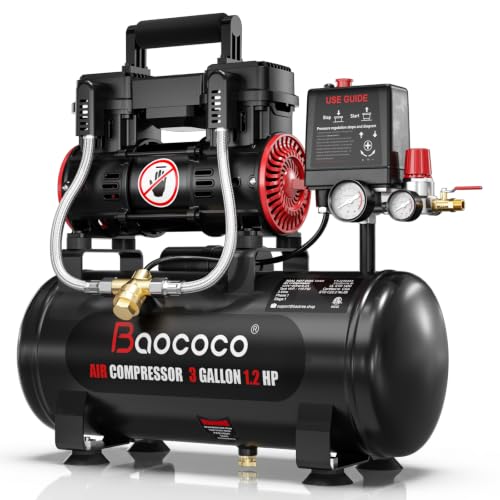 Baococo 3-Gallon Ultra Quiet Air Compressor |
7.8/10 | Buy | |
| Best Value |
 MZB MZB-1100H-24 6.4-Gallon Air Compressor |
7.8/10 | Buy |
 EVIL ENERGY 12V 1-Gallon Air Tank and Compressor |
7.8/10 | Buy | |
 VELPAX 8-Gallon Quiet Air Compressor |
7.8/10 | Buy |
VELPAX 6.4-Gallon 2HP Quiet Air Compressor
Delivering 6.71 CFM at 115 PSI while operating at just 60 decibels, this 6.4-gallon unit is built for noise-conscious workshop and garage tasks. Its oil-free 2HP motor provides reliable airflow for painting, nailing, and tire inflation with minimal upkeep.
Pros
- Quiet 60 dB noise level for indoor workshops
- Maintenance-free oil-less motor design
- Strong 6.71 CFM airflow rating at 115 PSI
- Equipped with built-in overload protection
- Integrated handle and drain valve for easy operation
Cons
- Lacks transport wheels for a 6.4-gallon tank
- Single air outlet restricts multi-tool operation
- 115 PSI maximum pressure limits heavy-duty commercial tools
MZB MZB-900H-24 6.4-Gallon Air Compressor
Delivering 5.65 CFM at 115 psi, this 1.2 HP oil-free unit rapidly pressurizes its 6.4-gallon tank in about one minute while maintaining a low 70-decibel noise output. It serves well for home garages and workshops handling nail guns, air tools, and light painting.
Pros
- Quiet 70 dB operating volume
- Fast tank recovery under 65 seconds
- Generous 5.65 CFM output at 115 psi
- Low-maintenance oil-free motor design
- Integrated wheels assist mobility
Cons
- Steel construction adds significant carrying weight
- Tank capacity limits continuous heavy spraying sessions
- Corded operation requires standard electrical outlet
MZB MZB-850H-9 2.4-Gallon Air Compressor
Built for carpentry, auto repair, and painting tasks, this compact compressor pairs a 1.2 HP oil-free motor with rapid 30-second tank recovery. Its steel frame and dual silencers balance durability with manageable 70 dB operation for portable workshop use.
Pros
- Fast 28 to 32 second tank fill time
- Maintenance-free oil-free motor design
- Solid 5.65 CFM output for its footprint
- Durable three-layer rust-resistant steel construction
Cons
- Maximum pressure is limited to 115 PSI
- Modest 2.4-gallon tank limits continuous heavy airflow
BUNKER INDUST 12V Off-Road Air Compressor
The BUNKER INDUST 12V Air Compressor delivers a listed 12.36 CFM and up to 150 PSI through a heavy-duty dual-cylinder pump engineered for rapid truck and off-road tire inflation. Equipped with digital auto-stop pressure regulation and dual quick-connect couplers, it is a practical mobile pneumatic tool for 4x4 drivers, overland travelers, and fleet owners.
Pros
- High rated airflow of 12.36 CFM drastically cuts down airing-up time on large truck and off-road tires
- Digital auto-stop control automatically shuts down pump operation at the exact target pressure
- Dual-hose configuration with T-fitting facilitates simultaneous two-tire inflation to keep pressures balanced
- Heavy-duty Anderson-style plug ensures a secure, low-resistance connection to vehicle 12V power
- Alloy cylinders with cooling fins and cleanable intake filters offer solid protection in dusty trail environments
Cons
- Tankless direct-drive pump design is not built for sustained continuous-draw pneumatic shop tools like rotary sanders or impact wrenches
- Heavy 12V current draw requires a direct battery terminal connection and cannot operate from standard vehicle accessory sockets
- Alloy cylinder heads generate noticeable surface heat during prolonged high-pressure cycles, requiring careful handling around the cooling fins
Baococo 3-Gallon Ultra Quiet Air Compressor
The Baococo 3-Gallon Ultra Quiet Air Compressor delivers up to 115 PSI at approximately 70dB, powered by a 1.2HP copper motor and an oil-free pump. With a 20-second recovery cycle, dual quick couplers, and integrated transport wheels, it is a practical, budget-friendly choice for indoor trim work, DIY repairs, and garage tire maintenance.
Pros
- Operates at roughly 70dB, allowing conversation and indoor use without deafening noise
- Rapid 20-second tank recovery cycle helps keep intermittent nailing projects moving
- Dual quick-connect couplers allow quick tool changes or running two air lines at once
- Built-in wheels and sturdy carry handle make rolling or lifting across the workspace easy
- Oil-free pump eliminates messy crankcase checks and prevents oil leaks during vehicle transport
Cons
- Maximum tank pressure tops out at 115 PSI, lower than 135 to 175 PSI contractor-grade units
- Manufacturer does not publish continuous CFM at 90 PSI, making it unsuited for continuous air tools like sanders or grinders
- Compact 3-gallon air reserve requires frequent motor cycling under rapid pneumatic demand
MZB MZB-1100H-24 6.4-Gallon Air Compressor
Built with an oil-free 1.5 HP motor and a 6.4-gallon steel tank, this compressor delivers 7.41 CFM at 115 PSI while keeping operating noise down to 70 decibels. It is a solid choice for workshops, auto detailing, and spray painting where quick recovery and quiet operation matter.
Pros
- Fast 60-second tank recovery time
- Quiet 70 dB operation with dual silencers
- High 7.41 CFM output at 115 PSI
- Low-maintenance oil-free motor design
- Durable three-layer coated steel tank
Cons
- Maximum 115 PSI limits high-pressure tools
- Steel tank adds weight compared to aluminum
EVIL ENERGY 12V 1-Gallon Air Tank and Compressor
This compact 12V onboard air kit pairs a 1-gallon reinforced steel reservoir with an integrated compressor rated up to 150 PSI across five 1/4-inch NPT ports. It is well suited for truck owners, off-road enthusiasts, and DIY builders needing reliable air storage for suspension bags, air horns, and tire topping.
Pros
- Compact 1-gallon footprint fits easily into tight truck beds, trunk compartments, or undercarriage locations
- Five 1/4-inch NPT ports provide exceptional layout flexibility for custom air lines and accessories
- All-in-one kit includes compressor, tank, drain valve, air hose, and mounting brackets
- Solid steel tank construction with anti-corrosion exterior coating designed for mobile environments
Cons
- One-gallon capacity is strictly intended for intermittent air needs, not continuous-demand air tools like sanders or impact wrenches
- Airflow delivery ratings (SCFM) and decibel sound output are not explicitly specified by the manufacturer
- Requires custom 12V automotive wiring, dedicated fuse protection, and careful placement away from extreme road debris
VELPAX 8-Gallon Quiet Air Compressor
Delivering 115 PSI at an approachable 68 decibels, this oil-free unit suits indoor spaces like home workshops and garages. Its 8-gallon tank and 1.75HP motor supply clean air for tire inflation, woodwork nailing, and basic pneumatic tools without excessive noise.
Pros
- Quiet 68 dB motor fits home workshops
- Oil-free design requires minimal regular maintenance
- Integrated overload protection supports safe operation
- Standard G1/4 outlet enables easy tool connections
Cons
- Maximum working pressure tops out at 115 PSI
- Lacks wheels for moving the 8-gallon tank
How Centrifugal Compression Turns Speed Into Pressure
A centrifugal air compressor uses a fast-spinning impeller to add velocity to incoming air. The air enters near the center, or eye, of the impeller, then rotating blades move it outward toward the rim. This movement increases the air’s kinetic energy, but velocity by itself is not the same as useful compressed-air pressure.
After leaving the impeller, the air travels through a diffuser, a set of stationary passages designed to slow the flow and convert velocity into static pressure. A volute or collector then gathers the pressurized air and directs it toward the outlet. Put simply, the impeller gives air speed, and the diffuser helps turn that speed into pressure.
The process is continuous rather than the repeating intake, compression, and discharge strokes of a piston pump. Air flows through the compressor while the rotor runs, rather than being compressed in separate cylinder charges. That continuous-flow characteristic is a major reason centrifugal machines are used in applications designed around substantial, steady airflow.
Impeller, diffuser, and collector each have a different job
The impeller is the rotating component that transfers energy to the incoming air. Its geometry, speed, and operating point influence how much flow it can handle and how much energy it adds. The diffuser is stationary, but its shape matters because it manages the transition from fast-moving air to higher static pressure.
The collector receives the air after that pressure conversion and guides it to the next part of the system. In larger machines, the path may include additional compressor stages, intercooling, controls, and downstream treatment equipment. Those components are part of the larger air system, not evidence that every centrifugal compressor has the same configuration.
This design depends on matching air demand to the compressor’s operating range. A centrifugal unit is not simply a piston compressor with a different pump shape; its performance changes with flow, pressure, and rotational conditions. Engineers select and control the machine as part of a system, rather than judging it from tank capacity alone.
Why flow and pressure are related but not interchangeable
Airflow describes the amount of air supplied over time, while pressure describes the force per unit area available in the system. A compressor can have a high maximum-pressure figure without supplying enough air for a tool that runs continuously. Likewise, a high airflow number is only meaningful when its pressure conditions and rating method are clear.
For air-tool planning, compare the tool’s required airflow with the compressor’s delivered airflow at the working pressure, not just its maximum PSI. A nailer usually draws air in short bursts, while a sander or spray gun may draw air for longer stretches. That usage pattern affects whether a tank can bridge short demand peaks or whether the pump must continuously keep pace.
Product descriptions may state CFM at a particular pressure, but that figure should not be treated as interchangeable with a different pressure rating or an unqualified maximum-flow claim. Check the manufacturer’s stated conditions and the tool maker’s air requirement. If those numbers are not supplied, avoid assuming that a compressor can sustain a particular tool.
What compression stages contribute
A centrifugal installation may use more than one impeller stage when its required pressure and flow call for a staged design. Each stage adds energy to the air, and interstage cooling may be used in some systems to manage heat. The number and arrangement of stages depend on the machine and application, so they should be confirmed from a model’s technical documentation.
Do not assume that the phrase “centrifugal compressor” automatically means a particular pressure, number of stages, or cooling arrangement. Those are design details, not universal specifications. A buyer evaluating an industrial system should review its performance curve, operating limits, cooling needs, and control strategy with the supplier.
That also explains why a simple comparison with a portable single-stage piston compressor can be misleading. The two designs serve different equipment classes and may be selected for different combinations of flow, pressure, and operating profile. A small tank compressor can be practical for occasional garage tasks even though it does not use centrifugal compression.
Where the Product Options Fit, and Where They Do Not
The products listed here are not identified as centrifugal compressors. Most are described as oil-free electric units with compact storage tanks, while the BUNKER INDUST model is a 12-volt dual-cylinder tire inflator and the EVIL ENERGY listing is a vehicle air-tank and compressor kit. Their specifications describe portable or vehicle-oriented equipment, not the impeller-and-diffuser arrangement discussed above.
That distinction matters because a listed CFM figure does not establish the pump mechanism. For example, the MZB 6.4 Gallon Ultra Quiet Air Compressor listings describe oil-free motors, steel tanks, and airflow figures, but the supplied descriptions do not call them centrifugal. The VELPAX units are also described as oil-free, portable tank compressors, without a centrifugal mechanism being specified.
Tank size is another separate specification. The listed options include compact tanks from 2.4 to 8 gallons, along with a one-gallon vehicle tank kit, while the BUNKER INDUST inflator is described as a 12-volt dual-cylinder unit. These capacities indicate stored-air volume, not the pump’s compression principle or its ability to deliver a continuous industrial air supply.
Maximum pressure also needs careful interpretation. Several products specify a maximum working pressure of 115 PSI, and the BUNKER INDUST listing states up to 150 PSI. These figures do not, by themselves, tell a buyer how much air will be available at a tool’s operating pressure or how long a pump can sustain a continuous load.
Use the listed specifications for the jobs they actually describe
The VELPAX 6.4-gallon option is described as an oil-free 2 HP unit with a 115 PSI maximum and 6.71 CFM at 115 PSI. The 8-gallon VELPAX description lists a 1.75 HP motor, a 115 PSI maximum, and 7.42 CFM at 115 PSI. These are the specifications provided for those products, and they should not be relabeled as CFM at 90 PSI or treated as verified centrifugal compressor output.
The MZB listings provide other examples of why it pays to read each product’s exact data. One 6.4-gallon version lists 5.65 CFM at 115 PSI and a 1.2 HP motor, while another 6.4-gallon description lists 7.41 CFM at 115 PSI and 1.5 HP. The 2.4-gallon version lists 5.65 CFM at 115 PSI and a 1.2 HP motor.
Those figures are useful for comparing the products as described, but they do not provide all the details needed to assess sustained tool use. The supplied data does not give CFM at 90 PSI for these models, duty-cycle ratings, electrical running amperage, or recovery times for each unit. A buyer should check the product documentation and tool requirements before planning frequent or continuous operation.
The Baococo 3-gallon listing describes an oil-free unit with a 1.2 HP motor and a 115 PSI maximum, but does not provide a CFM figure in the supplied information. The EVIL ENERGY kit specifies a 150 PSI-rated one-gallon tank and a 12-volt compressor, while the BUNKER INDUST inflator lists up to 12.36 CFM and 150 PSI. Those are distinct vehicle-oriented products, and their stated figures should not be used to infer industrial centrifugal performance.
How to Match a Centrifugal System to Air Demand
Start with the application, then identify the required pressure and airflow at the point of use. Add up the demand of tools that may operate at the same time, and distinguish short bursts from ongoing consumption. For a large system, a qualified supplier can compare that demand with a compressor performance curve and explain how the machine behaves across its operating range.
Continuous demand changes the sizing question
Intermittent tools can draw from stored air between pump cycles, but storage only acts as a buffer. It does not create additional compressor capacity. If demand repeatedly exceeds the machine’s delivered airflow, system pressure can fall even when the tank or receiver initially holds pressure.
Continuous processes place a different emphasis on the compressor’s ability to maintain flow. A paint system, production process, or continuously operated pneumatic tool may need sustained delivery throughout its work cycle. The appropriate design depends on the actual air consumption, pressure requirements, and allowable variation in supply, not just the receiver volume.
Air treatment can matter just as much as the compressor for sensitive applications. Moisture, oil, and particulates may need to be managed with suitable downstream filtration and drying equipment, selected for the required air quality. Do not assume that an oil-free pump alone delivers air that meets every process requirement.
For paint work in particular, a buyer should verify the spray equipment’s air demand and required air quality, then plan appropriate filtration and moisture control. Our air compressor spray-gun guide provides related context for matching compressed air to painting equipment. Compressor selection and air preparation should be treated as connected parts of the setup.
For a centrifugal installation, the supplier should clarify whether quoted capacity represents actual delivered flow at the required pressure and operating conditions. Ask how the system is controlled as demand changes, and whether its stated operating range covers expected peaks and normal load. Those questions help prevent a specification that looks adequate on paper from being mismatched to the process.
Controls, operating range, and system stability
Centrifugal machines generally need appropriate control to operate within their intended range as demand shifts. The exact method depends on the equipment, and the available product information does not specify controls for a particular centrifugal model. Review the manufacturer’s documentation for permitted operating conditions, protection functions, and required system components.
A system designer may also consider how the compressor interacts with receivers, distribution piping, and other compressors. Receiver volume can help smooth short-term changes in demand, but it cannot compensate indefinitely for insufficient production. Pressure loss through filters, dryers, regulators, and piping should also be considered when specifying the pressure needed at the end use.
For portable equipment, electrical supply and mobility may be central buying questions. The listed household units specify 110- or 120-volt operation, and the BUNKER INDUST and EVIL ENERGY options use 12-volt power. The supplied data does not state running or startup amperage for those products, so check the manufacturer’s instructions and electrical requirements rather than assuming compatibility with a particular circuit.
Noise, Maintenance, and Practical Operating Limits
Noise is a meaningful difference between the listed portable options, but it does not identify the compressor mechanism. The VELPAX 6.4-gallon model is described as operating at approximately 60 dB, while several MZB and Baococo descriptions state approximately 70 dB and the 8-gallon VELPAX lists approximately 68 dB. Those are product-description figures, not measurements from independent testing, and they do not establish a universal noise level for centrifugal equipment.
Operating noise can affect placement in an attached garage or indoor workshop, but compare ratings only with their measurement conditions if those are provided. The supplied product descriptions do not specify a standard measurement distance or a common test procedure. Hearing protection remains sensible around operating air equipment, particularly when other tools add to the noise.
The oil-free designs in the product listings avoid routine compressor-oil changes, according to their descriptions, but that does not mean they require no care. Users still need to follow the manual for cleaning, inspection, ventilation, and condensate management. Each model’s maintenance schedule and approved operating conditions should take precedence over general assumptions about oil-free pumps.
Stored compressed air can collect condensation, so follow the manufacturer’s directions for draining a tank. Depressurize equipment completely before servicing or transporting it, and do not loosen fittings while they are under pressure. Wear suitable eye and hearing protection while operating air equipment, and never bypass a safety valve or other protective device.
What a buyer should verify before specifying a system
For an industrial centrifugal compressor, request the exact model data, including delivered flow at the intended pressure, operating range, motor and electrical requirements, cooling needs, and maintenance instructions. Confirm whether the quoted capacity is stated under conditions that match the planned application. Ask what filtration, drying, controls, and receiver equipment are required for the air quality and demand pattern.
For a portable garage compressor, focus on the same basic logic at a smaller scale: compare tool air requirements with the product’s stated delivery at the relevant pressure, and account for whether the tool runs intermittently or continuously. Tank volume can support short bursts, but it is not a substitute for sufficient pump output. The supplied listings do not include every rating needed to settle every tool-compatibility question.
Horsepower and maximum PSI are not enough to establish suitability. A higher horsepower label does not tell you the delivered airflow at a specific pressure, and maximum pressure does not tell you how quickly a system can replace air while a tool is running. Treat these as separate specifications and seek the missing figures from the manufacturer before committing to an application.
Centrifugal compression works by imparting velocity to air with an impeller, then using stationary passages to convert that velocity into pressure. That mechanism suits system designs built around continuous flow, while the listed compact products are described as oil-free portable or vehicle compressors with their own specific uses. Choose by confirmed operating principle, delivered airflow at the required pressure, and application demand, rather than assuming the product category or tank size tells the whole story.
About the author
Tony Carrick is an experienced product researcher and writer specializing in tools, home improvement, automotive maintenance, and consumer equipment. With extensive experience reviewing tools and tackling hands-on renovation projects, he brings a buyer-focused perspective to compressor performance, usability, and overall value.