
How Big Air Compressor for Framing Nailer: Sizing and Pressure Guide for 2026
Learn how big air compressor for framing nailer sizing with CFM, PSI, and tank buffer advice for reliable fastener driving in November 2026.
 By Tony Carrick
Updated October 8, 2026


Driving heavy structural fasteners into dense framing lumber demands an immediate surge of pneumatic power that light-duty inflators cannot provide. Determining %how big air compressor for framing nailer% tasks need depends on balancing working pressure with continuous air volume. Framing tools require sufficient line pressure to seat nails flush without bogging down the electric motor. A mismatch between compressor capacity and tool demand leads to frustrating delays and inconsistent nail depth.
Most pneumatic framing nailers operate between 80 and 120 PSI, which means the compressor must maintain that threshold consistently through repeated cycles. Storage tank volume serves as a crucial cushion, while the pump air delivery rate dictates how quickly the system recovers. Consulting standard air compressor sizing guidelines helps clarify whether a compact pancake tank or a higher-output workshop unit fits your framing pace. Choosing the correct capacity keeps your fasteners flush and prevents your compressor from running continuously under heavy duty cycles.
| Award | Product | ACR Score About ACR ScoreThe ACR Score is our own rating from 0 to 10, based on performance, design and build, ease of use, and value. It reflects independent research and is never influenced by manufacturers, retailers, or affiliate commissions. Learn more › | |
|---|---|---|---|
| Best Overall |
Metabo HPT NT65M2S 16-Gauge Finish Nailer
|
9.1/10 | Buy |
| Best Budget |
 3PLUS H2190SP 21 Degree Framing Nailer |
9.1/10 | Buy |
| Best Premium |
 Metabo HPT EC28M Quiet Air Compressor |
9.1/10 | Buy |
 Dotool 21-Degree Framing Nailer |
8.8/10 | Buy | |
 VEVOR 21-Degree Pneumatic Framing Nailer |
8.8/10 | Buy | |
| Best Value |
 NuMax SFR2190WN 21-Degree Pneumatic Framing Nailer |
8.6/10 | Buy |
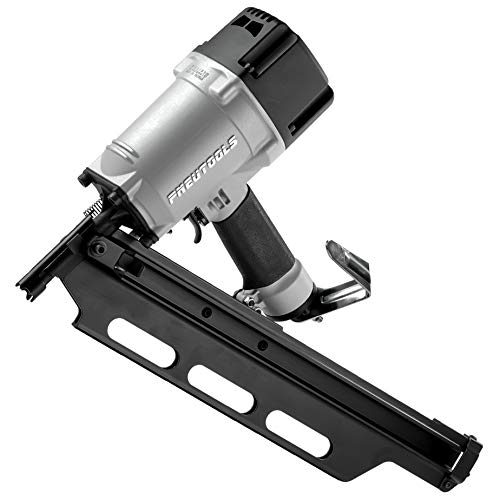 PneuTools SN2283H 21-Degree Framing Nailer |
8.4/10 | Buy | |
 Metabo HPT EC914S 6-Gallon 200 PSI Pancake Air |
8.3/10 | Buy | |
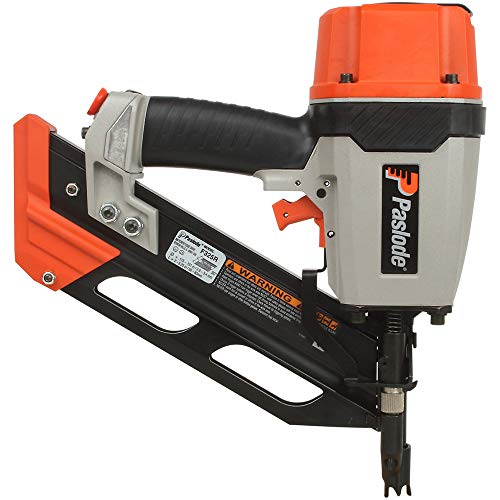 Paslode F325R Pneumatic Framing Nailer |
8.1/10 | Buy | |
 Metabo HPT NR90ADS1 30° Framing Nailer |
7.8/10 | Buy |
Metabo HPT NT65M2S 16-Gauge Finish Nailer
Weighing just 3.7 pounds, the Metabo HPT NT65M2S delivers balanced precision for trim carpenters and woodworkers installing molding, chair rails, or cabinetry. It combines versatile bump or sequential firing modes with a convenient built-in air duster to keep workspaces clear.
Pros
- Extremely lightweight and balanced at 3.7 pounds
- Tool-free depth adjustment for flush fastening
- Convenient selective actuation for bump or sequential firing
- Integrated air duster clears cutlines instantly
- Includes protective no-mar tip for fine work
Cons
- Requires connection to an air compressor and hose
- Limited strictly to 16-gauge finish nails
3PLUS H2190SP 21 Degree Framing Nailer
Framing crews and DIY builders will appreciate the 3PLUS H2190SP for its quick-switching actuation switch between bump and sequential firing. Designed for 21-degree full round head nails up to 3.5 inches, it includes useful jobsite features like a 360-degree exhaust, a hardened toe-nailing claw, and dry-fire protection.
Pros
- Tool-free depth adjustment enables precise nail placement
- Simple switch toggles bump and sequential fire modes
- Dry-fire lockout prevents blank firing damage
- Hardened claw tip provides dependable toe-nailing grip
Cons
- Relatively heavy tool body at 10.69 pounds
- Bulky 19.7-inch frame can be awkward in tight spots
Metabo HPT EC28M Quiet Air Compressor
Operating at an ultra-quiet 59 dB, the Metabo HPT EC28M 1-gallon oil-free air compressor provides low-noise pneumatic air power in a compact 25.2-pound roll-cage frame. It is an ideal portable match for trim carpenters, punch-list contractors, and residential DIYers needing peaceful indoor fastening.
Pros
- Remarkably quiet 59 dB operation makes it well-suited for occupied residential job sites
- Lightweight 25.2-pound weight and ergonomic rubber grip make carrying up stairs straightforward
- Sturdy steel roll cage provides reliable physical protection around gauges and controls
- Oil-free pump mechanism eliminates pump lubrication maintenance and avoids messy oil leaks
- Universal quick-connect coupler simplifies tool connections across standard pneumatic lines
Cons
- Compact 1-gallon tank capacity is intended for intermittent fastening rather than continuous air tools
- Small air storage volume causes frequent motor cycling during rapid nailing sequences
- Bare-tool configuration does not include an air hose or pneumatic finish nailers
Dotool 21-Degree Framing Nailer
Built for structural tasks like subflooring and framing, this Dotool pneumatic nailer drives 2-inch to 3-1/2-inch nails with tool-free depth adjustment. A sequential trigger and slip-reducing nose sleeve provide steady control for contractors and ambitious DIYers.
Pros
- Tool-free jam clearance and depth adjustments
- Rubber nose sleeve prevents slipping while toe-nailing
- 360-degree adjustable exhaust for user comfort
- Sequential trigger allows precise fastener placement
Cons
- Heavier build at 8.9 pounds
- Lacks a selectable bump-fire trigger mode
VEVOR 21-Degree Pneumatic Framing Nailer
Built for heavy construction and renovation projects, this pneumatic nailer supports multiple nail styles with selectable firing modes. Its tool-free depth control and open-nose jam release keep framing, decking, and subfloor tasks moving efficiently.
Pros
- Versatile compatibility with three nail shank types
- Tool-free depth adjustment wheel
- Dual sequential and bump firing modes
- Accessible open nose design clears jams quickly
- Durable aluminum magazine construction
Cons
- Weighs 9 pounds, which can tire arms overhead
- Magazine capacity holds only up to 60 nails
- Requires an external air compressor to operate
NuMax SFR2190WN 21-Degree Pneumatic Framing Nailer
The NuMax SFR2190WN is a pneumatic 21-degree framing nailer engineered for heavy-duty structural tasks like wall framing, subfloors, and deck building. Equipped with a dual-mode trigger, tool-free depth adjustment, and 500 included 3-inch framing nails, it offers outstanding value for DIY builders and residential remodelers.
Pros
- Versatile dual-mode trigger switches smoothly between precise sequential firing and rapid bump nailing
- Tool-free depth wheel makes it easy to set flush or countersunk nail heads in various wood species
- Anti-dry-fire safety mechanism protects the one-piece drive blade and internal seals from dry-fire damage
- Includes 500 count 3-inch framing nails to provide immediate out-of-the-box jobsite utility
Cons
- Weighing 8.6 pounds, sustained overhead truss or ceiling work can cause physical fatigue over long shifts
- Plastic-collated 21-degree magazines hold fewer fasteners per stick than high-capacity coil nailers
- Requires a compatible air compressor, pneumatic hose, and air fittings to supply driving pressure
PneuTools SN2283H 21-Degree Framing Nailer
Engineered for straightforward durability, the PneuTools SN2283H features a hardened end cap and a single-mode trigger suited for heavy-duty framing. It drives standard 21-degree plastic collated nails and includes a dedicated rafter hook for convenient staging.
Pros
- Hardened end cap enhances overall durability
- Integrated rafter hook allows easy hanging
- One-piece safety mechanism operates smoothly at speed
- Uses economical full round head fasteners
Cons
- Single-mode trigger lacks selectable firing options
- Restricted to 21-degree plastic collated nails only
Metabo HPT EC914S 6-Gallon 200 PSI Pancake Air
The Metabo HPT EC914S delivers an impressive 200 PSI maximum pressure and 4 CFM at 90 PSI from a 6-gallon tank, giving trim carpenters and remodelers the air volume needed to drive multiple nailers simultaneously. At roughly 41 pounds, it successfully combines high-pressure air storage with practical job-site portability.
Pros
- High 200 PSI tank ceiling stores substantially more usable air than conventional 150 PSI pancake models
- Generous 4 CFM at 90 PSI airflow rating supports multi-tool operation and reduces nailer drive hesitation
- Manageable 41-pound carry weight offers better portability than heavier twin-stack compressor configurations
- Engineered by Metabo HPT to support both lightweight trim nailers and larger framing or roofing guns
Cons
- At 41 pounds, it is noticeably heavier to carry than minimalist 1-to-3 gallon trim-only compressors
- Tank volume and CFM output remain inadequate for continuous high-demand air tools like HVLP sprayers or sanders
- Ships as a bare-tool compressor without included air hoses, pneumatic fittings, or nail guns
Paslode F325R Pneumatic Framing Nailer
Remodelers working overhead or within narrow stud bays will appreciate the Paslode F325R for its lightweight build and compact profile. Powered by an air compressor, it drives 30-degree framing nails smoothly and features a quick two-step reloading mechanism.
Pros
- Exceptionally lightweight design minimizes overhead fatigue
- Easily navigates tight 16-inch on-center framing bays
- Fast two-step reloading mechanism
- Engineered for low jamming with 30-degree nails
Cons
- Requires a compatible air compressor and air hose
- Limited specifically to 30-degree framing nails
Metabo HPT NR90ADS1 30° Framing Nailer
At just 7 pounds, this pneumatic framing nailer provides solid driving power in a well-balanced build suited for all-day framing, truss work, and decking. A simple switch toggles between sequential and bump firing, while the 30-degree magazine easily clears narrow stud bays.
Pros
- Lightweight 7-pound build reduces user fatigue
- Tool-free switch between sequential and contact firing
- 30-degree magazine navigates tight corners easily
- Simple depth-of-drive adjustment without extra tools
- Covered by a 5-year limited warranty
Cons
- Requires a pneumatic air hose and compressor setup
- Restricted to 30-degree paper-collated fasteners
- Manufacturer recommends brand-specific nails for best results
Sizing an Air Compressor for Pneumatic Framing Nailers
A standard pneumatic framing nailer generally requires an air compressor with at least a 4-gallon to 6-gallon tank delivering between 2.0 and 4.0 CFM at 90 PSI for steady single-user operation. While ultra-compact 1-gallon units can fire occasional framing nails during minor punch-list repairs, they lack the air reserve required for steady production framing. When air delivery falls below tool consumption, line pressure plummets below the nailer operating threshold, causing nails to stick out above the wood surface. Selecting the right compressor size requires balancing working pressure, air delivery rates, and tank storage volume against your specific nailing rhythm.
Framing Nailer Air Demands: Calculating CFM and Operating PSI
Pneumatic tools consume air in two distinct ways: continuous airflow or intermittent bursts. Rotary sanders demand continuous volume, but a framing nailer uses a discrete charge of compressed air for each fastener driven. Most full-size framing nailers operate reliably within a pressure band of 80 to 120 PSI. Tools such as the VEVOR 21-degree nailer or the NuMax SFR2190WN require this operating window to seat round head nails up to 3-1/2 inches deep into lumber. Operating below 80 PSI frequently results in proud nails that require manual hammering to seat flush.
Air consumption for intermittent tools is measured in cubic feet per minute based on an estimated firing cadence. A single framing shot generally consumes roughly 0.05 to 0.10 cubic feet of air at standard operating pressures. Driving 15 to 20 nails per minute yields an average air demand around 1.5 to 2.5 CFM at 90 PSI. A compressor delivering less than 2.0 CFM will struggle to replenish its tank during steady assembly, causing the pump to run without interruption. Matching compressor CFM to your realistic nailing tempo prevents purchasing an underpowered machine.
Tank Buffer Capacity: Why Gallons Matter for Firing Cadence
Tank capacity acts as an energy buffer between the compressor pump and your pneumatic tool. When you fire several nails in rapid succession, the nailer draws air directly from the stored volume inside the receiver tank. A small 1-gallon reservoir, like that on the Metabo HPT EC28M, empties after only a few framing shots before line pressure dips below 90 PSI. In contrast, a 6-gallon receiver provides a substantial buffer that absorbs rapid bursts without immediate pressure drops. That storage buffer prevents the driver blade from losing driving energy midway through a wall plate.
The relationship between tank volume and pump recovery time determines how smooth your workflow remains. Once tank pressure drops to the cut-in switch setting, the motor engages to repressurize the vessel. A larger tank takes slightly longer to fill initially, but it provides a longer window of uninterrupted work between pump cycles. Smaller tanks trigger constant motor cycling, which increases mechanical heat and electrical load on the circuit. For general framing, a 6-gallon pancake or twin-stack receiver provides an ideal balance of stored air and physical portability.
Single-Operator Framing Versus Multi-Gun Crew Air Delivery
Sizing an air system changes dramatically when moving from a solitary builder to a multi-carpenter framing crew. A single operator building partitions can work comfortably with a compressor delivering 2.5 to 3.0 CFM at 90 PSI. Connecting two framing nailers to the same manifold doubles the volume of air consumed during concurrent nailing passes. If both carpenters drive fasteners simultaneously, an undersized pump falls behind, starving both nailers of adequate driving energy. Crew leaders must calculate total pneumatic demand based on simultaneous tool usage.
High-output portable units solve multi-tool air starvation through elevated tank pressure and higher air delivery ratings. The Metabo HPT EC914S pancake compressor delivers 4.0 CFM at 90 PSI from a 6-gallon tank and is engineered to run two framing nailers simultaneously. Its elevated 200 PSI maximum pressure packs more usable cubic feet of air into a standard 6-gallon footprint than conventional 150 PSI tanks. This additional air reserve allows multiple large-body nailers to drive fasteners flush without noticeable delay. When supporting multiple workers, prioritizing CFM output at 90 PSI is far more critical than simply buying a larger empty vessel.
Maximum Working Pressure and Usable Air Storage
Maximum operating pressure plays a substantial role in determining the effective storage volume of an air compressor. Standard portable compressors typically operate with a cut-out pressure between 135 and 150 PSI, whereas high-pressure jobsite models reach 200 PSI. Because compressed air volume scales directly with pressure, a 6-gallon tank at 200 PSI stores roughly 30 percent more air than the same tank pressurized to 150 PSI. That extra reserve stays regulated down to your nailer working pressure, usually around 90 to 110 PSI. The result is a longer firing duration before the cut-in pressure switch turns on the motor.
A higher pressure ceiling also creates a broader differential between the tank cut-in point and tool operating pressure. If your regulator is set to 100 PSI and the tank cuts in at 165 PSI, the tool enjoys a 65 PSI safety margin before line starvation occurs. On a standard 135 PSI unit cutting in at 105 PSI, that safety margin narrows to just 5 PSI, leading to frequent tool sluggishness. Choosing a machine with a higher maximum operating pressure effectively expands usable storage without increasing external tank dimensions or weight.
Actuation Modes and Fastener Sizes Impact on Air Draw
The trigger mechanism on your framing tool directly alters how rapidly your compressor depletes its stored air. Framing tools like the 3PLUS H2190SP and the DOTOOL 21-degree nail gun include selective actuation switches for changing between sequential and bump fire modes. Sequential firing enforces a measured pace that gives the compressor pump ample time to recover pressure between shots. In contrast, contact bump firing during sheathing installation can discharge 40 to 60 nails per minute, causing rapid pressure loss. Sinking full 3-1/2-inch nails with tools like the Metabo HPT NR90ADS1 further increases air demand compared to smaller fasteners.
Fastener dimensions and wood density also dictate how much air pressure is consumed with each stroke. Finish nailers, such as the Metabo HPT NT65M2S 16-gauge model, use narrow pistons and small fasteners that require negligible air volume. Framing nailers require wide-bore cylinders operating between 100 and 120 PSI to drive heavy nails flush into engineered lumber. When framing at high speed with long fasteners, a compressor delivering at least 3.5 to 4.0 CFM at 90 PSI is necessary to prevent severe pressure dips. Balancing firing mode and fastener length ensures your compressor maintains consistent driving power.
Air Hose Sizing and Minimizing Dynamic Pressure Drop
Air compressor size is only one part of the pneumatic power equation; line restrictions also degrade tool performance. Running a long 1/4-inch inside diameter air hose creates substantial internal friction that chokes airflow during high-demand nailing bursts. Even if your tank regulator reads 110 PSI, dynamic pressure drop across a 100-foot narrow hose can reduce pressure at the nailer nose to under 85 PSI. Upgrading to a 3/8-inch inside diameter hose dramatically reduces friction and delivers full tank energy directly to the nailer inlet. This larger hose volume also acts as an auxiliary air buffer closer to the working area.
Fitting selection also affects how cleanly your framing nailer receives air. High-flow couplers and clean brass fittings ensure that pressure drops remain minimal between the regulator manifold and the tool. If you require extra mobility on a second-story deck or roof, consider using a short 1/4-inch whip line attached to a longer 3/8-inch main supply hose. This hybrid configuration provides the flexibility needed for maneuverability while preserving the airflow necessary for continuous framing. Proper hose management ensures that your compressor output actually translates into reliable driving power at the tool.
Jobsite Portability, Noise Levels, and Pump Mechanics
Jobsite conditions often dictate the physical form factor and motor design of your air compressor. Compact pancake models weighing roughly 40 to 45 pounds remain popular among remodelers who frequently carry equipment up staircases and across rough ground. Units like the Paslode F325R framing nailer emphasize low tool weight for tight spaces, and pairing such tools with a portable pancake compressor maximizes jobsite agility. However, high-speed universal motors found in many budget compressors can produce piercing sound levels exceeding 80 dBA. Evaluating noise ratings is crucial when working inside occupied residences or enclosed basements.
Ultra-quiet compressors, such as the 59 dB Metabo HPT EC28M, use dual-piston low-RPM induction motors that allow normal conversations during operation. While small quiet models work wonderfully for trim carpentry or punch-list framing, their lower CFM delivery limits continuous framing production. Understanding pump mechanism trade-offs between low-maintenance dry assemblies and lubricated pumps is equally important for equipment lifespan. Reviewing an oil-free versus oil-lubricated compressor guide helps clarify how pump construction impacts durability and cold-weather starting performance. Oil-free pumps eliminate maintenance chores on dirty jobsites, making them the standard choice for portable framing setups.
Electrical Circuit Demands and Safe Motor Startup
Air compressors draw substantial electric current when starting against head pressure, particularly during colder weather. Most portable jobsite compressors are designed to operate on a standard 120-volt, 15-amp household circuit. However, plugging a compressor into an overloaded branch circuit shared with high-draw work lights or power saws will instantly trip the circuit breaker. To prevent nuisance tripping, connect the compressor to a dedicated 15-amp or 20-amp outlet whenever possible. Verifying the unloader valve operates correctly ensures the motor never tries to start against trapped cylinder pressure.
Voltage drop caused by undersized extension cords is a leading cause of jobsite motor failure. Long, thin 16-gauge cords starve the compressor motor of essential voltage, causing it to overheat and trip its internal thermal overload switch. If you must extend your reach, it is far safer to add additional lengths of pneumatic air hose rather than running electrical cords. When an extension cord is unavoidable, utilize a heavy-duty 12-gauge or 10-gauge cord rated for contractor duty. Protecting motor voltage ensures clean startups and consistent pump performance throughout demanding framing days.
Moisture Management and Daily Tank Condensation Draining
Compressing ambient air inevitably generates moisture as atmospheric humidity condenses against the cool steel interior of the receiver tank. If this accumulated water is neglected, it corrodes internal tank walls and travels down the air line directly into your framing nailer. Moisture washes away vital factory lubricants inside the tool cylinder, leading to sticky O-rings and premature driver blade wear. Installing an inline moisture filter or water separator near the compressor outlet captures moisture before it reaches delicate nailer internals. Clean, dry air extends the working life of both your compressor tank and your pneumatic tools.
Daily tank maintenance is essential for preserving tank structural integrity and ensuring consistent air volume. At the end of every work session, depressurize the system and open the bottom drain valve to purge all standing condensation. Models equipped with quarter-turn brass ball valves make this maintenance routine fast and effortless compared to stiff threaded petcocks. Leaving moisture trapped inside an unpressurized tank accelerates rust formation that can weaken pressure vessel welds over time. Taking two minutes to purge your tank each evening keeps your equipment safe, reliable, and ready for the next framing project.
Matching your air compressor to your framing nailer comes down to balancing air volume and working pressure against your installation rhythm. For most single-carpenter jobs, a 6-gallon pancake compressor delivering 2.5 to 4.0 CFM at 90 PSI provides the ideal combination of portability, pressure stability, and recovery speed. Multi-gun crews or high-speed bump firing applications demand elevated operating pressures up to 200 PSI to maintain adequate reserves. Prioritizing delivered CFM and storage buffer over raw horsepower ensures your framing nailer sinks every fastener flush without stalling your jobsite workflow.
About the author
Tony Carrick is an experienced product researcher and writer specializing in tools, home improvement, automotive maintenance, and consumer equipment. With extensive experience reviewing tools and tackling hands-on renovation projects, he brings a buyer-focused perspective to compressor performance, usability, and overall value.