
Can You Use an Air Compressor to Fill Bike Tires?
Can you use an air compressor to fill bike tires? Learn how to match the valve, set pressure safely, and choose a suitable inflator for November 2026.
 By Kenny Koehler
Updated November 10, 2026

A bike tire can inflate quickly with compressed air, but a fast airflow and an inaccurate pressure setting can also damage a tube or push a tire beyond its recommended limit. Can you use an air compressor to fill bike tires? Yes, provided the compressor connects to the valve, lets you control pressure, and is used with the tire maker’s pressure guidance in mind.
Valve compatibility is often the first hurdle. A Schrader valve accepts many standard inflator chucks, while a Presta valve usually needs a dedicated Presta fitting or a small adapter; the Dunlop valve also requires a compatible connection. The products listed below include portable inflators and valve accessories, so the right choice depends on whether you need a complete pump or only a way to connect an existing air source.
Pressure control matters more than a compressor’s headline maximum PSI. A bike tire may need a pressure far below that maximum, and a high-flow shop compressor can add air faster than a rider can react. Check the tire’s sidewall and the bicycle or tire manufacturer’s recommendations, use a readable gauge, and stop at the appropriate pressure rather than treating maximum compressor pressure as a target.
For a broader look at pressure-related precautions, see our air compressor pressure safety guide. If you need a portable option for roadside use, this guide also explains how to match an inflator and valve setup to the job without assuming every compressor works with every bicycle valve.
Top Products
| Award | Product | ACR Score About ACR ScoreThe ACR Score is our own rating from 0 to 10, based on performance, design and build, ease of use, and value. It reflects independent research and is never influenced by manufacturers, retailers, or affiliate commissions. Learn more › | |
|---|---|---|---|
| Best Overall |
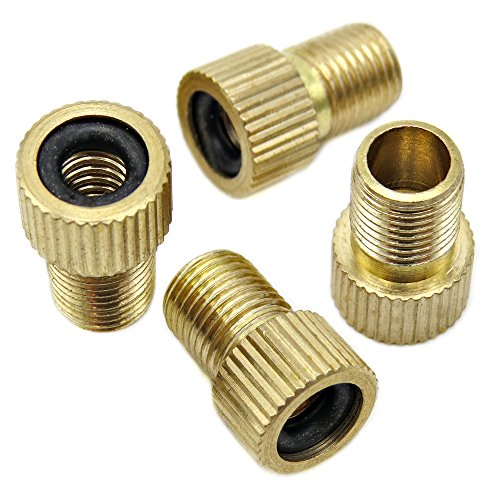
Bike Bits Brass Presta Valve Adapter (4-Pack)
|
9.2/10 | Buy |
| Best Budget |
 SFGSUP Cordless 150 PSI Tire Inflator |
9.2/10 | Buy |
 Ptiysta 8pcs Brass Presta Valve Adapter,Presta |
9.1/10 | Buy | |
| Best Value |
 Performance Tool Vortex E00001 Tire Inflator |
9.1/10 | Buy |
| Best Premium |
 AVID POWER 110V/12V Portable Tire Inflator |
9.1/10 | Buy |
 Smartour Cordless Portable Tire Inflator |
8.3/10 | Buy | |
 Prestacycle Prestaflator Mini Pro Inflator |
8.3/10 | Buy | |
 Airmoto 120 PSI Portable Tire Inflator |
8.3/10 | Buy | |
 Cimesen 007 150 PSI Cordless Tire Inflator |
8.1/10 | Buy | |
 AstroAI Portable Tire Inflator Air Compressor |
8.1/10 | Buy |
Bike Bits Brass Presta Valve Adapter (4-Pack)
Riders can easily convert standard Presta stems for gas station air hoses or auto compressors with this durable brass four-pack. Each piece installs by hand without tools and is rated up to 120 psi for road and gravel tires.
Pros
- Solid brass construction resists corrosion and thread damage
- Allows inflation using standard Schrader gas station hoses
- Handles tire pressures up to 120 psi reliably
- Installs quickly by hand without requiring any tools
Cons
- Not compatible with Dunlop or Schrader-only valve tubes
- Must be unscrewed to open the internal lock nut
SFGSUP Cordless 150 PSI Tire Inflator
Weighing under a pound with a compact frame, this battery-powered pump provides up to 150 PSI alongside emergency lighting and power bank capabilities. It serves as a practical, space-saving backup for drivers and cyclists seeking quick pressure top-offs.
Pros
- Lightweight, pocket-sized frame fits easily in small compartments
- Auto-stop feature eliminates the risk of over-inflation
- High-precision digital gauge measures down to 0.5 PSI
- Functions as both a tire pump and device charger
- Comes with a complete set of multi-valve adapters
Cons
- Requires a 10-minute cooldown after 15 minutes of use
- Sensitive to storage in humid or dusty locations
- Airflow is limited to 18 to 20 L/min
Performance Tool Vortex E00001 Tire Inflator
Built for quick roadside maintenance, this ultra-compact 12V pump tops off standard car tires in under two minutes and features an automatic LED work light. Its 1.1-pound footprint and 10-foot power cord make it a practical emergency tool to store in any trunk.
Pros
- Lightweight build weighing just 1.1 pounds
- Fast inflation for standard passenger tires
- Built-in LED activates immediately upon plug-in
- Includes three accessory nozzles and spare fuse
Cons
- 60 PSI maximum gauge limits heavy-duty use
- Requires a 15-minute rest after 10 minutes of runtime
- Short 18-inch air hose requires pump placement near tire
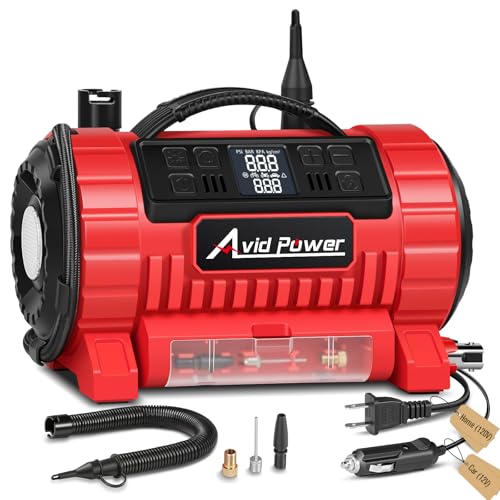
AVID POWER 110V/12V Portable Tire Inflator
Running on both household AC and vehicle DC power, this versatile inflator tackles car tires, sports equipment, and large camping mattresses with equal ease. Its dedicated high-volume deflation mode and automatic shutoff make it an adaptable tool for garage maintenance and roadside emergencies.
Pros
- Dual-power support for garage and roadside use
- Fast inflation with reliable auto-shutoff functionality
- High-volume hose supports rapid mattress deflation
- Bright emergency LED assists nighttime repairs
Cons
- Lacks an internal battery for cordless operation
- Bulkier footprint requires dedicated trunk storage space
Smartour Cordless Portable Tire Inflator
Weighing just over a pound, this compact cordless compressor provides convenient on-the-go pressure management for bicycles, sports balls, and automotive emergencies. Its clear digital screen and automatic shutoff make inflation straightforward, though filling larger car tires takes noticeable time.
Pros
- Compact and lightweight build weighs just one pound
- Accurate digital display with automatic shutoff function
- Modern USB Type-C rechargeable battery setup
- Integrated LED work light for night emergencies
- Includes four nozzle adapters for versatile use
Cons
- Slow inflation rate for full-sized automotive tires
- Screw-on hose can leak air during removal
Prestacycle Prestaflator Mini Pro Inflator
Built for quick shop setups, this compact inflator head connects to air compressor lines for fast, one-handed Presta valve inflation. Its gaugeless steel body makes it exceptionally rugged for home mechanics and public repair stations.
Pros
- Heavy-duty steel body withstands drops and tough conditions
- Push-to-inflate design allows easy one-handed operation
- Right-angle head accesses tight bicycle and automotive valves
- Durable gaugeless build resists shop wear and tear
Cons
- Lacks an integrated tire pressure readout gauge
- Requires an external air compressor line to operate
- Pressure control depends entirely on your compressor regulator
Airmoto 120 PSI Portable Tire Inflator
Weighing just 1.2 pounds, this compact cordless compressor delivers up to 120 PSI with automatic shutoff for routine top-offs on cars, bikes, and sports gear. Its pocket-sized form factor stores neatly in a glove box, serving as a convenient roadside backup.
Pros
- Extremely compact and lightweight design
- Auto shut-off prevents accidental over-inflation
- Clear digital LCD display with real-time pressure reading
- Integrated LED light aids night roadside repairs
- Internal hose storage keeps accessories organized
Cons
- Not suitable for heavy-load tires or large inflatables
- Cold temperatures and large tires drain battery quickly
- Requires frequent recharging before heavy usage
Cimesen 007 150 PSI Cordless Tire Inflator
This compact inflator delivers up to 150 PSI with automatic shut-off, making it a convenient portable solution for bicycles, sports balls, and roadside tire top-offs. An integrated 5200mAh battery eliminates trailing cords while doubling as an emergency work light and mobile power bank.
Pros
- High 150 PSI maximum pressure capacity
- Automatic shut-off prevents over-inflation
- Dual digital displays for target and current pressure
- Compact and lightweight for easy storage
- Emergency flashlight and power bank functionality
Cons
- 5200mAh battery limits extended high-volume inflation cycles
- 5V/2A USB port offers only standard charging speeds
AstroAI Portable Tire Inflator Air Compressor
The AstroAI Dual Power Tire Inflator combines a 12V DC vehicle plug and 120V AC household cord, delivering up to 150 PSI for car tires and a 350 L/min high-volume mode for rafts and mattresses. It is a dependable, compact choice for garage mechanics, road-trippers, and homeowners wanting versatile inflation without needing a bulky air tank.
Pros
- Dual 12V DC and 120V AC power cords offer genuine versatility for garage benches, driveways, and roadside emergencies
- Two dedicated inflation modes handle high-pressure tires up to 150 PSI as well as high-volume camping gear at 350 L/min
- Digital auto-shutoff stops pumping once target pressure is reached, preventing accidental over-inflation
- Integrated cord and air hose storage compartments maintain a clean, compact footprint in vehicle trunks
- Dual metal motor build provides reliable output with up to 15 minutes of continuous run time per cycle
Cons
- Not designed to support heavy-duty commercial truck tires or high-volume commercial vehicle applications
- Requires a mandatory 10-minute cooling rest after 15 minutes of continuous high-pressure pumping
- Tankless electric inflator design cannot drive pneumatic air tools such as brad nailers or impact wrenches
Using an Air Compressor on Bike Tires Safely
Yes, an air compressor can inflate a bike tire, as long as the connection matches the valve and you can monitor pressure. A small cordless tire inflator, a portable 12-volt unit, or a shop compressor with a suitable bike attachment can all supply air. The practical difference is how easily each setup delivers a controlled amount. A compressor is not automatically a better choice than a bicycle floor pump, especially if its chuck, gauge, or regulator is awkward for low-volume tires.
Bike tires hold much less air than car tires, so they can reach target pressure quickly. That makes a rapid, uncontrolled blast a poor approach even if the compressor has a pressure regulator. A digital preset and automatic shutoff can make the task easier, but they do not replace checking the actual tire and following its stated limits. Treat the compressor’s maximum PSI as a capability rating, not a recommended bicycle pressure.
Set tire pressure from the tire, not the compressor
Start with the pressure range printed on the tire sidewall, then consult bicycle or tire maker guidance if it gives a more specific recommendation for the bike and intended use. The right setting can vary with tire design, rider and cargo load, and the surface being ridden. Do not assume that the sidewall maximum is the best everyday setting. Avoid exceeding any limit printed on the tire or specified by the manufacturer.
A compressor’s gauge may not be precise enough for a small top-up, particularly if the tire pressure changes noticeably with a brief puff of air. A separate bicycle pressure gauge can help confirm the result, especially on high-pressure road tires. Check pressure with the gauge connected as directed, since some connectors release a little air during attachment or removal. If the reading is uncertain, add air in short bursts and recheck instead of holding the trigger down.
Preset functions are useful but deserve a quick setup check before use. Products such as the SFGSUP Tire Inflator Portable Air Compressor list a bicycle mode, an adjustable target, and automatic shutoff. The Airmoto and AVID POWER inflators also list bike-related use or a bike mode, while AstroAI’s supplied description lists high-pressure inflation for bicycle tires. Read the instructions for the specific unit and verify the pressure units and target before starting.
Match the connector to Presta, Schrader, or Dunlop
Schrader valves resemble the valves commonly found on car tires, and many inflator chucks are designed to connect directly to them. Presta valves are narrower and typically require a Presta-compatible chuck or a threaded adapter that converts the connection to Schrader. Dunlop valves appear on some bicycles and need a suitable fitting as well. Identify the valve before buying an adapter or connecting a compressor.
For a Presta valve, unscrew the small tip nut before inflation, then attach the correct connector without forcing it. A brass Presta-to-Schrader adapter, such as the Bike Bits or Ptiysta options in the product list, lets a Schrader-style inflator connect to a Presta stem. The supplied product descriptions say the Bike Bits adapter is intended for standard Presta threading and is rated to 120 PSI; follow the tire and adapter instructions rather than interpreting that adapter rating as a tire pressure recommendation.
Adapters solve a connection mismatch, not a pressure-control problem. Make sure the adapter seats securely and the chuck does not put excessive sideways force on a valve stem. After inflating, remove the adapter and close the Presta tip nut as directed. If air escapes at the connection or the valve moves under pressure, stop and correct the fit before continuing.
Choose a compressor setup that gives you control
A dedicated bicycle pump is often the simplest option for routine tire maintenance because its connection and pressure gauge are intended for bike valves. A compressor can be convenient when it already has a compatible chuck or when a portable inflator is useful for other tires and equipment. Compare the actual interface, pressure display, and ability to meter air, rather than choosing by maximum PSI alone.
Cordless inflators in the listed products advertise compact portability, digital displays, and preset shutoff features. The SFGSUP description lists a 150 PSI maximum and a pressure setting range from 3 to 150 PSI; Airmoto lists a 120 PSI rating and a rechargeable battery. Those are product specifications, not proof that either unit is ideal for every bike tire or that its display matches a separate gauge exactly. Check the manual for its bicycle mode and operating limitations.
Other options trade cordless convenience for a power connection. Performance Tool’s Vortex is listed as a 12-volt inflator with a gauge that reads up to 60 PSI, while AVID POWER and AstroAI list both household and vehicle power options. Those details can help a buyer decide where inflation will happen, but the product descriptions do not provide a bike-specific accuracy test. Consider how you will power the unit, store its hose and adapters, and verify pressure at the tire.
A shop compressor can work, but its regulator and air chuck need to suit the delicate, low-volume task. If your compressor lacks a bicycle fitting, a Presta-to-Schrader adapter may provide the connection, or a dedicated compressor inflation head may be more convenient. Prestacycle’s Prestaflator Mini Pro is described as a push-to-inflate tool for compressor lines, with a preset pressure function that depends on setting the compressor appropriately. Confirm that the attachment fits your valve and follow its instructions.
Use a measured sequence instead of a long air burst
First, check the tire and rim for visible damage, and identify the valve. Set the inflator to the correct unit and a target within the manufacturer’s recommended range, or set the compressor regulator conservatively if using a shop setup. Attach the chuck or adapter carefully, keeping the valve stem supported and avoiding a sideways pull.
Add air in brief increments, pausing to read the pressure as needed. On a compressor without a reliable preset shutoff, keep one hand ready to stop airflow and avoid walking away while the tire is connected. The smaller the tire’s air volume, the less useful it is to assume that a trigger can be held for a fixed amount of time. Make small adjustments and recheck rather than trying to reach the target in one uninterrupted burst.
Disconnect the chuck carefully and check the final pressure with a suitable gauge. Listen for leakage around the valve and connector, then inspect that the valve remains straight and intact. On a Presta valve, close the tip nut after removing the adapter. If the tire loses pressure quickly, investigate the tube, tire, valve, and connection instead of repeatedly topping it off without finding the leak.
Understand shop compressor limits and safety
Large workshop compressors can provide more stored air than a bicycle needs, but tank size alone does not make them easier to use for a bike. A regulator controls downstream pressure, while the connection and gauge determine how conveniently you can deliver and monitor air at the tire. Do not connect a tire directly to an unregulated high-pressure outlet or assume that the tank pressure is appropriate for a bicycle.
Air compressor settings, hose fittings, and regulators vary by unit, so follow the compressor maker’s instructions. Use eye protection when operating air equipment, keep the hose and chuck under control, and stay clear of moving or pressurized components. Never bypass a regulator or safety device to make an attachment work. If the equipment cannot be set and monitored reliably at the needed pressure, use a bicycle pump or a purpose-built inflator instead.
Portable tire inflators also have operating limits. The SFGSUP instructions caution against more than 15 minutes of continuous use and call for a 10-minute cooling period afterward. Airmoto’s description notes that battery performance depends on tire size, temperature, and charging, and says it is not designed for large-volume applications such as air mattresses. These cautions are not usually a barrier to a bike top-up, but they matter if you plan to use the device for repeated or larger inflation jobs.
If you are comparing cordless equipment for roadside needs, our guide to portable compressor and battery-jump options covers a related vehicle emergency use case. The shared buying question is whether the device’s power source, hose, attachments, and controls match the task. A bike-specific adapter may be a more useful purchase than a larger compressor if your existing air source already has suitable pressure control.
Common inflation problems and what they suggest
If no air enters the tire, check the valve type and chuck engagement first. A Schrader-only connector will not seal directly on a Presta stem without a compatible fitting, and a loose adapter can leak. Confirm that a Presta tip nut is open before inflation, then reconnect without twisting or bending the stem. If the connector still will not seal, stop and use the correct adapter rather than increasing pressure.
A pressure reading that barely changes can come from a poor seal, a closed valve, a blocked fitting, or a gauge that is not reading correctly. Disconnect and inspect the parts only after stopping airflow, and follow the inflator instructions before removing a hose or attachment. A rapid jump in the reading can mean the tire is taking air quickly, so stop and reassess the target. Do not rely on an automatic shutoff if the selected mode or units are wrong.
If air continues escaping after disconnection, check whether the valve core or Presta tip is closed and whether the connector damaged or loosened a component. Persistent leakage may point to a puncture, a faulty tube, or a valve problem. Avoid repeated high-pressure bursts as a diagnostic method. A bicycle shop can help identify damage when the source of a leak is unclear or the tire does not hold pressure.
Which option makes sense for your riding routine
For occasional home top-ups, a floor pump with the correct head may be more straightforward than setting up a compressor. It avoids a separate powered machine and typically gives the rider direct control over each stroke. A compact Presta adapter is a small accessory for someone who already has access to a Schrader-style air source, although it does not provide a gauge or regulate pressure by itself.
A cordless inflator may suit riders who want one portable device for bicycle and vehicle tire checks. Look for a clear pressure display, a bike-compatible connection, a controllable preset, and instructions that explain battery charging and cooling limits. The product descriptions for SFGSUP, Airmoto, Cimesen, Smartour, AVID POWER, and AstroAI list combinations of bicycle modes, adapters, displays, or automatic shutoff, but their features differ. Check the included accessories before assuming a Presta fitting or a particular power cord is supplied.
A home workshop compressor is a reasonable choice if it already has a suitable regulated outlet and a bicycle-compatible chuck. A Presta adapter or compressor inflation head can bridge the valve connection, while a separate gauge provides an independent pressure check. For a rider who only needs to inflate a bicycle, buying a large compressor solely for this job is difficult to justify because it adds equipment and setup without solving a need for high air volume.
The central decision is not whether compressed air can enter a bike tire; it can. The important questions are whether the valve connection seals, whether air can be added gradually, and whether pressure can be checked against the tire’s guidance. Choose a floor pump, portable inflator, or regulated shop compressor that lets you answer yes to all three, and stop if the equipment cannot provide predictable control.
About the author
Kenny Koehler is a power-tool specialist with more than a decade of hands-on evaluation experience and a science-based approach to product testing. His expertise in repeatable testing, tool performance, impact wrenches, and professional equipment brings a practical, data-focused perspective to compressor and pneumatic-tool comparisons.