
Can You Use an Air Compressor to Fill Balloons
Can you use an air compressor to fill balloons? Learn the pressure and nozzle considerations, safer alternatives, and practical limits for November 2026.
 By Bob Beacham
Updated November 10, 2026

Inflating party balloons calls for a gentle, controlled flow of air, not the high pressure used to run many pneumatic tools. Can you use an air compressor to fill balloons? In principle, yes, but the compressor needs a suitable nozzle and a way to keep the airflow manageable. A workshop unit may be awkward for this task, and its product specifications do not automatically establish that it is safe or convenient for balloons.
For occasional decorations, a purpose-built balloon inflator or manual balloon pump is usually the more direct choice. The products listed below are balloon pumps, not workshop air compressors: one is an electric inflator with multiple tips, and the other is a hand-operated pump set. Before connecting any compressor to a balloon, check the compressor and accessory instructions, avoid uncontrolled pressure, and use the equipment only in a way the manufacturers permit.
Pressure control matters because a balloon can stretch and burst well before a compressor reaches its normal tank pressure. Read our guidance on air compressor pressure safety before adapting workshop equipment for a delicate item. A compressor’s maximum PSI is not a recommended balloon-inflation pressure, and a regulator alone may not make an unsuitable nozzle or setup safe.
Top Products
| Award | Product | ACR Score About ACR ScoreThe ACR Score is our own rating from 0 to 10, based on performance, design and build, ease of use, and value. It reflects independent research and is never influenced by manufacturers, retailers, or affiliate commissions. Learn more › | |
|---|---|---|---|
| Best Overall |
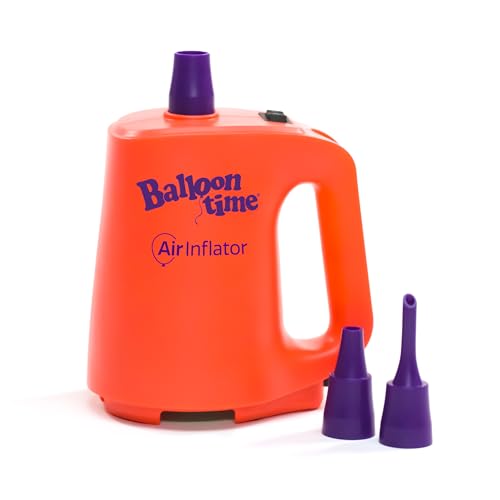
Balloon Time Portable Electric Air Pump
|
8.6/10 | Buy |
| Best Value |
 JANEF 4pcs Balloon Pump Hand Held Inflator Air |
8.1/10 | Buy |
Balloon Time Portable Electric Air Pump
Weighing just 1.5 pounds, this dual-mode inflator handles everything from party balloons to large pool floats and air mattresses. It combines continuous run and push-activated inflation modes with active deflation and built-in nozzle storage for streamlined event setup.
Pros
- Extremely lightweight and portable at 1.5 pounds
- Supports both inflation and active deflation
- Push-to-inflate mode allows precise balloon filling
- Integrated storage keeps interchangeable tips secure
Cons
- Requires access to an electrical outlet
- Six-foot cord restricts operating distance
Using a compressor for balloon inflation
Yes, an air compressor can move air into a balloon, but that basic possibility is not a recommendation to connect a balloon directly to a shop hose. A compressor stores air under pressure, while a balloon needs a controlled amount of air delivered gently through a suitable opening. The supplied compressor product data does not identify a compressor, a balloon nozzle, or a safe pressure setting for this use. So the practical answer is conditional: use a compressor only if its manufacturer allows the application and you can control the delivery appropriately.
Balloon pumps address this task more directly. The Balloon Time Electric Air Pump is described as a portable electric inflator with multiple tips, a push-to-inflate mode for individual balloons, and a continuous-run mode for larger inflatables. The JANEF hand pump is described as a manual option with two-way air holes and an angled nozzle intended for insertion into balloon openings. Those listed features are more relevant to party balloons than the usual pressure and air-delivery specifications used to select a workshop compressor.
Why shop pressure is not balloon pressure
A compressor’s pressure rating describes the pressure available in its system, not a safe target for every object connected to it. A balloon is flexible and changes shape as it fills, so a concentrated stream or excessive pressure can stretch it too quickly or cause it to burst. The available product information for the two pumps does not give a balloon pressure limit, and the source material does not provide a safe PSI value for balloons. Do not guess a regulator setting or treat a low tank setting as universally safe.
Airflow also matters. A large, fast-moving stream can be difficult to control at the balloon opening even if the compressor’s tank pressure is reduced. Regulators manage downstream pressure within their intended operating range, but they do not necessarily limit flow in a way that suits every balloon, valve, adapter, or hose. If the manufacturer does not approve the setup, choose a balloon inflator designed for the job instead of improvising a connection.
A balloon’s material and size can affect how it responds, but the supplied information does not establish compatible compressor settings for latex or foil balloons. The electric pump’s description lists tips for latex and foil balloons, while the JANEF pump’s description says its nozzle suits most latex and aluminum foil balloons. These are product-description statements about the pumps, not evidence that a general-purpose air compressor will inflate every balloon type correctly. Match the attachment and operating method to the balloon and the equipment instructions.
When a dedicated balloon pump is the simpler choice
For party decorations, a dedicated pump avoids the need to adapt a workshop air system. The Balloon Time model is listed with push-to-inflate and continuous-run modes, multiple tips, and a deflation feature for larger inflatables. Its description also identifies a carry handle, built-in tip storage, a six-foot cord, and a weight of 1.5 pounds. Those details support portability and task-specific attachments, though they do not establish a fill rate or guarantee a particular balloon size.
The JANEF set uses hand operation rather than an electric motor, and its listed contents include four hand pumps along with party-decorating accessories. Manual pumping avoids connecting a pressurized air line or plugging in an electric inflator, but it requires physical effort. The product description identifies a three-ring internal design and a two-way air path; it does not provide measured output or a verified time per balloon. Consider whether the job involves a few balloons or a larger decoration before deciding how much effort is acceptable.
Foil balloons may have narrow or self-sealing openings, while latex balloons stretch around a nozzle. The electric inflator’s multiple included tips are described for different projects, including foil and latex balloons, but the correct tip still depends on the balloon opening. The manual pump’s angled nozzle is described as easier to insert. Check the balloon and pump instructions rather than forcing an attachment into an opening that does not fit naturally.
These options also differ in power source and operating style. The electric unit can run continuously for larger inflatables according to its description, while its push-to-inflate mode is intended for individual balloons. The manual set requires repeated hand operation, with no electrical connection. Neither description supplies a quantified output comparison, so it would be misleading to claim a particular speed advantage or number of balloons per minute.
What to check before connecting a compressor
Start with the equipment manuals, not an improvised adapter. Confirm that the compressor manufacturer permits inflation of balloons, that the accessory is intended for the compressor and balloon type, and that the setup provides controlled delivery within the manufacturers’ stated limits. If instructions do not provide a suitable operating method, do not infer one from the compressor’s tank PSI or regulator markings. A purpose-built pump is the clearer choice when compatibility is uncertain.
Inspect the connection points and balloon opening before use. An attachment that is loose can leak or come free, while a nozzle that is too large or has an unsuitable shape may damage the opening. Do not hold a balloon over a bare air hose, and do not use an unregulated outlet as a substitute for a balloon nozzle. Keep the work area clear of people’s faces and use eye protection when operating air equipment, following the compressor manufacturer’s safety guidance.
If the compressor has a regulator, follow its instructions for setting and monitoring downstream pressure, but do not assume that the regulator alone makes this application appropriate. Use only pressure and accessories expressly allowed by the equipment makers. Never exceed a manufacturer’s stated pressure limit, and stop if the balloon expands unusually quickly, the connection shifts, or the setup behaves unpredictably. Avoid servicing or changing compressor fittings while the tank is pressurized; follow the manual’s safe depressurization directions.
Compressor accessories are not interchangeable simply because their fittings appear to connect. A nozzle designed for tires or general air use may not be shaped or controlled for balloons. If you are considering a different air fitting, consult instructions for changing an air compressor nozzle, then verify that the replacement is actually intended for balloon inflation. That guide concerns nozzle changes; it does not certify a particular attachment for balloons.
Why a workshop compressor may be inconvenient
A workshop compressor is selected for tasks such as supplying pneumatic tools, not necessarily for delicate inflatables. Its tank, hose, couplers, and regulator add setup steps that a small balloon pump may avoid. The products provided here include no compressor CFM, PSI, tank capacity, or noise rating, so those specifications cannot be used to estimate how either listed balloon pump would compare with a compressor. Check the actual compressor model’s documentation if you already own one.
Noise and location can matter at a home party or in a decorated room. The electric pump is listed as portable and includes a six-foot cord, but the product information does not state a decibel rating. A workshop compressor’s noise depends on its model and operating conditions, which are not supplied here. If noise is a concern, compare published sound information for the specific devices rather than assuming that an electric balloon pump or compressor will be quiet.
Power and storage are further practical distinctions. The Balloon Time model requires a power connection, while the JANEF hand pump does not need an electrical outlet. The electric model’s listed carry weight and built-in tip storage may be useful where equipment needs to move between rooms, but a cord still needs a suitable outlet and careful placement. A manual pump can be stored without an electrical connection, though inflating many balloons by hand may take more effort.
Consider the actual decoration rather than the broad label “inflatable.” The electric product description includes party balloons, arches, toys, pool floats, and air mattresses, with different tips intended for different projects. That range does not mean every tip is suitable for every opening or that continuous operation should be used for a single small balloon. Follow the mode and attachment instructions for the specific item being inflated.
Common setup errors and safer decisions
The most serious mistake is connecting a balloon directly to a high-pressure line and opening the air supply without a documented control method. Another is assuming that a pressure regulator’s dial guarantees a gentle, consistent flow at the nozzle. A regulator is only one part of a system, and the available data does not describe how any particular compressor behaves with a balloon attachment. Do not experiment on a valuable decoration or around children.
Using the wrong opening or attachment can create frustrating results even when the air source is otherwise appropriate. A nozzle that slips out may waste air, while pushing a poorly matched tip into a balloon can tear it. The included tips on the electric pump and the angled nozzle on the manual pump are intended to address different inflation tasks, according to their descriptions. Select the attachment that fits the balloon opening without forcing it, and stop if it will not seat securely.
Do not confuse inflation with deflation. The Balloon Time product description identifies a deflation mode intended for larger inflatables such as air mattresses and pool floats. That feature is not a reason to use the same setting for a party balloon, and the supplied information does not describe a special balloon-deflation procedure. Follow the manufacturer’s directions for the particular item and mode.
Finally, do not rely on product ratings or general category descriptions to establish a safe pressure. The supplied data lists ratings for the two balloon pumps but offers no verified compressor-to-balloon pressure range, test result, or compatibility certification. Ratings do not replace operating instructions, and there are no supplied review counts or user reports that would substantiate a particular outcome. Use manufacturer information as the basis for the setup.
Choosing the practical route for your balloons
For a small number of party balloons, the JANEF manual pump may suit someone who prefers a simple hand-operated tool and accepts the physical effort. For repeated balloon filling or mixed decoration projects, the electric Balloon Time pump offers listed operating modes and several tips. The descriptions do not provide a direct output comparison, so the decision should turn on power availability, task size, attachment needs, and the manufacturers’ instructions rather than an assumed speed ranking.
A compressor may be considered only when its manufacturer and the balloon-inflation accessory maker support the application and the user can follow their pressure and connection requirements. If either source leaves the setup unclear, avoid adapting the shop system. A purpose-built electric or manual balloon pump is generally the more straightforward option for party use because the supplied products are specifically described for balloon inflation.
So, can you use an air compressor to fill balloons? It may be possible with a manufacturer-approved, controlled setup, but the supplied specifications do not establish a safe compressor pressure or compatible compressor model. For predictable party preparation, choose a balloon pump with an appropriate tip and follow its instructions. Treat a workshop compressor’s pressure rating as a system specification, never as a balloon-inflation target.
About the author
Bob Beacham is an experienced tools and workshop writer with deep knowledge of power equipment, mechanical systems, and practical DIY applications. His coverage of air compressors, welding equipment, saws, and workshop tools helps translate technical specifications into useful guidance for homeowners and serious DIYers.