
Can You Use an Air Compressor as a Power Washer?
Can you use an air compressor as a power washer? Learn what compressed air can clean, where water pressure falls short, and safer alternatives for November 2026.
 By Kenny Koehler
Updated November 10, 2026

Compressed air can move dust and loosen some debris, but it doesn’t deliver the steady, water-driven flow that a pressure washer uses to rinse surfaces. That difference matters if you’re trying to clean a driveway, siding, vehicle, or outdoor furniture and expect a compressor to do the whole job.
Can you use an air compressor as a power washer? Not as a direct substitute for a conventional pressure washer. Some air-powered cleaning tools can use compressed air with water or cleaning solution, but their operating requirements and results depend on the tool, compressor, and cleaning task. A compressor’s PSI rating alone doesn’t tell you whether it can supply enough air or water flow for a particular attachment.
For cleaning with compressed air, the tool matters as much as the compressor. The air blow gun guide can help you understand a common air-only cleaning accessory, while our portable compressors for air tools overview offers context on matching a compressor to pneumatic equipment. Neither setup automatically becomes a pressure washer, so check the intended use and specifications of any attachment before connecting it.
Top Products
| Award | Product | ACR Score About ACR ScoreThe ACR Score is our own rating from 0 to 10, based on performance, design and build, ease of use, and value. It reflects independent research and is never influenced by manufacturers, retailers, or affiliate commissions. Learn more › | |
|---|---|---|---|
| Best Overall |
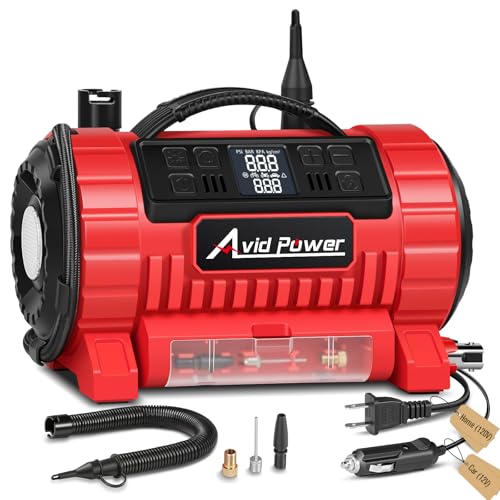
AVID POWER 110V/12V Portable Tire Inflator
|
9.1/10 | Buy |
| Best Value |
 CRAFTSMAN 1.5-Gallon 135 PSI Air Compressor |
8.3/10 | Buy |
 EGO Power+ IF1600 160 PSI Inflator |
8.0/10 | Buy | |
| Best Premium |
 California Air Tools 255C 2.5-Gal Pressure Pot |
8.0/10 | Buy |
 Generic 40-Gallon 15HP Gas Air Compressor |
8.0/10 | Buy | |
| Best Budget |
 HI-TECH Vortex II V-200 Air Cleaning Gun |
7.8/10 | Buy |
AVID POWER 110V/12V Portable Tire Inflator
Running on both household AC and vehicle DC power, this versatile inflator tackles car tires, sports equipment, and large camping mattresses with equal ease. Its dedicated high-volume deflation mode and automatic shutoff make it an adaptable tool for garage maintenance and roadside emergencies.
Pros
- Dual-power support for garage and roadside use
- Fast inflation with reliable auto-shutoff functionality
- High-volume hose supports rapid mattress deflation
- Bright emergency LED assists nighttime repairs
Cons
- Lacks an internal battery for cordless operation
- Bulkier footprint requires dedicated trunk storage space
CRAFTSMAN 1.5-Gallon 135 PSI Air Compressor
Built for light workshop duties and quick inflation tasks, this compact Craftsman unit delivers up to 135 PSI with a maintenance-free motor. Its three-layer steel tank and integrated thermal overload protection make it a dependable pick for finish nailing and topping off tires.
Pros
- Low-maintenance oil-free motor
- Compact and easily portable footprint
- Built-in thermal overload and auto shut-off protection
- Sturdy three-layer steel tank construction
Cons
- Low 1.5 CFM output limits continuous tool operation
- Small 1.5-gallon tank requires frequent motor cycling
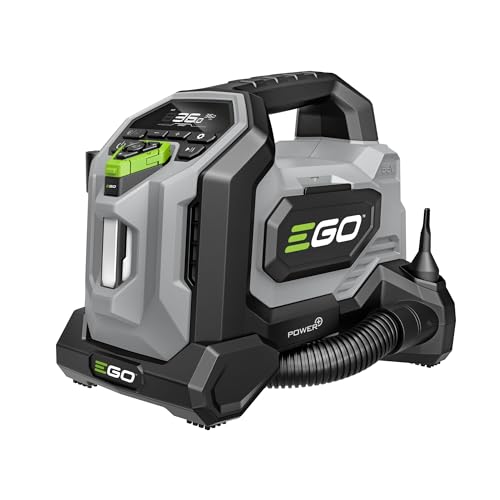
EGO Power+ IF1600 160 PSI Inflator
Designed for high-pressure and high-volume tasks, the EGO Power+ IF1600 tops off tires rapidly while handling inflatables and deflation. It serves as a versatile utility tool for homeowners already invested in the EGO 56V battery system.
Pros
- High-pressure output reaches up to 160 PSI
- Four programmable PSI memory presets
- Includes high-volume and deflation capabilities
- Versatile removable magnetic work light
- Generous five-year limited warranty
Cons
- Battery and charger are sold separately
- Relatively heavy tool body at over six pounds
California Air Tools 255C 2.5-Gal Pressure Pot
Built for bubble-free resin casting, this coated steel pressure chamber features integrated controls and stabilizing rubber feet. It provides a reliable 60 PSI operating range for hobbyists and makers working in compact studio spaces.
Pros
- Includes regulator and pressure relief valve
- Rubber feet prevent slipping during operation
- Reliable 60 PSI working pressure
- Integrated handle assists with portability
Cons
- Internal dimensions limit maximum casting project size
- Coated steel build weighs over 22 pounds
Generic 40-Gallon 15HP Gas Air Compressor
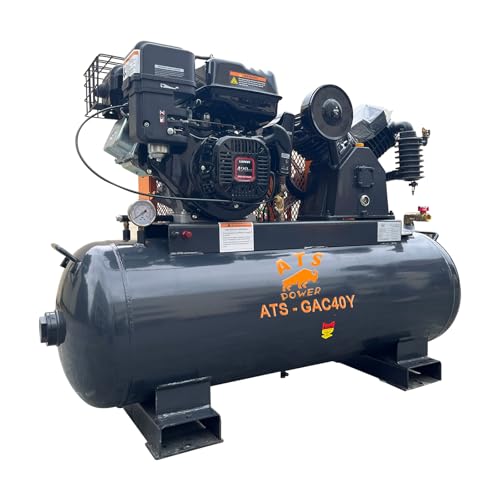
Built for demanding pneumatic tools like sandblasters and impact wrenches, this two-stage compressor pairs a 420cc RATO gas engine with a 40-gallon ASME tank. It delivers 24 CFM at up to 175 psi, providing reliable air delivery for off-grid job sites and busy workshops.
Pros
- High 24 CFM output powers demanding pneumatic tools
- Electric and recoil start provide flexible operation
- Durable ASME-certified steel pressure tank
- Oil-free pump minimizes routine maintenance tasks
- Integrated low-oil shutdown protects the engine
Cons
- Very heavy unit at 360 pounds
- Gas engine requires outdoor or well-ventilated placement
- Large footprint demands significant floor space
HI-TECH Vortex II V-200 Air Cleaning Gun
Built for thorough automotive detailing, the HI-TECH Vortex II combines pulsating compressed air with switchable wet and dry modes. It is an effective tool for dislodging stubborn grime from upholstery, carpets, and crevices while conserving cleaning chemicals.
Pros
- Switches smoothly between wet and dry cleaning modes
- Oscillating air motion lifts deep-seated grime quickly
- Efficient design cuts down on cleaning chemical usage
- Rugged build suitable for frequent detailing tasks
Cons
- Requires a dedicated air compressor to function
- Relatively bulky 13-inch frame in tight spaces
How Compressed Air Differs From Power-Washer Flow
A compressor stores air under pressure and supplies it as a pneumatic tool draws from the system. A power washer, by contrast, uses a pump to move water through a hose and nozzle at pressure intended for rinsing. The two machines may both be described using PSI, but that shared unit doesn’t make their output interchangeable.
Pressure describes force per area; it doesn’t describe how much fluid arrives over time. For compressor-powered tools, air volume is commonly expressed in CFM at a stated pressure, while pressure washers are often rated by water flow as well as pressure. A compressor may show a high maximum PSI and still lack the sustained air delivery needed by an air-driven cleaning attachment.
That distinction explains why a small compressor may inflate a tire effectively but struggle with a tool that consumes air continuously. A tank provides a reserve, not an unlimited supply: once the tool draws air, the pump must replenish it. If the tool’s demand is greater than the compressor’s delivered airflow, pressure can fall and the tool may work inconsistently.
Why PSI by itself can’t answer the question
It’s tempting to compare a compressor’s maximum PSI with a pressure washer’s advertised pressure and assume the larger number wins. That comparison leaves out the type and amount of flow, the nozzle design, and whether the machine is moving air or water. An air compressor’s pressure rating describes its compressed-air system, not a guaranteed water-cleaning pressure at a washer-like flow rate.
Attachments also have specific operating limits. A device intended to atomize a cleaning solution or agitate dirt with air isn’t necessarily engineered to create a pressure-washer jet. Follow its instructions for the approved compressor range, liquid, connections, and surfaces; don’t assume a fitting or nozzle is safe just because it attaches to an air hose.
Hose and regulator conditions matter, too. A regulator controls outlet pressure, but it cannot create additional airflow that the pump doesn’t supply. A restrictive hose, coupler, or fitting can further affect delivery, so a tool’s stated air requirements should be checked against the compressor’s documented output at the relevant pressure.
What air-powered cleaning tools actually do
An air blow gun directs compressed air at a surface to dislodge loose dust, crumbs, and debris. It doesn’t rinse away dirt with a stream of water, and it can send particles into the air or toward nearby people. Use suitable eye protection, direct the airflow safely, and follow the tool maker’s instructions, including any restrictions on using compressed air for cleaning.
Other products combine compressed air with liquid or use an air-driven motion to agitate a surface. The AC/DC portable compressor overview concerns portable compressor formats, while the specific tool’s documentation determines whether it can power a wet-cleaning process. Air-driven cleaning is still not necessarily equivalent to a pressure washer’s water volume, reach, or rinsing action.
The HI-TECH Vortex II Air Cleaning Gun in the product list is described as a compressor-powered detailing tool with wet and dry modes. Its description says the user can switch between cleaning solution use and dry air-only operation. That makes it relevant to certain vehicle-interior and detail-cleaning tasks, but the supplied information doesn’t establish that it operates as an outdoor pressure washer or specify the compressor airflow it requires.
Choose the Cleaning Method for the Surface
Loose dust and debris in narrow crevices may be appropriate for an air tool designed for that job. Stuck mud, road film, or grime that needs rinsing calls for a water-based cleaning method. The best match depends on the material, soil, and whether the job needs agitation, detergent, or a rinse rather than simply moving particles.
For vehicle interiors, an air cleaning gun with a wet mode may be useful if its directions permit the intended surface and cleaning solution. Interior fabrics, electronics, leather, and trim don’t all tolerate moisture or force the same way. Test cleaning products only as their manufacturers direct, avoid directing liquid into electrical components, and use controlled technique appropriate to the surface.
For outdoor surfaces that need substantial rinsing, use equipment designed to deliver water for that purpose. A garden hose, an appropriate pressure washer, or a purpose-built low-pressure cleaning attachment may be a better fit, depending on the surface and cleaning instructions. Avoid applying high pressure to fragile finishes, seals, electrical equipment, or surfaces that can be damaged by concentrated flow.
Match an air tool to delivered CFM
If an air-powered cleaner is under consideration, start with the tool maker’s required CFM and operating pressure. Then compare those requirements with the compressor’s rated air delivery at the same pressure, not only its maximum tank PSI. The supplied information for the listed CRAFTSMAN compressor specifies 1.5 CFM at 90 PSI and 135 PSI maximum pressure, but it does not establish compatibility with a particular cleaning attachment.
The AVID POWER Portable Tire Inflator Air Compressor is specified for tire inflation and low-pressure inflatables, with AC and DC power options and preset pressure modes. The EGO POWER+ 160 PSI Compact Inflator is also presented as an inflator with high-pressure, high-volume, and deflation functions. Those descriptions do not list sustained CFM for a pressure-washer-style tool, so don’t treat their PSI figures as proof that either can drive a continuous cleaning attachment.
Tank capacity and recovery also influence how long an air-powered tool can operate before pressure falls. A compact tank can buffer short bursts, but a continuous draw can use that stored air quickly. If product information doesn’t provide the attachment’s air consumption, compressor CFM at operating pressure, or duty-cycle guidance, the match remains uncertain and should be confirmed with the manufacturers.
For tool selection, our portable compressors with tanks overview provides related context about tank-equipped options. Use published output figures and the intended task to assess suitability, rather than choosing solely by tank size or peak pressure. A larger tank can provide more stored air, but it doesn’t change the pump’s underlying airflow capacity.
What the Listed Products Can and Cannot Tell You
The products accompanying this guide cover different jobs, so they shouldn’t be treated as a set of pressure washers. The CRAFTSMAN unit is a small oil-free compressor with a listed 1.5-gallon tank, 1.5 CFM at 90 PSI, and 135 PSI maximum pressure. Its description mentions uses such as nailers, micro sanding, spray guns, and tire inflation, but doesn’t specify water-washing performance.
The 40 Gallon Air Compressor is a gas-powered, two-stage model described with 24 CFM airflow and 175 PSI maximum pressure. Those specifications identify a higher-air-volume compressor for listed pneumatic applications such as sandblasting, impact wrenches, and spray guns. They still don’t establish compatibility with a pressure washer attachment, because no water flow rate or washer function is listed.
The California Air Tools 255C is a pressure pot for epoxy resin casting, not a pressure washer. Its listed maximum and operating pressures relate to its stated casting application. A product name containing the word pressure does not mean the vessel is intended to pump water through an outdoor cleaning nozzle.
The HI-TECH Vortex II is the closest match in the supplied products to an air-powered cleaning tool, but its description focuses on detailing interiors and exteriors, with wet and dry modes. The description does not provide an air-consumption figure, a pressure-washer water-flow rating, or approval for every surface. Confirm requirements and permitted uses with the tool manufacturer before selecting a compressor or cleaner.
Questions to answer before connecting an attachment
First, identify whether the attachment is designed for air-only dust removal, air-assisted liquid cleaning, or water pumping. Those functions are different, even if products share similar-looking hoses or fittings. Read the product label and manual for its operating pressure, airflow, liquid compatibility, and use restrictions.
Next, check the compressor’s rated delivery at the pressure the tool needs. If a manufacturer lists only maximum PSI or does not provide CFM, that information is not enough to verify continuous air-tool compatibility. Ask the tool and compressor manufacturers for the missing specifications rather than estimating from tank size, horsepower language, or a single maximum-pressure figure.
Finally, consider the work area and the consequences of overspray or airborne dirt. A tool that disperses particles can affect nearby people, vehicles, and finished surfaces. Keep bystanders clear, wear appropriate eye protection, and use hearing protection when operating air equipment, following both manufacturers’ safety directions.
Common Mistakes That Lead to Poor Cleaning
One common mistake is treating maximum PSI as a complete measure of cleaning ability. A tool also depends on the kind of flow it needs and how long it needs that flow. A compressor that reaches a pressure rating while the tank is idle may not maintain the air supply during continuous use.
Another is using an improvised nozzle or adapter to turn an air line into a water jet. Connections, materials, and pressure limits matter, and an attachment not designed for the intended fluid or pressure may create a hazard or damage the workpiece. Use only equipment intended for the stated application, with its supplied or manufacturer-approved connections.
Don’t assume that adding water to an air blow gun makes it a power washer. A purpose-built wet-cleaning tool has defined operating instructions and application limits, while a basic air nozzle is designed around compressed air. If the manufacturer doesn’t explicitly describe wet use, keep liquids out of the tool and follow the manual.
It is also easy to overlook air quality and moisture management. Compressed air systems can contain moisture, and the amount depends on operating conditions and equipment. Follow the compressor manual for tank draining and maintenance, and use filtration or separation only when the cleaning tool or task calls for it. Depressurize the tank completely before servicing or transporting the compressor, and follow the manufacturer’s safety guidance.
A Practical Decision for Home and Garage Cleaning
For dry dust removal, choose a suitable air blow gun or cleaning tool and verify its instructions. For detailing that uses cleaning solution, the Vortex II’s listed wet and dry modes may be relevant, but confirm its air requirements and surface guidance first. For jobs that depend on rinsing with water, select a water-cleaning system designed to deliver that flow instead of expecting an air compressor to function as a conventional power washer.
Buyers comparing compressors for an air-driven cleaner should prioritize documented CFM at the tool’s operating pressure, along with the tool’s intended duty and the compressor’s operating limits. PSI alone, a large tank, or a high horsepower claim cannot establish the match. If key airflow or use specifications are absent, seek confirmation before buying or connecting equipment.
In short, an air compressor can support certain cleaning tools, but it doesn’t replace the water pump and flow system of a power washer. Match the attachment to its stated job, confirm airflow requirements, and use equipment only within its manufacturer’s limits. That approach avoids both disappointing cleaning results and unsafe improvised connections.
About the author
Kenny Koehler is a power-tool specialist with more than a decade of hands-on evaluation experience and a science-based approach to product testing. His expertise in repeatable testing, tool performance, impact wrenches, and professional equipment brings a practical, data-focused perspective to compressor and pneumatic-tool comparisons.