
Can You Make an Air Compressor Quieter? A Practical Guide
Can you make an air compressor quieter? Learn practical noise-reduction steps, limits, and quieter equipment options for November 2026.
 By Glenda Taylor
Updated November 10, 2026

An air compressor that rattles across a concrete garage floor or roars through an attached workshop can make ordinary jobs unpleasant. Can you make an air compressor quieter? Often, you can reduce some transmitted vibration and control where the sound travels, but a few simple changes cannot make a loud pump operate silently. The best approach depends on whether the noise comes from the motor and pump, loose parts, airflow, or vibration reaching the floor and nearby walls.
Start by identifying the compressor’s operating noise rating, if one is provided, and checking its installation and maintenance instructions before changing its setup. The products listed below include a quiet airbrush compressor rated at 55 dB and a California Air Tools model listed at 75 dB, along with equipment that serves other purposes. Those specifications offer useful context, but they do not mean every listed product is a direct replacement for a shop compressor. For broader equipment context, see our portable compressor overview and guidance on air compressor pressure safety.
| Award | Product | ACR Score About ACR ScoreThe ACR Score is our own rating from 0 to 10, based on performance, design and build, ease of use, and value. It reflects independent research and is never influenced by manufacturers, retailers, or affiliate commissions. Learn more › | |
|---|---|---|---|
| Best Overall |
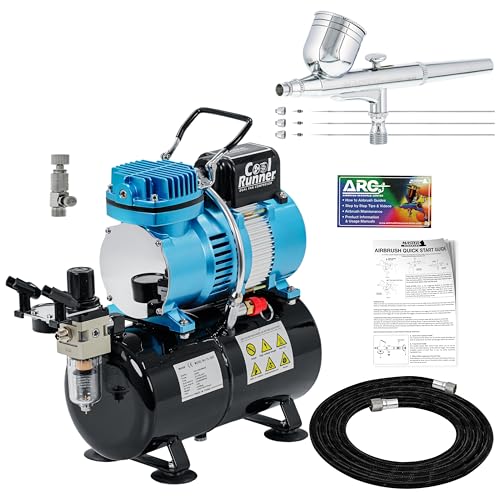
Master Airbrush Cool Runner II TC-326T Kit
|
9.1/10 | Buy |
| Best Budget |
 Can Air, Air Duster, 10oz Can |
8.9/10 | Buy |
| Best Premium |
 Micro-Air EasyStart Flex 398 Soft Start Kit for 2 |
8.8/10 | Buy |
 PointZero 1/5 HP Tank Airbrush Compressor |
8.3/10 | Buy | |
| Best Value |
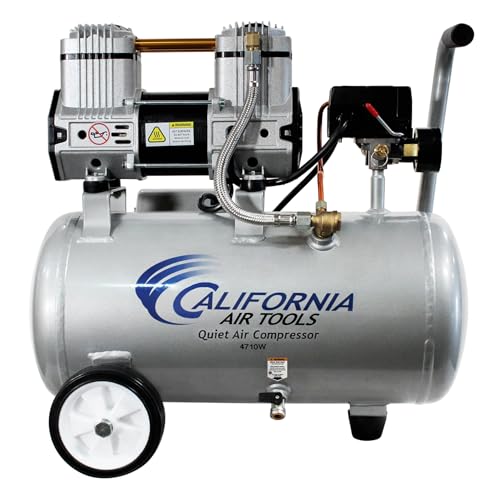 California Air Tools CAT-4710W 4.7-Gal Compressor |
8.3/10 | Buy |
 Air Lift 25980EZ WirelessONE Air Compressor |
8.1/10 | Buy | |
 Compressed Air Duster,150000rpm Rechargeable |
8.0/10 | Buy | |
 BUNKER INDUST 12V Off-Road Air Compressor |
8.0/10 | Buy | |
 EVIL ENERGY 12V 1-Gallon Air Tank and Compressor |
7.8/10 | Buy | |
 EVIL ENERGY 2-Gallon 12V Air Compressor Kit |
7.8/10 | Buy |
Master Airbrush Cool Runner II TC-326T Kit
Equipped with a 3-liter air tank and dual cooling fans, this setup provides smooth, pulsation-free airflow for extended hobby and craft sessions. The included G22 dual-action airbrush features three interchangeable tips, giving painters flexible control from fine lines to broader coverage.
Pros
- Air tank delivers consistent pressure without pulsation
- Dual fans keep the compressor cooler during long sessions
- Three nozzle sizes provide great spraying versatility
- Integrated moisture trap prevents water contamination
- Complete package includes hose, holder, and guide
Cons
- Weighs 12 pounds, making it somewhat bulky to transport
- 1/3-ounce fluid cup requires frequent refilling on large tasks
- Single-piston motor is not designed for heavy industrial use
Micro-Air EasyStart Flex 398 Soft Start Kit for 2
The Micro-Air EasyStart Flex 398 is an advanced soft starter module engineered to reduce air conditioner compressor startup inrush current by up to 75 percent. It is an ideal upgrade for homeowners and RV owners wanting to run central AC units on portable backup generators without tripping breakers or causing voltage drops.
Pros
- Cuts peak locked-rotor startup amperage by up to 75% to protect electrical panels and wiring
- Allows 2 to 6 ton central AC compressors to start reliably on modest portable generators
- Integrated Bluetooth connectivity provides helpful diagnostics and status monitoring
- Four-wire color-coded installation kit simplifies wiring inside outdoor condenser disconnect boxes
- Eliminates loud startup thuds, light flicker, and sudden line-voltage sags
Cons
- Requires working directly with high-voltage HVAC electrical wiring and capacitors
- Premium investment compared to basic analog hard-start capacitors
- Designed strictly for 2 to 6 ton cooling compressors rather than small plug-in workshop equipment
PointZero 1/5 HP Tank Airbrush Compressor
Equipped with a 3-liter air tank, this PointZero 1/5 HP compressor delivers steady, pulse-free airflow at a low 55 dB noise level. Its oil-less setup and integrated moisture trap make it well-suited for food decorating, nail art, and hobby painting.
Pros
- Dedicated air tank prevents pressure pulsations
- Quiet 55 dB motor for indoor operation
- Integrated water trap delivers clean, dry air
- Auto-stop function reduces wear and conserves energy
- Oil-less design safe for food and body art
Cons
- Heavier than tankless models at 11.71 pounds
- Air output is limited strictly to airbrush applications
California Air Tools CAT-4710W 4.7-Gal Compressor
Built for garage workshops and DIY tasks, this mobile unit features an oil-free dual-piston pump that fills its 4.7-gallon steel tank in 78 seconds. Its low 7.5-amp motor draw ensures smooth startups on standard household circuits without tripping breakers.
Pros
- Fast 78-second tank fill time from empty
- Low 7.5-amp draw prevents tripped breakers
- Low-maintenance oil-free pump operation
- Wheels and pull handle ease transport at 35 pounds
Cons
- Delivers only 2.2 CFM at 90 PSI for demanding tools
- Steel tank construction is heavier than aluminum alternatives
Air Lift 25980EZ WirelessONE Air Compressor
Designed for effortless vehicle leveling, the Air Lift 25980EZ combines a pre-assembled 12V compressor with wireless app and remote control. It is an ideal on-board inflation solution for drivers regularly towing or hauling heavy payloads.
Pros
- Pre-assembled bracket noticeably cuts down installation time
- Dual control options via wireless remote or mobile app
- Capable 120 PSI output handles demanding towing needs
- Three custom presets enable quick pressure adjustments
- Backed by a two-year manufacturer warranty
Cons
- Single-path system cannot level side-to-side loads independently
- Maximum pressure output capped at 120 PSI
- Requires adequate vehicle underbody mounting clearance
BUNKER INDUST 12V Off-Road Air Compressor
The BUNKER INDUST 12V Air Compressor delivers a listed 12.36 CFM and up to 150 PSI through a heavy-duty dual-cylinder pump engineered for rapid truck and off-road tire inflation. Equipped with digital auto-stop pressure regulation and dual quick-connect couplers, it is a practical mobile pneumatic tool for 4x4 drivers, overland travelers, and fleet owners.
Pros
- High rated airflow of 12.36 CFM drastically cuts down airing-up time on large truck and off-road tires
- Digital auto-stop control automatically shuts down pump operation at the exact target pressure
- Dual-hose configuration with T-fitting facilitates simultaneous two-tire inflation to keep pressures balanced
- Heavy-duty Anderson-style plug ensures a secure, low-resistance connection to vehicle 12V power
- Alloy cylinders with cooling fins and cleanable intake filters offer solid protection in dusty trail environments
Cons
- Tankless direct-drive pump design is not built for sustained continuous-draw pneumatic shop tools like rotary sanders or impact wrenches
- Heavy 12V current draw requires a direct battery terminal connection and cannot operate from standard vehicle accessory sockets
- Alloy cylinder heads generate noticeable surface heat during prolonged high-pressure cycles, requiring careful handling around the cooling fins
EVIL ENERGY 12V 1-Gallon Air Tank and Compressor
This compact 12V onboard air kit pairs a 1-gallon reinforced steel reservoir with an integrated compressor rated up to 150 PSI across five 1/4-inch NPT ports. It is well suited for truck owners, off-road enthusiasts, and DIY builders needing reliable air storage for suspension bags, air horns, and tire topping.
Pros
- Compact 1-gallon footprint fits easily into tight truck beds, trunk compartments, or undercarriage locations
- Five 1/4-inch NPT ports provide exceptional layout flexibility for custom air lines and accessories
- All-in-one kit includes compressor, tank, drain valve, air hose, and mounting brackets
- Solid steel tank construction with anti-corrosion exterior coating designed for mobile environments
Cons
- One-gallon capacity is strictly intended for intermittent air needs, not continuous-demand air tools like sanders or impact wrenches
- Airflow delivery ratings (SCFM) and decibel sound output are not explicitly specified by the manufacturer
- Requires custom 12V automotive wiring, dedicated fuse protection, and careful placement away from extreme road debris
EVIL ENERGY 2-Gallon 12V Air Compressor Kit
Built for onboard air horns, suspension systems, and tire inflation, this compact 12V kit pairs a reinforced steel tank with a 150 PSI compressor. Its six connection ports offer solid versatility for custom vehicle air systems.
Pros
- Six ports allow versatile multi-accessory routing
- Compact footprint fits neatly in vehicle spaces
- Includes essential installation hardware and drain valve
- Reinforced steel construction resists structural wear
Cons
- Requires regular weekly tank draining
- Manufacturer recommends professional installation
- Intended solely for fixed vehicle installations
How to Make an Air Compressor Quieter
Yes, you can often make an air compressor less disruptive, especially by reducing vibration and preventing sound from escaping directly into occupied rooms. But quieting methods have limits: the pump and motor still make airborne noise, and a sound enclosure that traps heat can create a separate problem. First identify what is making the noise, then choose a change that addresses that source without restricting cooling, ventilation, or safe operation.
Separate pump noise from rattles and vibration
Listen from a safe distance while the compressor runs in its normal configuration. A steady mechanical roar is different from a loose panel rattling, a sharp vibration transmitted through a hard floor, or an air leak that produces a hiss. Don’t touch moving parts, hot surfaces, wiring, or pressurized fittings while the unit is operating. If the sound has changed suddenly, or the compressor shakes more than usual, stop using it and consult the manufacturer’s troubleshooting guidance before attempting repairs.
With the unit switched off and unplugged, look for obvious loose external covers, fasteners, or accessories, and inspect the compressor’s feet and placement. Follow the manual for any tightening or service; don’t open the pump or motor housing unless the manufacturer’s instructions authorize that work. A unit that sits unevenly may send more vibration into the floor than one installed on a stable surface. A damaged foot or loose panel can also add rattling that makes the overall sound seem harsher.
Airborne sound and structure-borne vibration need different remedies. Soft, stable vibration-isolating pads may reduce how much movement reaches a suitable floor, but they must support the compressor securely and remain compatible with its installation instructions. Don’t place the unit on an unstable platform or block vents in an attempt to isolate it. If the compressor is bolted to a bench or wall, check the manufacturer’s mounting directions before changing that arrangement.
Move the sound source before building an enclosure
Distance is a straightforward way to reduce how much noise reaches a nearby work area. If the air hose and electrical setup allow it, locating the compressor farther from the operator may help, while a longer suitable air hose can bring the connection point closer. Keep the compressor in a dry, ventilated location and protect it from weather, dust, and accidental impacts. Follow the manual’s requirements for clearances, ambient conditions, and electrical supply rather than relocating the unit to an unsuitable closet or sealed room.
A barrier between the compressor and a work area can reduce the direct path of sound, but it should not obstruct the intake or cooling airflow. A purpose-built acoustic enclosure may help with airborne noise if it is designed for the compressor’s heat output and service access. A homemade sealed box is a poor shortcut: restricted ventilation can lead to overheating, and an enclosure can make it harder to hear a leak or abnormal mechanical sound. Never disable thermal protection or remove required guards to accommodate a sound-control modification.
Keep the compressor accessible for routine inspection and maintenance. The tank drain, regulator, power switch, and any service points should remain reachable as described in the manual. A sound barrier should not hide warning labels or make it difficult to shut the unit off promptly. If noise reduction depends on changing wiring, mounting hardware, pressure controls, or internal components, ask the manufacturer or a qualified service professional about an approved solution.
Use published decibel ratings carefully
Decibel figures can help narrow equipment choices, but they are meaningful only alongside their measurement conditions. The PointZero 1/5 HP Airbrush Compressor with Air is listed at 55 dB, while the California Air Tools CAT-4710W is listed at 75 dBA. These are product specifications, not measurements made in the same room, at the same distance, or under identical operating conditions. Treat them as a useful starting point, not a guaranteed prediction of the sound in your workshop.
The PointZero is a small, oil-less airbrush compressor with a 3-liter tank, regulator, gauge, and water trap. Its stated quiet operation and airbrush-oriented setup make it a more relevant option for hobby spraying than for general high-volume shop air. The California Air Tools model has a 4.7-gallon steel tank, wheels, and listed delivery of 3.00 CFM at 40 PSI and 2.20 CFM at 90 PSI. That gives buyers concrete specifications to compare, but the available data does not state its duty cycle or make it suitable for every tool.
The Master Airbrush Cool Runner II also has a 3-liter tank, a regulator, and two cooling fans, but no sound rating is supplied. Fans, pump design, and operating cycles can all affect the sound a listener hears, so don’t infer a decibel level from its features alone. Its intended airbrush use is distinct from running high-demand pneumatic tools. Verify both noise information and air delivery against the actual work you plan to do.
Sound ratings written in dB and dBA are not automatically interchangeable, and a stated figure does not explain the distance or conditions used to obtain it. Ask the manufacturer for test details if you need to compare close alternatives for a noise-sensitive room. Also account for the room: hard walls and concrete floors can make compressor sound more noticeable than furnishings and distance might suggest. A rating helps screen options, but the setup still matters.
Match quieter equipment to the job
A quieter compressor is useful only if it supplies enough air for the intended task. Airbrush work usually calls for a different delivery profile than a continuous-use sander or spray gun, so compare the tool’s air requirement with the compressor’s stated output at the relevant pressure. The California Air Tools listing provides figures at both 40 PSI and 90 PSI; the airbrush models are described for airbrush applications rather than as general-purpose high-volume compressors. Don’t assume a tank’s gallon capacity alone establishes how long a tool can run.
Intermittent use and continuous draw also affect how noisy a compressor feels over a work session. A compressor that cycles occasionally between short operations may be less intrusive than one running frequently to keep up with sustained demand, even if their rated sound levels are similar. An undersized unit can run for long periods or struggle to maintain pressure, which can undermine the reason for choosing a quieter model. Check the manufacturer’s duty guidance and tool air demand before buying.
Several products in this collection are not ordinary workshop compressors, so their presence should not be mistaken for a noise-control solution. The rechargeable electric air duster is for blowing dust from surfaces, and canned air is a cleaning product, not a compressor for powering pneumatic tools. The MICRO-AIR EasyStart Flex is a soft-start kit for certain air-conditioning systems; its listing concerns compressor startup and electrical demand, not reducing the operating sound of a portable shop compressor. The Air Lift system and vehicle tire inflators have vehicle-oriented purposes that differ from a quiet indoor air supply.
For a small hobby setup, the PointZero’s stated 55 dB rating and tank-equipped airbrush configuration may make it worth comparing with other airbrush compressors. For light general shop use, the California Air Tools model’s listed 75 dBA rating and delivery figures provide more relevant reference points, although they do not establish compatibility with every air tool. Buyers who need continuous tool operation should prioritize adequate delivered airflow and manufacturer duty guidance, then compare noise among models that meet those requirements. Don’t choose on a quietness claim alone.
Noise-reduction changes that can backfire
Covering a compressor with blankets, foam, or other loose material may seem easy, but it can block ventilation, contact hot components, or interfere with moving parts. Don’t use these materials as an improvised enclosure. Keep intake openings clear and maintain the clearance required by the manufacturer. A ventilation restriction can increase heat and shorten service life, while a covered unit may be harder to inspect or switch off.
Lubrication and routine maintenance matter, but use only the service schedule and materials specified for the particular compressor. The airbrush compressors described here are oil-less; adding oil would be inappropriate unless their manufacturer expressly directs it. Other compressor designs may have different maintenance requirements. Don’t apply lubricant to electrical components, belts, or pump parts based on a general noise-reduction tip.
Pay attention to hissing, repeated cycling, and new rattles because they may point to an air leak or mechanical issue rather than normal operating noise. Shut down and disconnect the unit before inspecting accessible external connections, and follow the manual for safe depressurization before servicing or transport. Never loosen a pressurized fitting, bypass a safety device, or alter factory pressure settings to quiet the machine. If the source isn’t obvious, qualified service is safer than trial-and-error disassembly.
When moving the compressor, follow the manufacturer’s transport instructions and depressurize the tank completely before servicing or transport where the manual requires it. Store and drain the tank as directed, since moisture management is an ownership issue even when the main concern is noise. Wear appropriate hearing and eye protection when operating air equipment; a quieter rating does not mean hearing protection is unnecessary. Keep other people away from exposed moving parts and pressurized connections.
Decide whether to quiet or replace the compressor
Small fixes make sense when the noise is mainly a loose external part, an unsuitable location, or vibration that can be addressed without changing the compressor. A persistent, loud pump may call for a different unit rather than a more elaborate enclosure. Before replacing it, list the tools you use, their pressure and airflow requirements, how often they run, and the sound information published for candidate compressors. That prevents a quieter but underpowered purchase.
Compare tank capacity, stated CFM at the pressure you need, power requirements, and noise ratings together. For example, a tank can provide stored air for short bursts, but it does not substitute for adequate pump delivery during sustained demand. The CAT-4710W listing provides CFM at two pressures, while the supplied data for the airbrush models does not provide comparable CFM figures. Where a specification is missing, ask the seller or manufacturer rather than filling the gap with assumptions.
Other equipment details can help establish whether a product fits the task, but they don’t prove that it will be quiet in a particular room. The California Air Tools compressor is listed as oil-free and portable, while the PointZero model is described as oil-less and designed for airbrushing. Those are useful distinctions for maintenance and application, but neither phrase means silent operation. A buyer should review the full manufacturer documentation, including operating sound conditions and service requirements.
If your current compressor has developed a new noise, diagnose the change before spending money on soundproofing. If it has always been loud and the work happens in an attached garage, a manufacturer-rated quiet model may be the more direct long-term answer, provided its air delivery matches your tools. Our tankless compressor overview can help explain how a different storage setup changes the comparison, though tankless designs are not inherently quieter. Choose based on the actual specifications and installation conditions.
In practice, start with the simplest safe changes: identify the source, secure the compressor on a suitable surface, and improve its location without blocking ventilation. Replace or service the unit when its normal operating noise remains disruptive, using comparable sound data and verified airflow requirements to choose a suitable alternative. A realistic goal is less noise at the work area, not silence or a soundproof enclosure that compromises cooling.
About the author
Glenda Taylor has extensive experience in residential construction, remodeling, home improvement, and tool use. Her practical approach to equipment evaluation focuses on usability, performance, safety, and value—helping DIYers and workshop users make better-informed decisions about compressors and related tools.