
Can I Use Air Tools With a Pancake Compressor: Practical Air Tool Guide for 2026
Can I Use Air Tools With A Pancake Compressor? Learn which pneumatic tools match compact tanks, CFM requirements, and pressure limits in our October 2026 guide.
 By Bob Beacham
Updated October 7, 2026
By Bob Beacham
Updated October 7, 2026

Starting a trim carpentry job or inflating vehicle tires often leads woodworkers and homeowners to question pneumatic tool compatibility. Sinking an 18-gauge brad nail flush into oak casing requires an instant burst of pressure, yet running a dual-action orbital sander or paint sprayer demands an unrelenting stream of continuous volume. Because portable oil-free pancake compressors feature compact receiver tanks ranging from 3 to 6 gallons, understanding airflow delivery is essential before connecting any air tool. Many workshop owners wonder, can i use air tools with a pancake compressor without constantly stalling the motor or leaving fastener heads proud of the workpiece? The short answer is yes, but your success depends entirely on matching the pneumatic air consumption of the tool to the delivered air rating of the compressor pump.
Pneumatic tools fall into two distinct operational categories: intermittent-demand tools and continuous-demand tools. Fasteners such as 23-gauge pin nailers, 18-gauge brad nailers, and light 16-gauge finish nailers consume a tiny fraction of a cubic foot of air per shot, making them ideal partners for a lightweight pancake tank. Conversely, continuous air tools like die grinders, rotary sanders, and paint sprayers consume heavy air volume that quickly depletes small air receivers. By evaluating air delivery ratings strictly measured as SCFM @ 90 PSI, along with operating tank pressure and pump recovery cycles, you can safely tackle countless fastening, inflation, and cleaning tasks without overwhelming your equipment.
| Award | Product | ACR Score About ACR ScoreThe ACR Score is our own rating from 0 to 10, based on performance, design and build, ease of use, and value. It reflects independent research and is never influenced by manufacturers, retailers, or affiliate commissions. Learn more › | |
|---|---|---|---|
| Best Overall |
ECOMAX Air Compressor 3 Gallon 110 PSI Pancake
|
8.8/10 | Buy |
| Best Value |
 ECOMAX Pancake Air Compressor MAX 150 PSI
|
8.8/10 | Buy |
| Best Budget |
 Ironton Oil-Free Pancake Air Compressor, 0.3 HP
|
8.6/10 | Buy |
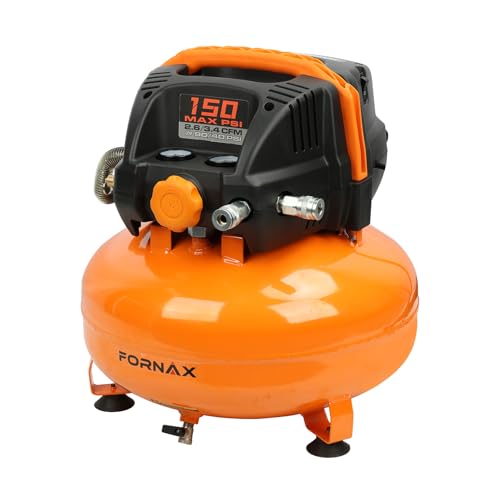 FORNAX Pancake Air Compressor with two couplers
|
8.4/10 | Buy | |
| Best Premium |
 ECOMAX Air Compressor 6 Gallon 175 PSI Pancake
|
8.4/10 | Buy |
 CRAFTSMAN 6 Gallon 150 PSI Oil-Free Pancake Air
|
8.1/10 | Buy | |
 FORNAX Pancake Air Compressor with two couplers
|
7.8/10 | Buy |
Matching Air Tools to Pancake Compressor Capabilities
Operating pneumatic air tools with a pancake compressor is entirely practical for a wide variety of woodworking, repair, and maintenance tasks. The key to successful operation lies in understanding the mechanical limitations of a compact receiver tank paired with a fractional-horsepower motor. Portable pancake compressors excel at supplying intermittent pulses of pressurized air, which makes them the standard choice for finish carpentry and residential punch-list projects. However, attempting to run high-volume equipment on a 3-gallon or 6-gallon reservoir quickly leads to tool starvation and line pressure drops.
Before connecting any air tool to your line, you must compare the air consumption rating of the tool against the delivery capabilities of your compressor pump. Air consumption is measured in standard cubic feet per minute, abbreviated as SCFM, and must always be evaluated at a specific working pressure like 90 PSI or 40 PSI. When the tool requires less air than the pump produces, the compressor easily maintains operating pressure and cycles off to rest. When the tool demands more air than the pump generates, the tank pressure rapidly plummets, stalling your progress.
Intermittent Versus Continuous Air Demands
The distinction between intermittent air tools and continuous air tools is the single most important concept in pneumatic equipment sizing. Intermittent tools consume a defined volume of compressed air only during the instant when the trigger is pulled. Once an 18-gauge brad nailer or narrow crown stapler drives a fastener, air consumption immediately drops back to zero while the operator repositions for the next shot. Because an individual fastener requires only 0.03 to 0.05 standard cubic feet of air per stroke, a small receiver tank can easily supply dozens of fasteners before triggering a motor restart.
Continuous air tools operate on a completely different principle by requiring an unbroken stream of high-velocity airflow through an internal pneumatic turbine or rotary motor. Common workshop tools like 1/4-inch die grinders, random orbital sanders, pneumatic cut-off tools, and paint spray guns demand constant airflow ranging from 4.0 to over 8.0 SCFM @ 90 PSI. Even when starting with a fully charged 6-gallon receiver pressurized to 150 PSI, a die grinder consuming 5.0 SCFM exhausts the usable air cushion in roughly twenty seconds. Once that reserve drops below the tool operating threshold, the tool slows to a crawl, and the pump cannot keep up.
Evaluating SCFM at 90 PSI and Maximum Pressure Limits
Air delivery ratings must always be qualified with an operating pressure reference to provide meaningful performance guidance. Bare CFM figures on marketing packaging are often misleading because moving air at atmospheric pressure requires significantly less mechanical energy than pushing air into a pressurized chamber. Standard cubic feet per minute, or SCFM, provides a standardized volume measurement corrected for temperature and pressure. Most pneumatic tools specify airflow appetite at 90 PSI because this represents the typical operating pressure required to cycle internal pistons and drive fasteners through dense wood.
Pancake compressors showcase a range of air delivery metrics that dictate their practical tool capabilities. For example, compact 3-gallon units like the Ironton 0.3 HP model operate up to 110 PSI for light fastening, while the ECOMAX 3 Gallon 110 PSI unit delivers 0.6 SCFM @ 90 PSI for pin nailers and tire inflation. Stepping up to 6-gallon platforms increases output significantly, with models like the CRAFTSMAN 6 Gallon, the FORNAX 6 Gallon, and the ECOMAX MAX 150 PSI delivering 2.6 SCFM @ 90 PSI. Furthermore, the ECOMAX 6 Gallon 175 PSI model delivers 3.0 CFM @ 90 PSI, providing expanded air storage that extends runtime before the motor restarts.
Pneumatic Fastening Tools: Brad, Finish, and Framing Nailers
Pneumatic nail guns represent the natural partner for portable pancake compressors across construction jobsites and residential workshops. Pin nailers driving 23-gauge micro pins consume negligible air per cycle, allowing even small 3-gallon compressors to run them for extended periods without cycling the motor. Brad nailers using 18-gauge fasteners, commonly utilized for shoe moulding and decorative picture frames, operate comfortably within the 0.6 to 2.6 SCFM delivery range of both 3-gallon and 6-gallon units. Because these smaller finish tools cycle intermittently, pressure recovery is swift and seamless.
Finish nailers and framing nailers demand careful attention to air consumption and operating pressure. Finish nailers driving 16-gauge or 15-gauge nails consume around 0.05 to 0.08 standard cubic feet of air per shot, making 6-gallon 150 PSI compressors ideal for installing baseboards and door casings. Conversely, full-size framing nailers driving 3-1/2-inch nails consume substantial volume that limits them to paced, sequential nailing. Attempting to rapid bump-fire framing nails drains the 6-gallon reservoir faster than a 2.6 SCFM pump can recover, causing line pressure to sag and leaving nail heads standing proud.
Tire Inflation, Blow Guns, and Light Maintenance Accessories
Tire inflation is one of the most common applications for portable pancake compressors in residential garages and mobile service vehicles. Inflating passenger vehicle tires, lawn tractor tires, utility trailers, and bicycles requires moderate line pressure but relatively modest total air volume. Compressors equipped with multi-piece accessory packages, such as the 11-piece kit included with the ECOMAX 3-gallon compressor or the 10-piece kit bundled with the ECOMAX 175 PSI model, supply the exact brass air chucks, high-pressure nozzles, and inflator needles needed for these tasks.
Air blow guns and tire chucks must still be managed according to pump output. Topping off a car tire from 28 PSI to 35 PSI happens quickly because differential pressure drives rapid airflow into the tire chamber. However, seating stubborn tubeless truck tire beads requires high sudden volume that can overwhelm a small 3-gallon reservoir. Similarly, pneumatic blow guns consume between 2.5 and 3.5 SCFM when held wide open, meaning users should employ brief, targeted cleaning bursts rather than continuous streams to keep the compressor from running continuously.
High-Demand Air Tools You Should Avoid
Understanding which pneumatic air tools are incompatible with pancake compressors prevents costly equipment damage and frustrating workshop delays. Continuous abrasive tools top the list of unsuitable pneumatic equipment. Random orbital palm sanders, rotary die grinders, angle grinders, and pneumatic cut-off wheels require massive, continuous airflow volumes ranging from 5.0 to 10.0 SCFM @ 90 PSI. Connecting a dual-action sander to a 6-gallon compressor delivering only 2.6 SCFM will starve the tool of air within seconds, reducing orbital sanding speed to an ineffective crawl.
Spray painting equipment and heavy automotive impact tools present similar mismatches on compact compressors. High-volume, low-pressure (HVLP) spray guns require 8.0 to 14.0 SCFM @ 40 PSI to atomize paint properly, and running them on a pancake unit causes pressure drops that produce uneven, spitting finishes. Likewise, 1/2-inch pneumatic impact wrenches can crack loose an individual lug nut using initial tank pressure, but cannot sustain multi-wheel tire rotations. For continuous spraying, sanding, or heavy automotive mechanics, larger stationary two-stage compressors or modern cordless tools are far superior choices.
Oil-Free Duty Cycles, Heat Buildup, and Motor Protection
Pancake air compressors rely on oil-free pump mechanisms designed for compact portability and zero routine oil changes. These pumps utilize high-speed universal electric motors operating at elevated rotational speeds, such as the 3550 RPM motor found in FORNAX 6-gallon models. The piston rides inside an aluminum cylinder using a self-lubricating polytetrafluoroethylene (PTFE) piston ring. Because these components do not circulate cooling oil, friction generates substantial internal heat during extended compression strokes, requiring users to respect duty-cycle limits.
To protect internal components from premature heat degradation, manufacturers design oil-free pancake compressors for an intermittent duty cycle, typically rated between 50 percent and 70 percent. This means the compressor motor should ideally run no more than five to seven minutes out of every ten-minute operating window. When users attach continuous air tools like sanders or grinders, the pump is forced to run 100 percent of the time, generating extreme heat that rapidly deteriorates the PTFE piston ring, valve reed plates, and cylinder walls.
Regulator Adjustments and Preventing Proud Fastener Heads
Accurate pressure control is critical to ensuring consistent pneumatic tool performance and preventing fastener drive defects. Pancake compressors feature dual pressure gauges installed directly on the control console: one gauge displays internal tank pressure, while the second gauge shows regulated outlet line pressure. Turning the large regulator knob clockwise increases output pressure, whereas turning it counterclockwise reduces the line pressure delivered to your air hose. Matching this setting to the tool manufacturer recommended operating pressure prevents premature tool wear and ensures consistent nail depth.
Fasteners standing proud of the trim surface are a common symptom of downstream pressure drops occurring during rapid nailing. When driving fasteners, dynamic pressure drop occurs as compressed air flows through restrictive fittings, miniature couplers, and long hose lines. If a finish nailer requires 95 PSI to seat nails into hardwood trim, but the compressor cut-in threshold drops to 85 PSI, the tool will fail to sink nails at the bottom of the cycle. Dual couplers on models like the CRAFTSMAN or FORNAX allow running two tools, but carpenters must pace their shots to avoid pressure drops.
Air Hose Length Versus Extension Cord Voltage Drops
Powering a portable compressor properly requires careful attention to electrical wire sizing and voltage drop. Pancake air compressors typically draw between 10 and 12 operating amps on a standard 120-volt household circuit, with momentary startup spikes reaching even higher. Connecting a compressor through a long, lightweight 16-gauge or 14-gauge household extension cord causes severe electrical resistance and voltage drop. This voltage reduction starves the electric motor of power, leading to sluggish startup, excessive heat buildup, and repeatedly tripped 15-amp circuit breakers.
The safest and most effective method for extending your reach across a jobsite is to leave the compressor plugged directly into a grounded wall receptacle and extend your air hose instead. Running an extra 25-foot or 50-foot air hose carries zero risk of electrical motor damage, ensuring the compressor always receives full line voltage. While a 1/4-inch hose works well for light brad nailing, switching to a 3/8-inch inner diameter air hose over longer runs minimizes internal friction, delivering maximum driving pressure to framing and finish nailers.
Tank Moisture Drainage and Practical Operating Takeaways
Moisture control is an indispensable aspect of maintaining pneumatic tools and protecting the structural integrity of your compressor tank. When an air compressor draws in ambient air, it concentrates the water vapor suspended in the atmosphere. As the hot compressed air cools inside the receiver tank, this moisture condenses into liquid water that collects at the bottom of the steel cylinder. If left unaddressed, accumulated water causes internal rust, reduces usable tank air volume, and travels down the air hose to corrode delicate internal nailer seals and trigger valves.
Purging this condensation requires opening the tank drain valve located at the lowest point of the pancake base after every work session. Many entry-level compressors feature thumb-twist petcock needle valves, which can become stiff and difficult to reach over time. Models equipped with quarter-turn brass ball valves simplify daily maintenance, allowing you to discharge moisture and air pressure in seconds with a simple flip of a lever. Always wear eye protection when purging the tank to guard against high-velocity moisture spray and rust particles.
Using pneumatic air tools with a pancake compressor is highly effective when you match tool consumption to the pump delivered airflow. Fastening tools, tire inflators, and light cleaning nozzles operate reliably, provided you respect intermittent duty cycles and avoid continuous rotary tools. By keeping the unit plugged directly into the wall, extending your air hose, and purging condensation daily, you can safely power an impressive range of pneumatic equipment for home improvement and finish woodworking projects.
About the author
Bob Beacham is an experienced tools and workshop writer with deep knowledge of power equipment, mechanical systems, and practical DIY applications. His coverage of air compressors, welding equipment, saws, and workshop tools helps translate technical specifications into useful guidance for homeowners and serious DIYers.