
Why Need Air Dryer for My Air Compressor? What You Need to Know
Why need air dryer for my air compressor? Learn how moisture affects tools and finishes, which dryer types fit your system, and what to check in November 2026.
 By Tom Scalisi
Updated November 10, 2026


Water in a compressed air line can spit onto a fresh paint finish, interfere with a pneumatic tool, or leave moisture collecting in downstream equipment. That’s why why need air dryer for my air compressor is a practical question for anyone using compressed air beyond occasional tire inflation. A dryer removes moisture from the air stream, while filters and separators handle other contaminants; the right setup depends on how dry your application needs the air to be.
A basic water separator may be enough for general shop use, but paint work or moisture-sensitive equipment may call for staged filtration and drying. Larger compressors and systems with sustained airflow can require a refrigerated dryer sized to the compressor’s flow, rather than a small point-of-use filter. For related setup details, see our guide to air compressor hose and delivery setups and our overview of compressed air for automotive detailing.
| Award | Product | ACR Score About ACR ScoreThe ACR Score is our own rating from 0 to 10, based on performance, design and build, ease of use, and value. It reflects independent research and is never influenced by manufacturers, retailers, or affiliate commissions. Learn more › | |
|---|---|---|---|
| Best Overall |
Gokluuk 4-Stage 3/4" NPT Air Dryer System
|
9.2/10 | Buy |
| Best Value |
 HQHAOTWU 7.5C 35 CFM Refrigerated Air Dryer |
9.2/10 | Buy |
| Best Budget |
 DAIERTEK 1/2" NPT 3-Stage Air Dryer |
9.1/10 | Buy |
| Best Premium |
 Schulz 50 CFM Refrigerated Air Dryer |
9.1/10 | Buy |
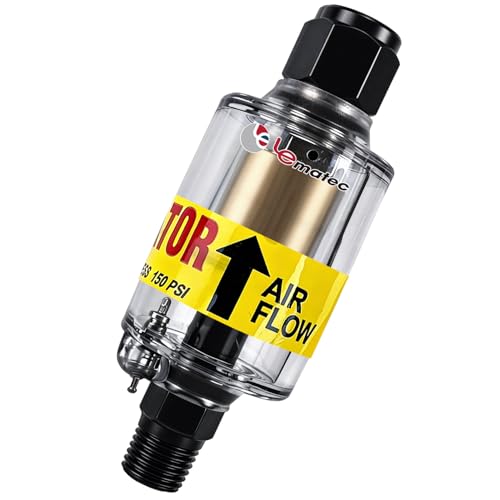 LE LEMATEC 1/4" NPT Inline Air Dryer |
8.9/10 | Buy | |
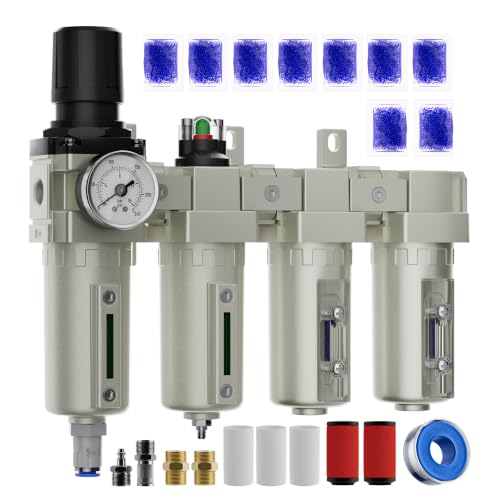 DAIERTEK 4-Stage 1/2-Inch NPT Air Dryer |
8.9/10 | Buy | |
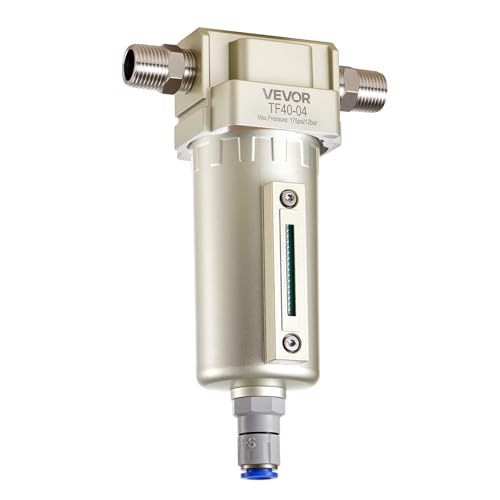 VEVOR 1/2-Inch NPT Air Compressor Filter |
8.8/10 | Buy | |
 VEVOR 50 CFM Refrigerated Compressed Air Dryer |
8.8/10 | Buy | |
 VEVOR 125 CFM Refrigerated Air Dryer |
8.8/10 | Buy | |
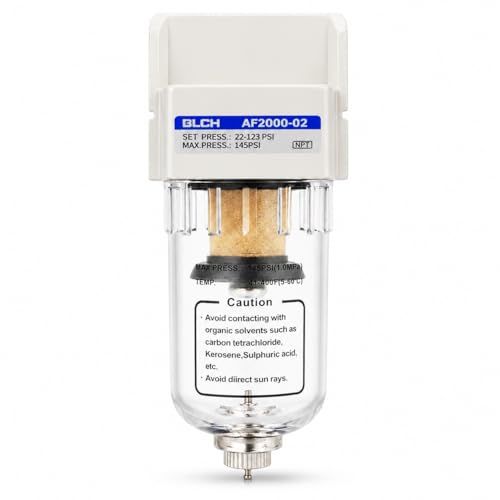 BLCH 1/4" NPT Air Line Dryer |
8.6/10 | Buy |
Gokluuk 4-Stage 3/4" NPT Air Dryer System
Built for high-demand pneumatic setups, this multi-stage filtration unit combines dual particulate filters, a coalescing separator, and desiccant drying to deliver clean air up to 240 PSI. Its color-changing beads and visual service indicator make routine maintenance straightforward for workshops.
Pros
- High 240 PSI maximum operating pressure rating
- Deep 0.01-micron filtration with coalescing separator
- Desiccant beads visibly change color when saturated
- Sturdy aluminum body with 3/4-inch NPT ports
- Comes complete with fittings, gauge, and replacement elements
Cons
- Must be mounted vertically, cannot be installed horizontally
- Requires regular desiccant replacement under heavy moisture loads
HQHAOTWU 7.5C 35 CFM Refrigerated Air Dryer
Built for workshop and industrial pneumatic setups, the HQHAOTWU 7.5C delivers a 35 CFM flow capacity to keep moisture out of compressed air lines with an operating dew point of 2 to 10 degrees Celsius. The compact unit includes three precision filters and an adjustable electronic drain timer for simplified maintenance.
Pros
- Delivers steady 35 CFM compressed air flow capacity
- Comes with three inline precision filters included
- Adjustable automatic drain valve prevents moisture buildup
- Compact footprint fits easily into tight shop spaces
Cons
- Requires a dedicated 220V power connection
- Demands a five-minute warm-up run before use
- Requires strict wall clearance spacing for proper airflow
DAIERTEK 1/2" NPT 3-Stage Air Dryer
Designed for moisture-critical tasks like spray painting and plasma cutting, this 3-stage filtration unit combines particulate, coalescing, and desiccant drying with integrated pressure regulation. Durable metal bowls and color-changing media make routine monitoring straightforward in workshop setups.
Pros
- Comprehensive three-stage filtration delivers dry, clean air
- Durable metal bowl construction for workshop environments
- Color-changing desiccant beads simplify maintenance tracking
- Generous bundle includes spare filters and fittings
Cons
- Requires vertical mounting for proper auto-drain operation
- Desiccant media requires regular maintenance and replacement
Schulz 50 CFM Refrigerated Air Dryer
The Schulz 50 CFM refrigerated air dryer delivers a reliable 41-degree Fahrenheit pressure dew point at 100 PSI using standard 115V power. It provides continuous moisture removal for 10HP and 15HP workshop compressors, making it an excellent choice for auto body painters and commercial shops needing clean, dry air.
Pros
- Maintains a stable 41-degree Fahrenheit dew point to prevent moisture downstream
- Runs on standard 115V single-phase electrical supply using 14-gauge wiring
- Handles up to 220 PSI inlet pressure from two-stage stationary pumps
- Generous 50 CFM rating matches demanding 10HP and 15HP compressor setups
Cons
- Requires a separate mandatory 1-micron particulate and oil pre-filter before the inlet
- At 70 pounds, the standalone cabinet requires dedicated bench or floor space
- Plumbing bypass valves and pre-filter canisters are not included with this standalone unit
LE LEMATEC 1/4" NPT Inline Air Dryer
Built for spray painting and plasma cutting setups, this compact inline separator captures oil and moisture down to 1 micron across a 2-150 PSI range. Its standard 1/4-inch NPT threading and built-in check valve help protect downstream pneumatic equipment from contamination.
Pros
- Filters oil and moisture down to 1 micron
- Wide operating range from 2 to 150 PSI
- Integrated one-way valve prevents backflow
- Standard 1/4-inch NPT fitting
- Extremely lightweight and compact profile
Cons
- Requires adapters for larger air line sizes
- Drain requires manual clearing and maintenance
DAIERTEK 4-Stage 1/2-Inch NPT Air Dryer
Designed for moisture-critical jobs like spray painting and plasma cutting, this comprehensive 4-stage system strips out particulates, oil aerosols, and water vapor down to 0.01 microns. Its rugged aluminum housing and integrated 0-240 PSI regulator provide steady, clean air delivery across demanding shop setups.
Pros
- Multi-stage separation effectively captures moisture, oil, and dust
- Includes ample replacement filters and desiccant media packs
- Sturdy metal bowl build suits rugged workshop environments
- Visual indicators simplify maintenance and media replacement timing
Cons
- Bulky 4-stage assembly requires significant wall mounting space
- Desiccant drying media requires periodic maintenance and replacement
VEVOR 1/2-Inch NPT Air Compressor Filter
Built with a sturdy aluminum alloy body and an automated float drain, this water separator protects pneumatic tools by capturing moisture and particles down to 5 microns. It serves home workshops and automotive setups that require dependable continuous moisture removal without manual maintenance.
Pros
- Automatic float-activated drain prevents forgotten manual emptying
- Durable aluminum alloy construction resists impacts and corrosion
- Reusable brass filter element cleans easily
- Supports working pressures up to 175 PSI
Cons
- Requires regular manual cleaning to prevent particle buildup
- Strict one-way airflow design requires precise line alignment
VEVOR 50 CFM Refrigerated Compressed Air Dryer
Designed for workshops running compressors up to 10 HP, this unit maintains a low dew point to protect pneumatic equipment from moisture damage. An integrated color display and automatic drain valve streamline daily operation without complicated maintenance.
Pros
- Automatic drain valve prevents moisture buildup
- Color display provides clear real-time monitoring
- Compatible with up to 10 HP compressors
- Standard 120V plug fits common workshop outlets
Cons
- Heavy 75-pound frame requires dedicated floor space
- Mismatched G3/4 machine and G1 filter port sizes
VEVOR 125 CFM Refrigerated Air Dryer
Engineered for mid-to-large commercial workshops, this unit strips moisture across a strong 125 CFM capacity to support up to 30HP compressors. A color monitor and automated electronic drain streamline operation without demanding manual condensate management.
Pros
- High 125 CFM rating supports up to 30HP compressors
- Color display offers clear real-time monitoring
- Automatic electronic drain reduces routine maintenance
- Runs on standard 110-120V power
- Durable copper tubing assists heat dissipation
Cons
- Heavy 143-pound chassis requires assistance to reposition
- Substantial footprint requires dedicated shop floor space
- Inlet air temperature cannot exceed 149 degrees Fahrenheit
Why Compressed Air Needs Drying
Compressed air carries water vapor from the air drawn into the compressor. Compression and cooling can cause some of that vapor to condense into liquid water in the tank, piping, filters, and hose. A dryer reduces moisture in the air delivered downstream, but it does not remove the need to maintain the compressor tank or to select suitable filtration for the application.
What moisture can do downstream
Liquid water in a line can reach a spray gun and mark a coating, making moisture control especially relevant to finishing work. Water can also collect in tools and air-system components, where it may contribute to corrosion or interfere with operation. The risks depend on the application and system conditions, so a dryer should be viewed as one part of air treatment rather than a cure-all.
Moisture management matters even when the compressor has a tank drain. The tank drain releases condensate that has already collected in the receiver, while a downstream separator or dryer treats air moving toward the tool. Those devices do different jobs, and a separator near a tool cannot drain the compressor tank for you.
Drying, filtering, and separating are different jobs
A water separator is designed to remove condensed liquid from the air stream. A particulate filter catches solid contaminants according to its filter element, while a coalescing filter targets fine liquid aerosols such as oil and water droplets. A desiccant stage absorbs residual moisture, and a refrigerated dryer cools compressed air so moisture condenses and can be drained away.
These terms are sometimes used loosely in product listings, so check the actual stages and specifications. A simple inline unit may combine filtration with a drain but does not necessarily provide the drying capacity of a refrigerated system. Conversely, a refrigerated dryer may require pre-filtration to protect the dryer, as the SCHULZ product listing specifically calls for a minimum 1-micron filter or water separator upstream.
Match the Dryer to the Air Demand
The useful starting points are the compressor’s air delivery, the dryer’s rated flow, the operating pressure, and the air quality your tool or process requires. A dryer that cannot handle the system’s airflow can restrict delivery or fail to provide the intended treatment. Do not choose only by port size or by the compressor’s horsepower label; compare the dryer’s published capacity with the compressor’s stated output and follow the manufacturer’s sizing instructions.
Point-of-use filters for smaller lines
Inline and compact filter-dryer units can be practical where treatment is needed close to one tool. The LE LEMATEC Inline Air Dryer & Water Separator is listed with 1/4-inch NPT/PT threading and an operating range of 2 to 150 PSI. Its description identifies a reusable 1-micron element and a drain, making it a compact option to consider for a point-of-use setup when its flow and connection limits suit the application.
The BLCH 1/4-inch NPT Air Line Dryer lists a 5-micron brass filter element, a manual drain, a maximum supply pressure of 145 PSI, and a listed flow rate of 27 CFM. That combination may suit a line where basic particulate and moisture separation is the goal, but the listing does not identify it as a refrigerated dryer or a desiccant dryer. Buyers needing a lower dew point should not assume that a small filter unit provides the same result as a dedicated drying system.
Port size matters because fittings and downstream equipment must connect correctly, but it is not a substitute for flow capacity. Check the airflow direction marked on the unit and confirm pressure limits before installation. A regulator can set working pressure, but lowering pressure does not itself dry the air.
Multi-stage desiccant systems for finer treatment
Multi-stage assemblies combine different forms of treatment in sequence. The 4 Stage 3/4-inch Air-Dryer-for-Compressor listing describes a particulate filter, a separator stage, and desiccant drying, with a stated maximum operating pressure of 240 PSI. Its desiccant beads change color from blue to pink as the media needs replacement, according to the product information.
The DAIERTEK 1/2-inch NPT Air Compressor Dryer is listed as a three-stage arrangement with a 5-micron filter, a 0.01-micron coalescing filter, and desiccant. A separate four-stage DAIERTEK model adds a second desiccant stage. These descriptions help distinguish the assemblies, but they do not establish that either unit is appropriate for every compressor or coating process.
Desiccant needs attention as it becomes saturated. Check the product’s maintenance instructions, observe any sight glass or service indicator, and replace or regenerate media only as directed by its manufacturer. A system with several stages also has several elements that may need service, so factor in replacement media and filter elements before choosing it.
Refrigerated dryers for higher airflow
A refrigerated dryer is a different scale of equipment from a small inline filter. The HQHAOTWU 7.5C listing specifies 35 CFM, 220V, and a dew point temperature range of 2 to 10 degrees Celsius. It also lists a maximum inlet temperature of 45 degrees Celsius and says to allow the unit to run for about five minutes before using the air.
The VEVOR 50 CFM refrigerated dryer is listed for 120V, with a stated working pressure range of 101.5 to 145 PSI and a dew point range of 35.6 to 50 degrees Fahrenheit. The SCHULZ standalone refrigerated dryer lists 50 CFM at 100 PSI, 115V single phase, and a 41-degree Fahrenheit dew point at 100 PSI. Those figures are product-specific; verify the conditions behind a rating and compare them with your system rather than assuming similarly rated dryers perform identically.
For a larger air system, the VEVOR 125 CFM model lists a 110 to 120V supply and a working pressure range of 87 to 232 PSI. Its product information names compatibility with compressors in the 20 to 30 horsepower range, but buyers should still confirm actual airflow, inlet conditions, connection requirements, and the dryer’s installation instructions. A system’s compressor rating alone does not tell you its delivered airflow at every pressure.
Refrigerated equipment needs suitable power, ventilation, and clearance. The HQHAOTWU listing gives a specific clearance recommendation and calls for sealing the pipe connections during installation. Read each manual for its electrical and piping requirements, and use a qualified installer when the work involves unfamiliar electrical connections or changes to a fixed air system.
Place and Install Air Treatment Carefully
Where a dryer sits in the system affects what it can protect. A point-of-use filter treats air close to a specific tool, while a central dryer can condition air feeding several branches. Either way, follow the airflow arrows, pressure limits, orientation requirements, and any pre-filter instructions listed for the unit.
Protect a refrigerated dryer with upstream filtration
Some refrigerated dryers require water and oil to be removed before air reaches the cooling equipment. The SCHULZ listing says to use at least a 1-micron filter or water separator ahead of the dryer and recommends a pre-filter package that also includes a coalescing filter for oil. This requirement is specific to that product information, but it illustrates why the dryer manual matters: a dryer is not automatically a replacement for upstream filtration.
Install any pre-filter in the sequence and position specified by its manufacturer. In a multi-stage setup, the intended order matters because each element is meant to handle a particular type or size of contaminant. Avoid improvising a layout based solely on which fitting is easiest to reach.
Use the listed NPT connection sizes and suitable fittings. Apply thread sealant or tape only as the product instructions allow, and do not let sealing material obstruct the air passage. After installation, check the assembly for leaks using an appropriate method and stay within the lowest pressure limit of any connected component.
Respect mounting and drain orientation
Orientation is not a cosmetic detail when a separator or filter uses a drain. The 4 Stage 3/4-inch unit says not to install it horizontally, and the DAIERTEK three-stage listing calls for vertical installation for proper automatic-drain operation. Follow the exact instructions for the model rather than assuming every air filter can be mounted in any direction.
Leave enough room to inspect bowls, indicators, drain outlets, and service parts. A unit hidden behind shelving or mounted where a bowl cannot be checked is more likely to be neglected. If the installation location is exposed to impacts or conditions outside the product’s stated range, choose a protected location consistent with its manual.
Automatic drains reduce some manual attention, but they still need inspection. Confirm that condensate can discharge safely and that the drain is not blocked. For manual-drain equipment, follow the manufacturer’s method and do not loosen a pressurized bowl or fitting.
Know What the Dryer Cannot Fix
A dryer does not increase compressor capacity, correct a leaking line, or make an undersized compressor suitable for a continuous-demand tool. If an air tool loses power, compare the tool’s air requirement with the compressor’s delivered airflow and check for restrictions or leaks. A regulator controls downstream pressure, while a dryer addresses moisture; those functions should not be confused.
Tank condensate still needs regular attention
Water can collect in the receiver even when a downstream dryer is installed. Drain the compressor tank according to its manual and maintenance schedule, because a line dryer does not empty the tank. Depressurize equipment completely before servicing or transporting it, and follow the manufacturer’s safety guidance for condensate disposal and drain operation.
Moisture control becomes more important when humid intake air and changing temperatures promote condensation, but there is no single drainage interval that fits every environment and compressor. Use the compressor manufacturer’s instructions and inspect the tank drain for signs of blockage or leakage. Never treat a dryer as a reason to ignore receiver maintenance.
Air treatment also cannot guarantee a particular paint finish. Surface preparation, coating condition, spray technique, and the gun’s requirements all matter. A dryer and appropriate filters can help manage moisture and contaminants, but match the equipment to the coating system and follow the paint and spray-gun manufacturers’ directions.
Separate moisture problems from airflow problems
If water appears at a tool, inspect the whole air path: the receiver, drain, piping, separators, dryer, and final hose. Check whether the dryer is within its rated flow and operating conditions, whether its drain is functioning, and whether any required filters are installed upstream. A saturated desiccant bed or neglected filter element can reduce the treatment available even if the compressor itself is operating normally.
If the problem is weak tool performance without visible water, investigate pressure and airflow rather than assuming the dryer is responsible. Look for clogged elements, undersized fittings, a regulator setting that is too low for the application, or leaks. A filter element can create resistance as it loads, so follow its service indicator and replacement guidance where provided.
For a workshop with several branches, map the order of the equipment and identify which devices protect which tools. A central dryer may serve the main line, while a specialized final filter may be needed at a sensitive application. Our large workshop compressor overview provides related context for evaluating bigger shop systems, but dryer sizing still depends on the specific compressor and air-treatment requirements.
Use Product Specifications as a Starting Point
The available products span compact inline filters, desiccant assemblies, and refrigerated dryers. Those categories address different airflow and air-quality needs, so compare stated flow, pressure, connection size, power supply, dew point information, drainage, and maintenance requirements. Do not select a unit simply because its product title includes the words “air dryer.”
Questions to settle before buying
First, identify the compressor’s actual air delivery and the maximum airflow the system may demand. Then decide whether the application needs basic liquid separation, particulate filtration, oil-aerosol removal, or a lower moisture level from desiccant or refrigeration. If the product does not provide a specification you need, contact the manufacturer rather than filling the gap with an assumption.
Next, check the installation constraints. A 220V dryer requires a compatible supply, while a 115V or 120V model has its own electrical requirements; voltage alone is not a complete circuit-sizing instruction. Verify the port size, pressure range, inlet temperature limits, clearance, mounting direction, and condensate drain arrangement before committing to a location.
Finally, consider ownership tasks. Filters and desiccant may need replacement, drains can require inspection, and refrigerated units need enough space for their cooling components and service access. A simpler separator may be adequate for general pneumatic use, but a moisture-sensitive task may justify more treatment stages if their specifications match the job.
The practical answer is that an air dryer is useful when moisture in compressed air threatens a finish, tool, or process, but the dryer type must match the required air quality and flow. Check the compressor’s delivery, the dryer’s ratings, pre-filter requirements, and maintenance instructions before installation. Keep draining and inspecting the compressor tank as directed, then verify that the air at the point of use is suitable for the work.
About the author
Tom Scalisi brings more than two decades of experience in construction, building maintenance, contracting, and hands-on tool use. His practical understanding of power tools, automotive work, repairs, and jobsite equipment helps readers evaluate compressors based on real workloads rather than specifications alone.