
Air Compressor Lifecycle Cost Comparison of 2026: Smart Cost Picks
Air compressor lifecycle cost comparison weighs airflow, noise, upkeep, and portability. Compare practical options for your shop in November 2026.
 By Kenny Koehler
Updated November 6, 2026


Introduction
A compressor that struggles to keep up with a nailer or runs loudly in a small garage can cost you time and patience long after purchase. This air compressor lifecycle cost comparison looks beyond the initial outlay to the features that affect everyday value: CFM at working pressure, tank capacity, noise, maintenance needs, and power source. Those details help explain why a compact 12V onboard unit and a wheeled shop compressor serve very different jobs.
Product specifications show a wide spread here, from a 0.8-gallon vehicle tank to a 13-gallon shop tank, and from oil-free electric pumps to gas-powered equipment. For example, the Stealth Air Compressor 2 Gallon lists 1.8 CFM at 90 PSI and noise below 60 dB, while the VEVOR 13-Gallon Air Compressor, 2HP lists 4.6 SCFM at 90 PSI and 66 dB. These figures are manufacturer-provided, not independent measurements, so match them to the tool’s stated air demand and allow for real-world operating limits.
Long-term costs also include electrical or fuel demands, pump upkeep, fittings, and the hassle of moving or draining the tank. Oil-free designs reduce routine oil maintenance, but tank moisture still needs attention. A 12V vehicle system can suit air springs or tire inflation, while a gas unit avoids dependence on a shop outlet but adds fuel considerations. For smaller pneumatic tools, see these small air compressors for air tools. If water management matters to your setup, this guide to compressor moisture control and dryer maintenance offers useful context.
| Award | Product | ACR Score About ACR ScoreThe ACR Score is our own rating from 0 to 10, based on performance, design and build, ease of use, and value. It reflects independent research and is never influenced by manufacturers, retailers, or affiliate commissions. Learn more › | |
|---|---|---|---|
| Best Overall |
200PSI Air Ride Suspension Compressor with 1/4 NPT
|
9.2/10 | Buy |
| Best Value |
 Stealth SAQ-1234 2-Gallon Air Compressor |
9.2/10 | Buy |
| Best Premium |
 VEVOR 13-Gallon 2HP Quiet Air Compressor |
9.2/10 | Buy |
| Best Budget |
 Lhfacc 150 PSI In-Cab Air Compressor System |
9.1/10 | Buy |
 DUBANGLONG On-Board 100 PSI Air Compressor |
8.9/10 | Buy | |
 Bopowo 3-Gallon 150 PSI Air Suspension Tank Kit |
8.9/10 | Buy | |
 VEVOR 9-Gallon 6.5HP Gas Air Compressor |
8.9/10 | Buy | |
 ALL-TOP 12V Dual-Cylinder Air Compressor |
8.8/10 | Buy | |
 VEVOR 12V Onboard Air Compressor with 0.8-Gallon |
8.4/10 | Buy | |
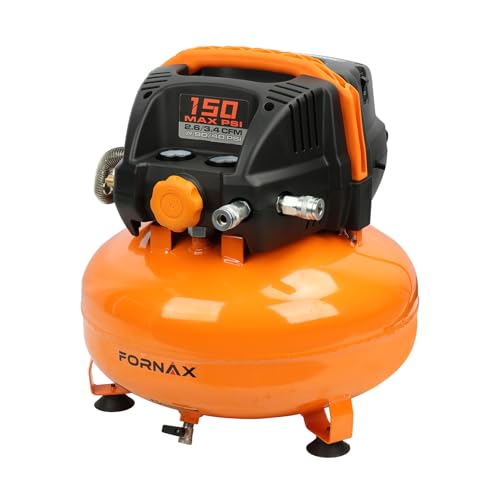 FORNAX 6-Gallon Pancake Air Compressor |
8.4/10 | Buy |
Stealth SAQ-1234 2-Gallon Air Compressor
Operating at under 60 decibels, this compact unit provides exceptionally quiet performance for garage DIY tasks, brad nailing, and tire inflation. Its oil-free motor reaches up to 125 PSI while keeping routine maintenance to a minimum.
Pros
- Quiet operation suitable for indoor workspaces
- Maintenance-free oil-free pump design
- Durable steel tank with rubber vibration dampening
- Reliable pressure recovery for intermittent nailing
Cons
- Relatively heavy to carry at nearly 42 pounds
- Small two-gallon tank limits continuous tool use
- Modest 1.8 CFM flow rate at 90 PSI
VEVOR 13-Gallon 2HP Quiet Air Compressor
Delivering 4.6 SCFM at 90 PSI with a quiet 66-decibel sound profile, this 13-gallon compressor suits home garages and workshops needing steady air supply without disruptive motor noise. Its oil-free 2HP motor fills the tank in under three minutes, while large rubber wheels help maneuver its substantial 71-pound frame.
Pros
- Quiet 66-decibel noise level during operation
- Oil-free motor design eliminates routine maintenance
- Fast air buildup in under three minutes
- Sturdy 7-inch rubber wheels assist transport
Cons
- Heavy 71-pound weight makes vehicle loading difficult
- Maximum 125 PSI ceiling limits high-pressure tools
Lhfacc 150 PSI In-Cab Air Compressor System
Designed for trucks and vans, this tankless system allows drivers to monitor and adjust suspension air springs directly from the cab. Its 150 PSI compressor and electric paddle valve setup deliver fast leveling support without taking up excessive chassis space.
Pros
- Compact tankless layout saves valuable vehicle space
- Generates up to 150 PSI for quick leveling
- Real-time digital readout directly inside the cab
- Complete installation kit with relay and air lines
Cons
- Lacks a reserve tank for pre-pressurized air storage
- Requires routing airlines and electrical wiring into the cabin
DUBANGLONG On-Board 100 PSI Air Compressor
Designed for truck owners needing on-the-fly suspension leveling, this on-board compressor system allows direct pressure adjustments from the cab. It combines a durable copper-coil motor with a complete installation package suited for half-ton to one-ton pickups.
Pros
- In-cab controls allow convenient pressure adjustments
- Fills suspension air bags in under two minutes
- All-inclusive hardware kit simplifies the setup process
- Self-locking fittings ensure leak-free hose connections
Cons
- Recommended working pressure is capped at 70 PSI
- Requires routing hoses and wiring into the vehicle cab
Bopowo 3-Gallon 150 PSI Air Suspension Tank Kit
Built for onboard air ride setups and train horn systems, this Bopowo kit pairs a 12-liter six-port aluminum tank with a sealed 150 PSI compressor. Its 2.03 CFM output and integrated thermal protection deliver dependable air delivery for custom automotive projects.
Pros
- Six ports allow flexible custom air line routing
- Corrosion-resistant aluminum tank resists dust and water
- Integrated thermal protection prevents motor overheating
- Solid 2.03 CFM flow rate ensures rapid filling
Cons
- Operation above 150 PSI is limited to intermittent duty
- Requires dedicated onboard 12V vehicle wiring
VEVOR 9-Gallon 6.5HP Gas Air Compressor
Built for remote jobsites without electrical access, this gas-driven unit supplies a dependable 9 CFM output from its 6.5HP engine. Dual outlets let two operators work simultaneously, though managing its 145-pound frame demands notable physical effort.
Pros
- High 9 CFM output drives demanding air tools
- Dual outlets support two operators at once
- Independent gas power works anywhere outdoors
- Fast 105-second tank fill time
Cons
- Heavy weight exceeds 145 pounds
- Maximum pressure capped at 115 PSI
- Produces gas exhaust requiring strict outdoor use
ALL-TOP 12V Dual-Cylinder Air Compressor
The ALL-TOP 12V Dual-Cylinder Air Compressor delivers a manufacturer-rated 12.35 CFM airflow and 150 PSI maximum pressure with an integrated digital LCD auto-stop controller. Powered via direct battery alligator clamps, this heavy-duty portable pump is built for overlanders, off-road enthusiasts, and truck owners needing rapid tire reinflation on remote trails.
Pros
- High rated airflow output of 12.35 CFM (350 L/min) significantly speeds up multi-tire trail reinflation
- Accurate digital auto-stop feature prevents over-inflation without requiring manual gauge checks
- Robust dual-cylinder motor with 221-degree Fahrenheit thermal shutdown and 120A circuit protection
- Anti-vibration metal base can be left portable or permanently bolted into an overland rig
Cons
- Substantial 26.5-pound weight makes it bulkier to stow than compact emergency inflators
- High current draw requires hooking directly to vehicle battery terminals with the engine running
- Normal 2 to 4 pause intervals during the digital inflation cycle may surprise unfamiliar users
VEVOR 12V Onboard Air Compressor with 0.8-Gallon
The VEVOR 12V Onboard Air Compressor pairs a 0.8-gallon steel tank with an automated 90-120 PSI pressure switch, providing dependable 12-volt pneumatic power for train horns and emergency tire inflation. Equipped with thermal overload protection and vibration mounts, this compact 9.9-pound unit offers great value for truck and SUV owners.
Pros
- Automatic 90-120 PSI pressure switch eliminates manual power cycling
- Dedicated 0.8-gallon welded steel tank provides instant pressure for horns and inflatables
- Motor includes 100-degree Celsius thermal overload protection and inline fuse safety
- Vibration-damping rubber mounting pads help reduce operational noise in vehicle cabins
- Accessible bottom drain plug facilitates routine tank condensation removal
Cons
- Limited air volume is unsuitable for continuous-duty pneumatic tools like air sanders or die grinders
- Requires direct 12V automotive DC wiring rather than standard 120V household wall outlets
- Compact 0.8-gallon tank requires cooling intervals during extensive tire inflations
FORNAX 6-Gallon Pancake Air Compressor
The FORNAX 6-Gallon Pancake Air Compressor delivers 2.6 CFM at 90 PSI and up to 150 PSI of maximum pressure, featuring dual couplers and a lightweight 28.8-pound portable footprint. It is a practical pneumatic power source for DIY homeowners, finish carpenters, and garage hobbyists driving nailers or managing tire inflation.
Pros
- Dual quick-connect couplers allow two nailers to operate simultaneously without adding an external splitter manifold
- Generous 6-gallon air tank capacity with a 150 PSI maximum pressure ceiling provides a dependable air reserve
- Lightweight 28.8-pound profile simplifies one-handed carrying up stairs and transport into work vans
- Maintenance-free oil-free pump eliminates oil checks, oil changes, and mess around finished work surfaces
Cons
- Operating sound output rated at 95 dBA is loud and makes hearing protection necessary, especially in closed rooms
- Airflow output of 2.6 CFM at 90 PSI cannot support continuous-demand tools like sanders, grinders, or paint sprayers
- Supplied as a bare-tool compressor without an included air hose, tire inflator chuck, or pneumatic nailers
FAQs
Which compressor features matter most for lifecycle cost?
Compare air delivery, power source, maintenance, and intended duty. A stated CFM rating at 90 PSI is more useful for tool matching than maximum PSI alone; tank gallons affect stored air, not the pump’s sustained output. Also account for noise, mobility, and moisture draining.
Can these compressors run an impact wrench or paint sprayer?
Only if the compressor’s delivered CFM meets the tool’s requirement at its working pressure. The VEVOR gas model lists 9 CFM, while the Stealth lists 1.8 CFM at 90 PSI; check the tool manual before buying. A tank can buffer short bursts, but it cannot make an undersized pump sustain a high-demand tool.
Is an oil-free compressor cheaper to maintain?
Generally, an oil-free pump removes routine oil changes, which can lower scheduled upkeep. It still needs sensible ventilation, appropriate operating intervals, and tank draining to limit condensation. The listed products do not provide comparable lifespan data, so longevity cannot be ranked from specifications alone.
Are quiet compressors suitable for an enclosed garage?
The Stealth is specified below 60 dB and the VEVOR 13-gallon model at 66 dB, making their listed noise figures worth considering for indoor use. Treat those as product claims rather than independent readings. Confirm ventilation and electrical requirements before running any compressor in an enclosed space.
Do 12V onboard compressors replace a shop compressor?
No, they serve different roles. The onboard kits are designed around vehicle air springs, horns, or inflation, with features such as pressure controls and compact tanks. They do not provide the tank volume and documented continuous tool airflow of a workshop compressor.
How should I compare options in 2026?
Start with the job, then compare CFM at the needed PSI, tank capacity, noise rating, and power source across the models in this Air Compressor Lifecycle Cost Comparison roundup. For automotive refinishing, review the requirements for your spray equipment and air preparation; these compressor options for body work can help narrow that search. Avoid assuming a listed maximum PSI guarantees adequate airflow.
About the author
Kenny Koehler is a power-tool specialist with more than a decade of hands-on evaluation experience and a science-based approach to product testing. His expertise in repeatable testing, tool performance, impact wrenches, and professional equipment brings a practical, data-focused perspective to compressor and pneumatic-tool comparisons.