
How to Make a Silent Air Compressor: Practical Guide
How to make a silent air compressor starts with reducing intake and vibration noise. Compare safer options for your workspace in November 2026.
 By Kenny Koehler
Updated November 10, 2026


A compressor that sounds tolerable in an open garage can become distracting in a basement or attached workshop, where hard walls reflect pump and motor noise. If you’re searching for how to make a silent air compressor, the practical goal is usually to reduce noise safely, not to make a running machine literally silent.
Start by identifying whether the loudest sound comes from the air intake, the pump and motor, vibration against the floor, or air escaping through a leak. Each source calls for a different response, and blocking ventilation or modifying pressure controls can create hazards. The products listed below range from intake silencers to compressors with specified noise ratings, so you can compare approaches using the supplied specifications rather than assuming one fix suits every machine.
Noise reduction also involves trade-offs. A muffler designed for an intake port is not a substitute for sound insulation around an entire compressor, and an enclosure that traps motor heat can shorten equipment life. For broader equipment context, see our guide to compressed-air drying systems, which explains an adjacent part of planning a workshop air setup.
| Award | Product | ACR Score About ACR ScoreThe ACR Score is our own rating from 0 to 10, based on performance, design and build, ease of use, and value. It reflects independent research and is never influenced by manufacturers, retailers, or affiliate commissions. Learn more › | |
|---|---|---|---|
| Best Overall |
Tnuocke 2-Pack 1/2-Inch 20mm Thread Air Compressor
|
9.1/10 | Buy |
| Best Value |
 Master Airbrush Cool Runner II Airbrush Compressor |
9.1/10 | Buy |
| Best Premium |
 Silentaire DR-150 Airbrush Compressor |
9.1/10 | Buy |
 Silentaire Super Silent 20-A Compressor |
8.8/10 | Buy | |
 Silentaire Super Silent DR-300 Silent Runnig |
8.6/10 | Buy | |
| Best Budget |
 OwnMy 1/2" PT 20mm Metal Air Compressor Intake |
8.3/10 | Buy |
 PointZero 1/5 HP Tank Airbrush Compressor |
8.3/10 | Buy | |
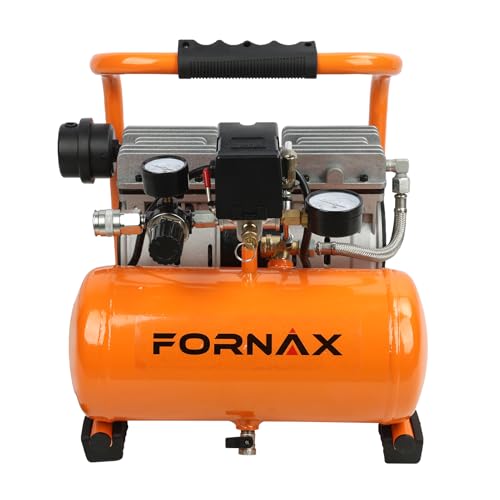 FORNAX 1.3-Gallon Ultra-Quiet Portable Air |
8.1/10 | Buy | |
 Silentaire DR-500 Silent Airbrush Compressor |
8.1/10 | Buy | |
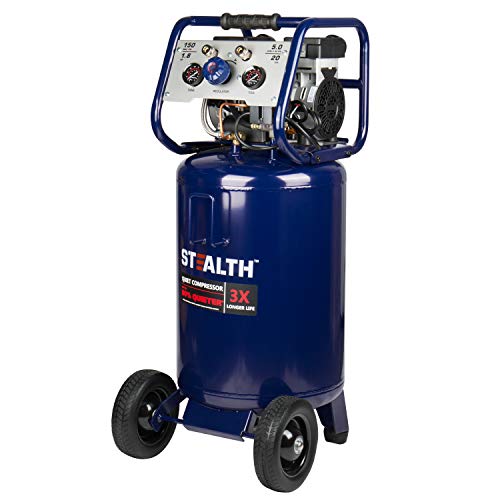 Stealth 20-Gallon 1.8 HP Air Compressor |
7.8/10 | Buy |
Tnuocke 2-Pack 1/2-Inch 20mm Thread Air Compressor
The Tnuocke 1/2-inch (20mm) intake filter silencer 2-pack combines a coated metal housing with intake filtration to muffle pump suction roar and keep shop dust out of the cylinder head. It is a practical, budget-friendly replacement for garage DIYers and shop owners refreshing worn or plastic intake filters on compressors and blowers.
Pros
- Sturdy coated metal casing resists heat and workshop impacts better than standard plastic housings
- Noticeable dampening of harsh pump intake suction roar in enclosed garages and workshops
- Convenient 2-pack provides an economical replacement for twin-cylinder pumps or backup stock
- Straightforward 1/2-inch thread installation requires minimal setup time
Cons
- Thread pitch is listed generically as 1/2-inch (20mm), which may require thread verification or an adapter on certain NPT vs metric ports
- Specific micron filtration rating and internal filter media replacement intervals are not documented by the manufacturer
- Compact canister size may restrict intake flow on oversized high-CFM industrial compressor pumps
Master Airbrush Cool Runner II Airbrush Compressor
The Master Airbrush Cool Runner II system centers on a 1/5 HP single-piston compressor featuring dual cooling fans designed for extended painting sessions without overheating. Bundled with three specialized airbrushes and acrylic paints, this 11.75-pound kit offers an accessible, all-in-one setup for hobbyists, scale modelers, and studio craft painters.
Pros
- Dual integrated cooling fans help manage operating temperatures during prolonged spraying sessions
- All-in-one system includes three distinct airbrushes, primary acrylic paints, reducer, cleaner, and maintenance brushes
- Supports varied spray techniques ranging from precision 0.3mm fine lines to broader 0.8mm spray patterns
- Built-in twin airbrush dock keeps loaded tools elevated and prevents messy desktop spills
Cons
- Dedicated 1/5 HP airbrush pump is strictly designed for hobby spraying and cannot power pneumatic shop tools or nail guns
- Compact single-piston setup lacks a large storage air tank, requiring the pump to cycle during active airbrushing
- Larger nozzle sizes such as the 0.8mm tip may require proper paint reduction to ensure smooth, unhindered atomization
Silentaire DR-150 Airbrush Compressor
Engineered for noise-sensitive studio environments, the Silentaire DR-150 runs at an exceptionally quiet 30 decibels while delivering up to 114 PSI. It offers reliable air delivery for precision airbrushing, though its 48-pound build significantly limits mobility.
Pros
- Exceptionally quiet operation at only 30 decibels
- High maximum pressure of 114 PSI
- Reliable operating range between 84 and 114 PSI
- Steady 0.7 CFM output for detailed airbrush work
Cons
- Heavy at 48 pounds, making transport difficult
- 0.7 CFM output cannot power standard pneumatic tools
Silentaire Super Silent 20-A Compressor
Operating at a quiet 30 decibels, this compact unit delivers 0.7 CFM for precise airbrush projects. Its 0.4-gallon tank maintains steady pressure up to 85 PSI for indoor studios and home workshops.
Pros
- Exceptionally quiet 30-decibel sound level
- Compact footprint easily fits on workbenches
- Built-in 0.4-gallon tank provides steady airflow
- Reaches up to 85 PSI working pressure
Cons
- Modest 0.7 CFM airflow limits use to smaller tools
- Small 0.4-gallon capacity drains rapidly during continuous spraying
- Maximum pressure capped at 85 PSI
OwnMy 1/2" PT 20mm Metal Air Compressor Intake
Featuring rugged metal housings and 1/2-inch PT (20mm) male threads, this OwnMy intake silencer kit dampens pump roar while filtering out dust and shop grit. It is a reliable, cost-effective maintenance upgrade for garage DIYers and mechanics running belt-driven air compressors.
Pros
- Rugged all-metal exterior housing offers far superior heat and vibration resistance compared to brittle factory plastic breathers
- Supplied with two complete metal muffler assemblies and six total replaceable paper filter cartridges for extended service life
- Two-piece canister disassembles smoothly, allowing quick filter inspection without unthreading the base from the pump head
- Effectively baffles low-frequency pump intake pulse noise while screening out harmful garage dust
Cons
- Thread standard is 1/2-inch PT (approximately 20mm outer diameter), which may require an adapter bushing if mating to domestic 1/2-inch NPT pump castings
- Paper filter media can load up quickly in heavy woodworking or drywall sanding environments, requiring frequent inspection to prevent intake restriction
PointZero 1/5 HP Tank Airbrush Compressor
Equipped with a 3-liter air tank, this PointZero 1/5 HP compressor delivers steady, pulse-free airflow at a low 55 dB noise level. Its oil-less setup and integrated moisture trap make it well-suited for food decorating, nail art, and hobby painting.
Pros
- Dedicated air tank prevents pressure pulsations
- Quiet 55 dB motor for indoor operation
- Integrated water trap delivers clean, dry air
- Auto-stop function reduces wear and conserves energy
- Oil-less design safe for food and body art
Cons
- Heavier than tankless models at 11.71 pounds
- Air output is limited strictly to airbrush applications
FORNAX 1.3-Gallon Ultra-Quiet Portable Air
The FORNAX 1.3-gallon portable air compressor delivers 1.7 CFM at 90 PSI with a 125 PSI maximum operating pressure, powered by a low-speed 1450 RPM oil-free 1 HP motor rated at just 65 dB. It is an excellent choice for DIY homeowners, finish woodworkers, and garage hobbyists seeking quiet, clean operation for brad nailers, staplers, and tire inflators.
Pros
- Low 65 dB operating sound level allows conversation-friendly use in enclosed garages and indoor work areas
- Low-speed 1450 RPM pump architecture minimizes heat buildup and vibration during operation
- Oil-free pump design requires zero crankcase fluid maintenance or scheduled oil refills
- Compact 31.8-pound design fits easily onto garage shelves, under workbenches, or into vehicle trunks
- Reaches up to 125 PSI maximum pressure for reliable tire topping and finish nailing
Cons
- 1.7 CFM at 90 PSI airflow rating is insufficient for continuous-demand pneumatic tools such as rotary sanders, die grinders, or paint sprayers
- Compact 1.3-gallon air reserve requires frequent motor cycling during sustained air consumption bursts
- Lack of transport wheels means the unit must be carried manually between work areas
Silentaire DR-500 Silent Airbrush Compressor
Built for sound-sensitive work areas, the Silentaire DR-500 runs at an exceptionally quiet 40 decibels while delivering 2.15 CFM. It maintains an operating pressure between 84 and 114 PSI, making it ideal for studio artists and dedicated airbrush stations.
Pros
- Extremely quiet 40 dB sound level
- Reliable 2.15 CFM air output
- Consistent 84 to 114 PSI working pressure
- Designed specifically for noise-free indoor airbrushing
Cons
- Bulky dimensions require dedicated studio space
- Output is insufficient for heavy-duty pneumatic tools
Stealth 20-Gallon 1.8 HP Air Compressor
Delivering 5 CFM at 90 PSI at an ultra-quiet 68 decibels, this oil-free machine is tailored for home garages and noise-sensitive workshops. Its generous 20-gallon tank supports high-demand pneumatic tools, though the 121-pound build limits effortless transport.
Pros
- Quiet 68-decibel sound output protects hearing
- Reliable 5 CFM delivery at 90 PSI
- Maintenance-free oil-free pump design
- Dual couplers streamline multi-tool setups
- Substantial 20-gallon tank capacity
Cons
- Hefty 121-pound weight hampers vehicle loading
- Tall 42-inch frame demands dedicated storage space
How to Reduce Compressor Noise Without Creating New Problems
How to make a silent air compressor has two different answers: reduce sound from a compressor you already own, or choose a model designed to operate at a lower listed noise level. A properly sized intake silencer may address intake noise, while a quieter compressor can reduce noise generated by the pump and motor themselves. Neither approach makes an operating air compressor silent, and the best option depends on the machine’s construction, airflow requirements, and location.
Do not start by enclosing the compressor or changing its pressure controls. Motors and pumps need adequate cooling, and air receivers and safety devices must remain unobstructed and operate as designed. Identify the noise source first, then use only accessories and setup changes suitable for the specific compressor, following its manual.
Identify whether the noise comes from the intake, pump, or vibration
Intake noise often has a distinct rushing or pulsing quality near the pump’s air inlet. Mechanical noise comes from the operating pump and motor, while vibration can make a bench, floor, or nearby panel resonate and amplify otherwise ordinary sound. Air leaking from a fitting or hose creates a separate hiss that should be treated as a potential maintenance issue, not simply covered with soundproofing.
Listen from a safe distance while the unit operates normally, without touching moving parts or opening a cover. Compare what you hear during startup, steady pumping, and shutdown, since the sound may change across those stages. If the compressor has recently become unusually loud, rattles, or develops a new hiss, stop and consult the manufacturer’s troubleshooting guidance before adding a muffler or enclosure.
A loose accessory or a hard, resonant surface may contribute to noise, but do not assume vibration pads will correct a mechanical fault. Place the compressor on a stable, level surface as its instructions require and keep its intake clear. Never place soft material against a hot motor, pump, belt, or ventilation opening.
Use an intake silencer only when the inlet and thread match
An intake silencer filters incoming air and may reduce sound at the inlet. The Tnuocke 2pcs 1/2" Thread Air Compressor is described as a coated-metal accessory with a 1/2-inch thread, intended for compressors and other equipment such as generators and blowers. Its product description also says it can block dust and moisture while reducing noise, but that claim does not establish a particular noise reduction amount or compatibility with every pump.
Check the inlet thread, available clearance, and the compressor manufacturer’s instructions before installation. A threaded accessory that does not match the inlet should not be forced into place or adapted in a way that restricts airflow. Intake filtration matters because a dirty or obstructed filter can interfere with the pump’s air supply, while a silencer with a clogged element can itself become a restriction.
The OwnMy silencer kit is also listed with a 1/2-inch PT 20 mm thread and replaceable internal filter elements. Its description says the filter should be replaced when it becomes very dirty. Treat those dimensions as a fit check, not a universal standard: verify the compressor inlet and the accessory details independently before ordering.
After any approved installation, inspect the connection for looseness and confirm that the intake remains unobstructed during operation. Follow the compressor manual for filter inspection and service intervals. If the pump sounds different or struggles to build pressure after a change, shut it down and check for a restricted inlet rather than continuing to run it.
Choose a quiet-rated compressor when intake treatment is not enough
An intake silencer cannot remove sound generated by the motor and pump. For buyers who need a lower-noise setup, compare the manufacturer-listed noise rating, output, pressure, and tank capacity of quieter compressor options. Ratings are useful for screening models, but the supplied descriptions do not specify a common measurement distance or test conditions, so avoid treating different listings as directly comparable laboratory measurements.
The Silentaire Super Silent DR-150 is listed at 30 decibels, with 0.7 CFM output and a maximum pressure of 114 PSI. The Silentaire Super Silent 20-a is also listed at 30 decibels, with 0.7 CFM, a maximum pressure of 85 PSI, and a 0.4-gallon tank. Those specifications make them options to examine for airbrush work, but their modest stated output and tank capacity do not establish suitability for tools with substantial continuous air demand.
The Silentaire DR-300 is listed at 40 decibels, 1.05 CFM, and a 1.0-gallon tank, while the DR-500 is listed at 40 decibels and 2.15 CFM. The product information gives a maximum pressure of 114 PSI for both models. Check the intended tool’s air consumption and required working pressure against the compressor’s specifications; maximum PSI alone does not show how much air the pump can deliver continuously.
Other products have different use profiles. The PointZero airbrush compressor is described as operating at 55 dB and delivering approximately 1.0 CFM, with a 3-liter storage tank and a regulator and water trap. The FORNAX portable compressor is listed at 65 dB, 1.7 CFM at 90 PSI, and 125 PSI maximum, while the Stealth 20-gallon model is listed at 68 dB and 5 CFM at 90 PSI.
These figures are product-description specifications, not a guarantee of quietness in every room or application. The Stealth’s larger tank and stated output serve a different purpose from a compact airbrush compressor, and its listed 68 dB rating is not equivalent to the lower ratings on the Silentaire airbrush models. Consider the room, the required air volume, and the manufacturer’s operating guidance together rather than selecting by the word “silent” in a product name.
Improve placement without blocking cooling or access
Where a compressor sits can affect how much sound reaches a person or neighboring room. If the manufacturer permits it, position the unit on a stable surface away from thin shared walls and work areas where people must remain close to it. Keep required clearances around the motor, pump, controls, and intake, and make sure the power cord and air hose are routed without creating trip hazards.
Do not assume that placing the compressor in a closet, cabinet, or homemade sound box is safe. A sealed space can trap heat, limit intake air, and make controls or shutoff access difficult. Any noise-control enclosure must be designed to preserve the ventilation and clearances required by the manufacturer; if those requirements are unclear, ask the manufacturer rather than improvising.
Soft vibration-isolating feet may help when vibration is transmitted into a surface, but the compressor must remain stable and must not move or tip during operation. Use only supports compatible with the unit’s weight and mounting arrangement. Avoid stacking the compressor on furniture or placing it on an unstable platform to increase distance from the floor.
Keep the air line long enough to place the compressor at a more suitable location when practical, while choosing a hose and fittings appropriate for the tool and pressure. A longer hose does not reduce the sound created at the pump, but it can let the operator work farther from the source. Inspect hoses and couplings for damage, and depressurize the system in accordance with the manual before servicing connections.
Do not confuse sound control with a pressure or electrical modification
Never try to make a compressor quieter by lowering or altering factory pressure-switch cut-out settings, disabling a safety device, or restricting the pump’s cooling airflow. Those changes can interfere with safe operation or prevent the unit from working as designed. Use the regulator only as instructed for controlling downstream working pressure, and do not exceed the compressor’s rated limits.
A compressor that repeatedly trips a breaker, struggles to start, or runs continuously should not be treated as merely noisy. The supplied product details do not provide startup current for these models, so no specific household circuit can be guaranteed suitable from the listings alone. Follow the manual’s electrical requirements, avoid unsuitable extension cords, and have a qualified person assess persistent electrical problems.
Wear suitable hearing and eye protection when operating air equipment, even if a model has a relatively low listed noise rating. A quieter compressor can still produce sound from the tool, airflow, or workpiece, and protective equipment should suit the whole task. Keep bystanders clear of moving parts and high-pressure air, and follow the manufacturer’s safety instructions.
Match noise reduction to the work, not just the room
Airbrush work and intermittent inflation place different demands on a compressor than continuous sanding or spraying. The Master Airbrush Cool Runner II is described as a 1/5 HP compressor with two cooling fans and a kit of airbrushes and paint, but the supplied data does not give a noise rating or CFM figure. Its inclusion of cooling fans is not evidence that it will be silent, so check the complete specifications and instructions for the particular task.
For continuous-use tools, compare delivered air volume at the pressure the tool requires, not only maximum PSI or tank size. The product descriptions here provide different output figures, and not every model has a stated CFM rating at 90 PSI. If that information is absent, request it from the manufacturer before relying on the compressor for a tool that draws air continuously.
Tank capacity provides a reserve, but it does not replace pump output during extended use. A small tank may support brief airbrush or inflation tasks while requiring more frequent pump cycles, depending on demand and the compressor’s controls. A larger tank can store more compressed air, but it does not make an undersized pump capable of sustaining a high-draw tool indefinitely.
For jobsite tools and portable applications, compare the full system rather than focusing only on sound. Our portable compressors for air tools guide provides a related starting point for considering tool use and portability. Confirm the required pressure, air delivery, electrical supply, and operating limits for the specific compressor and tool combination before purchase.
The simplest sensible path is to identify the source of the noise, verify that the compressor is operating normally, and use a correctly sized intake silencer only when the inlet specifications match. If the pump and motor remain too loud for the space, consider a compressor with a suitable listed noise rating and enough air delivery for the intended work. Preserve ventilation, factory safety controls, and manufacturer limits; reducing noise is not worth compromising safe operation.
About the author
Kenny Koehler is a power-tool specialist with more than a decade of hands-on evaluation experience and a science-based approach to product testing. His expertise in repeatable testing, tool performance, impact wrenches, and professional equipment brings a practical, data-focused perspective to compressor and pneumatic-tool comparisons.