
How to Adjust Air Compressor Pressure Switch Control Valve
How to adjust air compressor pressure switch control valve safely, understand cut-in and cut-out settings, and choose a compatible replacement for November 2026.
 By Clint DeBoer
Updated November 10, 2026

A compressor that starts and stops at the wrong pressure can disrupt tool use, but changing switch settings without understanding the controls can create a safety hazard. How to adjust air compressor pressure switch control valve depends on the switch design and the compressor manufacturer’s instructions, so don’t assume every switch has user-adjustable pressure settings. The products listed here include replacement switches with specified operating ranges, which is different from a universal adjustment procedure.
Start by identifying whether the problem is a switch setting, a pressure gauge reading, a regulator setting, or a fault elsewhere in the system. The cut-in and cut-out values govern when the motor starts and stops; a regulator controls outlet pressure for an air tool. Those controls serve different purposes, and confusing them can lead to unsafe changes. For context on pressure-related protection, see our air compressor pressure safety guide.
Top Products
| Award | Product | ACR Score About ACR ScoreThe ACR Score is our own rating from 0 to 10, based on performance, design and build, ease of use, and value. It reflects independent research and is never influenced by manufacturers, retailers, or affiliate commissions. Learn more › | |
|---|---|---|---|
| Best Overall |
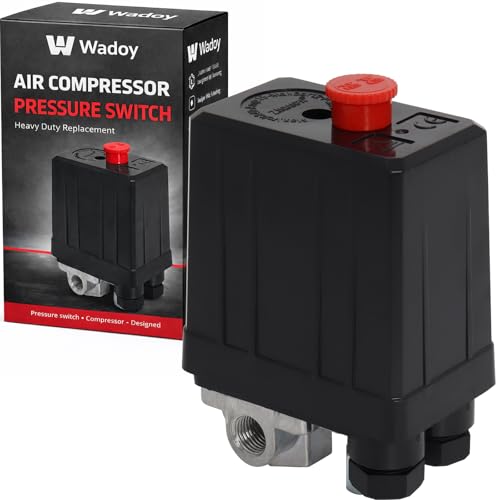
Wadoy 4-Way Air Compressor Pressure Switch
|
8.9/10 | Buy |
| Best Budget |
 Heywood 90-120 PSI 240V Pressure Switch |
8.6/10 | Buy |
| Best Value |
 cnaodun 90-120 PSI Air Compressor Switch Kit |
8.6/10 | Buy |
| Best Premium |
 MEANLIN MEASURE 110-150 PSI Pressure Switch |
8.1/10 | Buy |
 Ketofa LF10-4H 4-Port Pressure Switch |
7.8/10 | Buy | |
 MEANLIN MEASURE 110 to 150 PSI Pressure Switch |
7.8/10 | Buy | |
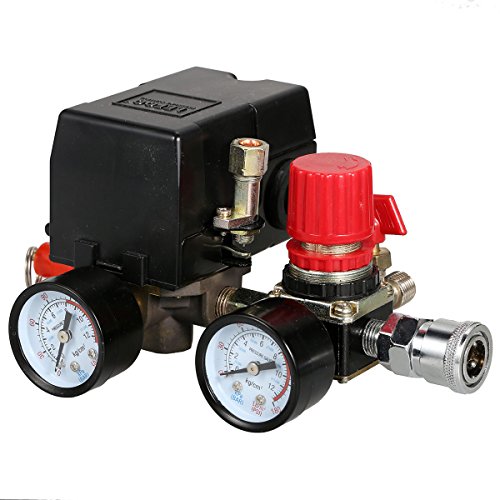 Secbolt Air Compressor Pressure Switch |
7.8/10 | Buy |
Wadoy 4-Way Air Compressor Pressure Switch
Designed as an aftermarket fix for small compressors, this Wadoy four-port valve automatically cycles air pressure between 90 and 120 PSI. Its metal build provides a practical way to restore reliable pressure control without replacing the entire machine.
Pros
- Durable metal construction
- Four ports accommodate gauges and relief valves
- Simple red auto control knob
- Economical alternative to buying a new compressor
Cons
- Non-OEM aftermarket replacement part
- Relief valves and gauges sold separately
Heywood 90-120 PSI 240V Pressure Switch
Designed as an aftermarket replacement for miniature air compressors, this switch automates power control within a 90 to 120 PSI range. It features a visible red on-off knob to simplify operation and manage motor runtime efficiently.
Pros
- Automates shut-off between 90 and 120 PSI
- Compact form factor fits miniature compressor setups
- Straightforward installation with manual control knob
- Direct aftermarket replacement for OEM switch units
Cons
- Non-OEM aftermarket replacement part
- Limited strictly to 240V electrical configurations
- Designed specifically for miniature compressor models
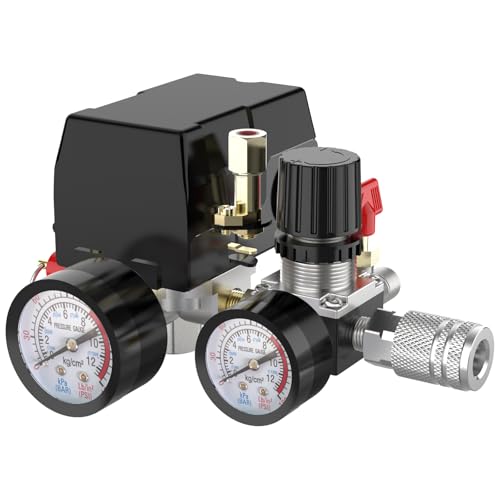
cnaodun 90-120 PSI Air Compressor Switch Kit
Built for residential and workshop air systems, this cnaodun control switch manages automatic cycling with a 90 PSI cut-in and 120 PSI cut-out. The package delivers an all-in-one replacement solution, pairing an aluminum regulator assembly with dual monitoring gauges.
Pros
- Complete kit with dual gauges and thread seal tape
- Heavy-duty silver contacts extend switch operational life
- Standard 1/4-inch NPT threads fit common compressor setups
- Clear dual dials provide immediate pressure visibility
Cons
- Fixed 90 to 120 PSI factory pressure range
- Multi-piece kit requires manual assembly and careful sealing
MEANLIN MEASURE 110-150 PSI Pressure Switch
Designed for compressor maintenance, this 4-way manifold assembly provides automated 110 to 150 PSI pressure control. It comes as a comprehensive replacement kit featuring an adjustable regulator, safety relief valve, and gauge.
Pros
- Comprehensive hardware bundle includes installation accessories
- Integrated relief valve protects against overpressurization
- Smooth knob allows precise airflow adjustment
- Standard 1/4-inch fittings ensure broad compressor compatibility
Cons
- Plastic outer housing and knob offer modest durability
- Fixed pressure cycle restricts custom cut-in settings
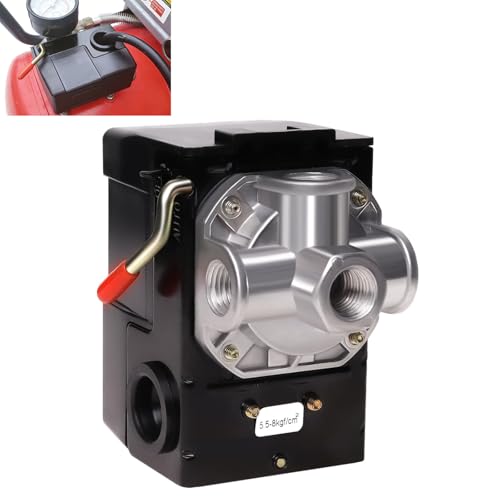
Ketofa LF10-4H 4-Port Pressure Switch
Built for single or two-stage air compressors, the Ketofa LF10-4H serves as a direct 95-to-125 PSI replacement control switch. It provides a standard four-port manifold alongside an integrated unloader valve and manual metal shut-off lever.
Pros
- Four-port manifold allows flexible component placement
- Pre-calibrated 95 to 125 PSI automatic pressure cycle
- Built-in unloader valve relieves head pressure effectively
- Sturdy metal manual shut-off lever
- Dual voltage compatibility for 120V and 240V motors
Cons
- Fixed pressure range cannot replace 135-175 PSI units
- Limited to 20A instead of 26A applications
- Requires matching a specific 6.3 mm unloader fitting
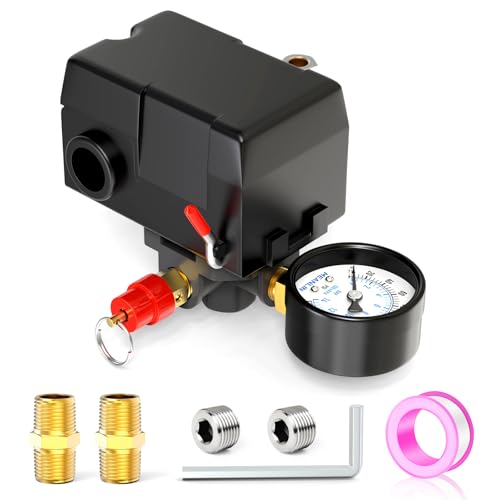
MEANLIN MEASURE 110 to 150 PSI Pressure Switch
Designed for automatic cycling between 110 and 150 PSI, this 4-way replacement valve kit comes complete with safety fittings, pipe plugs, and sealing tape. It provides workshop owners a comprehensive drop-in assembly for restoring 1/4-inch air compressor systems.
Pros
- Includes complete installation hardware and safety relief valve
- Supports wide 110V to 240V electrical systems
- Durable aluminum alloy internal valve construction
- Convenient manual red knob for quick shutoff
Cons
- Preset 110 to 150 PSI cycle lacks adjustability
- Plastic switch casing is vulnerable to heavy impacts
- Restricted exclusively to standard 1/4-inch port connections
Secbolt Air Compressor Pressure Switch
The Secbolt Air Compressor Pressure Switch and Regulator Manifold assembly provides automatic 90 PSI cut-in and 120 PSI cut-off control alongside a 4-port 1/4-inch FNPT manifold and dual pressure gauges. It suits DIYers, home garage mechanics, and workshop owners rebuilding or replacing an all-in-one control setup on small stationary or portable compressors.
Pros
- All-in-one design integrates pressure switch, regulator, manifold block, and dual gauges into a single unit
- Standard 90 PSI cut-in and 120 PSI cut-off settings match common light-duty workshop compressor cycles
- Adjustable brass outlet coupler allows lowering air pressure for finish nailers and sensitive air tools
- Includes threadlocker compound to help seal tapered pipe threads during bench assembly
Cons
- Fixed 90 to 120 PSI pressure cycle is not suited for high-pressure two-stage compressors requiring 150 to 175 PSI
- Requires careful alignment and sealing of multiple threaded joints to prevent slow micro-leaks
- Electrical voltage and maximum motor amp ratings are not specified on the primary packaging, requiring verification before wiring heavy-draw motors
Understanding and adjusting a pressure switch control valve
A pressure switch senses tank pressure and controls the compressor motor’s on and off cycle. Its cut-in pressure is the point where the motor starts as tank pressure falls, while cut-out pressure is the point where the motor stops as pressure rises. The difference between these values is the operating differential. A regulator, by contrast, reduces or controls pressure delivered to an outlet, so turning its knob doesn’t change the compressor’s automatic tank-pressure limits.
The word “valve” can add confusion because a pressure switch assembly may include ports, a regulator, gauges, or an unloader connection. The switch itself is an electrical control, while the regulator and relief valve perform separate pneumatic and safety functions. Replacement assemblies may combine several components in one manifold, but a shared housing doesn’t make their functions interchangeable. Identify each part before attempting any adjustment or repair.
First identify the control you mean to change
Read the compressor’s manual and inspect its labels before touching the switch. Look for the specified maximum working pressure, electrical supply requirements, and any documented user adjustment procedure. If the manual describes a fixed, non-adjustable switch, or doesn’t explain an adjustment, don’t try to create a new pressure range by turning internal screws. Ask the manufacturer or a qualified service technician to confirm the appropriate replacement or service path.
Check the tank gauge and regulated outlet gauge separately if both are present. A tank gauge indicates stored pressure, while an outlet gauge on a regulator reflects the setting supplied downstream, subject to airflow and system conditions. A low outlet reading during tool use doesn’t automatically mean the switch needs adjustment; a restrictive hose, leaking fitting, or tool demand that exceeds available airflow can also affect delivery. Compare readings with the compressor’s instructions and avoid treating a gauge discrepancy as proof of a switch fault.
Note the switch’s stated cut-in and cut-out range, port thread, voltage and current rating, and number of ports. Those specifications matter when replacing a switch because a similar-looking part may use different pressure settings or electrical ratings. For example, the listed Wadoy and Central Pneumatic options specify a 90 to 120 PSI range, while the LF10-4H listing gives 95 to 125 PSI. The MEANLIN MEASURE products specify 110 PSI cut-in and 150 PSI cut-out, so those settings should not be treated as interchangeable.
Safety comes before opening the switch enclosure
Pressure switches combine stored-air equipment with electrical contacts. Before servicing a switch or its fittings, disconnect the compressor from its power source according to the owner’s manual and allow the tank to depressurize completely. Do not rely on the motor’s off switch alone as electrical isolation, and do not open an enclosure or handle wiring if you aren’t qualified to do so. If the equipment has a hardwired supply, unfamiliar wiring, damaged insulation, or signs of overheating, stop and arrange qualified service.
Never disable, block, or substitute for the safety relief valve, and don’t raise the compressor’s cut-out setting beyond the tank or compressor manufacturer’s rating. A pressure switch isn’t a substitute for a relief device. The supplied product descriptions mention safety valves in some kits, but they don’t establish that a kit is suitable for every compressor or tank. Confirm the replacement’s specifications against the compressor documentation before buying or installing it.
Tank pressure must be fully released before servicing pneumatic connections, and stored air can remain in lines even after the tank is empty. Follow the manufacturer’s procedure for isolation and pressure release rather than improvising. Wear suitable eye protection when working around air equipment, and use hearing protection when operating a compressor. If you can’t verify that the tank and lines are depressurized, don’t proceed.
When an adjustment is permitted by the manufacturer
Use the exact procedure and target settings in the compressor manual, not a generic screw-turning recipe. Switch designs vary, and the supplied product information doesn’t provide adjustment screw locations, turn counts, calibration tolerances, or a procedure for changing factory settings. Those details cannot safely be inferred from a replacement part’s pressure range. If the manual authorizes adjustment, follow its sequence and limits exactly.
Record the documented starting values and the intended target before making any authorized change. Make only the adjustment described by the manufacturer, and keep clear of exposed electrical components and moving parts. Do not adjust the cut-out point to solve an unrelated problem such as slow recovery, a leaking hose, or a regulator that won’t hold outlet pressure. A switch setting should remain within the compressor’s approved operating range.
After an approved adjustment, close and secure the enclosure as directed before restoring power. Observe a normal automatic cycle from a safe position, using the installed gauges and the manual’s stated acceptable range. Confirm that the motor starts and stops at the intended tank pressures and that the safety relief device remains installed and unobstructed. If the switch chatters, the motor fails to stop, pressure rises beyond the stated limit, or readings are inconsistent, switch off and disconnect power if safe to do so, then seek service.
Do not keep changing the setting to quiet a symptom. A motor that starts too frequently may be responding to a leak, a small air reserve relative to demand, or a faulty gauge or control. A compressor that runs continuously may have a leak, a pump problem, or an air demand the machine cannot maintain. A pressure switch is only one possible cause, and changing its set points can conceal rather than correct a fault.
Choosing a replacement by pressure, ports, and electrical rating
Match more than the product name when selecting a replacement. Compare the compressor’s original cut-in and cut-out settings, maximum pressure, port thread and layout, voltage, current rating, and any unloader connection. The LF10-4H listing specifies four 1/4-inch NPT female ports, a 95 PSI cut-in and 125 PSI cut-out, and electrical ratings of 20A at 120V or 12A at 240V. It also describes a side-mounted unloader connection; confirm its size and arrangement against the installed equipment.
The Wadoy listing describes four female air inlet ports with an approximate 11 mm thread diameter and a 90 to 120 PSI range, while the cnaodun listing specifies 1/4 NPT threading and includes gauges, a regulator, a safety valve, fittings, and thread seal tape. These descriptions are not enough to establish a fit for a particular compressor. Thread type, switch pressure, electrical rating, and component arrangement all need to match the machine’s requirements.
Some options include more accessories than others, but a larger package isn’t automatically the better replacement. The MEANLIN MEASURE assembly listed at 110 to 150 PSI includes a regulator and safety-related fittings, while the other MEANLIN MEASURE version lists a pressure gauge and relief valve with a similar cut-in and cut-out range. Secbolt’s listing describes 90 PSI cut-in, 120 PSI cut-out, four 1/4-inch NPT female ports, and adjustable outlet pressure. Consider those as listed product details, not proof that any of these assemblies suits a specific compressor.
A buyer replacing a failed switch should start with the compressor’s model information and original part number, if available. Compare that information with the candidate switch documentation and contact the manufacturer when electrical or pressure specifications are missing. Don’t select a switch based only on a familiar pressure range or red on/off knob. Similar appearance doesn’t verify electrical compatibility or safe operating limits.
How the unloader and regulator affect the diagnosis
An unloader releases residual pressure from the pump discharge line when the motor stops, helping the motor restart without that trapped pressure. The LF10-4H listing specifies a built-in unloader, but the other product descriptions don’t all provide the same detail. A brief release of air at shutdown can be part of the unloader’s function; persistent hissing or a compressor that struggles to restart warrants inspection rather than an immediate pressure-setting change.
The tank check valve and unloader work in related but distinct ways. The check valve helps keep tank air from flowing back toward the pump, while the unloader vents pressure from the pump line at shutdown. A leak at a fitting, faulty check valve, or unloader problem may produce symptoms that resemble a switch issue. Because diagnosing those parts can involve pressurized air and electrical equipment, follow the service manual and use qualified service when the cause isn’t clear.
The regulator controls downstream working pressure for a tool; it doesn’t set the motor’s cut-in or cut-out thresholds. If a brad nailer, blow gun, or other tool receives less pressure than expected, compare the tank and outlet gauges, inspect hose and fitting connections for leaks, and set the regulator according to the tool maker’s instructions. A regulator knob cannot compensate for a compressor that lacks sufficient air delivery for a continuous-demand tool. Use suitable eye and hearing protection while operating equipment.
Readers considering a Central Pneumatic replacement can also consult our Central Pneumatic compressor overview for related compressor context. That article isn’t a substitute for the exact manual or switch specifications for your machine. Use the compressor model and original part details to verify fit and settings. If those records aren’t available, seek confirmation from the manufacturer rather than guessing.
Recognizing faults that shouldn’t be corrected by turning screws
A compressor that fails to reach cut-out may have a leak, restricted intake, pump wear, or another mechanical issue, but the available product information doesn’t identify a single cause. Listen for obvious air leakage and inspect accessible hoses and fittings only after the system has been safely shut down and depressurized as directed. Don’t open the pressure switch to compensate for a pump that can’t build pressure. If the pump runs unusually long or pressure continues rising beyond the specified limit, stop operation and arrange service.
Rapid cycling can also have several explanations, including air leakage, high demand, a pressure gauge problem, or a switch fault. Observe whether pressure falls while the compressor is idle, and check accessible connections using the manufacturer’s approved method. Avoid placing hands near suspected leaks because escaping compressed air can injure skin and eyes. If the cycle behavior remains abnormal, document the observed gauge readings and contact a service provider.
Electrical symptoms deserve particular caution. A switch with an incorrect voltage or current rating may be unsuitable even if its pressure range appears right, and a motor that hums, trips protection, or fails to start may have causes beyond the switch. Don’t bypass a breaker, thermal overload, grounding connection, or other protective device. Have a qualified technician inspect wiring and motor controls when the electrical cause isn’t clear.
A pressure reading that seems wrong can come from a damaged gauge, a blocked passage, or a mismatch between tank and outlet readings. Compare gauges only as the manual permits and don’t use an unverified reading to set a higher cut-out threshold. Some listed assemblies include one or two gauges, but the descriptions don’t establish their calibration accuracy. Treat a questionable gauge as a reason to verify readings with appropriate service equipment, not as permission to exceed the compressor’s limits.
Verify normal cycling and keep the original limits
Once a compatible replacement has been installed by an appropriately qualified person, the switch should be checked against the compressor’s documented operating range. Observe a complete cycle from cut-in to cut-out, noting the tank gauge readings and whether the motor stops as specified. Check for abnormal leakage around connections, but don’t touch exposed wiring or fittings while the system is running. If the cycle doesn’t match the manual or the motor doesn’t stop, shut the unit down and seek assistance.
Keep the compressor’s rated maximum pressure and the tank’s stated limits central to every decision. A switch that cuts out at a higher value isn’t automatically an upgrade, and raising pressure can overtax components not designed for it. The products covered here span different stated pressure settings and accessory layouts, so their labels are useful for comparison but don’t replace compressor-specific documentation. The safest choice is the specified part or a replacement confirmed by the manufacturer.
For routine use, adjust only the outlet regulator to the working pressure required by the tool, within the compressor and tool makers’ instructions. Leave automatic tank-pressure settings alone unless the manufacturer provides a service procedure for that exact compressor. Fully depressurize the tank before servicing or transporting the unit, and follow the owner’s maintenance and safety guidance. If there is doubt about the switch, wiring, or cut-out behavior, stop and have the control checked rather than experimenting with pressure settings.
The practical answer is simple: adjust a pressure switch only when the compressor manufacturer explicitly permits it and supplies the correct procedure. Otherwise, diagnose the symptom, verify the part specifications, and use a confirmed compatible replacement or qualified service. Keeping the switch within its documented cut-in and cut-out limits protects the compressor’s intended operating range and avoids confusing motor control with outlet regulation.
About the author
Clint DeBoer is an experienced tool-industry specialist with decades of involvement in technical media, hands-on product evaluation, and testing methodology. His focus on performance, practical usability, and data-driven comparisons makes his expertise highly relevant to professional air compressors, pneumatic tools, and workshop equipment.