
How Does an Electric Air Compressor Work?
How does an electric air compressor work? Follow the motor, pump, tank, and pressure controls from startup to usable airflow for November 2026.
 By Glenda Taylor
Updated November 10, 2026


A compressor that runs but delivers little air can leave a nailer waiting, a tire half-filled, or a small workshop tool short on pressure. Understanding how does an electric air compressor work starts with a simple sequence: electricity turns a motor, the motor drives a pump, and the pump moves compressed air into a tank or directly to an outlet. Pressure controls start and stop the motor as the stored air is used.
The options listed below range from compact tire inflators to a 25-gallon electric compressor, so their operating details and intended tasks differ. A small cordless inflator is built around portable tire pressure management, while tank-style units store a reserve for tools and repeated use. For related practical context, see our guide to filling a bike tire with compressed air.
| Award | Product | ACR Score About ACR ScoreThe ACR Score is our own rating from 0 to 10, based on performance, design and build, ease of use, and value. It reflects independent research and is never influenced by manufacturers, retailers, or affiliate commissions. Learn more › | |
|---|---|---|---|
| Best Overall |
Stealth SAQ-1234 2-Gallon Air Compressor
|
9.2/10 | Buy |
| Best Value |
 SURPUTS Tire Inflator Air Compressor 150PSI |
9.1/10 | Buy |
| Best Premium |
 DEWALT DXCM251.COM 25-Gallon Air Compressor |
8.8/10 | Buy |
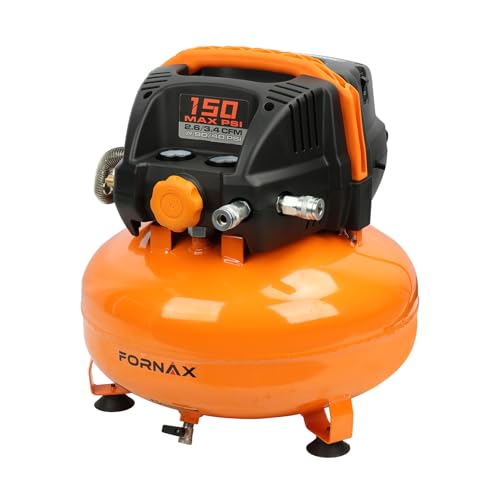 FORNAX 6-Gallon Pancake Air Compressor |
8.4/10 | Buy | |
 RIDGID 6-Gallon Pancake Air Compressor |
8.4/10 | Buy | |
| Best Budget |
 KOEZEOI 160 PSI Dual-Power Tire Inflator |
8.3/10 | Buy |
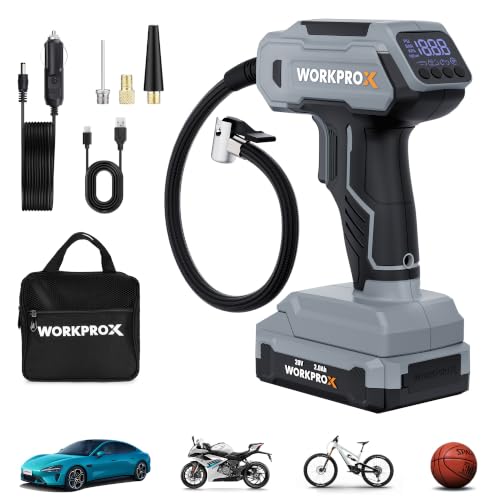 WORKPRO 150 PSI Cordless Tire Inflator |
8.3/10 | Buy | |
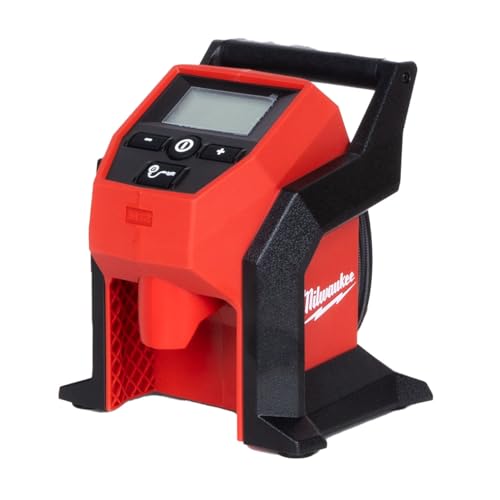 Milwaukee 2475-20 M12 120 PSI Inflator |
8.1/10 | Buy | |
 AstroAI AIRUN H1 Tire Inflator Portable Air |
7.8/10 | Buy | |
 CRAFTCISION 20V Cordless Tire Inflator |
7.8/10 | Buy |
Stealth SAQ-1234 2-Gallon Air Compressor
Operating at under 60 decibels, this compact unit provides exceptionally quiet performance for garage DIY tasks, brad nailing, and tire inflation. Its oil-free motor reaches up to 125 PSI while keeping routine maintenance to a minimum.
Pros
- Quiet operation suitable for indoor workspaces
- Maintenance-free oil-free pump design
- Durable steel tank with rubber vibration dampening
- Reliable pressure recovery for intermittent nailing
Cons
- Relatively heavy to carry at nearly 42 pounds
- Small two-gallon tank limits continuous tool use
- Modest 1.8 CFM flow rate at 90 PSI
DEWALT DXCM251.COM 25-Gallon Air Compressor
Built for demanding workshop tasks, this vertical unit pairs a 2 hp belt-drive motor with a 200 max PSI tank for reliable high-pressure output. Heavy-duty 10-inch pneumatic wheels and an oil-lubricated build make it a dependable, mobile choice for job site tools.
Pros
- High 200 max PSI operating capability
- Durable oil-lubricated pump construction
- Pneumatic wheels provide smooth mobility
- Efficient aluminum parts improve heat dissipation
Cons
- Oil-lubricated pump requires routine maintenance
- Tall 49-inch height demands vertical storage clearance
FORNAX 6-Gallon Pancake Air Compressor
The FORNAX 6-Gallon Pancake Air Compressor delivers 2.6 CFM at 90 PSI and up to 150 PSI of maximum pressure, featuring dual couplers and a lightweight 28.8-pound portable footprint. It is a practical pneumatic power source for DIY homeowners, finish carpenters, and garage hobbyists driving nailers or managing tire inflation.
Pros
- Dual quick-connect couplers allow two nailers to operate simultaneously without adding an external splitter manifold
- Generous 6-gallon air tank capacity with a 150 PSI maximum pressure ceiling provides a dependable air reserve
- Lightweight 28.8-pound profile simplifies one-handed carrying up stairs and transport into work vans
- Maintenance-free oil-free pump eliminates oil checks, oil changes, and mess around finished work surfaces
Cons
- Operating sound output rated at 95 dBA is loud and makes hearing protection necessary, especially in closed rooms
- Airflow output of 2.6 CFM at 90 PSI cannot support continuous-demand tools like sanders, grinders, or paint sprayers
- Supplied as a bare-tool compressor without an included air hose, tire inflator chuck, or pneumatic nailers
RIDGID 6-Gallon Pancake Air Compressor
Built for general pneumatic tool operation, this RIDGID electric compressor pairs a 6-gallon pancake tank with up to 150 PSI of maximum pressure. Its upright footprint saves workshop floor space, though hauling its 35-pound frame requires deliberate effort.
Pros
- 150 PSI maximum pressure handles pneumatic demands
- 6-gallon tank size supports consistent air delivery
- Compact pancake profile saves floor space
- Electric motor requires no fuel maintenance
Cons
- Weighs 35 pounds without transport wheels
- Upright frame can feel bulky to carry
KOEZEOI 160 PSI Dual-Power Tire Inflator
Designed for owners of compatible 20V power tool batteries, this inflator provides flexible dual-power operation through battery packs or a 12V car socket. With a clear LCD display, auto shut-off, and emergency lighting, it serves as a dependable roadside companion for cars and sports gear.
Pros
- Dual power via 20V battery or 12V car cord
- Delivers up to 160 PSI with rapid airflow
- Auto shut-off prevents accidental over-inflation
- Digital screen displays preset and real-time pressure
- Three-mode LED light assists during night emergencies
Cons
- Does not include a battery or charger
- Not suitable for large truck tires
- Battery must be disconnected manually to prevent drain
WORKPRO 150 PSI Cordless Tire Inflator
Equipped with both a 20V battery and a 12V car outlet adapter, this portable compressor delivers up to 150 PSI for emergency inflation. Its digital auto shut-off system and built-in LED light make it an accessible roadside tool for cars, bikes, and sports gear.
Pros
- Versatile dual battery and 12V corded power
- Precise auto shut-off prevents over-inflation
- Clear digital screen with multiple pressure units
- Includes four adapters and a storage bag
Cons
- Short 40cm air hose limits vertical reach
- Weight increases to 2 pounds with battery attached
Milwaukee 2475-20 M12 120 PSI Inflator
Built for quick roadside maintenance, this compact cordless tool reaches up to 120 PSI and tops off a standard car tire in under a minute. Its reinforced cage and portable footprint make it a dependable choice for drivers needing fast, reliable pressure adjustments.
Pros
- Fast inflation reaching up to 120 PSI
- Lightweight, compact frame weighing under four pounds
- Durable impact and weather resistant protective cage
- Accurate built-in gauge within three percent
- Delivers 0.63 CFM at 35 PSI
Cons
- 50% duty cycle limits continuous high-volume operation
- Short 26-inch hose restricts placement flexibility
CRAFTCISION 20V Cordless Tire Inflator
Designed for Dewalt tool users, this compact inflator pairs cordless 20V battery operation with a backup 12V car adapter for emergency roadside use. It offers convenient digital pressure presets with auto-shutoff alongside a dedicated deflation valve.
Pros
- Dual power options via Dewalt battery or 12V cord
- Digital auto-stop prevents overfilling tires
- Integrated deflation button eases pressure adjustment
- Lightweight build weighs under two pounds
Cons
- Dewalt 20V battery is not included
- Requires cooldown after 20 minutes of continuous runtime
How an Electric Air Compressor Makes and Controls Air
An electric air compressor converts electrical energy into compressed air by using a motor to drive a pump. The pump draws in surrounding air, reduces its volume, and sends it under pressure into a receiver tank or through an outlet. A pressure switch monitors tank pressure and controls motor cycling on tank-style compressors.
From wall power or battery to pump motion
On a corded model, electricity supplied through its power cord energizes the motor. The motor’s rotating shaft transfers motion to the pump directly or through a drive arrangement, depending on the design. As the pump cycles, its moving components draw air through an intake and compress it within a chamber.
A cordless inflator follows the same broad energy conversion, but it draws power from a compatible battery rather than a household outlet. For example, the SURPUTS tire inflator is described as a tool-only unit designed for compatible DEWALT 20V MAX batteries, which are not included. The WORKPROX inflator is described with rechargeable battery and 12V vehicle-power options, while the Milwaukee M12 compact inflator belongs to a cordless product line. Buyers should confirm battery requirements and included accessories in the current product details.
Motor design and electrical needs vary, and the supplied details do not provide voltage, running amperage, or startup-current figures for most listed products. Do not assume that every compressor can share a circuit with other high-draw equipment just because it has an ordinary household plug. Check the manufacturer’s electrical requirements, use a suitable power source, and avoid relying on an undersized or damaged extension cord.
How the pump compresses incoming air
Many portable electric compressors use a piston that moves inside a cylinder. On the intake stroke, the piston creates space that draws air through an intake valve. On the compression stroke, it reduces the space available to that air, raising its pressure before the compressed air passes through a discharge valve.
Valve movement is part of what makes the process directional: air enters through the intake path and leaves through the discharge path. The exact pump arrangement can differ by model, and the supplied product data does not specify the internal pump mechanism for every option. It is therefore more reliable to use the published specifications than to infer a particular piston, valve, or pump configuration from a compressor’s shape.
Compression also heats air. In a tank-style compressor, air moves from the pump into the receiver, where pressure builds as additional air enters. Heat, airflow, and pump wear depend on the unit’s design and operating conditions, so an owner should follow the manual’s limits and maintenance directions rather than assume that all electric pumps can run continuously.
The tank stores a reserve, not new air
A receiver tank stores compressed air so the tool can draw from a reserve while the pump is off or catching up. The tank does not create air or increase the pump’s sustained production. A larger tank can provide more stored volume, but the pump still has to replenish air used by the tool.
The products illustrate distinct scales. The Stealth compressor is listed with a 2-gallon tank and 125 PSI maximum pressure; the FORNAX and RIDGID pancake units are listed with 6-gallon tanks, and the DEWALT vertical model has a 25-gallon tank and 200 PSI maximum pressure. Those specifications describe storage and maximum pressure, not how long a particular tool can run or the compressor’s delivered CFM at a given pressure.
Tank pressure and usable tool pressure are related but not identical. A regulator reduces the pressure supplied to an air line to suit the task, while a gauge helps the operator monitor pressure. Airflow restrictions in a hose, coupler, or regulator can also affect a tool’s supply, so a high tank-pressure number alone does not establish that a compressor can keep a demanding tool running.
Pressure switches, gauges, regulators, and safety devices
On a tank-style unit, a pressure switch typically responds to tank pressure and cycles the motor as the stored air is depleted and replenished. The switch’s exact cut-in and cut-out settings are model-specific, and they are not provided for most products here. Do not alter factory settings to chase a higher pressure; use the compressor within its stated maximum rating and follow its service instructions.
A regulator serves a different purpose from the pressure switch. It controls the pressure delivered downstream to a tool, while the tank gauge indicates stored pressure and a separate regulated gauge, if fitted, can show outlet pressure. The available descriptions do not establish the gauge arrangement on every model, so check the product manual and panel labels before connecting equipment.
Tank-style compressors also rely on safety components intended to address abnormal pressure conditions. Never remove, block, or adjust a safety relief valve, and do not bypass a thermal overload protector. If a safety device activates repeatedly or the compressor behaves unexpectedly, stop using it and consult the manufacturer’s troubleshooting guidance or a qualified service provider.
Tank compressors and cordless tire inflators work differently
A tank compressor stores air in a receiver and generally cycles its pump in response to pressure. A portable tire inflator instead sends air through a hose to the tire or inflatable, often using a digital display and preset target pressure. The AstroAI AIRUN H1 description lists preset pressure selection and automatic shutoff at the selected pressure, while several cordless inflators also list digital gauges and auto-stop features.
Auto shutoff on an inflator is not the same thing as a tank compressor’s pressure switch. The inflator feature is intended to stop inflation at a selected target, while the tank compressor’s switch manages pressure in its receiver. A display reading is useful, but users should still check tire pressure with an appropriate gauge and follow the vehicle or equipment maker’s pressure recommendation.
Compatibility matters particularly for battery-powered options. The SURPUTS and CRAFTCISION descriptions specify compatibility with DEWALT 20V battery systems and state that batteries are not included. The KOEZEOI inflator also lists compatible DEWALT battery types, with a 12V car-power cable as another supply option. Confirm the exact battery platform and model support before purchase rather than treating battery brands or voltages as interchangeable.
Pressure is not the same as sustained airflow
PSI describes pressure, while CFM describes airflow volume over time. A compressor can reach a high maximum PSI yet still lack the airflow a tool needs during extended use. For tool selection, compare the tool’s air consumption with the compressor’s delivered CFM at the working pressure, when that figure is available.
The Stealth product listing provides 2.8 CFM at 40 PSI and 1.8 CFM at 90 PSI, which is more useful for matching tasks than its 125 PSI maximum alone. The FORNAX listing gives 3.4 CFM at 40 PSI and 2.6 CFM at 90 PSI. These are manufacturer-provided specifications, not a guarantee that every tool using those pressures will operate without interruption.
Intermittent tools such as nailers typically use air in short bursts, leaving time for a tank compressor to recover between shots. Continuous-use equipment can draw air steadily, so the pump’s delivered airflow and permitted operating duty become especially important. The supplied data does not list CFM for every product or the air consumption of specific tools, so check both manuals before pairing a compressor with a sander, sprayer, or other sustained-draw tool.
Our portable tank compressor guide offers another point of reference when comparing stored-air capacity and compressor form. For any setup, use the compressor’s published CFM at the pressure your tool requires, not its maximum PSI as a substitute for airflow. If the tool’s demand exceeds the pump’s supply, pressure can fall and the motor may run more often as it tries to restore the reserve.
Oil-free pumps, noise, and practical ownership
Oil-free describes the pump’s lubrication approach, not a promise that the compressor needs no care at all. The Stealth and FORNAX descriptions identify their pumps as oil-free, which may simplify routine pump lubrication compared with an oil-lubricated design. Owners still need to follow the manual for intake, tank, hose, and general inspection requirements.
The DEWALT vertical compressor is described as oil-lubricated and uses a belt drive, with a 2 horsepower motor listed in the product information. This is a different ownership arrangement from the oil-free portable options. Check its manual for the specified oil and service intervals; do not assume a generic oil type or maintenance schedule applies.
Noise can also shape where a compressor is practical. The Stealth listing claims operation as low as 60 decibels, while the FORNAX listing states 95 dB(A). These figures come from the supplied product descriptions and are not directly comparable without consistent measurement conditions, distance, and load. They do indicate why buyers should consider the stated noise information and intended work setting, while wearing suitable hearing protection when operating loud air equipment.
Tank compressors collect moisture as air cools, so follow the manufacturer’s directions for draining condensate. Depressurize the tank completely before servicing or transporting the compressor, and use eye protection when working around pressurized air. Inspect hoses and connections for damage, and do not use compressed air to direct debris toward people or exposed skin.
What to check before choosing or using one
Start with the job, then match the machine’s stated capabilities to it. Tire inflation favors a compact inflator with a readable gauge and a target-pressure shutoff, while pneumatic tools require attention to tank capacity, delivered airflow, maximum pressure, and recovery needs. A portability feature is useful only if the unit’s power source and operating limits also suit the task.
Read product listings carefully because a maximum PSI rating does not tell the whole story. Look for tank size, CFM at a relevant pressure, pump lubrication type, power source, and any stated operating or cooling limits. Where the listing omits a specification, treat it as unknown and consult the manual or manufacturer rather than filling in the gap with assumptions.
For cordless inflators, verify whether the battery and charger are included, which battery family is supported, and whether a vehicle power lead is supplied. The WORKPROX listing describes both battery and 12V DC operation, while the SURPUTS listing says its battery is not included. Those details affect readiness and total ownership needs even when two products advertise a similar maximum pressure.
For tank models, consider how often a tool draws air and whether the compressor can replenish it between uses. The DEWALT’s larger listed tank provides a different storage reserve than the small Stealth tank, but tank size alone does not prove sustained tool compatibility. Confirm CFM and duty-cycle guidance in the manufacturer’s documentation before planning a continuous workload.
An electric compressor works by turning electrical power into pump motion, then using that pump to compress and deliver air. The motor, pump, tank, pressure controls, and regulator each have a distinct job, and a good match depends on more than the headline PSI figure. Choose by the required airflow and task, confirm the power source and operating limits, and follow the manufacturer’s safety and maintenance instructions.
About the author
Glenda Taylor has extensive experience in residential construction, remodeling, home improvement, and tool use. Her practical approach to equipment evaluation focuses on usability, performance, safety, and value—helping DIYers and workshop users make better-informed decisions about compressors and related tools.