
How to Air Up a Tire With an Air Compressor: A Practical Guide
How to air up tire with air compressor safely, set the right pressure, and avoid overinflation. Practical tire inflation guidance for November 2026.
 By Clint DeBoer
Updated November 9, 2026


Introduction
A low tire-pressure warning or a soft tire can turn a routine drive into a stop for air. Knowing how to air up tire with air compressor makes it easier to restore the pressure at home or handle a roadside top-up without guessing. The key is to use the vehicle’s recommended cold-tire pressure, connect the inflator securely, and check the result with a gauge rather than relying only on a compressor’s maximum PSI rating.
Small portable inflators and compressor-powered tire chucks can both do the job, but they differ in power source, controls, and connection style. Some portable models include a digital display and automatic shutoff, while a workshop compressor needs a suitable tire chuck and a regulated air supply. If you’re also inflating bicycle tires, our bike tire inflation guide explains the valve and pressure considerations. For safe handling of stored air, see our overview of air compressor pressure safety.
Product Shortcode
| Award | Product | ACR Score About ACR ScoreThe ACR Score is our own rating from 0 to 10, based on performance, design and build, ease of use, and value. It reflects independent research and is never influenced by manufacturers, retailers, or affiliate commissions. Learn more › | |
|---|---|---|---|
| Best Overall |
Slime 40088 Portable 12V Tire Inflator
|
9.1/10 | Buy |
| Best Premium |
 DEWALT Cordless Tire Inflator Portable Air |
9.1/10 | Buy |
| Best Value |
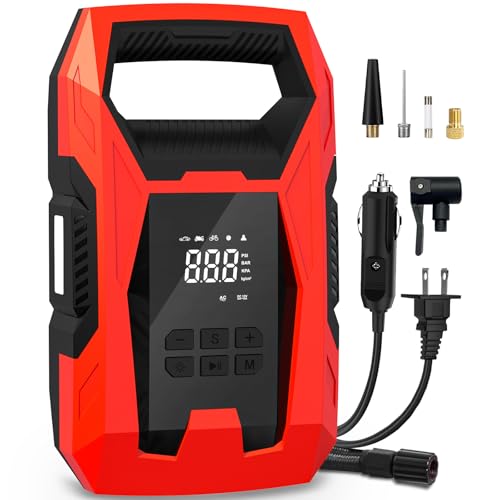 CARSUN AC/DC Portable Tire Inflator |
8.8/10 | Buy |
| Best Budget |
 Modari AP001 160 PSI Cordless Tire Inflator |
8.6/10 | Buy |
 VIAIR 88P 12V Portable Air Compressor |
8.4/10 | Buy | |
 CARSUN Dual Power AC/DC Portable Tire Inflator |
8.3/10 | Buy | |
 Airmoto 120 PSI Portable Tire Inflator |
8.3/10 | Buy | |
 LUMITECO 2-Pack Closed Flow Ball Foot Air Chuck |
8.1/10 | Buy | |
 Spurtar 10-120 PSI Tire Inflator Gauge |
8.0/10 | Buy | |
 AstroAI L7 Cordless Tire Inflator Portable Air |
8.0/10 | Buy |
Slime 40088 Portable 12V Tire Inflator
The Slime 40088 is a compact 12V portable tire inflator featuring Inflate Right automatic shut-off, an easy-to-read digital 99 PSI display, and emergency tubeless tire repair tools. It provides garage DIYers, commuters, and mobile equipment owners with a dependable roadside and driveway tire maintenance solution.
Pros
- Automatic shut-off helps prevent accidental tire over-pressurization during inflation cycles
- Clear digital pressure gauge reads up to 99 PSI for straightforward pressure setting
- Built-in LED work light enhances visibility around valve stems in dark roadside conditions
- Compact footprint makes it easy to store in a vehicle trunk, utility box, or garage shelf
- Includes heavy-duty emergency plug tools and tire repair strings for tubeless punctures
Cons
- Operates on 12V vehicle power, requiring a vehicle accessory socket rather than a standard 120V garage wall outlet
- Listed 6-minute inflation time is intended for routine passenger tire top-offs rather than high-volume continuous shop air
- Emergency tire repair plugs are suitable only for temporary punctures to reach a dedicated service facility
DEWALT Cordless Tire Inflator Portable Air
This compact DEWALT portable tire inflator delivers up to 150 PSI with smart auto shut-off, powered by an internal rechargeable battery or an included 10-foot 12V car plug. It provides an efficient, pocket-sized solution for vehicle owners, cyclists, and DIYers wanting rapid roadside top-offs without hauling a bulky tank compressor.
Pros
- True cordless freedom with an internal rechargeable battery plus a 10-foot 12V DC vehicle plug backup
- Accurate digital pressure gauge with 5 smart presets and automatic shut-off to eliminate overinflation
- Ultra-compact handheld design weighing just 0.63 kg for easy storage in glove boxes or saddlebags
- Integrated LED work light and emergency USB power bank functionality for travel safety
- Generous accessory bundle backed by a 3-year limited warranty
Cons
- Engineered exclusively for high-pressure inflation rather than operating pneumatic air tools or nailers
- Does not include a 120V AC residential wall outlet power adapter
- Compact tankless pump requires periodic cooling breaks during heavy multi-tire inflation runs
CARSUN AC/DC Portable Tire Inflator
Equipped with dual power inputs for 110V household outlets and 12V car sockets, this portable compressor delivers up to 150 PSI with auto-shutoff presets. It is a practical solution for drivers, cyclists, and households needing dependable inflation for standard vehicle tires and sports gear.
Pros
- Dual 110V AC and 12V DC power compatibility
- Automatic shutoff with memory preset function
- Clear backlit screen visible in direct sunlight
- Integrated LED light for nighttime emergencies
- Includes multiple adapters and dedicated carrying bag
Cons
- Not compatible with truck, tractor, or SUP board tires
- Requires 10-minute cooldown after 15 minutes of use
Modari AP001 160 PSI Cordless Tire Inflator
Built for quick roadside adjustments, the compact Modari AP001 delivers up to 160 PSI and 35 liters per minute of airflow with automatic shutoff protection. It serves passenger cars and bicycles well, doubling as an emergency flashlight and portable power bank.
Pros
- Compact footprint measuring 2.8 by 6.5 inches
- Fast airflow rate of up to 35L/min
- Auto-shutoff feature prevents over-inflation
- Doubles as a flashlight and power bank
Cons
- Not compatible with tires wider than 245mm
- Requires periodic recharging during long-term storage
VIAIR 88P 12V Portable Air Compressor
Designed for passenger cars and light trucks with tires up to 33 inches, the VIAIR 88P delivers dependable 120 PSI output directly from a vehicle battery. Its generous 26-foot total reach, built-in gauge, and integrated work light make it a practical emergency companion for road trips and camping.
Pros
- Solid 1.47 CFM flow rate provides brisk inflation
- Generous 26-foot reach easily accesses all four tires
- Built-in LED work light aids dark roadside repairs
- Compact body weighs under five pounds for convenient storage
Cons
- Requires direct battery connection instead of standard 12V outlet
- Limited to a 25-minute duty cycle before cooling
- Not designed for tires larger than 33 inches
CARSUN Dual Power AC/DC Portable Tire Inflator
The CARSUN Dual Power Tire Inflator delivers up to 150 PSI of high-pressure air running from either a 110V household outlet or a 12V vehicle socket. With digital pressure presets, automatic shutoff, and a lightweight 2.1-pound frame, it is an ideal maintenance pump for passenger vehicles, bicycles, and household inflatables.
Pros
- Versatile dual-voltage operation works seamlessly in the home garage or on the road without requiring an external converter
- Accurate auto-shutoff mechanism protects tires from accidental over-pressurization during routine top-offs
- Compact 2.1-pound build packs away easily in car trunks, under vehicle seats, or on garage shelving
- Clear digital display allows fast switching across four standard pressure measurement units
Cons
- Requires a mandatory 10-minute cooldown period after every 15 minutes of continuous operation
- Manufacturer explicitly states it does not support heavy truck tires, tractor tires, or stand-up paddleboards (SUP)
- Tankless inflator design cannot run standard workshop pneumatic air tools like brad nailers or paint sprayers
Airmoto 120 PSI Portable Tire Inflator
Weighing just 1.2 pounds, this compact cordless compressor delivers up to 120 PSI with automatic shutoff for routine top-offs on cars, bikes, and sports gear. Its pocket-sized form factor stores neatly in a glove box, serving as a convenient roadside backup.
Pros
- Extremely compact and lightweight design
- Auto shut-off prevents accidental over-inflation
- Clear digital LCD display with real-time pressure reading
- Integrated LED light aids night roadside repairs
- Internal hose storage keeps accessories organized
Cons
- Not suitable for heavy-load tires or large inflatables
- Cold temperatures and large tires drain battery quickly
- Requires frequent recharging before heavy usage
LUMITECO 2-Pack Closed Flow Ball Foot Air Chuck
The LUMITECO 2-Pack Ball Foot Air Chuck Set features a closed-flow internal shut-off valve rated up to 300 PSI, making it an excellent addition to tire inflator gauges and shop air drops. Designed with standard 1/4-inch FNPT threads and supplied with quick-connect plugs, this kit provides a dependable, leak-resistant solution for automotive enthusiasts and garage DIYers.
Pros
- Internal closed-flow valve prevents air discharge when disconnected, conserving compressor tank pressure
- Rated up to 300 PSI maximum pressure for wide versatility across passenger cars and light commercial vehicles
- Complete installation kit includes two male quick-disconnect plugs and thread sealing Teflon tape
- Standard 1/4-inch FNPT threads ensure straightforward compatibility with aftermarket inflator gauges and hose whips
Cons
- Closed-flow design is unsuitable for direct connection to small portable 12-volt inflators that lack an integrated pressure switch or trigger
- Compact ball-foot profile can be difficult to position on deeply recessed dually truck wheels compared to extended straight-foot chucks
- Base metal alloy is not explicitly listed, requiring careful alignment during threading to avoid cross-threading over time
Spurtar 10-120 PSI Tire Inflator Gauge
Equipped with an extended dual-head chuck and chrome-plated iron stem, this bayonet-style inflator gauge handles pressures up to 120 PSI. It provides a durable, all-in-one inflation and pressure-checking solution for standard passenger vehicles and dual-wheel trucks.
Pros
- Reaches difficult inner valves on dually tires easily
- Durable chrome-plated steel stem resists wear
- Comes with extra valve cores and repair tools
- Calibrated to 2 percent accuracy standards
Cons
- Two-pound scale increments limit fine-tuning precision
- 120 PSI maximum range excludes higher-pressure commercial tires
- Requires connection to a separate air compressor
AstroAI L7 Cordless Tire Inflator Portable Air
The AstroAI L7 is a lightweight, handheld cordless air compressor delivering up to 150 PSI with an integrated 4000mAh rechargeable battery and precise auto-shutoff. It provides dependable, pocket-sized inflation performance for motorists, cyclists, and DIYers needing quick roadside tire top-offs.
Pros
- Weighs only 0.96 pounds for effortless storage in vehicle consoles, toolbags, or cycling packs
- High-speed digital sensor samples tire pressure at 200 times per second to prevent over-inflation
- Internal 4000mAh battery provides cordless freedom without tangling 12V cigarette lighter cords
- Versatile secondary utility as an emergency LED flashlight and portable USB power bank
Cons
- Not intended for heavy-duty truck tires or commercial tires larger than 25 inches in diameter
- Duty cycle requires allowing the unit to cool for 10 minutes after 15 minutes of continuous run time
- Tankless micro-compressor design cannot power workshop pneumatic air tools
How to Inflate a Tire Accurately and Safely
Inflating a vehicle tire is a pressure-control task, not a contest to reach the highest PSI printed on a pump. Use the cold tire pressure listed on the vehicle placard or in its owner manual, then add air in measured amounts and verify the final reading. A portable inflator with a preset and automatic shutoff can simplify the process, but a separate pressure check remains useful because readings can vary between gauges.
Find the correct pressure before connecting a pump
Look for the recommended tire pressure on the placard, commonly found on a door jamb, or consult the vehicle manual. The recommendation is for the vehicle and tire fitment, so don’t substitute the tire sidewall’s maximum pressure for the normal inflation target. That sidewall figure describes a tire limit, not necessarily the pressure your car should use for everyday driving.
Check tires when they are cold, meaning before driving or after the vehicle has been parked long enough for the tires to cool. Driving warms the air inside the tire and can raise the reading, so adjusting a warm tire to the cold specification may leave it underinflated once it cools. If you must check after driving, follow the vehicle maker’s guidance rather than letting air out to reach the cold number.
Use the same pressure unit across the vehicle recommendation and inflator display. Many digital pumps allow selection among PSI, kPa, and bar, while a manual gauge may show PSI only. Unit confusion can produce a substantial error, so pause and confirm the display before setting a target.
Choose an inflator and power source for the task
A compact battery inflator is convenient for occasional top-ups because it can be carried to each wheel without a cord. The Airmoto and AstroAI L7 listings describe rechargeable battery operation, digital pressure settings, and automatic shutoff. The AstroAI listing also notes a rest period after extended operation, so follow the unit’s instructions rather than running it continuously through multiple tires without a break.
A 12-volt inflator powered from a vehicle accessory socket can avoid battery-only limitations, while a dual-power model can also run from a household outlet where that connection is available. The CARSUN AC/DC inflators are listed with both 110V/120V AC and 12V DC power options. Check the specific model’s power instructions and limitations before use; the supplied product information cautions that these units are not for truck or tractor tires.
A larger portable compressor such as the VIAIR 88P uses battery clamps and is listed for vehicle tires, including trucks and SUVs, within its stated tire-size guidance. This connection method differs from a small plug-in pump, so follow its instructions for connecting to the vehicle battery and operating the unit. Never assume that every compressor with a high maximum PSI is suitable for a large tire or extended inflation session.
Workshop compressors can inflate tires too, but they require a tire chuck or inflator gauge that matches the air hose connection. Their tank pressure is not the tire target: use a regulator and a gauge to control and measure tire pressure. Follow the compressor and accessory manuals, wear suitable eye protection around pneumatic equipment, and don’t exceed the pressure ratings of the tire, hose, chuck, or inflator.
Connect the hose without losing air
Park safely on a level surface, apply the parking brake, and switch off the vehicle before working around its tires. Remove the valve cap and keep it somewhere clean. Inspect the valve stem for visible damage or debris, since a poor seal at the connection can waste air and make a gauge reading unreliable.
Attach the inflator’s chuck straight onto the valve stem. A threaded connector may need to be turned until secure, while a lever-style chuck locks by pressing it into place and moving its lever. Listen for a sustained hiss; a brief escape of air during connection can happen, but a continuing leak means the chuck may not be seated correctly or the valve may need inspection.
Some accessories use a closed-flow chuck that passes air only when engaged with a valve. The LUMITECO set is listed as a closed-flow ball chuck with a 1/4-inch female NPT inlet, but check the thread and quick-connect compatibility of your hose before buying or attaching it. A pressure gauge with an inflator control, such as the Spurtar model listed here, combines checking and adding air, though its scale and connection still need to suit the job.
If you use a shop compressor, set the regulator conservatively and use a tire inflator gauge that allows controlled additions and pressure checks. Avoid directing an unrestricted air line at a tire valve. A regulator does not replace careful monitoring, and the compressor’s maximum working pressure is not a safe target for a tire.
Add air in controlled increments
With a digital inflator, choose the correct pressure unit, set the vehicle’s recommended cold pressure, and start the pump. Automatic shutoff is a convenience feature found in several listed inflators, including DEWALT, CARSUN, Airmoto, and AstroAI models. Stay nearby and watch the operation rather than treating the shutoff feature as a substitute for checking the finished pressure.
If the inflator has no preset function, add air in short bursts. Stop periodically, release the chuck as directed, and check pressure with a reliable gauge. A small amount of air may escape while removing some connectors, so reconnect and top up gradually instead of making a large correction based on a single uncertain reading.
Do not keep pumping simply because the tire still looks soft. Tire sidewalls can flex, and appearance alone is not a precise pressure measurement. Use the gauge and the vehicle’s stated target, and stop if the tire, valve, hose, or pump shows damage or unusual behavior.
Inflation time depends on the tire’s starting pressure, tire volume, inflator output, and operating conditions. The product descriptions give example inflation times for particular models and tire sizes, but those figures are not universal guarantees. A cold battery, a larger tire, or an inflator’s required cooling interval can change the time needed.
Verify pressure and finish the other tires
After the pump stops, check the tire with a gauge and compare the reading with the vehicle’s cold-pressure recommendation. If the reading is low, add a little air and check again. If it is high, use a gauge’s release function or the valve stem carefully to let out a small amount, then measure again rather than guessing.
Replace the valve cap after checking. The cap helps keep dirt and moisture away from the valve, though it does not correct a leaking valve core. Repeat the same cold-pressure procedure for the other tires, including the spare if the vehicle maker recommends checking it and its location is accessible.
Pressure differences among tires can matter even when only one warning light appeared, so check all tires rather than inflating only the one that looks low. Record or remember any tire that repeatedly needs air. A recurring pressure loss can indicate a puncture, damaged valve, bead leak, or other issue that an inflator cannot repair.
After driving, tire pressure may rise as the tires warm. Don’t release air just to force a warm tire to match the cold specification. Recheck once the tires cool, and use the vehicle manufacturer’s directions if the warning system remains illuminated after pressure correction.
Match products to occasional tire inflation
The listed products include complete inflators as well as accessories, so identify what you actually need. A cordless pump can suit a driver who values compact storage and freedom from a power cord. The DEWALT listing describes a rechargeable battery, 12V car connection, digital presets, and a stated maximum pressure of 150 PSI; those features do not mean it should be used to inflate every tire type or volume.
For use at home and in a vehicle, the CARSUN dual-power options offer a choice of wall power or a 12V accessory connection according to their listings. Compare the model’s stated limitations and cooling guidance with your intended use. The two CARSUN listings describe similar functions, but verify the exact included accessories and instructions for the model being considered.
The VIAIR 88P is a different style of portable unit, with battery-clamp power, a built-in gauge, a listed maximum working pressure of 120 PSI, and a stated 25-minute duty cycle at 30 PSI. Its product information identifies use with tires up to 33 inches. Those details may suit buyers who need a battery-powered compressor for vehicle and off-road tire duties, but the duty cycle and operating instructions still govern how long it can run.
The smaller cordless models are aimed at routine inflating and lighter-duty uses described in their listings. For example, Airmoto’s information says it is not designed for large-volume items such as paddleboards or heavy-load tires. The MODARI listing similarly excludes large tires over its stated size limit. Respect those limits; a maximum PSI figure describes pressure capability, not necessarily the pump’s capacity to move large volumes of air.
Accessories can be a sensible choice if you already own a compressor. The LUMITECO chucks and Spurtar inflator gauge provide different ways to connect, measure, and add air, but they do not include the compressor itself. Confirm fitting threads, valve compatibility, gauge range, and whether your existing hose and regulator are appropriate before ordering.
Recognize a leak or a tire problem
If pressure drops again soon after inflation, adding air repeatedly is not a repair. A puncture, damaged valve stem, leaking valve core, or leak at the tire bead may be responsible. A tire shop can inspect the assembly and determine whether repair or replacement is appropriate.
A chuck that hisses while attached may simply be misaligned, but persistent leakage after reseating it deserves attention. Check that the connector is the right type for the valve and that its seal is not visibly damaged. Disconnect the inflator before examining fittings, and follow the product manual for any cleaning or maintenance.
If a tire is visibly damaged, has a bulge, or loses air rapidly, don’t rely on a portable pump to make it safe for normal driving. Avoid driving on a severely underinflated tire, which can be damaged by continued use. Arrange appropriate roadside help or professional inspection instead.
Compressor accessories also need routine inspection. Look for cracked hoses, damaged couplers, loose fittings, or a gauge that gives inconsistent readings. For any compressor maintenance, follow its manual and fully depressurize the tank before servicing fittings or accessories; use eye protection when handling compressed-air equipment.
Common inflation errors to avoid
Using the tire sidewall maximum as the routine target is a common mistake. The vehicle placard or manual provides the recommended pressure for the vehicle’s specified tires, while the sidewall marking is not a substitute for that instruction. Another mistake is checking pressure only after a long drive, when tire temperature can affect the reading.
Don’t assume that a pump’s automatic stop makes every reading exact. Set the target carefully, use the correct units, and confirm the finished pressure with a gauge when practical. If a gauge and inflator disagree noticeably, check the connector seal and compare with another suitable gauge rather than continuing to add air.
Do not exceed the inflator’s own duty limits while trying to hurry. Some compact models specify a cooling break after sustained use, and battery-powered pumps can run down before multiple tires are complete. Let the equipment cool as directed, recharge it when needed, and avoid placing a hot inflator in a confined storage space.
Finally, don’t use a tire inflator as a general-purpose compressor unless its instructions allow the intended task. A tire pump may not deliver the airflow needed for air tools or large inflatables. Likewise, a workshop compressor should be controlled with appropriate pressure regulation and tire-specific fittings rather than an open air hose.
Make the pressure check part of routine care
Check tire pressure regularly and before longer trips, following the vehicle manufacturer’s schedule. Temperature changes can affect pressure, so seasonal weather shifts are a useful reminder to check rather than assume the last reading still applies. A dependable gauge and a charged, serviceable inflator make routine checks easier.
Keep the inflator’s adapters, charging lead, and instructions together so the equipment is ready when needed. Inspect the hose and power connection occasionally, and recharge a battery unit according to its manual, especially after use or extended storage. Product descriptions for battery models recommend periodic charging or a full charge before use, but the specific manufacturer’s directions take precedence.
If an inflator has a built-in light, treat it as a convenience, not a replacement for a safe work area. Move the vehicle away from traffic when possible, use hazard lights where appropriate, and avoid working in a position that exposes you to moving vehicles. On a roadside, personal safety comes before completing the pressure adjustment.
The best result is a tire at the vehicle’s specified cold pressure, measured with a sound gauge and achieved without overworking the pump. Choose a compact inflator or compressor accessory that matches your power access, tire size, and expected frequency of use. If pressure will not hold, stop topping up and have the tire inspected.
For tire inflation, a suitable pressure setting matters more than the pump’s headline maximum PSI. Connect securely, add air in controlled steps, verify with a gauge, and heed the equipment’s limits. That approach makes occasional top-ups more predictable while helping you spot a tire problem that needs more than air.
About the author
Clint DeBoer is an experienced tool-industry specialist with decades of involvement in technical media, hands-on product evaluation, and testing methodology. His focus on performance, practical usability, and data-driven comparisons makes his expertise highly relevant to professional air compressors, pneumatic tools, and workshop equipment.