
How Big Air Compressor for Painting Car?
How big air compressor for painting car depends on gun demand, airflow, and finish quality. Compare the key sizing details for November 2026.
 By Clint DeBoer
Updated November 10, 2026


A paint gun that runs short of air can produce uneven atomization and interrupt a pass, while an oversized setup can take up more garage space and cost more than the job requires. The central question behind how big air compressor for painting car is not tank size alone. You need to match the compressor’s delivered airflow at the gun’s working pressure, then consider how long the gun will spray and how the system handles moisture and oil.
Check the spray gun manufacturer’s air consumption and pressure requirements before buying a compressor. A short burst from a small tank is different from sustained spraying across a panel or an entire vehicle, so the compressor’s CFM rating and duty limits matter as much as its gallon capacity. For background on matching a spray gun and compressor, see our guide to compressor spray guns, and use this practical guide to air compressor connections for general setup context.
| Award | Product | ACR Score About ACR ScoreThe ACR Score is our own rating from 0 to 10, based on performance, design and build, ease of use, and value. It reflects independent research and is never influenced by manufacturers, retailers, or affiliate commissions. Learn more › | |
|---|---|---|---|
| Best Overall |
CRAFTSMAN 12V Portable Tire Inflator with
|
9.2/10 | Buy |
| Best Value |
 CRAFTSMAN 2-Gallon Portable Air Compressor |
9.1/10 | Buy |
 Master Airbrush Cool Runner II 3-Airbrush Kit |
8.9/10 | Buy | |
| Best Premium |
 VELPAX 6.4-Gallon 2HP Quiet Air Compressor |
8.9/10 | Buy |
| Best Budget |
 OlarHike Portable Tire Inflator Air Compressor |
8.8/10 | Buy |
 Baotree 4-Gallon 110 PSI Air Compressor |
8.8/10 | Buy | |
 ECOMAX 6-Gallon 150 PSI Portable Pancake Air |
8.8/10 | Buy | |
 MZB MZB-900H-24 6.4-Gallon Air Compressor |
8.6/10 | Buy | |
 VEVOR 2.1 Gallon Portable Air Compressor |
8.4/10 | Buy | |
 Klutch 20-Gallon Portable Air Compressor |
8.4/10 | Buy |
CRAFTSMAN 12V Portable Tire Inflator with
The CRAFTSMAN 12V Portable Tire Inflator is an ultra-compact 1.9-pound roadside unit delivering up to 150 PSI with digital auto shut-off and built-in cord storage. Powered via a standard 12V car accessory plug, it offers fast tire top-offs and dependable emergency inflation without crowding trunk space.
Pros
- Weighs only 1.9 pounds for effortless glove box, under-seat, or trunk storage during road trips
- Digital auto shut-off prevents accidental over-inflation without requiring constant manual gauge monitoring
- Bright three-mode LED light provides critical illumination during nighttime roadside emergencies
- Comes fully equipped with multi-valve adapters, a replacement fuse, and a tailored carry pouch
Cons
- Requires a 12V DC vehicle accessory socket and does not include a 120V AC household outlet adapter
- Compact tankless pump is built strictly for tire inflation and cannot drive pneumatic nailers or air tools
- The 2.17-foot air hose length means the compressor must sit on the ground adjacent to the wheel valve stem
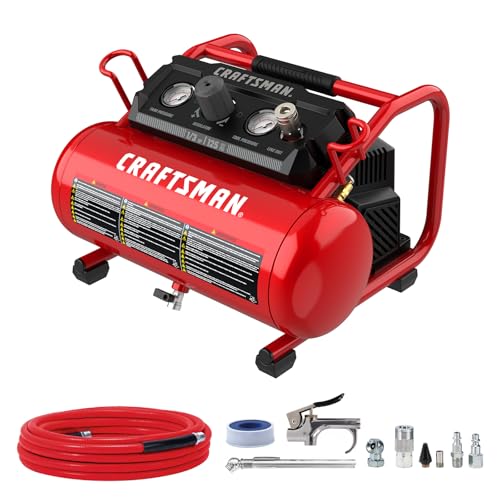
CRAFTSMAN 2-Gallon Portable Air Compressor
This CRAFTSMAN 2-gallon portable compressor package pairs a max 125 PSI oil-free pump with a versatile 10-piece pneumatic accessory kit using standard 1/4-inch NPT fittings. It is a practical, lightweight solution for DIYers and homeowners tackling tire inflation, air dusting, and light fastening.
Pros
- Complete out-of-the-box pneumatic package with air hose, blow gun, tire chuck, and 1/4-inch NPT quick-connect hardware
- Lightweight 19-pound carry weight makes moving between the garage, driveway, and workbench effortless
- Oil-free pump eliminates crankcase oil checks and prevents oil aerosol contamination in downstream air lines
- Dual quick couplings allow quick hookups without needing additional brass splitters
Cons
- Small 2-gallon receiver tank and 1/3 HP motor are limited to light-duty pneumatic tasks rather than continuous air-hungry tools
- The included starter air hose and accessories are entry-level components that high-volume shops may eventually want to upgrade
- Fittings utilize standard 1/4-inch auto profile plugs which require matching couplers if your shop uses alternate pneumatic profiles
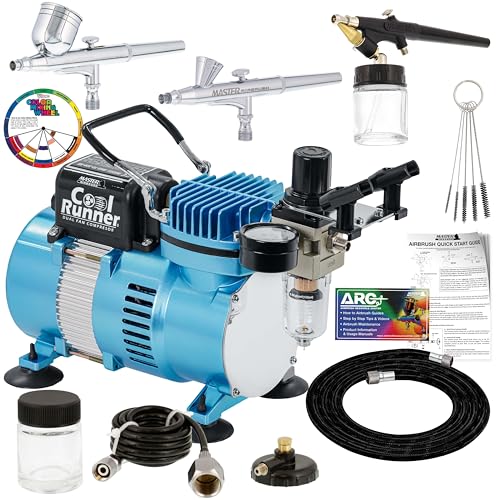
Master Airbrush Cool Runner II 3-Airbrush Kit
Equipped with three specialized airbrushes and a dual-fan compressor, this comprehensive set provides steady airflow for extended creative sessions. It is well suited for hobbyists, decorators, and crafters needing versatile nozzle sizes for both broad coverage and fine detail.
Pros
- Dual cooling fans reduce heat during long sessions
- Versatile selection of three distinct nozzle sizes
- Includes helpful accessories like cleaning brushes and guide
- Built-in holder keeps airbrushes secure while working
Cons
- Relatively bulky setup requires considerable workspace
- Single-piston 1/5 HP motor limits heavy industrial use
VELPAX 6.4-Gallon 2HP Quiet Air Compressor
Delivering 6.71 CFM at 115 PSI while operating at just 60 decibels, this 6.4-gallon unit is built for noise-conscious workshop and garage tasks. Its oil-free 2HP motor provides reliable airflow for painting, nailing, and tire inflation with minimal upkeep.
Pros
- Quiet 60 dB noise level for indoor workshops
- Maintenance-free oil-less motor design
- Strong 6.71 CFM airflow rating at 115 PSI
- Equipped with built-in overload protection
- Integrated handle and drain valve for easy operation
Cons
- Lacks transport wheels for a 6.4-gallon tank
- Single air outlet restricts multi-tool operation
- 115 PSI maximum pressure limits heavy-duty commercial tools
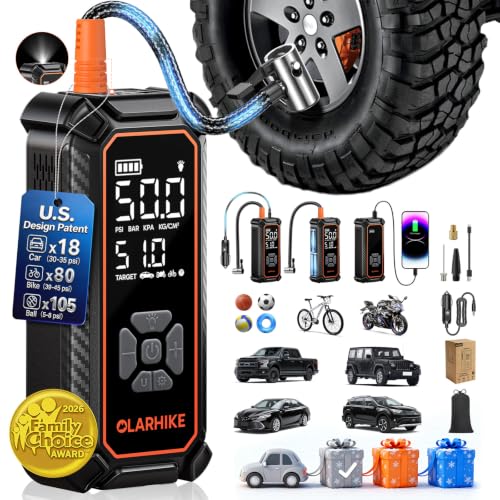
OlarHike Portable Tire Inflator Air Compressor
The OlarHike Portable Tire Inflator combines dual-power versatility via a 12V DC vehicle plug or built-in rechargeable battery with an automatic shut-off digital display. It provides dependable roadside tire top-offs and inflation for passenger cars, crossovers, motorcycles, and bicycles.
Pros
- Dual-power design allows cordless field operation or continuous power through any standard vehicle 12V DC port
- Automatic shut-off technology stops the motor precisely at preset pressure to prevent over-inflation
- Integrated 6000mAh battery reserve doubles as an emergency phone charger and includes an LED work light
- Pocket-sized footprint weighs well under two pounds for convenient transport in center consoles or backpacks
Cons
- Maximum vehicle pressure rating of 51 PSI is not suitable for heavy-duty commercial trucks, RVs, or high-pressure trailer tires
- Compact tankless inflator mechanism cannot power workshop pneumatic tools such as nail guns or air ratchets
- Recharging requires a standard 5V 2A or 5V 3A adapter and is not compatible with high-wattage fast chargers
Baotree 4-Gallon 110 PSI Air Compressor
Built for light household maintenance and small DIY crafts, this lightweight Baotree unit delivers up to 110 PSI with quiet operation. Its compact four-gallon tank and manageable 18.7-pound frame make it easy to transport between garage and home workspaces.
Pros
- Lightweight build under 19 pounds for effortless transport
- Low-noise motor suitable for indoor or residential use
- Built-in automatic overpressure shutoff enhances safety
- Clear analog gauge enables straightforward pressure monitoring
Cons
- Low 0.6 SCFM output limits high-demand pneumatic tools
- Modest 0.5HP motor unsuitable for heavy-duty workshop jobs
- 110 PSI ceiling restricts high-pressure air requirements
ECOMAX 6-Gallon 150 PSI Portable Pancake Air
The ECOMAX 6-Gallon 150 PSI Pancake Air Compressor delivers portable, low-maintenance pneumatic power with its 1.5 HP oil-free pump, dual quick-connect couplers, and bundled 10-piece accessory kit. Featuring cold-weather starting support and a flip-up handle, it is an accessible choice for DIYers, trim carpenters, and garage tire maintenance.
Pros
- Comes with a 10-piece accessory kit including an air hose, tire chuck, and blow gun ready out of the box
- Dual quick-connect couplers enable two operators to run pneumatic lines simultaneously
- Oil-free pump design requires zero motor oil maintenance and prevents oil discharge into air lines
- Low-voltage and cold-weather startup capability helps ensure reliable motor turnover in chilly garages
- Flip-up carrying handle and built-in cord bracket simplify transport and tidy storage
Cons
- PVC air hose included in the kit can become stiff and difficult to manage in freezing temperatures
- Not intended for continuous high-demand air tools such as rotary sanders or automotive paint sprayers
- Standard universal motor noise level makes hearing protection advisable during indoor use
MZB MZB-900H-24 6.4-Gallon Air Compressor
Delivering 5.65 CFM at 115 psi, this 1.2 HP oil-free unit rapidly pressurizes its 6.4-gallon tank in about one minute while maintaining a low 70-decibel noise output. It serves well for home garages and workshops handling nail guns, air tools, and light painting.
Pros
- Quiet 70 dB operating volume
- Fast tank recovery under 65 seconds
- Generous 5.65 CFM output at 115 psi
- Low-maintenance oil-free motor design
- Integrated wheels assist mobility
Cons
- Steel construction adds significant carrying weight
- Tank capacity limits continuous heavy spraying sessions
- Corded operation requires standard electrical outlet
VEVOR 2.1 Gallon Portable Air Compressor
Delivering 2.2 CFM at 90 PSI with a 116 PSI maximum operating threshold, the VEVOR 2.1 Gallon Air Compressor combines a 1.2 HP oil-free dual-cylinder motor with a compact 27-pound steel chassis. It serves DIY homeowners, finish carpenters, and garage hobbyists seeking a dependable, low-maintenance air supply for brad nailing, stapling, and tire inflation.
Pros
- Maintenance-free oil-free pump design eliminates messy fluid changes and allows spill-free transport
- Dual-cylinder intake setup delivers a solid 2.2 CFM at 90 PSI in a portable 27-pound frame
- Dual cooling fans and thermal overload protection safeguard motor longevity during heavy garage sessions
- Dual intake silencers help reduce harsh operating noise compared to unshielded high-RPM pumps
Cons
- Maximum operating pressure of 116 PSI provides less stored air buffer than standard 150 PSI contractor units
- 2.1-gallon air reservoir is not sized to sustain continuous high-draw tools like rotary sanders or paint sprayers
- The 3500 RPM motor runs fast, making regular cooling cycles necessary during warm weather work
Klutch 20-Gallon Portable Air Compressor
Featuring a 2.0 HP 120V motor and a 20-gallon tank, the Klutch portable air compressor delivers a rated 4.2 SCFM at 90 PSI for versatile workshop air. Its oil-free pump and wheeled design make it a dependable choice for garage mechanics, woodworkers, and serious DIYers needing steady air storage.
Pros
- Generous 20-gallon air storage capacity provides a substantial buffer for intermittent shop tools
- Delivers a listed 4.2 SCFM at 90 PSI, outperforming smaller pancake compressors for workshop chores
- Oil-free pump design eliminates messy oil changes and allows clean, upright transport
- Rugged rubber wheels and built-in ergonomic handle make moving the 90-pound frame manageable
- Integrated thermal overload protection helps prevent motor burnout during demanding cycles
Cons
- Substantial 90-pound weight makes lifting into truck beds or carrying up stairs difficult without assistance
- Oil-free motor configurations generally produce noticeable operating noise compared to low-RPM lubricated units
- At 4.2 SCFM at 90 PSI, high-draw continuous air tools like sanders or grinders will require recovery pauses
How to Size an Air Compressor for Automotive Painting
For automotive painting, size the compressor around the spray gun’s stated airflow demand and intended pressure, not a generic tank-size rule. The supplied product details do not include a verified compressor specification that establishes one universal CFM threshold for car painting, and spray guns vary substantially. Use the gun’s own manual as the starting point, then choose a compressor whose delivered CFM at the required pressure can support the planned spraying pattern and duration.
Start with the spray gun’s air consumption
Find the gun’s air consumption, usually expressed as CFM or SCFM, and the recommended inlet pressure. Confirm whether the manufacturer’s figure is measured at the gun inlet or describes another point in the system, because the hose, regulator, and fittings can affect pressure available at the tool. The compressor’s advertised maximum PSI is not a substitute for an airflow rating at the pressure where you will spray.
Compare the gun’s requirement with the compressor’s delivered air output at the relevant pressure. A compressor may list a high maximum pressure yet provide too little airflow for a continuously operating paint gun. If the compressor specification gives only tank pressure or motor horsepower, but no usable CFM at pressure, it does not answer the main sizing question.
Allow for the real setup rather than planning around an ideal connection. Long or restrictive hoses, small couplers, filters, and regulators can contribute to pressure loss between the tank and gun. Use appropriate air-line components and check the gun’s pressure at its inlet while air is flowing, following the gun and compressor manufacturers’ directions.
Why tank gallons do not determine spray time
A tank stores compressed air; it does not create additional air once its reserve is used. A larger tank can provide a buffer and may reduce how quickly pressure falls during a brief demand, but the pump still has to replace the air the gun consumes. For sustained spraying, compressor output and the manufacturer’s permitted duty cycle are more important than tank capacity by itself.
Small portable compressors can suit intermittent tasks, but that does not make them suitable for continuous automotive spraying. For example, the listed CRAFTSMAN portable compressor has a 2-gallon tank and a maximum pressure of 125 PSI, while the VEVOR model has a 2.1-gallon tank and lists 2.2 CFM at 90 PSI. Those figures describe the products, but they do not establish compatibility with every paint gun or a full-vehicle spray job.
Other listed options have tanks of 4, 6, or 6.4 gallons, but the data supplied for several of these models does not include a CFM rating at 90 PSI. A bigger tank is not evidence that a compressor can continuously meet a gun’s air consumption. If the available specifications omit the delivery rate or duty-cycle limit, contact the manufacturer or consult the full manual rather than estimating performance from gallons or horsepower.
Continuous spraying changes the sizing decision
Painting panels involves repeated, controlled passes, and the gun draws air while its trigger is engaged. A compressor that can inflate a tire or operate a nailer briefly may not keep up with a spray gun for long periods. If pump output falls behind demand, tank pressure declines, the motor may run for extended periods, and airflow at the gun can become inconsistent.
Consider the job’s pattern. Small touch-ups and short bursts leave recovery intervals between uses, while painting larger panels or multiple parts can involve much longer trigger time. A compressor needs enough delivered air for the expected workload, with a duty cycle appropriate to that workload; do not assume a portable unit can run continuously unless its manufacturer says so.
Do not try to compensate for insufficient airflow by raising the regulator beyond the spray gun’s stated operating range. Excess pressure can change the gun’s behavior and may create unsafe operating conditions. Follow the gun instructions, stay within compressor limits, and stop if the motor or pump shows signs of overheating or the equipment’s overload protection activates.
Air Quality Matters as Much as Compressor Capacity
A compressor that supplies enough air can still produce poor painting conditions if moisture, oil, or contamination reaches the gun. Compressed air cools as it travels through the system, and water can collect in the tank and air lines. Paint finishing calls for a clean, dry air path, so plan filtration and moisture management along with compressor capacity.
Plan for water and contamination control
Drain the tank according to the compressor manual and inspect the air path for water before painting. A water separator or suitable filtration arrangement may help manage moisture, but its selection and placement should follow the spray-gun and filter manufacturers’ guidance. Filters have flow limits, so a restrictive unit can undermine the airflow you worked to provide.
Oil-free pumps can be appealing where avoiding pump-oil carryover is a priority, but oil-free does not mean the air is automatically free of water or every contaminant. Several products in the supplied list are described as oil-free, including the VEVOR 2.1-gallon compressor and the ECOMAX 6-gallon pancake model. Their descriptions do not establish that either has the airflow, filtration, or duty-cycle capacity required for a particular automotive paint gun.
Some product descriptions are inconsistent about pump maintenance. The Baotree listing identifies an oil-free compressor but also mentions regular oil checks, so verify the actual manual and product configuration before relying on that description. For paint work, use the manufacturer’s maintenance instructions and do not add oil to a pump unless its manual specifically requires it.
Tank moisture management also matters for compressor life. Condensation can remain inside a tank, and neglecting the prescribed draining routine can contribute to corrosion over time. Depressurize the equipment as directed before servicing, keep clear of the drain outlet, and wear eye protection; never open fittings or service components while the tank is pressurized.
Keep pressure stable from tank to gun
Set pressure according to the spray-gun instructions, measuring at the gun inlet under the relevant operating condition rather than relying only on the tank gauge. A static reading can differ from the pressure available while air is flowing. If pressure falls when the trigger is held, check the compressor output, hose and fitting restrictions, filter condition, and regulator setup before changing the gun setting.
Use hose and couplers suited to the required airflow, and keep the route as straightforward as practical. A small passage or restrictive fitting can contribute to pressure loss even when the tank gauge looks adequate. Do not assume that changing to a higher tank pressure will solve a flow restriction; remain within the compressor’s and gun’s stated limits.
For more context on workshop equipment and the range of tasks it supports, our home mechanic compressor guide discusses the difference between occasional garage use and more demanding air-tool work. That distinction is useful here because painting is a sustained airflow application, not simply a question of whether a compressor can reach a pressure number. Confirm the specific spray gun and compressor requirements before purchasing.
What the Listed Compressor Options Can and Cannot Tell You
The products listed alongside this guide span small portable units, airbrush equipment, quiet compressors, and a larger wheeled tank. Their listed specifications can help screen options, but they do not establish that each compressor is intended for automotive body painting. A buyer should treat advertised application language as a starting point and verify airflow, operating pressure, and duty-cycle details in the complete manufacturer documentation.
Airbrush compressors serve a different scale of work
The Master Airbrush Cool Runner II is an airbrush kit with a 1/5 HP compressor and three airbrushes. The listing describes uses such as auto graphics and other fine-art applications, which are distinct from spraying automotive body panels with a conventional paint gun. Its inclusion does not make it a substitute for a compressor sized to the airflow requirements of a full-size gun.
Airbrush work generally uses different equipment and application patterns from refinishing a car body. Match the compressor to the tool actually being used, rather than assuming that a product associated with automotive graphics can sustain a conventional spray gun. If your work is airbrushing graphics, use the airbrush manufacturer’s specifications; if it is panel painting, use the spray-gun requirements.
Interpret portable tank and airflow specifications carefully
The VEVOR compressor’s listed 2.2 CFM at 90 PSI is more useful for an airflow comparison than its maximum pressure alone, but a buyer still needs the paint gun’s consumption figure and the compressor’s duty-cycle information. The listing says the unit is suitable for spray painting, but that broad description does not identify which gun, paint process, or duration is supported. Avoid treating it as an assurance that the compressor will run any automotive gun continuously.
The Klutch 20-gallon model lists 4.2 SCFM at 90 PSI and a 2 HP motor. That delivery figure provides a clearer comparison point than tank size, but it still must be checked against the selected gun’s air demand. The data provided does not state a paint-specific duty cycle or confirm a particular spray-gun pairing, so the manual and tool specifications remain decisive.
The VELPAX 6.4-gallon compressor lists 6.71 CFM at 115 PSI, while the MZB 6.4-gallon listing states 5.65 CFM at 115 PSI. Those figures are given at 115 PSI, not 90 PSI, and should not be casually treated as equivalent measurements at a different pressure. Check the full manufacturer data for output at the gun’s working pressure and any duty-cycle guidance before using either for extended spraying.
The ECOMAX listing states that its pump delivers “3 cubic inches of air” at 90 PSI, which is not a standard CFM value as presented. Do not convert or compare that wording as though it were a verified CFM rating. Ask the manufacturer for a clear delivered-air specification if you are considering this compressor for a paint gun.
Electrical, Noise, and Shop Setup Considerations
Airflow is the core sizing issue, but the compressor also has to work safely in the garage where painting will take place. The listed electric models include 110V or 120V descriptions, but the supplied data does not give the running amperage or startup inrush for every unit. Check the nameplate and manual for electrical requirements, and avoid sharing a circuit with other high-draw equipment if the manufacturer warns against it.
Do not select an extension cord or change wiring based on a guess. Follow the compressor’s electrical instructions and use a suitable outlet and supply. If a breaker trips, the motor struggles to start, or the cord or plug becomes hot, stop and have the setup assessed rather than repeatedly resetting protection or bypassing a safety device.
Noise can affect comfort during a long garage job. The VELPAX listing states approximately 60 dB, and the MZB listing states 70 dB, but these are manufacturer-listed values, not independent measurements under a shared test method. A quiet rating does not establish that a compressor has sufficient airflow for a spray gun, so keep acoustic preference separate from capacity selection.
Plan compressor placement to keep the intake clear and make the controls accessible, while following the manual’s ventilation and operating-location guidance. Keep the unit away from paint mist and other sources of contamination, and route the air line so it does not create a trip hazard or interfere with the work. Use suitable eye and hearing protection when operating air equipment.
A Practical Decision Before You Buy
Write down the spray gun’s required inlet pressure, air consumption, and intended use duration, then compare those figures with the compressor’s delivered CFM at a matching pressure. Confirm the compressor’s duty-cycle limits and electrical requirements in its manual. If a key specification is missing or given at a different pressure, get clarification rather than assuming the tank size or horsepower fills the gap.
For occasional touch-ups, a smaller compressor may be workable only if its actual airflow and operating limits match the gun and job. For repeated panel work or a full vehicle, prioritize adequate sustained output, appropriate duty cycle, moisture control, and stable pressure at the gun. The listed products include options with varied tank sizes and output claims, but the supplied information does not justify a universal recommendation for car painting.
The sensible answer to how big an air compressor should be is therefore specific to the paint gun and the length of each spraying session. Choose by verified delivered airflow at operating pressure, then confirm duty cycle, air quality provisions, and power supply. That approach is more reliable than buying by gallons or maximum PSI alone.
About the author
Clint DeBoer is an experienced tool-industry specialist with decades of involvement in technical media, hands-on product evaluation, and testing methodology. His focus on performance, practical usability, and data-driven comparisons makes his expertise highly relevant to professional air compressors, pneumatic tools, and workshop equipment.