
How Does a Air Compressor Regulator Work: A Practical Guide
How does a air compressor regulator work? Learn how it controls outlet pressure, how to set it for a tool, and what to check in November 2026.
 By Glenda Taylor
Updated November 10, 2026


A nailer that misfires or a spray gun that receives too much pressure can make a straightforward job frustrating. The compressor tank may hold air at one pressure while the tool needs a lower, controlled supply at the outlet. Understanding how does a air compressor regulator work helps explain that difference and gives you a practical way to set up an air line.
A regulator reduces and controls downstream pressure; it does not create more air or raise the tank’s maximum pressure. Its gauge generally shows the regulated outlet pressure, so the reading can change as you adjust the knob and may respond differently while air is flowing. The replacement options below range from simple regulators to filter-regulator combinations, making thread size, pressure range, and moisture control important details to check before buying.
For broader compressor context, see this workshop compressor guide. If a spray gun is part of your setup, the air compressor paint-spray guide can help frame the tool-side requirements.
Top Products
| Award | Product | ACR Score About ACR ScoreThe ACR Score is our own rating from 0 to 10, based on performance, design and build, ease of use, and value. It reflects independent research and is never influenced by manufacturers, retailers, or affiliate commissions. Learn more › | |
|---|---|---|---|
| Best Overall |
PAOSDKSUI AB-9051114 Compressor Regulator
|
9.2/10 | Buy |
| Best Budget |
 Beduan BR4000 Air Compressor Regulator Combo 1/2" |
9.2/10 | Buy |
| Best Value |
 Dreyoo Air Compressor Regulator |
9.2/10 | Buy |
| Best Premium |
 VEVOR 1/2" NPT 3-Stage Air Filter Regulator |
8.8/10 | Buy |
 Apex Tool Supply AB-9051114 Replacement Air |
8.4/10 | Buy | |
 SNS Air Compressor Pressure Regulator With Bracket |
8.4/10 | Buy | |
 Hromee 1/2 Inch Compressed Filter Regulator Combo |
8.4/10 | Buy | |
 Hromee AW2000-02 1/4-Inch Filter Regulator |
8.1/10 | Buy | |
 SNS AR2000-N02 1/4 NPT Air Regulator |
8.1/10 | Buy |
PAOSDKSUI AB-9051114 Compressor Regulator
This replacement valve provides adjustable air pressure regulation for multiple compressor brands including Bostitch, Husky, and Craftsman. It serves as a practical repair component for maintaining consistent output pressure across standard workshop systems.
Pros
- Compatible with multiple major compressor brands
- Maintains stable and consistent air pressure output
- Straightforward installation for quick replacements
- Compact and lightweight build
Cons
- Requires Teflon tape installation to avoid air leaks
- Third-party replacement rather than direct OEM component
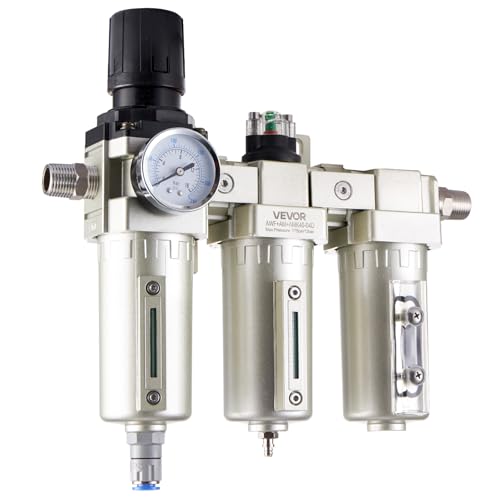
VEVOR 1/2" NPT 3-Stage Air Filter Regulator
Designed for clean shop air during spray painting and auto repairs, this three-stage system strips moisture and particulate down to 0.1 microns. An automated float drain and durable 175 PSI aluminum housing ensure reliable, low-maintenance air line regulation.
Pros
- Thorough three-stage filtration down to 0.1 microns
- Automatic float-style water drainage prevents buildup
- Durable, corrosion-resistant aluminum alloy build
- High 175 PSI maximum working pressure rating
- Integrated desiccant stage delivers dry air for painting
Cons
- Desiccant dryer media requires periodic maintenance and replacement
- Requires reduction adapters for 1/4-inch or 3/8-inch lines
- Weighs 6.6 pounds, requiring rigid wall mounting
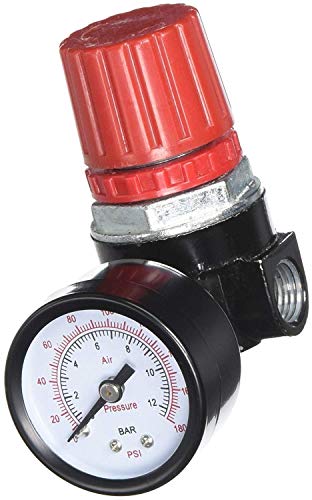
Apex Tool Supply AB-9051114 Replacement Air
The Apex Tool Supply AB-9051114 is a lightweight replacement pressure regulator engineered to restore accurate line pressure on compatible Bostitch, Husky, Hitachi, and Craftsman compressors. Weighing just 0.35 pounds, it gives DIYers and trim carpenters an affordable way to resolve creeping pressure or air leaks without replacing their entire machine.
Pros
- Cost-effective solution to repair erratic line pressure or internal regulator leaks on compatible compressors
- Compact, lightweight 0.35-pound profile fits neatly inside standard compressor shroud layouts
- Direct replacement fit for compressors using OEM part number AB-9051114 across Bostitch, Husky, Hitachi, and Craftsman models
- Restores predictable PSI adjustment for finish carpentry, punch-list tasks, and tire inflation
Cons
- Arrives in bulk packaging as a bare regulator body without replacement gauges, fittings, or thread sealant
- Requires verifying specific manifold port threading and compressor model part numbers prior to purchase
- Does not resolve compressor pump, motor, or tank check valve issues unrelated to pressure regulation
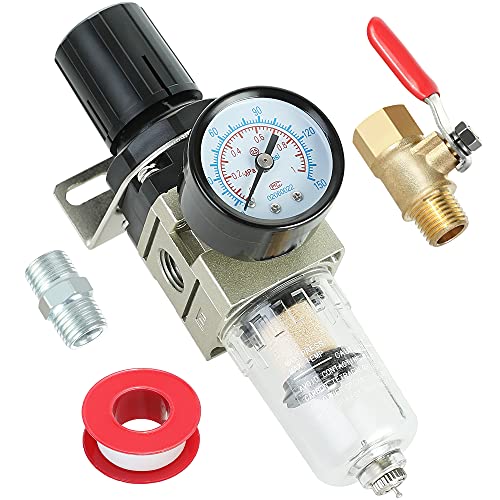
Hromee AW2000-02 1/4-Inch Filter Regulator
Designed for compact workspaces, this piggyback system integrates moisture filtration and pressure regulation into a single unit. Its brass filter element helps protect pneumatic tools from water and debris, while the included bracket and shutoff valve simplify setup.
Pros
- Durable brass filter element resists wear over time
- Dual-unit gauge provides clear pressure readings
- Compact piggyback design suits space-constrained setups
- Includes shutoff valve, bracket, and seal tape
Cons
- Requires manual operation to drain collected fluids
- Pressure capacity is capped at 150 PSI
SNS AR2000-N02 1/4 NPT Air Regulator
Designed for pneumatic systems requiring low-pressure control, the SNS AR2000-N02 regulates airflow between 7 and 42 psi. Its aluminum alloy housing, bundled pressure gauge, and mounting bracket offer an accessible solution for light-duty compressor setups.
Pros
- Sturdy aluminum alloy construction
- Includes dedicated mounting bracket and pressure gauge
- Locking knob prevents accidental adjustment
- Supports flow rates up to 19.4 SCFM
Cons
- Limited to low-pressure tasks under 42 psi
- Minimum regulated threshold begins at 7 psi
How an Air Compressor Regulator Controls Outlet Pressure
An air regulator sits between the compressor’s stored-air supply and the downstream hose or tool. Its job is to restrict or admit air as needed to maintain a selected outlet pressure within the regulator’s operating range. The tank pressure remains a separate condition, and the regulator does not change the pressure switch settings that control when the compressor motor starts and stops.
Most regulators use an adjustment knob, an internal spring and diaphragm, and a valve that responds to changes in downstream pressure. Turning the knob changes spring force, which establishes the pressure setting; the diaphragm senses outlet pressure and moves the valve to admit or restrict air. The exact internal design varies, but the practical result is a controllable pressure supply for connected equipment.
Tank pressure and regulated pressure are different readings
A compressor may store air at a pressure higher than the amount needed by a nailer, inflator, or other tool. The tank gauge, if fitted, indicates pressure in the tank, while a gauge connected to the regulator’s outlet indicates the pressure downstream. Some regulators have only an outlet gauge, so identify which port and gauge you are reading rather than assuming every dial reports tank pressure.
The Dreyoo regulator listing explicitly notes that it cannot measure pressure inside the storage tank. It has two gauge ports intended for monitoring regulated output from different viewing angles, with gauges not included. This distinction matters when diagnosing a compressor that cycles normally but supplies a tool with a different pressure than expected.
A regulator can control pressure, but it cannot increase the compressor’s air-production capacity. If a tool consumes air faster than the pump can replenish it, outlet pressure can fall during use even though the regulator is adjusted correctly. This is especially relevant for sustained air demand; a pressure setting alone does not tell you whether the compressor can supply the required airflow.
What happens as a tool draws air
With no air flowing, the outlet may reach the selected pressure and remain near that setting. Once a tool opens its valve, air moves through the regulator, hose, couplers, and tool. The regulator responds to the downstream pressure change, but every part of the delivery path can contribute to a pressure drop, particularly when airflow demand is high or a component is restrictive.
For that reason, a static gauge reading is not always the pressure a tool experiences while operating. Check the gauge while the tool is drawing air when the tool’s instructions allow that approach, and compare the pressure behavior with the tool maker’s stated requirements. If the reading sags substantially, investigate airflow supply and restrictions instead of simply turning the knob higher.
Do not exceed the maximum pressure specified for the tool, hose, regulator, or other connected equipment. A regulator’s range is not permission to operate every component at its upper limit. Follow the equipment manufacturers’ instructions, use suitable eye and hearing protection around operating air equipment, and depressurize the tank completely before servicing fittings or removing a regulator.
Setting the Regulator for a Pneumatic Tool
Start with the tool manufacturer’s recommended operating pressure and the regulator’s labeled range. The products in this selection do not all serve the same pressure range or connection size, so verify those details before installation or adjustment. A standard regulator marked for a broad range is not interchangeable by assumption with a low-pressure model intended for a narrower application.
Many adjustable regulators use a pull-up, turn, and push-down control. The SNS AR2000-N02 listing says to pull up the rotary knob, turn clockwise to increase pressure and counterclockwise to decrease it, then use the knob’s lock action as described. Hromee’s listings also describe pulling up and turning the adjustment knob. Controls differ by product, so follow the specific instructions supplied with the regulator.
Choose a setting with the tool specification in view
Use the operating pressure specified by the tool maker rather than choosing a setting based on the compressor’s maximum tank pressure. A brad nailer, impact tool, and spray gun can have different pressure requirements, and the regulator should be set for the connected tool and task. If the product instructions give a range, remain within it and account for the fact that line losses can affect pressure at the tool.
For spray finishing, stable pressure and clean, dry air both matter, but a regulator alone does not remove moisture or contaminants. The Hromee filter-regulator combinations add a brass filter element intended to capture moisture and fine particles, while the VEVOR unit combines filtration, desiccant drying, and regulation. These features address air treatment as well as pressure control, but users still need to follow the manufacturers’ maintenance directions.
When setting pressure, make small adjustments and watch the outlet gauge rather than making a large turn and guessing at the result. If pressure does not change as expected, confirm that the knob is unlocked if the design has a lock, check the gauge and connections, and consult the product instructions. Avoid forcing a stiff control or disassembling a pressurized assembly.
Account for flow, hose, and coupler restrictions
A regulator must be compatible with the airflow and connections in the intended system. The SNS standard-pressure regulator lists a rated flow of 19.4 SCFM and 1/4-inch NPT threads, while the Beduan BR4000 lists a 1/2-inch NPT inlet and a 0-to-145-PSI operating range. Those specifications describe different configurations; they should not be treated as evidence that either one fits every compressor or tool setup.
Thread size is only one part of compatibility. Confirm whether each port is male or female, whether the thread standard matches, and whether the installation orientation follows any airflow arrow on the body. The VEVOR filter-regulator listing calls for aligning airflow with the marked arrow and cleaning ports and fittings before installation. Use appropriate thread sealing methods as directed by the product maker, and avoid overtightening components.
A narrow hose, quick-connect fitting, or filter can restrict flow even when the regulator is set correctly. If pressure holds while idle but drops during tool use, inspect the full path from compressor outlet to tool rather than assuming the regulator has failed. The linked spray-gun air supply article offers related context for matching a regulated line to a finishing application.
Choosing Between a Regulator and a Filter-Regulator
A basic regulator is appropriate when the air is already suitably clean and dry for the tool, and the main need is outlet-pressure control. Replacement valves can also make sense when an existing compressor regulator is damaged, worn, or unstable, provided the replacement’s port arrangement and pressure range match the equipment. Compatibility descriptions should be checked against the compressor model and actual connection layout, not taken as a universal fit guarantee.
The AB-9051114 replacement options are described for Bostitch, Husky, Hitachi, Craftsman, and Senco systems, but the supplied product information does not give a complete model-by-model fit list. Compare the part reference, mounting arrangement, port threads, and original component before ordering. The Apex Tool Supply listing identifies the replacement part and named brands, while the PAOSDKSUI listing also recommends thread tape for installation; follow the instructions applicable to the specific part.
A filter-regulator combination adds moisture and particle management upstream of pressure adjustment. Hromee offers 1/2-inch and 1/4-inch configurations in the supplied data, both described with a brass filter element, gauge, and drain arrangement. Its 1/2-inch model lists a semi-automatic drain, while the 1/4-inch model lists a manual drain and includes a ball valve; verify the exact package and ports before buying.
The VEVOR assembly is a more involved air-treatment option, with staged filtration, a desiccant drying stage, automatic drainage, and a listed maximum working pressure of 175 PSI. That specification is a component limit, not a target pressure for every tool or compressor. Check the operating limits of the compressor, connected equipment, and fittings, and keep moisture-control components maintained according to their instructions.
Read product specifications as a system, not a single number
For a replacement, compare port size, thread type, pressure range, gauge ports, mounting bracket, and whether filtration is needed. The Beduan BR4000 listing specifies a 1/2-inch NPT female inlet, 0-to-145-PSI operating pressure, and 160-PSI maximum working pressure. Those figures describe that listed unit only and should not be applied to another product in the group.
The Dreyoo product lists a 0-to-150-PSI adjustable range and 1/4-inch NPT inlet and outlet ports, with 1/8-inch NPT gauge ports. The SNS standard-pressure model also lists 1/4-inch NPT threads and a 0-to-150-PSI adjustment range, while the SNS low-pressure version is listed for 7-to-42 PSI. A low-pressure range may be useful for equipment requiring finer control in that band, but it is unsuitable if the needed setting is outside its stated range.
Names and brand compatibility are not substitutes for checking the physical assembly. Some products include a bracket or gauge, while others specify gauge ports without including gauges. Confirm what is supplied, how the unit mounts, and whether the gauge scale and connection arrangement suit the planned installation.
Recognizing Regulator Problems
An outlet reading that will not respond to the adjustment knob can point to a locked control, an incorrect gauge, a blocked passage, or a regulator fault. A reading that rises or falls unexpectedly may also reflect a leak, changing tank pressure, or air demand beyond the system’s ability to maintain flow. Check simple causes first, including loose fittings and whether the gauge is installed at the outlet being monitored.
Air escaping around the regulator body or adjustment area is a reason to stop and inspect the assembly according to its manual. Do not attempt to service a pressurized regulator. Shut the compressor off, disconnect the air supply where appropriate, and release stored pressure safely before tightening or replacing fittings; if the leak persists or the cause is unclear, seek qualified service.
A filter bowl that collects liquid needs attention before it reaches the product’s marked limit. Drain arrangements vary: some units are manual, some semi-automatic, and some list automatic drainage. Follow the product instructions, dispose of drained liquid appropriately, and do not assume a drain mechanism is working simply because the unit has one.
Separate a pressure-setting issue from an airflow issue
If the gauge shows the desired pressure at rest but the tool slows or behaves inconsistently, the cause may be insufficient airflow, a leak, or restriction in the hose and fittings rather than a bad pressure setting. Compare the tool’s air requirement with the compressor’s documented delivery and consider whether the task is intermittent or continuous. The product information supplied for these regulator options does not provide compressor CFM data, so it cannot establish whether a particular compressor can sustain a specific tool.
Check connections for leaks using the safe method recommended by the equipment manufacturer, and examine hoses and couplers for visible damage or obstruction. Do not raise the regulator above the tool’s permitted pressure to compensate for a flow problem. A higher setting can create a safety or finish-quality problem without increasing the pump’s air-production capacity.
If the regulator itself is suspected, compare its behavior with a known accurate gauge where suitable, and inspect the product for damage only after depressurizing the system. A regulator that cannot hold a stable setting or shows persistent leakage may need replacement. Select a replacement based on the required range, flow rating, ports, and application rather than brand name alone.
Installation and Safe Use Considerations
Install the regulator in the direction indicated on its body and use the correct fittings for the listed port threads. Keep the assembly accessible enough to read its gauge and operate its control, and support it with the supplied bracket when the product calls for one. If the regulator includes a filter bowl, orient and maintain it as instructed so drainage and inspection remain practical.
Turn off the compressor and completely depressurize the tank before removing a regulator or servicing connected fittings. Follow the compressor and regulator manuals for isolation and pressure-release procedures, and never alter pressure-switch settings or bypass a safety device to make a regulator behave differently. Use suitable eye protection, and wear hearing protection when operating air equipment in noisy surroundings.
After installation, inspect the connections and run the system according to the manufacturer’s directions. Watch the outlet gauge as the tank pressure changes and, where appropriate, as air flows through the tool. Confirm that the selected pressure remains within every connected component’s rating and that the assembly does not leak before putting it into routine service.
For moisture-control units, follow the specified drain routine and do not let collected liquid exceed the marked limit. Tank condensate is a separate maintenance concern from the regulator’s outlet-pressure setting, so maintain the compressor tank as its manufacturer directs. Depressurize completely before transporting or servicing equipment, and do not rely on the regulator knob to make a tank safe to open.
Practical Takeaway
A regulator works by using an adjustable control and pressure-responsive valve to manage the air pressure delivered downstream, while leaving tank pressure and compressor output capacity as separate issues. Choose a unit whose pressure range, flow rating, ports, and mounting suit the system, and add filtration or drying only when the application calls for it. Set pressure from the tool maker’s instructions, check behavior under airflow, and investigate restrictions or leaks rather than using excessive pressure to mask them.
About the author
Glenda Taylor has extensive experience in residential construction, remodeling, home improvement, and tool use. Her practical approach to equipment evaluation focuses on usability, performance, safety, and value—helping DIYers and workshop users make better-informed decisions about compressors and related tools.