
Can You Use 6 Gallon Air Compressor for Paint Sprayer
Can you use 6 gallon air compressor for paint sprayer? Match the gun’s air demand to compressor output and tank capacity for November 2026.
 By Clint DeBoer
Updated November 10, 2026


A paint sprayer can empty a small compressor’s stored air faster than the pump can replace it, which may cause pressure to sag during a pass. The key question behind can you use 6 gallon air compressor for paint sprayer is not just tank size: check the sprayer’s air consumption against the compressor’s delivered airflow at the pressure you plan to use. A six-gallon tank can be suitable for some intermittent or lower-demand spraying, but it does not guarantee steady airflow for every gun or coating. The products listed here include six-gallon compressors, larger portable tanks, and a spray gun with stated air consumption, so their specifications offer useful points of comparison.
For a finish-sensitive job, airflow alone is not the whole setup. Regulation, moisture control, hose restrictions, and the compressor’s ability to keep up all affect whether the gun receives consistent air. A buyer comparing a compact pancake model with a quieter, larger-tank compressor can also review our air compressor spray gun guide and pancake compressor options for related equipment context.
Top Products
| Award | Product | ACR Score About ACR ScoreThe ACR Score is our own rating from 0 to 10, based on performance, design and build, ease of use, and value. It reflects independent research and is never influenced by manufacturers, retailers, or affiliate commissions. Learn more › | |
|---|---|---|---|
| Best Overall |
VELPAX 6.4-Gallon 2HP Quiet Air Compressor
|
8.9/10 | Buy |
| Best Budget |
 Baotree 4-Gallon 110 PSI Air Compressor |
8.8/10 | Buy |
| Best Value |
 MZB MZB-1100H-24 6.4-Gallon Air Compressor |
8.8/10 | Buy |
 Jacquard YouCAN Refillable Air Powered Spray Can |
8.6/10 | Buy | |
 MZB MZB-900H-24 6.4-Gallon Air Compressor |
8.6/10 | Buy | |
| Best Premium |
 Baotree 8-Gallon 150 PSI Air Compressor |
8.6/10 | Buy |
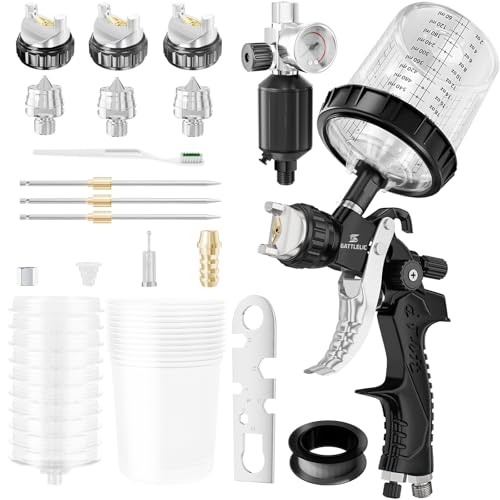 GATTLELIC 3-Nozzle HVLP Spray Gun Kit |
8.4/10 | Buy | |
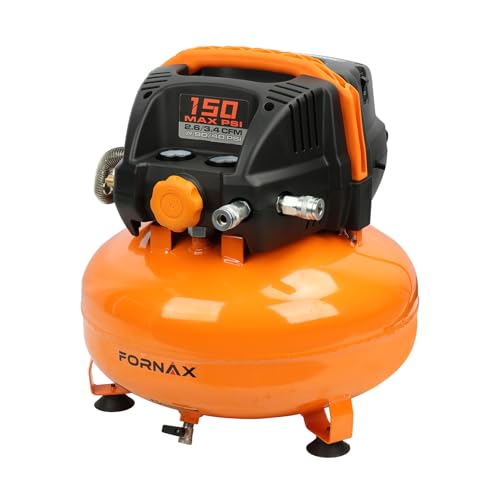 FORNAX 6-Gallon Pancake Air Compressor |
8.4/10 | Buy | |
 FORNAX 6-Gallon Pancake Air Compressor: 150 PSI |
7.8/10 | Buy |
VELPAX 6.4-Gallon 2HP Quiet Air Compressor
Delivering 6.71 CFM at 115 PSI while operating at just 60 decibels, this 6.4-gallon unit is built for noise-conscious workshop and garage tasks. Its oil-free 2HP motor provides reliable airflow for painting, nailing, and tire inflation with minimal upkeep.
Pros
- Quiet 60 dB noise level for indoor workshops
- Maintenance-free oil-less motor design
- Strong 6.71 CFM airflow rating at 115 PSI
- Equipped with built-in overload protection
- Integrated handle and drain valve for easy operation
Cons
- Lacks transport wheels for a 6.4-gallon tank
- Single air outlet restricts multi-tool operation
- 115 PSI maximum pressure limits heavy-duty commercial tools
Baotree 4-Gallon 110 PSI Air Compressor
Built for light household maintenance and small DIY crafts, this lightweight Baotree unit delivers up to 110 PSI with quiet operation. Its compact four-gallon tank and manageable 18.7-pound frame make it easy to transport between garage and home workspaces.
Pros
- Lightweight build under 19 pounds for effortless transport
- Low-noise motor suitable for indoor or residential use
- Built-in automatic overpressure shutoff enhances safety
- Clear analog gauge enables straightforward pressure monitoring
Cons
- Low 0.6 SCFM output limits high-demand pneumatic tools
- Modest 0.5HP motor unsuitable for heavy-duty workshop jobs
- 110 PSI ceiling restricts high-pressure air requirements
MZB MZB-1100H-24 6.4-Gallon Air Compressor
Built for garage and workshop tasks, this compressor delivers 7.41 CFM at 115 PSI while keeping sound output down to 70 decibels. Its oil-free 1.5 HP motor fills the 6.4-gallon steel tank in 60 seconds, offering reliable air delivery for nailing, blowing, and spray finishing.
Pros
- Fast 60-second tank fill time
- Quiet operation at 70 decibels
- High 7.41 CFM delivery at 115 PSI
- Oil-free design requires minimal routine upkeep
- Integrated wheels for easier positioning
Cons
- Maximum operating pressure capped at 115 PSI
- Requires access to a 110V electrical outlet
MZB MZB-900H-24 6.4-Gallon Air Compressor
Delivering 5.65 CFM at 115 psi, this 1.2 HP oil-free unit rapidly pressurizes its 6.4-gallon tank in about one minute while maintaining a low 70-decibel noise output. It serves well for home garages and workshops handling nail guns, air tools, and light painting.
Pros
- Quiet 70 dB operating volume
- Fast tank recovery under 65 seconds
- Generous 5.65 CFM output at 115 psi
- Low-maintenance oil-free motor design
- Integrated wheels assist mobility
Cons
- Steel construction adds significant carrying weight
- Tank capacity limits continuous heavy spraying sessions
- Corded operation requires standard electrical outlet
Baotree 8-Gallon 150 PSI Air Compressor
Built for garage DIYers tackling tire inflation, brad nailing, and light spray painting, this 8-gallon unit pairs a 2HP motor with a stable 30.8-pound frame. It supplies up to 150 PSI safely on standard 120V household power while keeping operating noise low.
Pros
- Generates up to 150 PSI for versatile tool use
- Low operational noise suitable for home workspaces
- Built-in automatic overpressure shutoff enhances safety
- Clear pressure gauge makes air delivery easy to read
- Relatively compact 30.8-pound build for an 8-gallon tank
Cons
- 2.8 SCFM at 90 PSI restricts heavy continuous air tools
- Requires regular oil level checks and ongoing maintenance
- Weight of nearly 31 pounds may require two hands to move
GATTLELIC 3-Nozzle HVLP Spray Gun Kit
Designed for automotive work and furniture refinishing, this GATTLELIC spray gun kit provides three interchangeable nozzle sizes alongside an integrated air filter regulator. Its disposable cup system minimizes cleanup time while reducing paint and solvent waste.
Pros
- Includes three nozzle sizes for varied coatings
- Disposable cups reduce solvent use and cleanup time
- Integrated air regulator features a built-in filter
- Brass 15-hole cap produces uniform atomization
Cons
- Requires matching needle swaps with every nozzle change
- High air demand at 275 liters per minute
- Total kit weight exceeds 3.2 pounds
FORNAX 6-Gallon Pancake Air Compressor
The FORNAX 6-Gallon Pancake Air Compressor delivers 2.6 CFM at 90 PSI and up to 150 PSI of maximum pressure, featuring dual couplers and a lightweight 28.8-pound portable footprint. It is a practical pneumatic power source for DIY homeowners, finish carpenters, and garage hobbyists driving nailers or managing tire inflation.
Pros
- Dual quick-connect couplers allow two nailers to operate simultaneously without adding an external splitter manifold
- Generous 6-gallon air tank capacity with a 150 PSI maximum pressure ceiling provides a dependable air reserve
- Lightweight 28.8-pound profile simplifies one-handed carrying up stairs and transport into work vans
- Maintenance-free oil-free pump eliminates oil checks, oil changes, and mess around finished work surfaces
Cons
- Operating sound output rated at 95 dBA is loud and makes hearing protection necessary, especially in closed rooms
- Airflow output of 2.6 CFM at 90 PSI cannot support continuous-demand tools like sanders, grinders, or paint sprayers
- Supplied as a bare-tool compressor without an included air hose, tire inflator chuck, or pneumatic nailers
FORNAX 6-Gallon Pancake Air Compressor: 150 PSI
The FORNAX 6-gallon pancake air compressor delivers 2.6 CFM at 90 PSI and 150 max PSI with dual couplers and an oil-free pump, weighing in at an easy-to-carry 28.8 pounds. It is a practical setup for DIY homeowners and finish carpenters tackling trim nailing, tire inflation, and workshop blow-off tasks.
Pros
- Dual quick-connect couplers support running two pneumatic nailers simultaneously
- Solid airflow delivery with 2.6 CFM at 90 PSI and 3.4 CFM at 40 PSI
- Manageable 28.8-pound portable weight simplifies one-handed transport
- Maintenance-free oil-free pump eliminates messy oil checks and changes
- Comes with a 14-piece accessory kit for out-of-the-box pneumatic utility
Cons
- High operating noise level rated at 95 dBA makes hearing protection mandatory, especially indoors
- Limited CFM output is unsuitable for continuous-demand air tools like HVLP paint sprayers or orbital sanders
- Fast-spinning 3,550 RPM motor generates noticeable vibration during recharge cycles
Using a Six-Gallon Compressor for Paint Spraying
Yes, a six-gallon compressor can run a paint sprayer when the compressor’s delivered airflow and pressure meet the gun’s stated requirements. The answer is conditional, not universal: a tank stores air, while the pump’s output determines how quickly the compressor can replenish it. A small tank may support short bursts or intermittent work, yet require frequent recovery pauses when a gun draws air continuously. Check both the gun and compressor specifications before buying or connecting them.
Why tank capacity does not settle the compatibility question
A gallon rating describes the tank’s nominal volume, not the quantity of air the pump can deliver indefinitely. Air pressure falls as a tool consumes the stored reserve, and the motor then runs to rebuild pressure. If the gun’s demand is higher than the pump’s output at working pressure, the tank only delays the mismatch. That delay can be useful for short sprays, but it cannot turn an undersized pump into a continuous-duty air source.
Tank pressure and regulated gun pressure are also different readings. A compressor may store air at a higher pressure than the gun requires, but a regulator reduces the outlet pressure to the gun’s specified range. The tank’s maximum PSI is not a substitute for an airflow rating, and it should never be raised beyond the manufacturer’s limit. Compare compressor CFM or SCFM at a pressure close to the sprayer’s operating pressure, rather than relying on maximum PSI alone.
Air delivery ratings need careful reading. CFM at 90 PSI and CFM at 40 PSI describe output at different pressures, so they are not interchangeable. A maximum-pressure number says how much pressure the system is designed to reach, but does not tell you how much air it can continuously supply while spraying. If a product listing omits delivered airflow at the gun’s working pressure, treat compatibility as uncertain and seek the manufacturer’s complete specification.
Compare the gun’s air consumption with pump output
The listed GATTLELIC HVLP Air Spray Gun with 1.4/1.7/2mm Nozzles & Air specifies air consumption of 275 L/min and a working-pressure range of 2.5 to 3.5 bar. Those figures are a starting point for matching a compressor. Convert units consistently if the compressor specification is in CFM, then compare the gun’s demand with delivered output at the relevant pressure. Avoid treating the compressor’s maximum PSI as proof that it supplies enough volume.
The included gun description also identifies an air regulator and reusable filter, which can help the operator control pressure and address particulate filtration at the gun connection. It does not establish that the kit removes all moisture or oil from compressed air. Paint finishing may require additional air preparation based on the coating, gun instructions, and finish expectations. Follow the coating and tool makers’ instructions for filtration, pressure, and safe handling.
Do not compare a gun’s required flow with a compressor’s intake displacement or an unqualified peak figure and assume the numbers match. Delivered airflow under pressure is the useful comparison. If the pump output equals the gun’s stated consumption only under ideal or differently stated conditions, there may be little reserve for hose losses, pressure changes, or other air use. A margin above the tool’s requirement is generally a more practical target, but use manufacturer data rather than an invented universal multiplier.
What the listed compressor specifications tell you
The FORNAX Pancake Air Compressor with two couplers is listed with a six-gallon tank, 150 PSI maximum pressure, and 2.6 CFM at 90 PSI. It is also described as oil-free and rated at 95 dB(A). That 90 PSI airflow figure is more useful for tool matching than the 150 PSI maximum, although the spray gun’s pressure range should still guide setup. The supplied information does not state this compressor’s duty cycle or confirm continuous paint spraying, so do not assume it can run a high-draw gun without pauses.
Two MZB 6.4-gallon listings show different stated airflow figures. One lists 7.41 CFM at 115 PSI, while another lists 5.65 CFM at 115 PSI; both descriptions state a 70 dB noise level and oil-free operation. These ratings are not directly equivalent to CFM at 90 PSI, and product descriptions do not provide all operating details needed to predict sustained spray time. Confirm the exact model’s full specifications and ask the seller or manufacturer to clarify any missing airflow or duty-cycle information.
The VELPAX Ultra Quiet Air Compressor, Only 60dB, is listed with a 6.4-gallon tank, 6.71 CFM at 115 PSI, and a maximum working pressure of 115 PSI. Its product description identifies an oil-free pump and a 2 HP motor. Those are listed specifications, not independent test results, and the airflow rating is at 115 PSI rather than at the spray gun’s exact operating pressure. Its stated low noise level may be relevant for an indoor workspace, but airflow compatibility still comes first.
The Baotree Portable Air Compressor has a four-gallon tank and is listed at 0.6 SCFM at 90 PSI and 1.0 SCFM at 40 PSI. Its description mentions small spray guns and small paint jobs, but that broad wording should not replace checking a particular gun’s air requirement. The Baotree eight-gallon option is listed at 2.8 SCFM at 90 PSI and 3.8 SCFM at 40 PSI, with a 150 PSI maximum. Its larger tank provides more stored volume than the six-gallon models, but the stated 90 PSI output remains the relevant number for sustained demand.
Intermittent spraying versus a long continuous pass
Short bursts, small projects, and pauses between passes give a portable compressor time to recover. A long, uninterrupted pass asks the pump to supply air while the gun is consuming it, making delivered CFM and duty-cycle guidance more important than tank capacity alone. If the tank pressure drops during a pass, atomization and spray consistency may change. Stop and allow the system to recover rather than trying to compensate by increasing pressure beyond the tool’s instructions.
Some spray tasks draw less air than others, and nozzle selection, coating viscosity, gun adjustments, and technique can affect the working demand. Do not assume that changing to a smaller nozzle automatically makes an incompatible compressor suitable. The supplied GATTLELIC gun lists three nozzle sizes, but the product information gives one air-consumption figure rather than separate demand figures for each tip. Treat the stated consumption as the available reference unless the manufacturer provides more detailed data.
Compare the expected rhythm of the job with compressor recovery rather than focusing on a single tank-fill claim. The supplied listings do not provide comparable recovery times from cut-in to cut-out under a spray load. A tank may refill quickly when no tool is running yet fall behind during continuous use. If the manufacturer does not publish a duty cycle, ask how the compressor is intended to be operated and avoid assuming that a small portable unit is rated for uninterrupted spraying.
Intermittent pneumatic tools are a different case. A nailer typically consumes air in short events, leaving gaps for recovery, while a spray gun can draw air throughout a pass. That distinction explains why a compressor that seems adequate for inflation or occasional nailing may struggle with paint finishing. For more context on matching tools to airflow, our portable compressors for air tools guide discusses the importance of application and air demand.
Pressure regulation, hose losses, and clean air
Set the gun’s inlet pressure according to its instructions, checking the pressure at the gun if the manufacturer recommends that method. A regulator mounted at the tank may show a different pressure from the pressure available at the tool while air is flowing. Hose length, fittings, and restrictions can contribute to pressure loss, especially when the gun is drawing air. Keep connections suitable for the equipment and inspect them for leaks before starting a finish coat.
Use the regulator to control working pressure, not to compensate for inadequate airflow. Raising the regulator setting may increase demand and can push the gun outside its specified range. If pressure falls while spraying, check the compressor output, tank recovery, hose connections, and filter condition. Follow the compressor and spray-gun manuals for regulator adjustment and do not alter factory pressure-switch settings or safety devices.
Water and oil contamination can spoil a coating, while dust entering the air path may affect the finish or tool. The supplied options include oil-free compressor designs, which avoid adding pump oil to the compressed-air stream through an oil-lubricated pump, but oil-free does not mean moisture-free. Compressed air can still contain water vapor that condenses as it cools. Use appropriate filtration and moisture control for the coating and gun, and maintain components according to their manufacturers.
Drain accumulated moisture from the tank according to the compressor manual, using its specified procedure and location. Depressurize the tank completely before servicing or transporting the compressor, and never remove fittings while the tank is pressurized. Wear suitable eye and hearing protection when operating air equipment. A safe setup also keeps the compressor stable, its ventilation unobstructed, and its electrical connection consistent with the product’s stated requirements.
When a six-gallon unit is a sensible match
A six-gallon compressor may be a practical match if its delivered airflow at the required pressure meets the gun’s stated demand and the manufacturer allows the intended operating pattern. Small, occasional jobs with pauses are more forgiving than continuous production work. Verify the exact compressor model, not just a similar product name or tank size, because listed airflow varies across the options here. Also check whether the seller publishes a duty cycle and an airflow figure at the pressure the gun actually uses.
A larger tank can provide a bigger temporary reserve, but it does not necessarily provide a higher ongoing air supply. The Baotree eight-gallon model’s listed 2.8 SCFM at 90 PSI illustrates why both tank capacity and airflow belong in the comparison. A buyer considering longer spray passes should prioritize sustained output and manufacturer duty guidance, then view additional tank volume as a buffer rather than a substitute for pump capacity. If these details are unavailable, a compressor marketed for spray painting is not automatically proven suitable for a particular gun.
Noise can also influence the choice in a home garage, but it is separate from spray compatibility. The supplied FORNAX listing states 95 dB(A), the MZB listings state 70 dB, and the VELPAX listing states approximately 60 dB. These are product-description figures, and the provided data does not establish common measurement conditions across models. A quieter listed figure may be attractive indoors, yet it should not outweigh an airflow shortfall for the intended coating work.
Motor horsepower figures are similarly incomplete as a standalone selection tool. Listings include horsepower claims, but the supplied information does not establish a uniform continuous-output measurement method across brands. Use the stated air delivery at pressure, tank size, electrical requirements, and duty-cycle information when available. Avoid treating a horsepower label or a maximum-pressure rating as a direct measure of how well the compressor will sustain a paint gun.
Check electrical and operating limits before spraying
Confirm the voltage and supply requirements on the compressor nameplate and in its manual before connecting it. The product listings identify 110V or 120V power for several models, but they do not provide running amperage or startup inrush current for each option. Do not assume a circuit will handle the compressor simply because the plug fits. Avoid overloading a shared circuit, and follow the manufacturer’s guidance for any extension cord or power arrangement.
Continuous motor cycling can create heat and may trigger thermal protection if the compressor is operated beyond its intended limits. The supplied product descriptions do not give comparable duty-cycle ratings, so a buyer should obtain that information before planning extended spray sessions. Stop if the unit overheats or its protection trips, and use the prescribed reset and cooling instructions. Never bypass thermal protection, pressure controls, or the safety relief valve.
Check the compressor’s gauges and listen for leaks before applying paint. Confirm that the tank pressure reaches its normal operating range, the regulator responds, and the hose remains secure during airflow. Do not try to raise the compressor’s cut-out setting to improve spray performance. If the gun’s demand exceeds the compressor’s documented delivery or the compressor cannot maintain stable operation, use a properly rated air source rather than forcing the setup.
For paint work, the practical decision is straightforward: six gallons can work for a compatible gun and an intermittent job, but the tank label alone cannot establish that match. Compare the gun’s stated air consumption with delivered compressor airflow at the working pressure, confirm the intended duty cycle, and account for filtration and moisture control. If the necessary specifications are missing or the pump cannot keep up, choose a better-documented source with adequate sustained airflow.
About the author
Clint DeBoer is an experienced tool-industry specialist with decades of involvement in technical media, hands-on product evaluation, and testing methodology. His focus on performance, practical usability, and data-driven comparisons makes his expertise highly relevant to professional air compressors, pneumatic tools, and workshop equipment.