
How Air Compressor Pressure Switch Works: Practical Guide
How air compressor pressure switch works, from cut-in control to unloader action, with replacement tips and product details for November 2026.
 By Tom Scalisi
Updated November 10, 2026
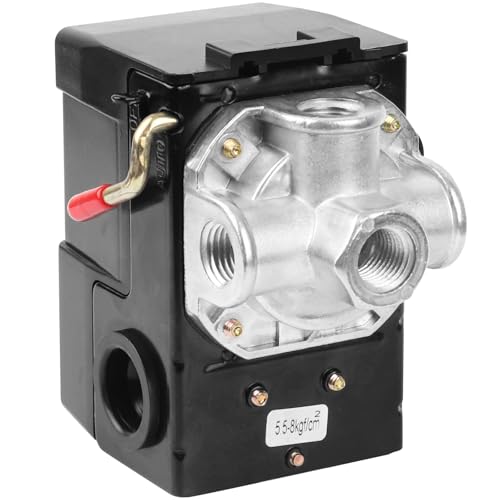

A compressor that starts and stops at the wrong pressure can interrupt tool work, strain the motor, or leave the tank short of usable air. Understanding how air compressor pressure switch works helps you distinguish normal automatic cycling from a switch, unloader, or compatibility problem. The products listed below are replacement pressure switches and control assemblies with different pressure ranges, electrical ratings, and port arrangements, so matching specifications matters more than choosing by appearance.
A pressure switch senses tank pressure and controls the compressor motor between two preset points. It does not create air, increase pump capacity, or replace the safety relief valve. Some listed assemblies also include gauges, regulators, relief valves, or an unloader connection, but those parts have separate jobs. For workshop context, see our home mechanic compressor guide and the overview of air compressors for paint spray guns.
Product Shortcode
| Award | Product | ACR Score About ACR ScoreThe ACR Score is our own rating from 0 to 10, based on performance, design and build, ease of use, and value. It reflects independent research and is never influenced by manufacturers, retailers, or affiliate commissions. Learn more › | |
|---|---|---|---|
| Best Overall |
LF10-4H Pressure Switch, 95-125 Psi 20 Amp
|
9.1/10 | Buy |
| Best Premium |
 Dreyoo Air Compressor Pressure Switch |
9.1/10 | Buy |
| Best Budget |
 QWORK Air Compressor Pressure Switch Manifold |
8.6/10 | Buy |
 Ketofa LF10-4H 4-Port Pressure Switch |
7.8/10 | Buy | |
| Best Value |
Dreyoo 135-175 PSI 4-Port Pressure Switch
|
7.8/10 | Buy |
 MEANLIN MEASURE 110 to 150 PSI Pressure Switch |
7.8/10 | Buy | |
 I.E.E LF10A 26A 4-Port Pressure Switch |
7.8/10 | Buy | |
 Secbolt Air Compressor Pressure Switch |
7.8/10 | Buy | |
 Square D 9013FHG12J52M1X 95-125 PSI Switch |
7.8/10 | Buy |
QWORK Air Compressor Pressure Switch Manifold
The QWORK Air Compressor Pressure Switch Manifold provides an integrated pressure switch, regulator, and dual gauges with a factory 90 to 120 PSI cycling range. It suits DIYers and shop owners looking to rebuild a compressor manifold, though American users must note its G1/4 BSP thread sizing requires adapters for standard NPT equipment.
Pros
- Factory-set 90 to 120 PSI cut-in and cut-out cycling provides stable air supply regulation
- Convenient pre-assembled manifold block integrates dual monitoring gauges and a pressure regulator
- Solid pressure tolerance capable of handling equipment setups up to 175 PSI maximum
- Reinforced ABS cover protects electrical switch contacts from shop dust and debris
Cons
- Features G1/4 BSP threaded ports, meaning standard 1/4-inch NPT American fittings will not thread directly without adapters
- Fittings are constructed from iron rather than solid brass, requiring careful sealing against moisture corrosion
- Adjustment instructions are minimal, requiring users to carefully verify cut-in and cut-out settings before operation
Ketofa LF10-4H 4-Port Pressure Switch
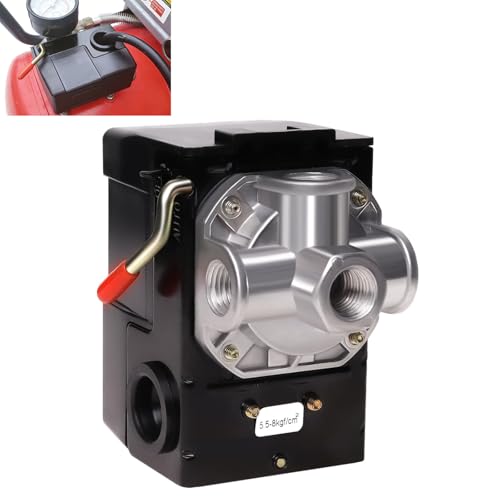
Built for single or two-stage air compressors, the Ketofa LF10-4H serves as a direct 95-to-125 PSI replacement control switch. It provides a standard four-port manifold alongside an integrated unloader valve and manual metal shut-off lever.
Pros
- Four-port manifold allows flexible component placement
- Pre-calibrated 95 to 125 PSI automatic pressure cycle
- Built-in unloader valve relieves head pressure effectively
- Sturdy metal manual shut-off lever
- Dual voltage compatibility for 120V and 240V motors
Cons
- Fixed pressure range cannot replace 135-175 PSI units
- Limited to 20A instead of 26A applications
- Requires matching a specific 6.3 mm unloader fitting
Dreyoo 135-175 PSI 4-Port Pressure Switch
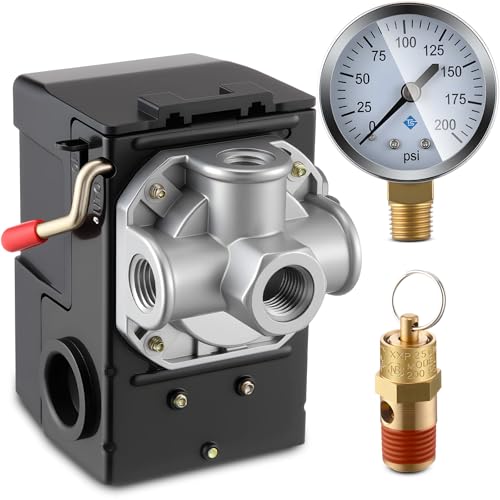
This all-in-one replacement switch kit simplifies compressor maintenance with its pre-installed gauge, brass safety valve, and universal four-port layout. It provides automated 135 to 175 PSI pressure control for single-stage and two-stage workshop compressors.
Pros
- Includes calibrated pressure gauge and brass safety valve
- Four standard 1/4-inch ports allow versatile component mounting
- Manual lever enables cut-in and cut-out fine-tuning
- Complete assembly enables quick plug-and-play installation
Cons
- Limited to 110-120V circuits, ruling out 240V setups
- Outer casing is plastic rather than full metal
- High operating range is unsuitable for low-pressure systems
MEANLIN MEASURE 110 to 150 PSI Pressure Switch
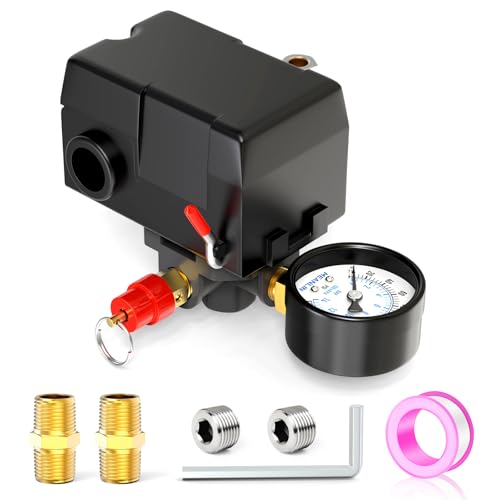
Designed for automatic cycling between 110 and 150 PSI, this 4-way replacement valve kit comes complete with safety fittings, pipe plugs, and sealing tape. It provides workshop owners a comprehensive drop-in assembly for restoring 1/4-inch air compressor systems.
Pros
- Includes complete installation hardware and safety relief valve
- Supports wide 110V to 240V electrical systems
- Durable aluminum alloy internal valve construction
- Convenient manual red knob for quick shutoff
Cons
- Preset 110 to 150 PSI cycle lacks adjustability
- Plastic switch casing is vulnerable to heavy impacts
- Restricted exclusively to standard 1/4-inch port connections
I.E.E LF10A 26A 4-Port Pressure Switch
Built for heavy-duty shop setups, this switch assembly supports up to 26 amps across single or three-phase air compressor systems. It includes an integrated 0-200 PSI gauge and pop-off safety valve for a complete manifold replacement.
Pros
- Heavy-duty 26-amp rating suits demanding motor setups
- Comes with matched pressure gauge and relief valve
- Four-port design offers versatile accessory connections
- UL Listed and CSA certified for electrical safety
Cons
- NEMA 1 enclosure is restricted to indoor environments
- Factory set strictly for 145-175 PSI compressor cycles
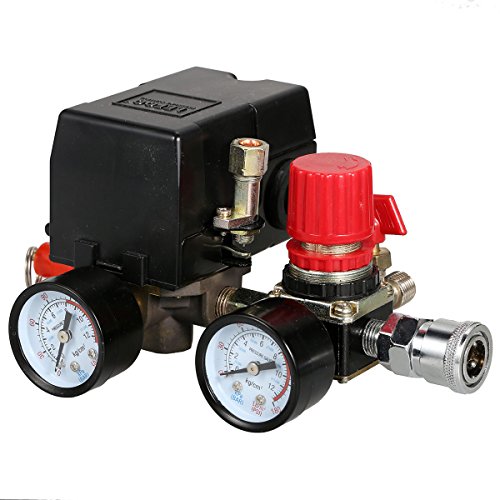
Secbolt Air Compressor Pressure Switch
The Secbolt Air Compressor Pressure Switch and Regulator Manifold assembly provides automatic 90 PSI cut-in and 120 PSI cut-off control alongside a 4-port 1/4-inch FNPT manifold and dual pressure gauges. It suits DIYers, home garage mechanics, and workshop owners rebuilding or replacing an all-in-one control setup on small stationary or portable compressors.
Pros
- All-in-one design integrates pressure switch, regulator, manifold block, and dual gauges into a single unit
- Standard 90 PSI cut-in and 120 PSI cut-off settings match common light-duty workshop compressor cycles
- Adjustable brass outlet coupler allows lowering air pressure for finish nailers and sensitive air tools
- Includes threadlocker compound to help seal tapered pipe threads during bench assembly
Cons
- Fixed 90 to 120 PSI pressure cycle is not suited for high-pressure two-stage compressors requiring 150 to 175 PSI
- Requires careful alignment and sealing of multiple threaded joints to prevent slow micro-leaks
- Electrical voltage and maximum motor amp ratings are not specified on the primary packaging, requiring verification before wiring heavy-draw motors
Square D 9013FHG12J52M1X 95-125 PSI Switch
Designed for air compressor systems, the Square D 9013FHG12J52M1X maintains operating levels between 95 and 125 psi. It incorporates an unloader valve and a dedicated on-off lever for reliable compressor cycling and manual control.
Pros
- Factory-calibrated 95 to 125 psi operation
- Built-in unloader valve prevents hard compressor starts
- Dedicated on-off lever allows easy manual shutdown
- Compact and lightweight footprint
Cons
- Single-port design limits direct accessory mounting
- Specific pressure range requires adjustment for custom PSI needs
How an Air Compressor Pressure Switch Controls Cycling
An air compressor pressure switch is an automatic electrical control: it starts the motor when tank pressure falls to its cut-in setting and stops the motor when pressure reaches its cut-out setting. The difference between those thresholds is the operating differential. A switch marked 95-125 PSI, for example, is described as starting the compressor at 95 PSI and stopping it at 125 PSI. The switch controls the cycle; the pump and tank determine how quickly pressure rises and how much stored air is available.
Pressure sensing, contacts, and the cut-in/cut-out cycle
Inside a conventional mechanical switch, tank pressure acts on a sensing element, commonly a diaphragm, against a spring mechanism. At the lower threshold, the mechanism closes the motor circuit; at the upper threshold, it opens the circuit. The product information here describes pressure ranges and automatic on/off control, but does not provide internal diagrams for every model. Treat the maker’s wiring diagram and settings for the exact compressor as authoritative rather than assuming all switches are internally identical.
Cut-in and cut-out are not interchangeable with a regulator setting. The switch thresholds govern the pressure range stored in the tank, while a regulator reduces pressure supplied downstream to a tool or hose. A compressor can therefore stop at its cut-out setting while the regulated outlet gauge shows a lower working pressure. That difference is normal when the regulator is set below tank pressure, provided the equipment is operating within its rated limits.
The switch must also be compatible with the motor circuit. Product listings include differing electrical ratings, including 20 amps at 120 volts or 12 amps at 240 volts for the LF10-4H model, and a separate 26-amp model listing. Those figures are ratings stated for the switch, not a claim about the current draw of every compressor motor. Compare the original switch label, motor nameplate, supply voltage, and manufacturer instructions before selecting a replacement.
What the unloader does when the motor stops
Some pressure switches have an unloader connection that vents a small amount of trapped air from the pump discharge line when the motor stops. The purpose is to reduce pressure against the pump head so the motor can restart more easily. This is different from draining the tank: the tank remains pressurized, and the unloader should not be treated as a tank drain or pressure-relief device. Several products here list a compression unloader connection, while the Square D Pumptrol listing describes an unloader and manual on/off lever.
A brief release of air around shutdown may be part of normal unloader operation, but ongoing leakage deserves attention. The cause could involve the unloader, its tube or connection, or the tank check valve that separates stored tank air from the pump line. Do not assume the pressure switch alone is defective based on a hiss. Consult the compressor documentation or a qualified service provider if the source is unclear, and never disable the unloader or safety relief valve to stop a leak.
Switch, gauge, regulator, and safety valve: distinct jobs
A pressure gauge displays pressure; it does not control the motor. A regulator adjusts downstream working pressure; it does not set the compressor’s automatic cut-out. A safety relief valve provides a separate protective function and must remain installed and unobstructed. Some listed replacement assemblies bundle a gauge and brass safety valve with the switch, but the inclusion of those parts does not make their functions interchangeable.
Four-port manifolds offer connection points for compatible components, but port count alone does not establish fit. The products described commonly list 1/4-inch NPT female ports, while QWORK specifies G1/4 BSP joints and explicitly warns that they are not compatible with NPT-threaded compressors. NPT and BSP threads are different standards. Check thread type, port layout, unloader connection size, and any fittings needed before ordering, rather than forcing a mismatched fitting into place.
Gauge readings also deserve sensible interpretation. The Dreyoo assembly is listed with a 0-200 PSI gauge and a stated reading error under plus or minus three percent, while other products give different included gauge details. A gauge is a useful indication, but do not use an uncertain reading to justify operating above the compressor’s rated maximum pressure. If gauges disagree substantially or readings do not make sense, stop and consult the compressor manufacturer or a service professional.
Matching replacement pressure ranges and port standards
Start replacement selection with the original compressor’s required cut-in and cut-out settings, not a guess based on tank size or tool type. The listings cover several distinct ranges: 95-125 PSI, 90-120 PSI, 110-150 PSI, 120-155 PSI, 135-175 PSI, and 145-175 PSI. These settings are not automatically interchangeable. A higher cut-out setting can exceed the pressure rating of a compressor component, and a lower cut-out can change the intended operating cycle.
For example, the QCG LF10-4H is listed for a 95-125 PSI cut-off range, with a 1/4-inch NPT female connection and a 6.3 mm unloader connection. Ketofa’s LF10-4H listing describes a similar pressure range and electrical ratings of 20 amps at 120 volts or 12 amps at 240 volts. Those similarities do not establish that either part fits every compressor using an LF10-4H style switch. Confirm the exact model, original wiring configuration, pressure range, thread standard, unloader tubing, and current rating.
Other products suit different specified pressure windows. Dreyoo’s options are listed at 120-155 PSI and 135-175 PSI, and its descriptions include four 1/4-inch NPT ports, a gauge, and a 200 PSI brass safety valve. I.E.E lists a 26-amp, four-port model with a 145-175 PSI setting. Those specifications describe the products, not a universal recommendation for compressors operating at those pressures. Use a higher-range switch only when the compressor manufacturer identifies it as suitable.
The Square D Pumptrol listing differs from the four-port options: it is described as a one-port 95-125 PSI switch with an unloader and on/off lever. Secbolt’s assembly is listed with four female 1/4-inch NPT ports, cut-in at 90 PSI, cut-out at 120 PSI, and an adjustable outlet regulator. QWORK’s product has a 90-120 PSI range but uses G1/4 BSP connections. These distinctions can determine whether an assembly is suitable, even if its pressure settings appear close to the original.
Reading product listings without assuming universal fit
Product titles can compress several important differences into a short label. Check the full specification for port count, thread type, voltage and current rating, factory pressure range, unloader provision, and included components. A four-port manifold may allow a gauge, relief valve, or outlet connection, but the arrangement still has to match the compressor and fittings. A bundled kit may simplify component sourcing, but it does not remove the need to verify compatibility.
The MEANLIN MEASURE product is listed with a 110-150 PSI cut-on/cut-off range and includes a safety relief valve, plugs, pipe fittings, a hex wrench, and thread tape. Its listed package contents should not be mistaken for proof that the fittings match every compressor. Likewise, the Dreyoo listings mention a red lever for fine-tuning. Avoid changing factory cut-in or cut-out settings unless the compressor maker specifically permits the adjustment and provides a safe procedure.
Brand name alone is not enough to identify a replacement. Square D is represented by a specific Pumptrol configuration, while other listings use LF10-4H descriptions and different ranges or port layouts. Even two switches with similar labels can differ in contact rating, thread standard, and unloader connection. Use the compressor model and the markings on the original switch as the starting point, then verify every relevant specification against the replacement documentation.
Safe checks before installing or troubleshooting
Pressure switches combine stored pneumatic energy with electrical connections, so inspection and replacement are not casual adjustments. Disconnect power using the procedure specified by the compressor manufacturer, and ensure the tank is completely depressurized before servicing fittings or removing a switch. If you cannot verify that power is isolated or pressure is fully released, stop and arrange qualified service. Wear suitable eye protection, and follow the compressor’s safety instructions throughout.
Before blaming the switch, compare the tank gauge reading with the specified cut-in and cut-out points during normal operation, without opening the electrical enclosure. Note whether the motor starts when pressure falls, stops when pressure reaches the listed cut-out, and whether air continues escaping after shutdown. A motor that fails to start can have causes beyond the switch, including a supply problem or a mechanical starting issue. Repeatedly resetting or cycling equipment without identifying the cause can create additional risk.
If a compressor fails to stop at its expected pressure, switch contacts may be one possibility, but the gauge, sensing passage, wiring, and control configuration may also need professional inspection. Turn off and isolate the unit according to its manual rather than allowing it to continue building pressure. Never rely on the safety valve as the normal means of stopping the pump. A switch that does not stop the compressor at its specified cut-out needs prompt attention.
A motor that starts and stops rapidly may reflect air consumption, a leak, a small tank reserve, or a pressure-control issue; the symptom alone does not identify a failed switch. Check for obvious air leaks only in a safe manner and compare the behavior with the compressor manual. If the compressor cycles while no tool is drawing air, or if pressure drops unexpectedly, have the system checked. Do not open or adjust the pressure switch while it is energized.
How switch settings affect real air use
The cut-in/cut-out range determines when the pump replenishes tank pressure, but it does not tell you whether the compressor can sustain a particular air tool. That depends on delivered airflow, tool demand, tank reserve, and operating pattern. The product data here concerns switches, not compressor CFM output, tank capacity, or recovery times, so it cannot establish whether a compressor will run a sander, impact wrench, or spray gun effectively. Check the compressor and tool specifications separately.
Intermittent tools and continuous-demand tools place different demands on a compressor. A nailer typically uses short bursts, while a sander or spray gun may draw air for longer periods. A larger cut-out number alone does not create more pump capacity; it only describes a pressure threshold. If the pump cannot keep up with sustained air use, pressure can fall even when the switch and its settings are correct.
Regulated outlet pressure also matters. The tank may contain air at a pressure above the tool’s required working pressure, while a regulator supplies a lower setting. Airflow restrictions, hose connections, and tool demand can affect pressure at the tool during use. For planning continuous pneumatic work, consult our portable compressor options for air tools and compare published air delivery with the tool manufacturer’s requirement.
Do not raise a pressure switch setting to compensate for weak airflow, a leaking connection, or an undersized compressor. Operating beyond the compressor’s stated maximum pressure can endanger the tank and connected components. If pressure falls under load, investigate air demand, leaks, regulator settings, and compressor specifications rather than changing the cut-out point. Follow manufacturer guidance for duty cycle and allow the pump to operate only within its stated limits.
Choosing among the listed switch styles
A buyer replacing a switch should prioritize exact operating and connection requirements over extra accessories. The LF10-4H options are relevant only when the compressor requires their pressure range, electrical rating, and connection arrangement. Four-port assemblies can be convenient where the existing setup uses a matching manifold, while a one-port Square D configuration may suit a different layout. Neither port count nor a familiar brand name makes a part universally interchangeable.
Included gauges and relief valves can be useful if they match the installation, but verify their ratings and connection details against the compressor documentation. The Dreyoo models list a 200 PSI brass safety valve and a 0-200 PSI gauge; this does not mean a compressor should be operated at 200 PSI. The compressor’s own maximum working pressure governs. A safety component must be appropriately rated and installed as specified, never plugged, removed, or treated as optional.
Adjustability can sound appealing, especially when a listing describes a lever for fine-tuning, but it creates a responsibility to preserve the compressor’s approved operating limits. The original pressure range is often selected to coordinate with the pump, tank, motor, and connected controls. An altered setting may cause a pump to run longer or expose components to an unsuitable pressure. If you need a different operating range, confirm suitability with the compressor maker rather than relying on a generic switch advertisement.
Price should not be the deciding specification. A lower-cost switch that uses the wrong thread standard or electrical rating is not a useful replacement, while a bundled assembly may include pieces the installation does not need. Compare the required part number, pressure thresholds, voltage and current rating, port configuration, and unloader connection before considering convenience or included accessories. Keep the product documentation with the compressor so later maintenance can be based on the installed specifications.
Confirming normal operation after service
After any service, use the compressor manufacturer’s commissioning instructions rather than an improvised test. The essential checks are that the unit starts and stops at its specified pressure points, the motor does not continue running beyond cut-out, and the unloader behaves as described for that model. Inspect for air leaks only by a safe method approved by the manufacturer. Keep clear of moving parts and use appropriate eye and hearing protection while operating the equipment.
Observe a complete automatic cycle without changing the switch settings. If the displayed pressure does not align with the specified range, or the motor fails to stop, switch the compressor off and seek service. If a fitting leaks or a connection appears mismatched, do not attempt to compensate with excessive force or an incompatible sealant. Depressurize the tank completely before any further work, and follow the manufacturer’s guidance for electrical isolation and component replacement.
Drain tank moisture according to the compressor instructions, since stored compressed air can collect condensate. Fully depressurize the tank before servicing or transporting the compressor, and use the specified drain procedure. Moisture management is separate from switch operation, but it supports responsible ownership of the air system. Never point an open drain or pressurized fitting toward people, and wear eye protection when handling compressed-air equipment.
The practical answer is to treat the pressure switch as a matched control component, not a universal accessory. Identify the required cut-in and cut-out range, electrical rating, thread standard, port layout, and unloader connection, then verify them against the compressor manual and original part markings. If the compressor will not cycle correctly after a compatible replacement, stop operating it and have the fault diagnosed rather than increasing pressure or bypassing a safety device.
About the author
Tom Scalisi brings more than two decades of experience in construction, building maintenance, contracting, and hands-on tool use. His practical understanding of power tools, automotive work, repairs, and jobsite equipment helps readers evaluate compressors based on real workloads rather than specifications alone.