
Can You Turn an Air Compressor Into a Pressure Washer?
Can you turn an air compressor into a pressure washer? Learn what air-powered washer attachments can do and where they fall short in November 2026.
 By Clint DeBoer
Updated November 10, 2026


Introduction
A garden hose can rinse loose dirt, but stubborn grime often calls for more cleaning force. That can make an air compressor seem like a handy shortcut, especially if one is already in the garage. The short answer to can you turn an air compressor into a pressure washer is usually no: an air compressor and a pressure washer move different working fluids, and a typical compressor isn’t designed to supply the steady water flow a pressure washer needs.
Some accessories use compressed air to help spray or atomize water, but they aren’t automatically equivalent to a conventional pressure washer. Their performance depends on the attachment’s design, the compressor’s air delivery, and its operating limits. Before buying an accessory or modifying equipment, check the manufacturer’s instructions and compare the tool’s air requirements with the compressor’s documented output. If you’re shopping for equipment to run pneumatic tools, this portable compressor guide for air tools covers a separate but related air-supply decision.
Product Shortcode
| Award | Product | ACR Score About ACR ScoreThe ACR Score is our own rating from 0 to 10, based on performance, design and build, ease of use, and value. It reflects independent research and is never influenced by manufacturers, retailers, or affiliate commissions. Learn more › | |
|---|---|---|---|
| Best Overall |
Dreyoo Air Compressor Pressure Switch
|
8.6/10 | Buy |
| Best Budget |
 Pair of Air Pressure Switch 135-175 PSI Tank Mount |
8.3/10 | Buy |
 Fyntave 1/4" NPT 150 PSI Safety Valve (2-Pack) |
8.1/10 | Buy | |
| Best Premium |
 California Air Tools 255C 2.5-Gal Pressure Pot |
8.0/10 | Buy |
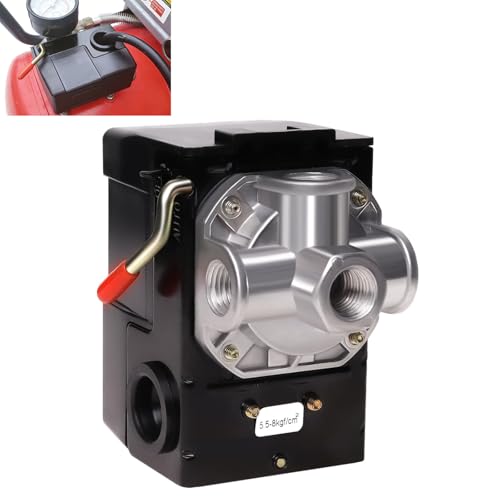 Ketofa LF10-4H 4-Port Pressure Switch |
7.8/10 | Buy | |
| Best Value |
 Dreyoo 4-Port 135-175 PSI Pressure Switch Kit |
7.8/10 | Buy |
 HITY MOTOR PS2020M Pressure Switch 135/105 PSI |
7.8/10 | Buy |
Fyntave 1/4" NPT 150 PSI Safety Valve (2-Pack)
Constructed from solid brass, this two-pack of relief valves automatically manages overpressure up to 150 PSI across air, water, and oil setups. Its standard 1/4-inch NPT threading and compact profile make it a practical replacement part for standard workshop compressors.
Pros
- Solid brass build resists high temperatures and wear
- Standard 1/4-inch NPT fitting fits common air compressors
- Handles air, water, and oil discharge safely
- Includes two valves for convenient backup replacement
Cons
- Fixed 150 PSI preset cannot be manually adjusted
- Restricted to systems requiring 1/4-inch NPT connections
California Air Tools 255C 2.5-Gal Pressure Pot
Built for bubble-free resin casting, this coated steel pressure chamber features integrated controls and stabilizing rubber feet. It provides a reliable 60 PSI operating range for hobbyists and makers working in compact studio spaces.
Pros
- Includes regulator and pressure relief valve
- Rubber feet prevent slipping during operation
- Reliable 60 PSI working pressure
- Integrated handle assists with portability
Cons
- Internal dimensions limit maximum casting project size
- Coated steel build weighs over 22 pounds
Ketofa LF10-4H 4-Port Pressure Switch
Built for single or two-stage air compressors, the Ketofa LF10-4H serves as a direct 95-to-125 PSI replacement control switch. It provides a standard four-port manifold alongside an integrated unloader valve and manual metal shut-off lever.
Pros
- Four-port manifold allows flexible component placement
- Pre-calibrated 95 to 125 PSI automatic pressure cycle
- Built-in unloader valve relieves head pressure effectively
- Sturdy metal manual shut-off lever
- Dual voltage compatibility for 120V and 240V motors
Cons
- Fixed pressure range cannot replace 135-175 PSI units
- Limited to 20A instead of 26A applications
- Requires matching a specific 6.3 mm unloader fitting
Dreyoo 4-Port 135-175 PSI Pressure Switch Kit
Designed for single-stage and two-stage compressors, this complete Dreyoo replacement assembly features a four-port switch preset to 135 to 175 PSI alongside an integrated gauge and safety valve. It provides a direct replacement solution for DIYers and mechanics maintaining standard 110-120V workshop air setups.
Pros
- Complete kit enables quick replacement right out of the box
- Four-port design offers versatile connections for gauges and valves
- Durable brass safety valve enhances pneumatic system protection
- Pressure thresholds can be fine-tuned via the adjustment lever
Cons
- Restricted to 110-120V circuits and incompatible with 240V setups
- Maximum current capacity is capped at 20 amps
- Outer housing uses plastic rather than full-metal construction
HITY MOTOR PS2020M Pressure Switch 135/105 PSI
Built for targeted Rolair air compressors, this replacement pressure switch maintains automatic operation between 105 and 135 PSI. It features an integrated 1/4-inch compression fitting for unloader lines, serving as a direct repair component for compatible equipment.
Pros
- Pre-set 105 PSI cut-in and 135 PSI cut-out
- Direct replacement fit for select Rolair units
- Includes dedicated 1/4-inch unloader line fitting
Cons
- Compatibility is limited to specific Rolair models
Can an Air Compressor Work as a Pressure Washer?
An air compressor can operate certain air-powered cleaning accessories, but it does not become a conventional pressure washer simply by adding a hose or nozzle. A pressure washer uses a water pump to deliver water at pressure and flow intended for cleaning. An air compressor stores and supplies compressed air, which is a different kind of output. An attachment may use air to move, mix, or spray water, but its actual function and limits depend on that specific product.
Air pressure and water flow are not interchangeable
Pressure is only part of a cleaning system. A useful cleaning stream also depends on how much water the equipment can deliver over time, how the nozzle shapes that stream, and whether the pump can sustain its intended operating conditions. An air compressor’s PSI rating describes pressure in its compressed-air system; it does not tell you how many gallons of water a washer can pump each minute. Treating air PSI as a direct substitute for a pressure washer’s water pressure rating can lead to a poor equipment match.
A compressor’s air tank supplies a stored reserve, and the pump replenishes that reserve as pressure falls. That setup can suit tools used in short bursts, but a water-cleaning task may call for sustained output. If an attachment draws more air than the compressor can replenish, tank pressure can drop and the motor may keep cycling. The tool’s advertised operating pressure alone won’t show whether the compressor can keep up.
For compatibility, look for the attachment manufacturer’s required air pressure and air volume, usually expressed in CFM at a stated PSI. Then compare those figures with the compressor manufacturer’s delivered-air rating at the same pressure, if available. The supplied product information for the listed items doesn’t provide CFM ratings, so it can’t establish that any of those products can run a water-cleaning attachment. Pressure switches, relief valves, and a resin pressure pot are not pressure washers.
What air-powered washing attachments actually do
An air-powered cleaning attachment may combine compressed air with water to create a spray, foam, or other cleaning pattern. That doesn’t mean it has the same pump, flow rate, or intended applications as an electric or gas-powered pressure washer. Some products are designed for light rinsing or applying cleaning solution, while others may have different stated uses. The product manual, rather than the word “pressure” in a listing, should determine what the accessory is built to do.
Check whether the attachment connects to a pressurized water supply, draws water from a container, or uses another specified feed arrangement. Confirm its approved pressure range, air consumption, water connection, and any restrictions on detergent or water temperature. Don’t assume that a standard garden hose connection or a familiar quick-connect fitting means the parts are compatible. Thread type, flow requirements, and intended use all matter.
Also distinguish an air-operated cleaning tool from a pressure washer pump driven by compressed air. An accessory that atomizes water may produce a useful spray without delivering the concentrated water flow expected from a pressure washer. If the job involves embedded grime, large outdoor surfaces, or cleaning that calls for a specified water flow, an attachment may not be an adequate substitute. Use the cleaning equipment designed for the job rather than trying to make the compressor perform as a water pump.
How to Judge Whether a Compressor Can Run an Attachment
Match the stated air demand, not just maximum PSI
Start with the accessory’s operating specifications. The critical comparison is its required CFM at its stated working pressure against the compressor’s delivered CFM at that pressure. A compressor’s maximum PSI is not a measure of its sustained air volume. If either rating is missing, ask the manufacturer or seller for it rather than estimating from tank size, motor appearance, or a pressure-switch label.
Tank capacity affects how much compressed air is available before pressure falls, but a larger tank does not increase the pump’s ongoing air production. A small tank paired with a high-demand attachment may lose pressure quickly; a larger tank may extend the initial run but still require recovery time. A more capable pump can replenish air faster, but the product data must support that conclusion. For a tank-size perspective in a different portable-compressor context, see this guide to portable compressors with tanks.
Consider how the accessory will be used. Brief bursts with pauses give a compressor some time to recover, while prolonged spraying can keep the pump running and draw down the stored reserve. Without a published duty cycle or air-delivery figure, you can’t reliably determine whether a particular compressor is suitable for continuous operation. Follow both manufacturers’ guidance, and stop if the compressor shows signs of overheating, abnormal operation, or repeated protective shutdown.
Hose and fittings can affect the setup too. The accessory needs connections that match its air and water ports, and the air path must not be restricted by an unsuitable fitting. Use components rated for their intended service and compatible with the manufacturer’s instructions. Don’t modify a pressure vessel, replace a safety device with an incompatible part, or assume an adapter makes a mismatch safe.
Why the supplied products don’t convert a compressor
The products in the shortcode are chiefly air-compressor pressure switches, a safety relief valve, and a resin-casting pressure pot. These are not water-pumping systems or pressure-washer attachments. A pressure switch controls compressor start and stop behavior according to its design, while a relief valve is a safety component intended to release excess pressure at its specified setting. Neither creates the water flow required of a washer.
For example, the Ketofa LF10-4H pressure switch is described with 95 PSI cut-in and 125 PSI cut-out settings. That information identifies its specified switching range, not the compressor’s CFM delivery or the water-cleaning ability of any connected accessory. Product descriptions for the other switches also give switching ranges or electrical and port details, but those details don’t demonstrate pressure-washer compatibility. Verify a replacement switch against the compressor’s original specifications, including pressure settings, ports, and electrical ratings.
The California Air Tools 255C product is a pressure pot for resin casting, not a water pressure washer. Its listing gives an operating pressure of 60 PSI and a maximum pressure of 80 PSI for its stated casting application. Those figures are specific to that pressure vessel and don’t establish that it can spray cleaning water or serve as a washer. Never repurpose a tank or pressure chamber outside its labeled use.
A safety relief valve also should not be treated as a pressure-control accessory for increasing cleaning force. Its role is protective, and its rating must be appropriate for the equipment it serves. Don’t adjust the compressor’s pressure switch to raise its operating pressure beyond the manufacturer’s specifications, and never bypass or remove a relief valve. If a switch or safety valve needs replacement, confirm the correct part and have uncertain electrical or pressure-system work handled by a qualified service provider.
Practical Alternatives and Safe Setup
Choose equipment for the cleaning task
For ordinary rinsing, a garden hose and suitable nozzle may be enough. For work that requires pressure-washer performance, use a purpose-built pressure washer whose water flow and pressure are specified for the task. Compare the manufacturer’s instructions with the surface being cleaned, since delicate finishes and materials can be damaged by an overly aggressive stream. Select accessories and cleaning agents only when their makers approve them for the washer and application.
If an air-powered wash or foam attachment is the intended purchase, treat it as its own tool rather than as a universal pressure-washer conversion kit. Read its complete requirements before choosing a compressor, including air demand, working pressure, water supply, and connection details. Compare compressor output at the required pressure, not just maximum tank PSI. If the listing doesn’t provide enough information to make that comparison, get confirmation from the manufacturer before buying.
A compressor’s other capabilities may still make it useful around a garage or workshop, but those uses don’t prove washer suitability. The products listed here focus on pressure control and related compressor components, so they may be relevant when maintaining a compatible compressor system. They don’t add a water pump or establish the air-delivery capacity needed for a particular attachment. Keep the distinction clear when evaluating product titles and search results.
Keep pressure equipment within its rated use
Compressed air and pressurized water both store energy, so improvised assemblies deserve caution. Use only pressure-rated components specified for the intended medium and operating conditions. A fitting that holds air is not automatically appropriate for water, and a vessel meant for one application should not be adapted to another. Follow equipment manuals, wear suitable eye protection, and use hearing protection when operating loud air equipment.
Before servicing compressor fittings or attachments, follow the manufacturer’s shutdown and depressurization directions. Disconnect power as directed and ensure stored pressure is released before working on the system; never loosen a pressurized connection. Keep hands and face away from outlets and spray paths, and don’t aim compressed air or water at people, animals, or electrical equipment. If a component leaks, behaves unexpectedly, or has damaged threads, stop using it and resolve the issue with an appropriate replacement or service.
Do not use a pressure-switch replacement to alter the compressor’s intended operating limits. The Dreyoo and other switch listings specify particular cut-in and cut-out ranges, while the compressor itself has its own manufacturer-defined limits. A switch that doesn’t match the compressor can cause improper cycling or create a hazardous condition. Confirm the motor voltage and current rating, port arrangement, pressure range, and unloader connection where applicable before selecting a replacement.
Water management matters if the compressor is used for an approved air-powered accessory. Moisture can collect in compressor tanks and air lines, and water in the air stream may affect a tool or its result. Follow the compressor manual for tank draining and maintenance, and use any water separation or filtration required by the accessory maker. Depressurize the tank as directed before servicing, and don’t leave stored pressure in equipment during transport unless its instructions allow it.
Make the final compatibility check before use
Write down the attachment’s required air pressure and CFM, then find the compressor’s delivered-air ratings at the matching pressure. Confirm the water-feed method, fittings, and any stated operating limits as well. If the compressor documentation only gives maximum PSI and tank volume, that isn’t enough information to establish sustained compatibility. Ask the manufacturers rather than extrapolating from those two figures.
During operation, follow the prescribed setup and watch for pressure loss, repeated cycling, unusual noise, leaks, or protective shutdown. Those signs don’t identify a single cause, but they are reasons to stop and consult the equipment instructions rather than continuing to run an overloaded or questionable assembly. Don’t defeat thermal protection or increase pressure to compensate for poor performance. A properly matched purpose-built washer is the straightforward choice when the job needs dependable water-cleaning output.
In short, an air compressor can power some specifically designed air-and-water accessories, but it does not become a conventional pressure washer. The deciding evidence is the attachment’s intended function and air demand matched against the compressor’s documented output, not the compressor’s PSI alone. The pressure switches and related parts listed here don’t perform that conversion. Choose a dedicated pressure washer for pressure-washer work, and use compressor accessories only within their stated limits.
About the author
Clint DeBoer is an experienced tool-industry specialist with decades of involvement in technical media, hands-on product evaluation, and testing methodology. His focus on performance, practical usability, and data-driven comparisons makes his expertise highly relevant to professional air compressors, pneumatic tools, and workshop equipment.