
What Is Best Air Compressor Hose: Practical Workshop Guide for 2026
Understand what is best air compressor hose options, core materials, and airflow ratings to optimize garage pneumatic tools and jobsite setups in November 2026.
 By Kenny Koehler
Updated November 10, 2026
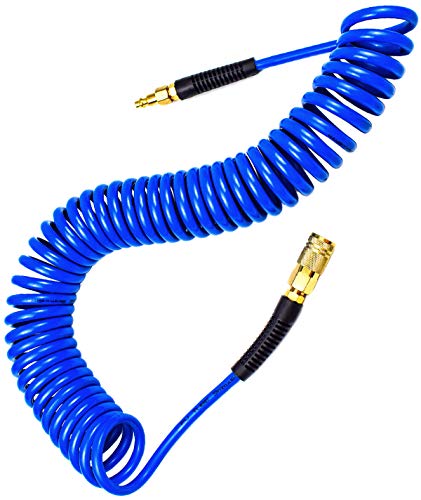

Airflow restriction, line pressure drop, and rigid coiling often turn simple pneumatic tasks into frustrating workshop bottlenecks. When an air line kinks under working pressure or stiffens in cold garage temperatures, connected air tools lose the steady volume needed for consistent nailing, painting, or lug nut removal. Determining what is best air compressor hose requires looking past basic exterior colors to examine core tube composition, internal diameter sizing, burst resistance, and fitting integrity. If you need step-by-step guidance on changing fittings or swapping lines, learning how to replace an air compressor hose ensures leak-free connections from the tank manifold to the tool.
Modern pneumatic setups rely on specialized materials like premium hybrid polymers, reinforced braided polyurethane, and traditional PVC blends to balance working flexibility against abrasion resistance. Selecting the right line directly affects downstream CFM delivery, tool maneuverability, and overall safety under continuous pressure loads up to 300 PSI. Whether you need a self-coiling recoil line for compact bench tasks or a high-flow 50-foot supply run for automotive work, matching hose architecture to your air delivery system keeps pneumatic operations running smoothly.
| Award | Product | ACR Score About ACR ScoreThe ACR Score is our own rating from 0 to 10, based on performance, design and build, ease of use, and value. It reflects independent research and is never influenced by manufacturers, retailers, or affiliate commissions. Learn more › | |
|---|---|---|---|
| Best Overall |
YOTOO 1/4-Inch x 25-Foot Polyurethane Recoil Air
|
9.2/10 | Buy |
| Best Budget |
 Flexzilla 1/4-Inch x 25-Foot Air Compressor Hose |
9.1/10 | Buy |
| Best Value |
 Hromee 1/4-Inch x 25-Foot Hybrid Air Compressor |
8.6/10 | Buy |
| Best Premium |
 YOTOO 3/8-Inch x 50-Foot Hybrid Air Hose |
8.6/10 | Buy |
 WYNNsky 3/8-Inch x 25ft PVC Air Hose Kit |
8.4/10 | Buy | |
 RainBello 25-Ft 1/4-Inch Polyurethane Air Hose |
8.3/10 | Buy | |
 FYCQER 25-Foot Coiled Air Hose (1/4 Inch) |
8.1/10 | Buy |
YOTOO 1/4-Inch x 25-Foot Polyurethane Recoil Air
The YOTOO 1/4-inch by 25-foot polyurethane recoil air hose provides a lightweight, tangle-resistant pneumatic connection rated for up to 150 PSI. Equipped with pre-installed 1/4-inch industrial quick-connect fittings and flexible operation down to -40 degrees Fahrenheit, it is a convenient, space-saving accessory for garage hobbyists, trim carpenters, and workbench setups.
Pros
- Self-retracting coil design eliminates manual hose winding and prevents messy shop floor clutter
- Comes ready to work with factory-installed 1/4-inch industrial quick-connect coupler and plug
- Retains pliability in freezing conditions down to -40 degrees Fahrenheit
- Durable bend restrictors protect high-wear junction points from premature cracking or kinking
- Lightweight polyurethane build significantly minimizes hand and wrist fatigue during detailed tool work
Cons
- 1/4-inch inner diameter restricts airflow volume required for continuous high-demand tools like dual-action sanders or spray guns
- Coil tension increases when stretched near the full 25-foot reach, which can pull back against lightweight pneumatic tools
- Not intended for severe rough-framing jobsite abuse where heavy-duty reinforced rubber hoses are typically preferred
Flexzilla 1/4-Inch x 25-Foot Air Compressor Hose
The Flexzilla 1/4-inch by 25-foot air hose features a premium hybrid polymer blend that stays pliable from -40 to 140 degrees Fahrenheit without kinking under pressure. Built with crush-resistant aircraft aluminum fittings and a 300 PSI working rating, it offers lightweight, zero-memory convenience for trim carpenters, tire inflation, and home workshops.
Pros
- Extreme all-weather flexibility keeps the hose manageable even in sub-freezing garages down to -40 degrees Fahrenheit
- Zero-memory material lays flat instantly and coils effortlessly for quick end-of-day cleanup
- Crush-resistant aircraft aluminum fittings include molded bend restrictors to prolong connection life
- Lightweight design dramatically reduces tool drag during overhead trim work and detailed finish carpentry
Cons
- 1/4-inch inner diameter creates friction loss that may restrict high-CFM continuous tools like rotary sanders or impact wrenches
- Signature high-visibility green color easily shows grease and grime in automotive shop environments
- 25-foot working length can feel short for expansive workspaces or outdoor vehicle maintenance without an extension line
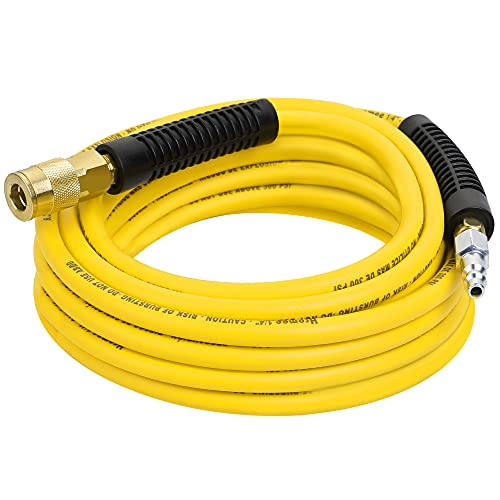
Hromee 1/4-Inch x 25-Foot Hybrid Air Compressor
The Hromee 1/4-Inch x 25-Foot Hybrid Air Compressor Hose provides a flexible, lightweight pneumatic connection with a 300 PSI working pressure, bend restrictors, and pre-attached industrial fittings. Rated for -40°F to 150°F, it is well-suited for trim carpenters, home mechanics, and DIYers seeking kink-resistant hose handling.
Pros
- Pliable hybrid polymer stays flexible in cold weather down to -40°F without severe memory coils
- Comes ready to use out of the box with pre-connected brass coupler and industrial steel plug
- Integrated bend restrictors minimize strain and kink points near the MNPT fittings
- Lightweight two-pound design makes overhead nailing and portable trim work easy on user arms
Cons
- The 25-foot length provides limited reach across larger garages or multi-room jobsite setups without an extension
- A 1/4-inch inner diameter creates higher airflow restriction than 3/8-inch hoses when supplying high-CFM continuous tools
- Bright yellow exterior easily shows garage grime, motor oil, and jobsite dirt over time
YOTOO 3/8-Inch x 50-Foot Hybrid Air Hose
The YOTOO 3/8-inch by 50-foot hybrid air hose combines rubber flexibility with lightweight PVC durability, handling up to 300 PSI for high-demand shop tools. Equipped with pre-installed 1/4-inch brass fittings and bend restrictors, it is an ideal upgrade for DIYers, garage mechanics, and woodworkers looking to minimize line pressure drop.
Pros
- 3/8-inch inner diameter supplies greater air volume to impact wrenches, inflators, and nailers than narrower hoses
- Comes ready to use straight from the box with pre-installed brass coupler and industrial plug fittings
- Hybrid construction resists kinks and coils flatter than rigid PVC air hoses
- Bend restrictors protect the hose ends from bending fatigue near tool connections
Cons
- Hybrid polymer can still experience slight stiffness in near-freezing winter garage temperatures compared to premium 100% rubber hoses
- Factory-installed 1/4-inch standard industrial couplers may need replacement if your shop runs dedicated high-flow V-style fittings
- At 50 feet, it requires thoughtful coiling or an air hose reel to prevent workshop floor clutter
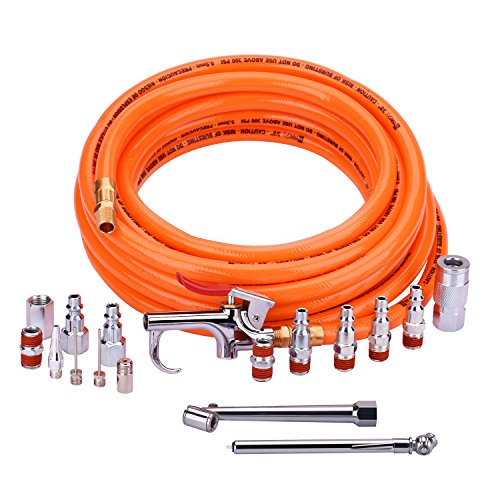
WYNNsky 3/8-Inch x 25ft PVC Air Hose Kit
Equipped with a lightweight PVC hose and a 17-piece accessory bundle, this package delivers the essential fittings needed for home workshop DIY projects. Solid brass connections ensure dependable seals, supported by a 300 PSI maximum working pressure.
Pros
- Solid brass fittings resist corrosion and seal reliably
- Complete accessory set provides essential starter fittings
- Lightweight hose design allows easy transport and handling
- Handles up to 300 PSI maximum working pressure
Cons
- 25-foot length provides limited reach across larger workshops
- PVC construction is typically less flexible than rubber hoses
RainBello 25-Ft 1/4-Inch Polyurethane Air Hose
The RainBello 25-foot 1/4-inch reinforced polyurethane air hose delivers high flexibility and a 300 PSI working pressure rating for garage workshops and trim jobs. Equipped with factory brass swivel fittings and quick-connect hardware, it provides a reliable, kink-resistant connection for DIYers and finish carpenters.
Pros
- Braided polyurethane outer jacket resists scuffing, kinking, and twisting
- Factory-installed 1/4-inch brass swivel fittings and quick-connect couplers save setup time
- Substantial 300 PSI working pressure rating handles common pneumatic tasks
- Remains pliable in sub-freezing temperatures down to -40°F
Cons
- A 1/4-inch internal diameter restricts airflow volume for continuous high-CFM tools like dual-action sanders
- The 25-foot length may limit reach across larger multi-bay automotive garages without an additional extension
FYCQER 25-Foot Coiled Air Hose (1/4 Inch)
Built from flexible polyurethane, this self-storing coiled hose extends your reach up to 25 feet without tangling. Its 300 PSI rating and pre-sealed brass fittings make it a dependable pick for light garage work and tire inflation.
Pros
- Pre-sealed brass fittings ensure secure, leak-resistant connections
- Compact coil profile snaps back quickly for easy storage
- Rated up to 300 PSI for high-pressure tools
- Wide operating temperature range prevents cold-weather kinking
Cons
- Coil tension may pull back when stretched near 25 feet
- 1/4-inch inner diameter limits high-CFM air tools
- 25-foot length may feel short for larger workshop layouts
Evaluating Pneumatic Lines to Determine What Is Best Air Compressor Hose
To answer what is best air compressor hose, one must evaluate how pneumatic air lines bridge the gap between compressor storage tanks and operating air tools. An air hose does not merely contain compressed air; it acts as an active conduit where internal friction, diameter constraints, and material flexibility dictate delivered tool performance. Choosing the wrong air line can lead to sudden pressure drops, persistent tripping hazards, and frustrating hose coils that refuse to lay flat on a garage floor.
The Mechanical Role of Air Delivery Lines in Pneumatic Setups
Compressors compress atmospheric air into a storage tank, but pneumatic tools depend on the steady transfer of that stored energy through an unobstructed line. When an air tool triggers, compressed air rushes through the hose, immediately encountering resistance along the inner wall. If the internal volume or flexibility of the line is compromised, the tool experiences dynamic pressure drops that reduce operational torque or firing consistency.
System configuration also plays a major role in overall efficiency, whether operating high-output stationary systems or compact portable units. For example, comparing belt-drive versus direct-drive compressors shows how different pump configurations deliver air volume to the manifold, which the hose must then carry without restriction. A heavy-duty compressor pump cannot compensate for a constricted, kinked, or leaking air line. Viewing the hose as a primary mechanical component rather than an afterthought ensures consistent pneumatic power delivery.
Comparing Hose Materials: Hybrid Polymers, Polyurethane, and PVC
Hose material determines how an air line handles bending, abrasion, ambient temperature swings, and daily wear. Traditional PVC hoses, such as the WYNNsky PVC assembly, are lightweight and cost-effective for basic home tasks, but they tend to retain coil memory and stiffen when temperatures drop. Blended PVC materials remain popular for utility setups where budget and straightforward garage chores take precedence, though users often battle loops that resist lying flat across a floor.
Hybrid polymer hoses, exemplified by the Flexzilla and Hromee models, blend polyurethane, PVC, and rubber compounds to create exceptional all-weather suppleness. These hybrid lines feature zero memory, which allows them to unroll completely flat right out of storage without coiling back into tight rings. They maintain flexibility under standard operating pressures up to 300 PSI without kinking under sudden movement. For general automotive maintenance and workshop utility, hybrid materials offer an outstanding balance of manageable weight and physical resilience.
Polyurethane represents another distinct material category, frequently utilized in reinforced straight lines like the RainBello hose and self-coiling recoil models from YOTOO and FYCQER. Braided polyurethane combines high tensile strength with an ultra-lightweight profile, resisting cuts, grease, and garage chemicals while sliding effortlessly over rough concrete surfaces. Because polyurethane is naturally abrasion resistant, it provides long service life without adding unnecessary drag or bulk to a technician’s toolkit.
Inner Diameter Selection: 1/4-Inch Versus 3/8-Inch Airflow
The inner diameter of an air hose directly dictates the maximum volume of air, measured in cubic feet per minute, that can travel to your tool. A 1/4-inch inner diameter hose, found on the Flexzilla, Hromee, and RainBello models, provides an exceptionally lightweight and agile connection. This smaller diameter is ideal for intermittent tools that consume low air volume, such as brad nailers, finish staplers, and tire inflation chucks. The reduced weight prevents hand fatigue when working overhead or moving rapidly around a room.
In contrast, a 3/8-inch inner diameter line, such as the YOTOO Hybrid 50-foot hose or WYNNsky assembly, delivers substantially higher air volume with minimal friction resistance. Continuous-draw tools like 1/2-inch impact wrenches, pneumatic die grinders, dual-action sanders, and paint spray guns require this larger cross-sectional area to avoid air starvation. When a high-demand tool operates on a 1/4-inch line, dynamic pressure can drop precipitously during trigger depression, causing the tool to stall or lose torque. Choosing between these two diameters involves balancing physical line weight against the continuous CFM requirements of your air tools.
Working Pressure Ratings and Burst Strength Safety
Pneumatic air lines must comfortably withstand the maximum output pressure regulated by your compressor manifold switch. Most portable and garage air compressors operate with cut-out pressures between 125 PSI and 175 PSI, making a hose working pressure rating a vital safety metric. Premium models like the Flexzilla, Hromee, RainBello, and FYCQER feature a maximum working pressure rating of 300 PSI, offering a wide safety cushion above standard regulator outputs.
In comparison, specialized recoil lines, such as the YOTOO Polyurethane Recoil hose, are rated for working pressures up to 150 PSI. While 150 PSI is sufficient for standard nail guns and inflation tasks operating at 90 PSI, it leaves less headroom for higher-pressure dual-stage compressor systems. Burst pressure, which is typically rated at three times the working pressure, defines the ultimate structural limit of the reinforced inner braiding. Operating well below this burst threshold prevents catastrophic wall failure or rapid pressure blowouts during heavy duty cycles.
Temperature Tolerance and Cold-Weather Pliability
Workshop conditions and outdoor jobsites often expose pneumatic equipment to sub-freezing mornings or sweltering summer afternoons. A hose that stiffens in the cold transforms into an unmanageable, rigid rod that resists bending, increases trip hazards, and puts excessive lateral strain on tool fittings. High-grade hybrid polymers and premium polyurethane compounds excel specifically in their thermal stability. Both Flexzilla and Hromee hoses maintain flexibility across a wide range from -40 degrees to 140 or 150 degrees Fahrenheit.
Similarly, reinforced polyurethane lines like the RainBello model offer operational stability from -40 degrees up to 160 degrees Fahrenheit without softening excessively or blistering under heat. This broad temperature tolerance ensures that the hose remains easy to unroll and maneuver, even when stored overnight in an unheated trailer during midwinter. Selecting an all-weather hybrid or polyurethane line prevents wasted time wrestling with coiled loops before starting a project and protects the outer jacket from developing micro-cracks.
Straight Braided Hoses Versus Self-Coiling Recoil Designs
Deciding between a straight braided pneumatic hose and a self-coiling recoil line depends heavily on workspace layout and mobility needs. Straight hoses, such as the 25-foot Flexzilla or 50-foot YOTOO hybrid, lay flat along shop floors and provide unrestricted range across larger garages and construction sites. These hoses require manual coiling or a dedicated hose reel for storage, but they offer maximum durability and allow users to move around workpieces without resistance.
Self-coiling recoil hoses, such as the YOTOO Polyurethane Recoil and FYCQER models, utilize built-in spring memory to retract automatically into a compact footprint when released. This design is exceptionally beneficial for dedicated assembly benches, automotive service bays, and tire inflation stations where floor clutter must be kept to a minimum. However, pulling a 25-foot recoil hose to its outer limit exerts continuous backward force on the user wrist and can drag light workpieces off a bench. For projects requiring mobility across a broad shop floor, a straight hybrid hose remains preferable, while benchtop stations gain major efficiency from a tidy recoil line.
Coupler Integrity, Thread Sealing, and Swivel Connections
A premium air hose is only as dependable as the end fittings connecting it to the compressor regulator and pneumatic tools. Factory-installed fittings commonly utilize 1/4-inch National Pipe Taper (NPT) threads, matching the standard industrial interchange format. High-quality fittings feature solid brass or brass-core construction, seen on models like the Hromee, WYNNsky, and FYCQER hoses, which resist corrosion and provide superior thread sealing compared to softer metals.
Some manufacturers, such as Flexzilla, utilize crush-resistant aircraft aluminum fittings to reduce overall carrying weight while retaining structural resilience. In contrast, models like the RainBello hose incorporate brass swivel fittings, which rotate freely under pressure to prevent the hose from twisting into knots during active tool manipulation. Lines like the FYCQER hose come with pre-applied thread sealant on the fittings, eliminating the immediate need for PTFE tape during initial setup. Verifying that couplers and plugs click securely into place ensures that full tank pressure transfers downstream without hissing leaks or sudden line disconnections.
Strain Relief Engineering and Bend Restrictor Benefits
The junction where a flexible hose meets a rigid metal fitting represents the most vulnerable stress concentration point on any pneumatic line. Repeated bending, pulling, and twisting at this junction can lead to severe kinking, internal reinforcement fatigue, and eventual hose necking. To prevent this failure mode, quality hoses from brands like YOTOO, Flexzilla, Hromee, and RainBello incorporate heavy-duty bend restrictors on both ends.
Bend restrictors consist of molded rubber, plastic, or composite sleeves that encase the hose collar adjacent to the brass or aluminum fittings. These sleeves gradually distribute bending forces over a broader radius rather than allowing the hose to pinch sharply against the edge of the metal crimp. High-quality restrictors remain firmly in place without sliding down the hose jacket, shielding the crimped connection from tension when the line is pulled taut across a room. This straightforward structural reinforcement extends the overall lifespan of the hose and prevents premature air leaks near the tool connection.
Pressure Drop Over Distance and Moisture Management
Compressed air traveling through an interior line experiences friction against the tube wall, resulting in a predictable drop in working pressure over distance. A 25-foot 1/4-inch hose provides adequate volume for low-demand tools with minimal measurable drop, but extending that same diameter to 50 or 100 feet creates noticeable flow restriction. If your projects require working at extended distances from your air compressor, upgrading to a 3/8-inch inner diameter hose, like the 50-foot YOTOO hybrid, minimizes pressure drop across the run. The larger cross-sectional area allows air to travel at lower velocity for the same volumetric output, delivering consistent regulated pressure to high-demand tools.
Moisture accumulation also compounds internal flow resistance and damages downstream equipment over extended operating sessions. Maintaining dry, clean air delivery requires routine air compressor drain valve maintenance to purge condensed water from the tank before it migrates into your air line. Keeping water out of the hose prevents internal wall contamination, preserves coupler seals, and ensures stable airflow delivery to your tools.
Matching Hose Configurations to Specific Pneumatic Tools
Identifying what is best air compressor hose ultimately depends on the specific demands of your pneumatic toolkit. For finish carpentry, crown molding installation, and indoor trim work, a lightweight 1/4-inch hybrid or polyurethane hose like the Flexzilla or RainBello is hard to beat. Its featherweight profile will not pull down on delicate brad nailers, and its non-marring outer jacket protects painted baseboards and hardwood flooring from unsightly scuffs.
For automotive restoration, tire changing, and heavy mechanical repair, a 3/8-inch hybrid assembly, such as the 50-foot YOTOO model, provides the sustained air volume required by impact wrenches and air ratchets. The rugged outer cover handles contact with shop floor debris, light automotive fluids, and abrasive concrete without degrading. Meanwhile, the extended 50-foot reach allows technicians to circle an entire vehicle without dragging the heavy compressor tank along.
Home hobbyists and garage utility users frequently benefit from all-in-one solutions like the WYNNsky 3/8-inch PVC kit or compact recoil setups like the FYCQER line. The WYNNsky kit provides a versatile 17-piece assortment of blowguns, tire gauges, and quick-connect adapters for immediate general-purpose use. Conversely, recoil hoses provide the ideal setup for dedicated workbench stations, where quick tire top-offs and dust blow-downs require instant access without wrestling loose hose coils across the floor.
Selecting the ideal air compressor hose centers on matching hose material, inner diameter, and pressure rating to your typical pneumatic workload. Hybrid polymer lines deliver unbeatable zero-memory flexibility for mobile contractor tasks, while durable 3/8-inch assemblies supply the continuous air volume needed for high-demand automotive tools. By evaluating fitting quality, bend protection, and temperature ratings alongside your specific air delivery requirements, you can equip your workshop with a dependable air line that delivers consistent, leak-free pneumatic performance.
About the author
Kenny Koehler is a power-tool specialist with more than a decade of hands-on evaluation experience and a science-based approach to product testing. His expertise in repeatable testing, tool performance, impact wrenches, and professional equipment brings a practical, data-focused perspective to compressor and pneumatic-tool comparisons.