
How to Connect Hose to Husky Air Compressor: Practical Guide for 2026
Master how to connect hose to husky air compressor fittings safely in October 2026 with proper coupler alignment and leak prevention techniques.
 By Tom Scalisi
Updated October 26, 2026
Compressed air manifolds on portable and workshop compressors rely on secure mechanical couplings to maintain stable operating pressure without dangerous line blowouts. Learning how to connect hose to husky air compressor fittings properly ensures that your nailers, impact wrenches, and inflators receive uninterrupted airflow. Husky units typically utilize standard quick-connect brass couplers mounted directly beside the pressure regulator dial. Before pushing any fitting into place, verifying that the tank pressure is regulated and that the locking sleeve moves freely prevents unexpected air discharge. If your setup features cracked lines or damaged ferrules, reviewing a practical air compressor hose replacement guide can help you refresh your pneumatic line before attaching it to the compressor.
A loose or mismatched air fitting causes constant pressure bleeding, forcing the electric motor to cycle repeatedly and overheat. Standard Husky portable units operate between 125 and 175 maximum PSI, which places heavy mechanical stress on every connection point. Matching the correct plug profile to the factory coupler eliminates annoying hissing leaks and preserves maximum CFM delivery at your pneumatic tools. Modern hose assemblies often feature pre-installed industrial fittings with bend restrictors to protect the connection joint from severe stress during active movement. Taking the time to understand fitting styles, thread sealants, and sleeve lock mechanics guarantees a secure, airtight seal every time you power up your garage equipment.
| Award | Product | ACR Score About ACR ScoreThe ACR Score is our own rating from 0 to 10, based on performance, design and build, ease of use, and value. It reflects independent research and is never influenced by manufacturers, retailers, or affiliate commissions. Learn more › | |
|---|---|---|---|
| Best Overall |
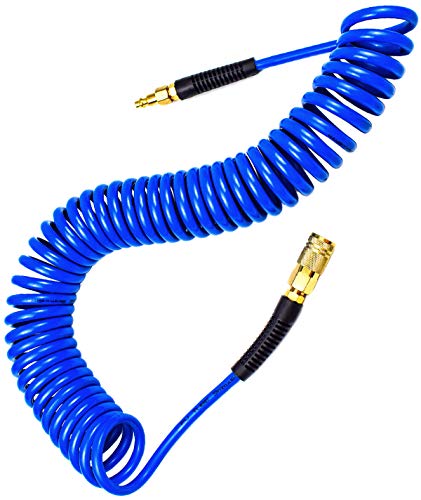
YOTOO 1/4-Inch x 25-Foot Polyurethane Recoil Air
|
9.2/10 | Buy |
| Best Budget |
 HHYOOSOO Brass Winterize Blowout Plug (2-Pack) |
9.1/10 | Buy |
| Best Value |
 Minimprover 12-Inch Blowout Adapter with Valve |
9.1/10 | Buy |
| Best Premium |
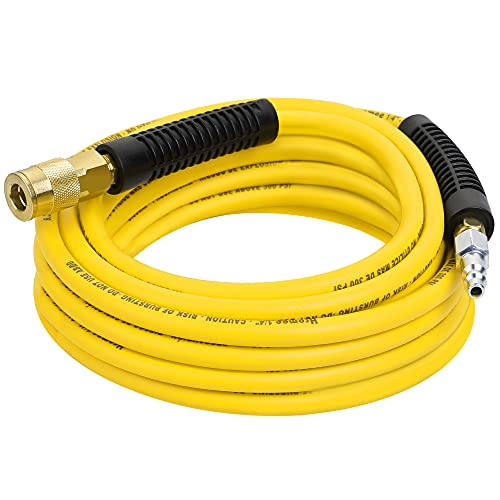 Hromee 1/4-Inch x 25-Foot Hybrid Air Compressor |
8.6/10 | Buy |
 LUMITECO 9.8-Foot Recoil Air Hose Adapter |
8.4/10 | Buy | |
 YELUN Brass RV Winterizing Blowout Kit |
8.4/10 | Buy | |
 LitOrange Brass Blow Out Adapter (2-Pack) |
8.0/10 | Buy |
YOTOO 1/4-Inch x 25-Foot Polyurethane Recoil Air
The YOTOO 1/4-inch by 25-foot polyurethane recoil air hose provides a lightweight, tangle-resistant pneumatic connection rated for up to 150 PSI. Equipped with pre-installed 1/4-inch industrial quick-connect fittings and flexible operation down to -40 degrees Fahrenheit, it is a convenient, space-saving accessory for garage hobbyists, trim carpenters, and workbench setups.
Pros
- Self-retracting coil design eliminates manual hose winding and prevents messy shop floor clutter
- Comes ready to work with factory-installed 1/4-inch industrial quick-connect coupler and plug
- Retains pliability in freezing conditions down to -40 degrees Fahrenheit
- Durable bend restrictors protect high-wear junction points from premature cracking or kinking
- Lightweight polyurethane build significantly minimizes hand and wrist fatigue during detailed tool work
Cons
- 1/4-inch inner diameter restricts airflow volume required for continuous high-demand tools like dual-action sanders or spray guns
- Coil tension increases when stretched near the full 25-foot reach, which can pull back against lightweight pneumatic tools
- Not intended for severe rough-framing jobsite abuse where heavy-duty reinforced rubber hoses are typically preferred
HHYOOSOO Brass Winterize Blowout Plug (2-Pack)
Designed for seasonal maintenance, this solid brass blowout plug connects standard air compressors to garden hose threads to purge water from RVs and irrigation lines. It offers a practical way for homeowners and RV owners to protect plumbing from freezing damage.
Pros
- Durable, machined solid lead-free brass build
- Quick 1/4-inch air compressor connection
- Fits standard 3/4-inch garden hose threading
- Versatile for RV, boat, and sprinkler winterizing
- Convenient two-pack configuration
Cons
- Requires a separate air compressor to operate
- Limited to 3/4-inch female hose thread fittings
Minimprover 12-Inch Blowout Adapter with Valve
Built with lead-free brass and flexible EPDM rubber, this adapter connects an air compressor to standard garden hose threads to clear water lines. Its integrated shut-off valve and 300 PSI tolerance make winterizing RVs and sprinkler systems straightforward in confined spaces.
Pros
- Certified lead-free brass ensures safer potable water line maintenance
- Rated for high working pressures up to 300 PSI
- Flexible rubber hose maneuvers easily into cramped connection points
- Built-in valve provides direct control over compressed air flow
Cons
- Requires a separate air compressor to operate
- Short 12-inch reach may require working close to fittings
- Demands careful pressure regulation to prevent plumbing damage
Hromee 1/4-Inch x 25-Foot Hybrid Air Compressor
The Hromee 1/4-Inch x 25-Foot Hybrid Air Compressor Hose provides a flexible, lightweight pneumatic connection with a 300 PSI working pressure, bend restrictors, and pre-attached industrial fittings. Rated for -40°F to 150°F, it is well-suited for trim carpenters, home mechanics, and DIYers seeking kink-resistant hose handling.
Pros
- Pliable hybrid polymer stays flexible in cold weather down to -40°F without severe memory coils
- Comes ready to use out of the box with pre-connected brass coupler and industrial steel plug
- Integrated bend restrictors minimize strain and kink points near the MNPT fittings
- Lightweight two-pound design makes overhead nailing and portable trim work easy on user arms
Cons
- The 25-foot length provides limited reach across larger garages or multi-room jobsite setups without an extension
- A 1/4-inch inner diameter creates higher airflow restriction than 3/8-inch hoses when supplying high-CFM continuous tools
- Bright yellow exterior easily shows garage grime, motor oil, and jobsite dirt over time
LUMITECO 9.8-Foot Recoil Air Hose Adapter
Connecting directly to standard tire inflators, this 9.8-foot coiled PU extension provides extra reach and hands-free convenience for awkward valve stems. Solid brass chucks and an included Presta adapter make it a versatile upgrade for bicycle, motorcycle, and automotive tires.
Pros
- Generous 9.8-foot coiled reach provides working flexibility
- Brass locking chuck seals tightly without leaking
- Supports both Schrader and Presta valve stems
- Durable PU construction resists wear and oil
Cons
- Recoil tension pulls back when stretched to maximum length
- Requires compatible threaded connection on the host inflator
YELUN Brass RV Winterizing Blowout Kit
The YELUN RV Winterizing Blowout Kit uses durable brass fittings to purge water from RV lines, sprinkler systems, and outdoor faucets before freezing weather hits. Equipped with standard 1/4-inch compressor plugs, 3/4-inch hose threads, and an integrated ball valve, it provides a straightforward method for controlled blowout winterization.
Pros
- Sturdy brass construction resists corrosion
- Built-in ball valve simplifies air regulation
- Standard fittings match most garden hoses and compressors
- Includes two adapters for versatile male and female connections
Cons
- Requires a compatible air compressor to operate
- Requires manual pressure regulation to protect plumbing
LitOrange Brass Blow Out Adapter (2-Pack)
Machined from lead-free brass, this adapter pair connects standard air compressors to outdoor faucets and irrigation systems to blow out standing water. It offers an easy, durable winterizing solution for homeowners, RV travelers, and boat owners.
Pros
- Durable, lead-free brass construction
- Compact design fits confined plumbing areas
- Standard 3/4-inch hose and 1/4-inch air compressor fit
- Convenient two-pack bundle
Cons
- Requires a compatible external air compressor to operate
- Requires eye protection and caution during pressure blowout
Step-by-Step Guide to Connecting Air Hoses on Husky Compressors
Connecting an air delivery line to a Husky compressor requires understanding the relationship between the manifold regulator, the female quick-connect coupler, and the male hose plug. Husky manufactures a wide range of compressors, from compact pancake models to large stationary workshop tanks, but most share standardized pneumatic connection points. Securing this joint properly ensures consistent pressure delivery, extends the service life of internal rubber seals, and protects the operator from unexpected hose whip. This deep-dive exploration breaks down the mechanical components, connection steps, leak prevention techniques, and safety procedures required for an airtight setup.
Understanding the Husky Manifold and Outlet Coupler Anatomy
Husky air compressors feature a central control manifold that houses the pressure switch, tank pressure gauge, regulated working pressure gauge, and outlet port. The outlet port on most consumer and contractor Husky models is equipped with a female 1/4-inch quick-connect brass coupler. This coupler contains spring-loaded internal ball bearings and a rubber O-ring that seals against the exterior profile of a male plug. When the outer brass sleeve is pulled back, the internal bearings retract, allowing the hose plug to slide into the socket. Releasing the sleeve forces the bearings into the groove of the male plug, locking the line firmly in place against internal tank pressure.
Some newer Husky compressors feature universal push-to-connect female couplers that eliminate the need to manually retract the brass collar during insertion. With universal couplers, pushing the male plug directly into the socket engages the internal locking pawls automatically. However, standard industrial couplers still require pulling the knurled sleeve backward with one hand while pushing the hose fitting forward with the other. Inspecting the coupler face before every work session prevents dirt and grit from jamming the internal slide mechanism. Built-up grime inside the coupler body can scratch the male plug shoulder and create persistent micro-leaks that degrade compressor efficiency.
Matching Air Hose Fittings to Standard Husky Quick-Connect Ports
Pneumatic fittings come in several distinct interchange styles, including Industrial Type M, Automotive Type T, and ARO Type 210. Husky air compressors almost universally ship from the factory fitted with 1/4-inch Industrial Type M female couplers. Attempting to force an Automotive or ARO plug into an Industrial coupler can distort internal locking balls or fail to seat the seal entirely. The male plug must feature the distinctive shoulder shape and groove depth corresponding to the 1/4-inch Industrial standard. Many pre-assembled hoses, such as the Hromee Air Compressor Hose 1/4 Inch x 25 Feet, come pre-equipped with factory-installed steel I/M type plugs that slide directly into standard Husky outlet couplers without modification.
Recoil polyurethane options, such as the YOTOO Polyurethane Recoil Air Hose, also arrive with pre-installed 1/4-inch industrial couplers and plugs. These factory fittings are commonly threaded with 1/4-inch male NPT joints secured by factory thread sealant and protected by rubber bend restrictors. If your air hose came with bare threaded ends rather than quick-connect fittings, you will need to install an industrial male plug before connecting to the compressor. The male plug threads directly onto the female or male hose terminal depending on your hose configuration. Using mismatched fittings remains the single most common reason why operators struggle to seat their air lines into Husky compressors.
Step-by-Step Air Hose Connection Procedure
Prior to making any pneumatic connection, ensure the compressor power switch is turned off and the regulated pressure dial is set to zero PSI. While modern quick couplers are designed to connect under pressure, connecting against full line pressure requires significant physical effort and increases wear on the internal O-ring. Grasp the compressor female coupler by the knurled outer collar with one hand. Pull the collar firmly backward toward the compressor body until you feel the spring compress and the collar stops moving. Hold the collar in this retracted position while preparing to align the hose fitting.
With your other hand, take the male plug attached to your air hose and align it straight with the center opening of the compressor coupler. Push the male plug firmly into the socket until the shoulder seats completely against the internal stop. Once the fitting is fully inserted, release the outer collar, allowing the internal spring to snap the collar forward into its locked position. You should hear and feel an audible metallic click as the sleeve returns to its resting position. An incomplete click indicates that the locking bearings have not settled into the plug groove, which can cause the hose to eject violently when pressure increases.
Perform a physical pull test by firmly tugging the air hose backward away from the compressor manifold. A properly locked quick-connect fitting will not budge or slide out of the socket under manual pulling force. After confirming the physical mechanical lock, turn on the compressor motor and allow the tank to build pressure until the pressure switch automatically cuts out. Slowly rotate the regulator adjustment knob clockwise to supply regulated working pressure to your hose line. Listen closely for any faint hissing noises around the connection collar, which would indicate improper seating or a damaged internal seal.
Installing Threaded NPT Fittings and Applying Thread Sealant
When outfitting a bulk air hose or replacing damaged fittings, you must install a quick-connect plug onto the threaded NPT hose end. National Pipe Taper threads rely on tapered metal surfaces that wedge together to create a seal, but they require supplemental sealant to achieve complete airtightness. Wrap high-density PTFE thread tape clockwise around the male threads three to four complete turns, starting one thread back from the end. Wrapping clockwise ensures that screwing the fitting into place tightens the tape rather than unraveling it inside the air channel. Avoid allowing tape to overhang the leading edge of the fitting, as shredded tape fragments can enter pneumatic tools and jam internal trigger valves.
Thread the male quick-connect plug onto the hose fitting by hand to ensure the threads align smoothly without cross-threading. Once finger-tight, use two open-end wrenches to tighten the connection, placing one wrench on the hose hex ferrule and the other on the plug flats. Tighten the joint approximately two to three full turns past finger-tight until substantial resistance is met. Avoid excessive wrench torque on brass fittings, because brass is relatively soft and can easily crack or warp under extreme force. Solid brass construction, found on heavy-duty fittings and adapter kits, provides excellent corrosion resistance and reliable thread strength when tightened within reasonable workshop limits.
Connecting Specialized Hoses, Tire Chucks, and RV Blowout Adapters
Husky air compressors are often called upon for specialized pneumatic tasks that require non-standard hose connections and auxiliary adapters. Tire inflation setups frequently benefit from compact extension lines, such as the LUMITECO 9.8 FT Extension Recoil Air Hose Adapter, which connects to standard inflator nozzles and converts between Schrader and Presta valves. For seasonal maintenance, homeowners use their Husky compressors to blow residual moisture out of underground sprinkler systems and recreational vehicles. Specialized brass blowout tools, including the Lead-Free Brass Winterize Sprinkler Systems adapter and the Litorange Lead-Free Brass Winterize Sprinkler fitting, feature standard 1/4-inch quick-connect plugs mated to 3/4-inch garden hose threads.
When winterizing water lines, the 1/4-inch male quick plug connects directly into your Husky air hose coupler just like a pneumatic nailer. Units equipped with integrated shutoff valves, such as the Minimprover Lead -Free Brass 16.9″ Winterize adapter or the YELUN Brass RV Winterizing Blowout Kit, provide superior manual control over the air stream entering delicate plumbing. Flexible rubber hose extensions on these blowout kits allow easy positioning in tight valve boxes while reducing bending stress on rigid PVC pipe threads. Regulating your Husky compressor down to 30 to 50 PSI during winterization is critical to prevent damaging plastic sprinkler heads or recreational vehicle water lines. Solid lead-free brass construction ensures that drinking water supply pipes remain uncompromised by toxic heavy metal leaching during blowout operations.
Diagnosing Air Leaks and Pressure Drops at the Coupler
Even a seemingly secure hose connection can harbor hidden air leaks that waste energy and cause unnecessary compressor pump cycling. If you suspect an air leak at the Husky manifold coupler, spray a mild solution of soapy water directly onto the connected joint while the tank is pressurized. Expanding soap bubbles immediately pinpoint the precise escape point, whether between the plug and coupler sleeve or around the threaded adapter joint. Thread leaks indicate insufficient PTFE sealant or inadequate wrench torque on the NPT joint. In contrast, bubbling directly from the front of the female coupler sleeve indicates a worn, flattened, or nicked internal nitrile O-ring.
Replacing an internal coupler O-ring is inexpensive, but replacing the entire female coupler assembly is often faster and restores peak locking tension. Mechanical wear on the male plug itself can also allow pressurized air to escape around the retaining balls. Heavy steel plugs generally resist groove wear better than soft aluminum alternatives, maintaining a tighter physical fit across thousands of connection cycles. If the hose connection bleeds air only when the hose is pulled sideways, the coupler sleeve is experiencing side-load distortion. Equipping your air line with bend restrictors, such as those found on hybrid and recoil hoses, dampens lateral torque and keeps the plug aligned true with the coupler bore.
Safe Disconnection Practices to Prevent Hose Whip Injuries
Disconnecting a pressurized air hose without proper precautions presents a serious jobsite hazard known as hose whip. When an unvented quick coupler is released, the trapped high-pressure air in the hose rushes out explosively, hurling the metal hose end through the air. To disconnect safely, first shut off the compressor motor and turn the pressure regulator counterclockwise to stop forward airflow. Next, discharge the air stored inside the hose by triggering the attached pneumatic tool or depressing an air blow gun tip until the line pressure reaches zero. Once the line is fully depressurized, grip the hose firmly near the fitting with one hand while retracting the coupler collar with the other.
Never point the open end of a disconnected hose fitting toward your face, eyes, or nearby coworkers. Residual particulate matter, condensation drops, and traces of lubricant can be propelled out of the line during the final mechanical separation. Wearing impact-rated safety goggles during connection and disconnection protects against accidental debris discharge. If you must disconnect while line pressure remains, wrap a shop towel around the joint and hold the hose fitting firmly against your palm to absorb the recoil. Taking these simple safety precautions prevents equipment damage and reduces the risk of accidental workshop injuries.
Selecting Hose Diameter, Length, and Overall System CFM
The mechanical connection between your Husky compressor and the air line also dictates the airflow volume available to your tools. Standard 1/4-inch inner diameter hoses work exceptionally well for low-consumption tools like finish nailers, tire chucks, and blow guns across distances up to 25 or 50 feet. However, high-demand continuous tools like random orbital sanders and impact wrenches suffer from dynamic pressure drop if forced through narrow or excessively long hoses. Upgrading to a 3/8-inch inner diameter hose reduces frictional resistance and ensures that the full CFM delivered by the compressor pump reaches your tool inlet. Understanding how pump engineering affects output, including the mechanical traits of belt-drive vs direct-drive compressor configurations, helps you pair the right air line with your machine.
Hose material also plays a major role in user ergonomics, kink resistance, and overall connection durability. Hybrid polymer hoses combine the cold-weather flexibility of traditional rubber with the lightweight abrasion resistance of PVC, laying flat without holding annoying coils. Polyurethane recoil hoses provide excellent space-saving convenience in tight garage stalls, snapping back automatically after use to keep workshop walkways clear of trip hazards. In addition to managing your air lines, maintaining the overall pneumatic system requires regular moisture draining to prevent internal rust and moisture carryover into your hose line. Performing routine air compressor drain valve maintenance guarantees that clean, dry air flows through your fittings every time you work.
Mastering the process of attaching and maintaining your air lines keeps your Husky compressor operating at peak performance while extending the lifespan of your pneumatic tools. Choosing durable industrial quick-connect fittings, applying thread sealant methodically, and testing for airtight seals guarantees dependable pressure delivery across every project. Always inspect your hose ends and manifold couplers for grime or O-ring wear before beginning high-pressure tasks. With the proper connection procedures and safety habits established, your garage pneumatic system will deliver reliable power for years to come.
About the author
Tom Scalisi brings more than two decades of experience in construction, building maintenance, contracting, and hands-on tool use. His practical understanding of power tools, automotive work, repairs, and jobsite equipment helps readers evaluate compressors based on real workloads rather than specifications alone.