
What Is the Best Tire Inflator With Gauge: A Practical Guide for 2026
Determining what is the best tire inflator with gauge for November 2026 ensures precise tire pressure, reliable roadside safety, and longer tire life.
 By Tom Scalisi
Updated October 8, 2026


Sudden morning temperature drops often trigger the yellow tire pressure warning light on vehicle dashboards, leaving drivers searching for a fast, reliable way to restore proper inflation. Maintaining correct tire pressure protects fuel efficiency, prevents uneven tread wear, and significantly lowers the risk of high-speed blowouts during seasonal highway commutes. When motorists evaluate what is the best tire inflator with gauge, they quickly encounter two distinct tool categories designed for different maintenance environments. Understanding whether your setup requires a self-contained portable compressor or a pneumatic shop line attachment is the essential starting point for dependable vehicle care.
A standalone motorized unit operates from a 12V auxiliary vehicle socket or an internal rechargeable lithium-ion battery, making it the ideal emergency backup tool for vehicle trunks and roadside stops. In contrast, heavy-duty pneumatic inflator gauges connect directly to an existing garage air compressor, delivering high airflow throughput alongside precision pressure regulation for multi-vehicle driveway fleets. Both designs eliminate reliance on broken gas station air pumps while providing calibrated pressure readouts that keep tires aligned with driver-door placard specifications. Investing in the right inflation tool ensures that seasonal pressure adjustments and emergency roadside top-offs remain quick, controlled, and stress-free.
| Award | Product | ACR Score About ACR ScoreThe ACR Score is our own rating from 0 to 10, based on performance, design and build, ease of use, and value. It reflects independent research and is never influenced by manufacturers, retailers, or affiliate commissions. Learn more › | |
|---|---|---|---|
| Best Overall |
AZUNO 200 PSI Digital Tire Inflator Gauge
|
9.2/10 | Buy |
| Best Premium |
 CRAFTSMAN 12V Portable Tire Inflator with |
9.2/10 | Buy |
| Best Value |
 AstroAI L7S 150 PSI Cordless Tire Inflator |
8.8/10 | Buy |
 OlarHike Portable Tire Inflator Air Compressor |
8.8/10 | Buy | |
| Best Budget |
 DigitPro 250 PSI Digital Tire Inflator Gauge |
8.4/10 | Buy |
 GERCHWAY 100 PSI Tire Inflator Gauge |
8.4/10 | Buy | |
 AstroAI L7S 150 PSI Cordless Tire Inflator |
8.1/10 | Buy | |
 Spurtar 10-120 PSI Tire Inflator Gauge |
8.0/10 | Buy | |
 AstroAI 100 PSI Tire Inflator Gauge |
8.0/10 | Buy | |
 AstroAI 250 PSI Digital Tire Inflator Gauge |
7.8/10 | Buy |
AZUNO 200 PSI Digital Tire Inflator Gauge
Built for garage and roadside maintenance, this 200 PSI inflator accessory combines single-handed operation with a digital readout accurate to within 1%. It pairs with standard air compressors to service everything from passenger cars to heavy-duty trucks.
Pros
- Precise digital readout accurate within 1%
- Simple one-handed inflation and deflation controls
- Backlit screen readable in low-light conditions
- Includes dedicated storage case
Cons
- Requires an external air compressor to function
- Heavier than analog gauges at nearly 1.8 pounds
CRAFTSMAN 12V Portable Tire Inflator with
The CRAFTSMAN 12V Portable Tire Inflator is an ultra-compact 1.9-pound roadside unit delivering up to 150 PSI with digital auto shut-off and built-in cord storage. Powered via a standard 12V car accessory plug, it offers fast tire top-offs and dependable emergency inflation without crowding trunk space.
Pros
- Weighs only 1.9 pounds for effortless glove box, under-seat, or trunk storage during road trips
- Digital auto shut-off prevents accidental over-inflation without requiring constant manual gauge monitoring
- Bright three-mode LED light provides critical illumination during nighttime roadside emergencies
- Comes fully equipped with multi-valve adapters, a replacement fuse, and a tailored carry pouch
Cons
- Requires a 12V DC vehicle accessory socket and does not include a 120V AC household outlet adapter
- Compact tankless pump is built strictly for tire inflation and cannot drive pneumatic nailers or air tools
- The 2.17-foot air hose length means the compressor must sit on the ground adjacent to the wheel valve stem
AstroAI L7S 150 PSI Cordless Tire Inflator
Built with a protective silicone sleeve and a 4000mAh battery, this compact inflator quickly tops off standard car tires while doubling as an emergency power bank. It is an ideal glovebox companion for daily drivers and cyclists seeking reliable, hands-free inflation.
Pros
- Lightweight 1.01-pound frame fits inside compact storage spaces
- Auto shut-off prevents accidental over-inflation
- Doubles as a portable emergency USB power bank
- Protective silicone sleeve dampens noise and vibration
Cons
- Incompatible with heavy-duty truck, RV, and trailer tires
- Best suited for pressure top-offs rather than large inflatables
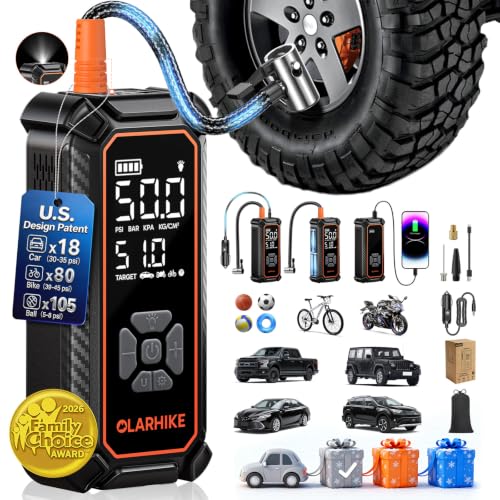
OlarHike Portable Tire Inflator Air Compressor
The OlarHike Portable Tire Inflator combines dual-power versatility via a 12V DC vehicle plug or built-in rechargeable battery with an automatic shut-off digital display. It provides dependable roadside tire top-offs and inflation for passenger cars, crossovers, motorcycles, and bicycles.
Pros
- Dual-power design allows cordless field operation or continuous power through any standard vehicle 12V DC port
- Automatic shut-off technology stops the motor precisely at preset pressure to prevent over-inflation
- Integrated 6000mAh battery reserve doubles as an emergency phone charger and includes an LED work light
- Pocket-sized footprint weighs well under two pounds for convenient transport in center consoles or backpacks
Cons
- Maximum vehicle pressure rating of 51 PSI is not suitable for heavy-duty commercial trucks, RVs, or high-pressure trailer tires
- Compact tankless inflator mechanism cannot power workshop pneumatic tools such as nail guns or air ratchets
- Recharging requires a standard 5V 2A or 5V 3A adapter and is not compatible with high-wattage fast chargers
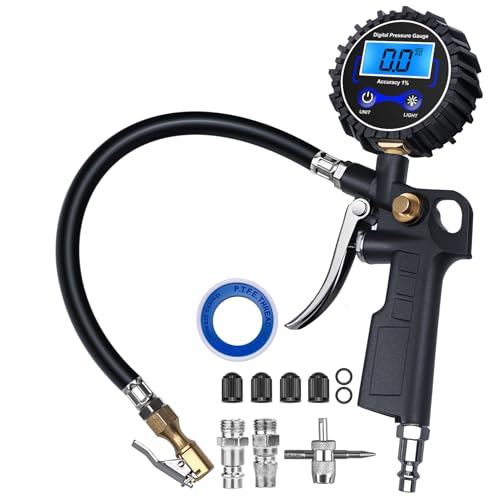
DigitPro 250 PSI Digital Tire Inflator Gauge
Equipped with a backlit screen and brass hardware, this versatile tool measures pressure up to 250 PSI with 0.1 PSI resolution. It is a practical workshop accessory for vehicle owners who already use an air compressor.
Pros
- Accurate readings within 1 percent across four units
- Durable brass and stainless steel build
- Backlit digital display for clear low-light visibility
- Combines checking, inflation, and deflation in one tool
Cons
- Requires a separate air compressor for inflation
GERCHWAY 100 PSI Tire Inflator Gauge
Designed for routine automotive maintenance, this mechanical inflator combines pressure checking, inflation, and deflation into a single battery-free unit. Its 100 PSI dial offers ±2 PSI accuracy, making it well matched for standard passenger cars and SUVs.
Pros
- Battery-free operation ensures reliable everyday use
- Swivel chuck provides an airtight, hands-free seal
- Protective rubber casing shields the gauge from drops
- Standard 1/4-inch NPT fitting connects easily to air hoses
Cons
- 100 PSI limit is unsuitable for high-pressure commercial tires
- Requires an external air compressor for tire inflation
- Analog dial is less precise to read than digital screens
AstroAI L7S 150 PSI Cordless Tire Inflator
Weighing just over a pound, the AstroAI L7S combines a 150 PSI compressor, emergency power bank, and multi-mode LED work light into a pocketable tool. It offers convenient on-the-go inflation for passenger cars, bicycles, and sports gear without taking up valuable cargo space.
Pros
- Extremely compact and lightweight at roughly one pound
- Protective silicone sleeve guards against drops and scrapes
- Preset auto shut-off prevents over-inflation
- Doubles as a backup power bank and flashlight
Cons
- Incompatible with heavy-duty trucks, RVs, and trailers
- Limited continuous battery capacity for large volume inflatables
Spurtar 10-120 PSI Tire Inflator Gauge
Equipped with an extended dual-head chuck and chrome-plated iron stem, this bayonet-style inflator gauge handles pressures up to 120 PSI. It provides a durable, all-in-one inflation and pressure-checking solution for standard passenger vehicles and dual-wheel trucks.
Pros
- Reaches difficult inner valves on dually tires easily
- Durable chrome-plated steel stem resists wear
- Comes with extra valve cores and repair tools
- Calibrated to 2 percent accuracy standards
Cons
- Two-pound scale increments limit fine-tuning precision
- 120 PSI maximum range excludes higher-pressure commercial tires
- Requires connection to a separate air compressor
AstroAI 100 PSI Tire Inflator Gauge
Built with durable brass and stainless steel parts, this analog unit combines tire pressure measurement, inflation, and deflation in one tool. It is well suited for drivers and home mechanics who need a straightforward Schrader-compatible gauge for their garage air compressor.
Pros
- Durable brass and stainless steel internal parts
- Combines inflation, deflation, and pressure checks
- Standard 1/4-inch NPT compressor quick-connect fitting
- Accurate analog dial rated to ANSI B40.1
Cons
- Requires an external air compressor to inflate tires
- Max 100 PSI cap limits heavy commercial use
- Analog dial lacks precise digital decimal readouts
AstroAI 250 PSI Digital Tire Inflator Gauge
Built for garage DIYers and mechanics, this tool pairs high ANSI Grade 2A accuracy with an integrated deflator valve and digital backlit screen. A built-in LED flashlight and quick auto-shutoff make routine tire pressure maintenance straightforward in dim conditions.
Pros
- Precise ANSI Grade 2A accuracy rating
- Convenient 3-in-1 inflation and deflation controls
- Easy-to-read backlit display with auxiliary flashlight
- Wide measuring capability up to 250 PSI
Cons
- Requires an external air compressor for inflation
- Requires batteries for the digital screen to function
Readers working through this often check what is the best tire inflator portable air compressor next.
Understanding What Is the Best Tire Inflator with Gauge for Your Vehicle
Finding what is the best tire inflator with gauge requires understanding that the market divides into two fundamentally different tool categories. Motorists frequently mix up portable standalone 12V air compressors with pneumatic shop air attachments designed for stationary air compressor tanks. Selecting the right design depends entirely on whether you need roadside emergency portability in a vehicle trunk or high-volume inflation speed in a home workshop. By evaluating gauge accuracy standards, power delivery systems, duty cycles, and valve chuck interfaces, you can choose a reliable tool that maintains proper cold tire pressure throughout the year.
The Core Divide: Portable Motorized Pumps vs. Workshop Air Compressor Attachments
The first step in evaluating inflation equipment is recognizing how air is generated and delivered to your tires. Standalone portable inflators contain an internal electric motor and miniature piston cylinder that compress ambient air on demand. These motorized units, such as compact 12V DC plug-in models or cordless lithium-ion pumps, carry their own compression mechanism directly to the tire valve stem. They are engineered primarily for roadside emergencies, routine driveway top-offs, and situations where no external compressed air supply exists.
In contrast, inflator gauge attachments like the AZUNO Digital Tire Inflator, GERCHWAY Air Chuck, or AstroAI Tire Pressure Gauge do not generate compressed air on their own. Instead, these tools serve as precision pneumatic control handles that connect to a separate air compressor tank using standard 1/4-inch NPT quick-connect fittings. They combine an inflation trigger, an inline pressure gauge, and a pressure relief bleeder valve into a single handheld assembly. This design allows users to harness the massive airflow volume of a workshop compressor while monitoring pressure continuously.
Drivers who prioritize emergency preparedness, trunk storage, and mobility should focus on self-contained motorized tire inflators. These compact tools operate independently wherever your vehicle travels, requiring only a 12V cigarette lighter socket or a charged internal battery pack. Conversely, DIY mechanics and home garage owners who already maintain a stationary or pancake air compressor will benefit far more from a dedicated pneumatic inflator attachment. A shop air attachment delivers significantly faster inflation speeds and never suffers from electrical motor burnout or duty cycle restrictions.
Pressure Gauge Mechanics: Comparing Digital Transducers, Bourdon Tubes, and Bayonet Sliders
The accuracy of your pressure gauge directly determines the safety and longevity of your vehicle tires. Digital pressure gauges use solid-state piezoresistive pressure transducers to convert pneumatic line force into electronic numeric readouts on backlit LCD screens. Many modern digital gauges, such as those found on the AstroAI Digital Tire Pressure Gauge or DigitPro Digital Tire Pressure Gauge, provide readings down to 0.1 PSI resolution. These electronic displays often adhere to ANSI B40.7 Grade 2A calibration standards, maintaining accuracy within half a percent across their measuring span.
Traditional mechanical dial gauges operate using an internal curved copper or brass Bourdon tube that flexes outward as internal pressure rises. This mechanical movement translates through a gear train to sweep a needle across an analog dial face, as seen in the GERCHWAY Air Chuck and AstroAI Tire Pressure Gauge. Bourdon tube gauges require zero batteries to operate, ensuring they never fail unexpectedly during freezing winter mornings. However, mechanical gauges are calibrated according to ANSI B40.1 standards, which typically offer their greatest accuracy in the middle third of their overall scale.
A classic bayonet-style slide gauge, exemplified by the Spurtar 10-120 PSI Tire Pressure Gauge, relies on an internal calibrated spring that pushes a marked metal slide indicator out from the handle. While bayonet inflators are renowned for their rugged durability and drop resistance in commercial service bays, they provide coarser reading increments, typically marked in 2-PSI intervals. For passenger cars with recommended cold inflation targets between 32 and 35 PSI, a dedicated digital readout or a 100-PSI analog dial offers far better precision than an oversized 250-PSI commercial scale.
Power Source Architectures: 12V DC Vehicle Auxiliary vs. Cordless Lithium-Ion Batteries
When selecting a motorized portable tire inflator, the power delivery configuration dictates both convenience and roadside reliability. Dedicated 12V DC corded inflators, such as the CRAFTSMAN Portable 12V Tire Inflator with its 10-foot power lead, draw current directly from your vehicle cigarette lighter socket. This design provides continuous, reliable electrical current without worrying about battery shelf-life degradation or forgotten charging cycles. A corded 12V inflator can sit in a vehicle trunk for years and remain instantly operational whenever plugged into a live auxiliary socket.
Cordless battery-powered models, such as the AstroAI L7S Tire Inflator Portable Air Compressor with its 4000mAh battery, deliver complete freedom from tangled cords and vehicle socket reach limitations. Cordless inflators excel when servicing bicycles, motorcycles, sports balls, and vehicles parked far away from power outlets. However, internal lithium-ion cells naturally experience self-discharge over time and can lose temporary cranking voltage when left in freezing vehicle cabins during winter months. Maintaining cordless inflators requires periodically checking and recharging the battery pack every few months.
Dual-power inflators represent an increasingly popular compromise by integrating both rechargeable lithium-ion battery cells and a 12V DC car adapter cord. The OlarHike Tire Inflator Portable Air Compressor demonstrates this hybrid architecture by combining internal rechargeable cells with a backup 12V auxiliary power cable. If the internal battery runs low while topping off a second or third tire, the user can plug the auxiliary cord into the dashboard socket to complete the job. This dual-source flexibility provides the speed of cordless operation alongside the fail-safe reliability of vehicle electrical power.
Inflation Flow Rate, CFM Delivery, and Motor Duty Cycle Constraints
Airflow volume and motor endurance determine how quickly an inflator can recover lost pressure without overheating. Compact portable compressors feature small reciprocating pistons that generate modest airflow, typically measured in liters per minute or fractions of a cubic foot per minute. For example, standard portable units can raise a passenger car tire from 30 to 36 PSI in roughly 60 to 90 seconds. However, raising an empty tire from zero pressure requires significantly longer runtimes that can stress miniature motor windings.
Duty cycle defines the percentage of time a compressor can safely operate before requiring a mandatory cool-down period. Most compact 12V and cordless tire inflators carry a continuous duty cycle rating of 10 to 15 minutes, followed by a mandatory 10-minute rest interval. Exceeding this operational limit causes rapid thermal buildup within the cylinder head, risking internal Teflon piston seal degradation or tripping internal thermal overload cut-off switches. Drivers managing large SUV or light truck tires must allow these cool-down breaks between tires to preserve motor longevity.
Pneumatic shop air inflator attachments bypass duty cycle constraints entirely because the heat of compression is absorbed by the stationary garage compressor. The handheld tool simply regulates the pre-compressed air flowing out of the storage reservoir, allowing instantaneous tire top-offs in mere seconds. If your inflation needs involve managing multiple fleet vehicles, utility trailers, or high-volume truck tires in a single session, a workshop compressor line attachment is vastly superior to a miniature 12V motorized pump.
A closely related question is covered in who makes the best tire inflator, which may help alongside this section.
Valve Chuck Mechanisms: Brass Threads, Quick-Lock Levers, and Dual-Head Stems
The interface between the inflator hose and the tire valve stem has a major impact on user experience and air retention. Threaded brass screw-on chucks provide an exceptionally secure mechanical coupling that cannot blow off under high backpressure. However, unscrewing a threaded brass fitting from a Schrader valve stem can be clumsy, often leaking two to three PSI of air before the threads clear the valve core. This pressure loss forces users to deliberately overinflate tires slightly to compensate for disconnect bleed.
Quick-release thumb-lock chucks and push-on locking mechanisms solve the disconnection air loss problem with a rapid-action release lever. Locking air chucks, like those included on the AZUNO Digital Tire Inflator and GERCHWAY Air Chuck, clamp firmly onto the external valve stem threads with an internal rubber O-ring seal. Flipping the thumb lever disengages the chuck instantly, eliminating air loss while keeping hands clear of hot metal components. Premium attachments often incorporate 360-degree brass swivels that prevent the rubber hose from binding or twisting during tight valve stem access.
Dual-head straight and angled chucks, featured on bayonet models like the Spurtar 10-120 PSI Tire Pressure Gauge, are specifically engineered for commercial and multi-wheel applications. The forward 30-degree push chuck reaches standard outer wheel valve stems, while the reverse pull chuck latches onto concealed inner valve stems on dual-wheel pickup trucks and motorhomes. When servicing specialized equipment, ensuring your inflator kit includes brass Presta adapters for road bicycles, needle adapters for sports equipment, and tapered nozzles for small inflatables maximizes general household utility.
Step-by-Step Procedure: Calibrating and Operating Your Tire Inflator
Proper tire inflation begins before you even attach the air chuck to the valve stem. Always locate the official tire and loading information placard mounted on your vehicle driver-side door jamb. This placard specifies the exact manufacturer-recommended cold inflation pressure, which typically ranges between 32 and 36 PSI for passenger sedans and crossovers. Never use the maximum pressure molded onto the tire sidewall, as that number represents the absolute structural limit of the tire carcass under maximum load rather than the vehicle optimal operating pressure.
When operating a 12V DC plug-in inflator, start your vehicle engine before connecting the auxiliary power cord to the dashboard lighter socket. Idling the engine maintains a stable 13.8 to 14.4 system voltage, which keeps the inflator motor running at maximum efficiency while preventing starter battery depletion. Connect the air hose chuck securely onto the valve stem, ensuring a tight seal with zero hissing sounds. If your inflator features digital auto shut-off, set your target pressure on the LCD screen, initiate inflation, and step back while the unit pumps automatically.
For workshop pneumatic inflator guns, connect the quick-connect plug to your regulated air hose line set between 90 and 120 PSI. Squeeze the ergonomic hand trigger fully to pump compressed air into the tire, or release the trigger halfway to read the static pressure on the gauge face. If you inadvertently overshoot your target, depress the thumb-operated brass bleeder valve to exhaust excess air down to your exact desired PSI. Once inflation is complete, quickly remove the chuck, verify the resting pressure, and replace the plastic valve stem dust cap to shield the internal valve core from road grit.
Troubleshooting Electrical Faults, Blown Fuses, and Inaccurate Pressure Readings
Blown 12V auxiliary power fuses represent the single most common frustration experienced with portable car tire inflators. Most vehicle cigarette lighter circuits are protected by a 10-amp or 15-amp fuse located in the interior fuse panel. If you attach an air chuck to a tire already pressurized at 35 PSI before switching on the inflator motor, the compressor must fight against immediate head backpressure. This high-torque startup condition creates a massive inrush current spike that can instantly pop a 10-amp fuse.
To prevent blown auxiliary fuses, turn the portable inflator power switch on first to establish motor momentum, or ensure the unit features soft-start circuitry before securing the chuck. If your inflator suddenly stops running mid-inflation, inspect the tip of the 12V male cigarette plug collar, which often contains an internal replaceable glass cartridge fuse. Alternatively, the compressor internal thermal protection switch may have tripped from excessive runtime, requiring a 15-minute cool-down period before internal contacts reset.
Pressure discrepancies between inflator gauges and vehicle Tire Pressure Monitoring System (TPMS) dashboard sensors are also widely misunderstood. Remember that active line pressure displayed while the compressor pump is running will always read 2 to 4 PSI higher than true resting pressure due to airflow resistance inside the narrow rubber hose. Always turn off the motor or release the pneumatic inflation lever to allow line pressure to equalize before reading your final static PSI. Additionally, ambient seasonal temperature drops reduce tire pressure by roughly 1 PSI for every 10-degree Fahrenheit drop, requiring regular monthly pressure checks.
Long-Term Maintenance and Proper Vehicle Storage Habits
Maintaining your tire inflation equipment ensures it functions dependably when roadside emergencies strike. For pneumatic compressor attachments, periodically inspect the rubber hose for surface cracking, dry rot, or fitting leaks near the brass crimps. Apply a drop of pneumatic air tool oil into the 1/4-inch NPT quick-connect coupler occasionally to lubricate internal piston O-rings and prevent valve sticking. Keep the air chuck rubber seal clean and free from metal debris that could compromise valve stem seating.
Cordless lithium-ion inflators require careful environmental storage management to prevent premature cell failure. Extreme vehicle cabin heat during summer months can accelerate battery capacity degradation, while sub-freezing winter trunk storage reduces immediate battery output. If you store a cordless inflator in your vehicle emergency kit, make a habit of bringing it indoors every three months to verify charge level and top off the internal cells. Storing the tool in an insulated glovebox or dedicated carry case shields delicate digital LCD displays and silicone protective sleeves from vibration and mechanical impacts.
Ultimately, determining the best tire inflator with a gauge comes down to matching your primary use case with the right engineering design. Commuters and road trippers will find unbeatable convenience in dual-power or cordless 12V inflators equipped with digital auto shut-off, while home mechanics and garage hobbyists are best served by rugged pneumatic line inflator gauges. By investing in calibrated accuracy, observing duty cycle limits, and checking cold tire pressures regularly, you ensure maximum vehicle safety, optimal tire lifespan, and complete peace of mind on every journey.
A closely related question is covered in what is the best tire inflator with pressure gauge, which may help alongside this section.
About the author
Tom Scalisi brings more than two decades of experience in construction, building maintenance, contracting, and hands-on tool use. His practical understanding of power tools, automotive work, repairs, and jobsite equipment helps readers evaluate compressors based on real workloads rather than specifications alone.