
What Is the Best Tire Inflator to Buy: Practical Guide for 2026
Maintaining proper tire pressure protects safety and fuel economy. Learn what is the best tire inflator to buy for cars, SUVs, and RVs in November 2026.
 By Tony Carrick
Updated October 8, 2026


A sudden dashboard tire pressure monitoring system warning on a freezing morning often signals a common seasonal reality: ambient temperature drops reduce tire pressure by roughly one pound per square inch for every ten-degree drop. Finding an accurate, functioning gas station air pump during a rush-hour commute can quickly turn a routine top-off into an aggravating delay. Deciding %what is the best tire inflator to buy% comes down to matching your vehicle class, storage habits, and inflation demands against real pneumatic capabilities. Portable air compressors range from compact glovebox emergency pumps to continuous-duty multi-cylinder units capable of handling large truck and trailer tires. Understanding key technical specifications like air delivery volume, duty cycle limitations, and power delivery ensures that you select a reliable unit that will not leave you stranded.
Vehicle owners frequently struggle with slow inflation speeds, overheating pump motors, and blown vehicle auxiliary power fuses caused by excessive electrical inrush current. Choosing the right inflator requires balancing airflow delivery rate measured in cubic feet per minute, maximum operating pressure, and secure chuck connections that prevent annoying pressure bleed. Whether you need a direct-drive 12V direct battery clamp compressor for large off-road tires, a dual-cylinder unit with an integrated tire plug repair kit, or an upgraded locking chuck adapter to eliminate threaded stem leaks, the right hardware makes tire maintenance seamless. Investing in a dependable tire inflator restores peace of mind, preserves tire tread life, and guarantees rapid roadside recovery whenever pressure drops unexpectedly.
| Award | Product | ACR Score About ACR ScoreThe ACR Score is our own rating from 0 to 10, based on performance, design and build, ease of use, and value. It reflects independent research and is never influenced by manufacturers, retailers, or affiliate commissions. Learn more › | |
|---|---|---|---|
| Best Overall |
VIAIR 450P-RV 150 PSI 12V Air Compressor
|
9.2/10 | Buy |
| Best Budget |
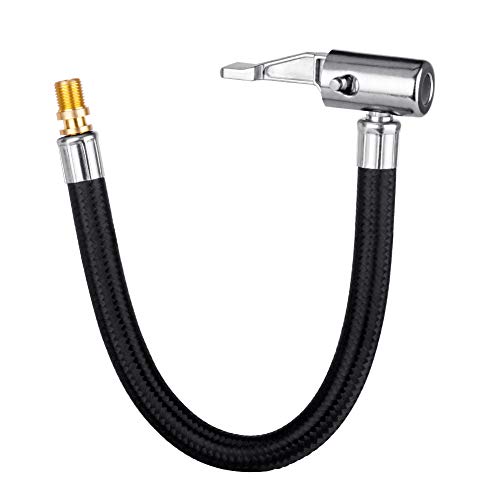 LUMITECO 10-Inch Locking Tire Chuck Hose Adapter |
8.9/10 | Buy |
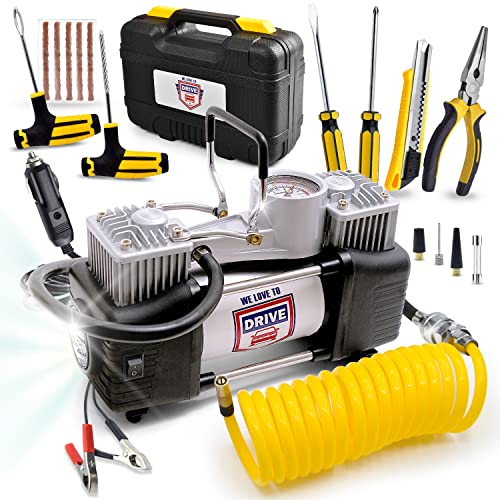 WE LOVE TO DRIVE Dual Cylinder Tire Inflator |
8.6/10 | Buy |
VIAIR 450P-RV 150 PSI 12V Air Compressor
Engineered for Class A motorhomes and heavy trucks, this heavy duty 12V compressor features a 100 percent duty cycle and automatic shutoff for continuous tire inflation up to 150 PSI. Direct battery connection and high flow output make it a reliable setup for large vehicle maintenance and roadside emergencies.
Pros
- 100 percent duty cycle allows extended continuous use
- Automatic shutoff simplifies moving between tires
- Capable of inflating large tires up to 42 inches
- High 1.80 CFM free-flow rate delivers fast inflation
- Includes gas station-style inflation gun and carry bag
Cons
- Requires direct connection to vehicle battery
- Relatively heavy at over 13 pounds
- Requires vehicle engine running during operation
LUMITECO 10-Inch Locking Tire Chuck Hose Adapter
The LUMITECO 10-Inch Locking Tire Chuck Adapter converts frustrating twist-on inflator hoses into a quick-locking thumb clamp to prevent air loss when disconnecting from valve stems. It is a practical, low-cost upgrade for commuters, cyclists, and drivers looking to simplify routine tire pressure maintenance.
Pros
- Converts tedious screw-on chucks to quick-release lock-on levers to eliminate disconnect air loss
- Standard 0.305-inch x 32 TPI thread matches standard Schrader valve dimensions on vehicle pumps
- Reinforced nylon-wrapped rubber hose resists kinking while adding 10 inches of working reach
- All-metal 90-degree thumb clamp allows reliable hands-free connection during inflation
Cons
- Not designed to connect directly into bare air compressor housings without an existing twist-on chuck
- Restricted to light-duty passenger vehicles and bicycles; strictly forbidden for commercial heavy trucks
- Open-flow design requires attachment to the tire valve stem before starting air delivery to avoid line venting
WE LOVE TO DRIVE Dual Cylinder Tire Inflator
Combining a dual cylinder 12V compressor with a complete plug and patch kit, this roadside set delivers up to 150 PSI for car, truck, and recreation tires. It serves as a comprehensive trunk solution for drivers who want both rapid inflation and immediate flat repair tools on road trips.
Pros
- Dual cylinder mechanism delivers high-pressure 150 PSI output
- Bundles essential flat tire repair plugs and patch tools
- Integrated gauge enables straightforward pressure monitoring
- Versatile application for trucks, SUVs, and recreational gear
Cons
- Relatively hefty carry weight at over eight pounds
- Tethered to a 12V DC vehicle power source
For more on a connected point, our page on best compact tire inflator home depot vs lowes goes into it separately.
Evaluating Tire Inflators: How to Choose the Right Compressor for Your Vehicle
Deciding %what is the best tire inflator to buy% requires looking beyond raw maximum pressure numbers to evaluate how pneumatic hardware performs under actual backpressure. A compressor rated for high maximum pressure can still deliver air so slowly that topping off a standard passenger tire takes an excessive amount of time. Selecting the right tire inflator depends on your vehicle class, tire air volume, electrical capacity, and intended roadside or garage use. When you match motor power, continuous duty cycle ratings, and valve connection fittings to your vehicle requirements, tire maintenance shifts from a stressful chore to a quick, predictable routine.
Airflow Delivery and Tire Volume: Matching CFM to Your Wheels
Airflow delivery volume, commonly measured in cubic feet per minute (CFM) or liters per minute (LPM), dictates how quickly an inflator introduces air into a tire chamber. Many motorists mistakenly focus entirely on the peak pounds per square inch rating stamped on a pump casing, overlooking that nearly any basic compressor can eventually reach moderate pressure if run long enough. The true differentiator in real-world performance is the volume of air delivered against active line backpressure. Passenger cars with standard tires require significantly less air volume to gain five pounds of pressure than oversized light truck, SUV, or motorhome tires.
Heavy-duty platforms like the VIAIR 450P-RV Automatic 12V Air Compressor deliver a free-flow rating of 1.80 CFM, allowing them to fill large tires efficiently without motor strain. When servicing large tires found on Class A motorhomes, lifted trucks, or travel trailers, a low-volume compact pump may run for extended periods without reaching target pressure. Dual-cylinder configurations, such as the Tire Inflator Portable Air Compressor with Tire from WE LOVE TO DRIVE, employ twin pistons to move a greater volume of air with each motor revolution. This increased volume output reduces wait times substantially, especially when airing up from flat or adjusting multiple tires after trail driving.
Understanding the distinction between high-pressure, low-volume tasks and low-pressure, high-volume tasks prevents costly buying mistakes. A road bicycle tire operates at relatively high pressure but holds a tiny volume of air, meaning even a small pump can inflate it in seconds. Conversely, a light truck tire operating at sixty pounds per square inch contains thousands of cubic inches of interior volume that demand sustained air movement. Matching your compressor displacement to your tire volume ensures the motor operates within its designed capacity without stalling against resistance.
Duty Cycle and Thermal Saturation: Avoiding Motor Shutdowns
Duty cycle represents the percentage of time a compressor can operate continuously at a given pressure before requiring a mandatory cool-down interval. A portable compressor operating under load generates substantial heat inside the cylinder head as air molecules are compressed. If a pump features a low duty cycle, such as twenty or thirty percent, it can run for only a brief window before internal thermal switches trip to prevent permanent motor burnout. Drivers servicing multiple tires often encounter this limitation when a compact pump suddenly cuts out on the third tire.
Continuous-duty performance changes this dynamic by dissipating thermal energy as quickly as it builds up. The VIAIR 450P-RV Automatic provides a 100 percent duty cycle at 100 PSI, allowing it to run continuously under demanding conditions without forced pauses. This continuous capability is essential for large recreational vehicles and multi-vehicle households where airing up several tires in a single session is routine. Without adequate heat dissipation fins and robust motor components, heat degrades piston seals and scorches internal connecting rods.
Observing thermal limitations is vital for extending the operational life of any portable air compressor. Even units equipped with automatic thermal overload protection suffer accelerated mechanical wear if pushed past their operating limits repeatedly. Allowing compact pumps to rest between tires gives the motor windings and high-pressure hose couplings time to radiate heat. Handling the metal fittings near the cylinder head with gloves or care is also essential, as these components reach elevated temperatures during sustained compression cycles.
Power Architecture: Cabin Auxiliary Sockets versus Battery Clamps
How a portable compressor draws electrical current directly influences its motor size, continuous power delivery, and reliability. Standard twelve-volt cigarette lighter auxiliary outlets inside vehicle cabins are typically protected by ten-amp or fifteen-amp fuses. Compressors designed to plug into these dashboard ports must limit their electrical draw to remain below that circuit threshold. While convenient for quick top-offs on passenger sedans, this amperage ceiling caps the physical horsepower of the direct-drive electric motor.
High-output compressors and heavy-duty dual-cylinder pumps require significantly more electrical current than a cabin auxiliary socket can safely deliver. Units that draw twenty or thirty amps rely on heavy-duty alligator clamps that connect directly to the positive and negative terminals of the vehicle battery. This direct connection bypasses delicate interior wiring harnesses and prevents blown dashboard fuses during motor startup. Running the vehicle engine during inflation stabilizes the system voltage at roughly fourteen volts and prevents draining the starter battery.
Before connecting any pump, inspect your vehicle fuse ratings and manual specifications to avoid electrical overloads. Starting an electric motor against closed valve backpressure creates an initial current inrush that can easily trip a fifteen-amp cabin fuse. If your compressor uses a standard twelve-volt plug, powering the unit on before locking the chuck onto the valve stem can reduce this startup resistance spike. For larger vehicles, trucks, and recreational platforms, direct battery clamp power remains the superior, trouble-free configuration.
If this topic is part of a bigger decision, what is the best tire inflator with gauge is a useful related read.
Automatic Pressure Cut-Off and Gauge Calibration Accuracy
Modern portable tire inflators increasingly incorporate digital pressure transducers and automatic shut-off systems to streamline roadside inflation. An automatic shut-off mechanism allows the user to dial in a target pressure based on the vehicle door-jamb cold tire placard and let the pump run hands-free. Once the internal sensor detects that the preset pressure has been achieved, the controller cuts power to the motor automatically. This feature eliminates the guesswork of manual monitoring and prevents dangerous over-pressurization that can damage tire casings.
Dynamic air delivery introduces a common pneumatic challenge where active line pressure reads higher than actual static tire pressure. As compressed air rushes through the narrow orifice of the tire valve stem, the internal sensor measures the combined backpressure of the air stream and the tire chamber. Quality inflators compensate for this discrepancy through momentary pauses or specialized calibration curves, whereas traditional mechanical gauges require manual shut-down to read resting pressure. The VIAIR 450P-RV Automatic incorporates an automatic cut-off sensor that cycles the compressor dynamically whenever the inflation gun trigger is released.
Verifying onboard gauge accuracy against a dedicated, calibrated standalone pressure gauge is always good automotive practice. Digital gauges can experience minor sensor drift over time due to mechanical vibration, extreme temperature swings, or drops against hard pavement. A variance of one or two pounds per square inch may seem minor, but it can affect fuel efficiency, tire wear patterns, and dashboard monitoring system warnings. Regularly confirming that your inflator shuts down at the true resting cold tire pressure ensures consistent, safe road contact.
Valve Chuck Mechanics: Threaded Brass versus Quick-Lock Adapters
The mechanical connection between the air hose and the tire valve stem is a critical, yet frequently overlooked, component of any inflation setup. Standard screw-on brass chucks create an airtight seal by threading directly onto the valve stem threads. While threaded brass fittings resist blowing off under high line pressure, unscrewing them from a recessed valve stem can be clumsy and slow. During the seconds it takes to spin a threaded fitting off the stem, escaping air can bleed several pounds of pressure, undoing recent progress.
Quick-release locking chuck adapters solve this disconnection frustration by converting twist-on lines into instant thumb-press mechanisms. The LUMITECO Locking Tire Chuck with Rubber Hose attaches directly to standard screw-on hoses and provides a ninety-degree open-flow clamping head. Built with all-metal internals and a reinforced nylon-wrapped rubber hose, this adapter clamps securely onto standard fine-thread valve stems with a simple press of the lever. This design allows hands-free inflation and enables rapid, zero-loss disconnection once target pressure is reached.
Maintaining clean, undamaged valve threads is essential when using any style of air chuck fitting. Road grime, winter road salt, and grit can foul fine brass threads, leading to cross-threading or improper seating that causes severe air leaks during pumping. Inspecting the internal rubber O-ring inside your chuck adapter guarantees that high-pressure air enters the tire core rather than escaping around the collar. Keeping a threaded valve cap installed on every wheel prevents contamination and protects the delicate Schrader valve core from road debris.
Roadside Repair Capability and Emergency Readiness
Pumping air into a tire that has suffered a puncture from a nail or screw provides only temporary relief unless the physical breach is sealed. Roadside emergencies frequently involve slow leaks that rapidly worsen once highway speeds and tire heat generate added pressure. Integrated emergency setups like the WE LOVE TO DRIVE kit pair a dual-cylinder compressor with a complete tire plug and patch kit. Having heavy-duty insertion tools, rasps, vulcanizing cement, and rubber plugs alongside your air source allows you to repair tread punctures directly on the shoulder.
Performing a proper roadside plug repair requires basic mechanical awareness and strict safety precautions. Plugs are designed exclusively for punctures located within the central tread area and should never be used on damaged sidewalls or tire shoulders. Once the puncturing object is extracted and the hole reamed, inserting a vulcanized plug seals the channel against moisture and air loss. Reinflating the tire immediately afterward with a high-output compressor confirms whether the seal holds before you merge back into traffic.
Roadside conditions rarely present ideal lighting, level surfaces, or warm weather when tire emergencies arise. Integrated work lights on compressor housings help illuminate dark wheel wells, valve stems, and roadside hazards during nighttime emergencies. Bright hazard lighting modes alert approaching motorists to your stationary vehicle on narrow highway shoulders. Combining illumination, repair plugs, and dependable inflation hardware transforms a standard air pump into a complete roadside recovery system.
Establishing a Cold Pressure Verification and Maintenance Routine
Owning a high-performance tire inflator delivers maximum value only when paired with consistent tire pressure maintenance habits. Cold tire pressure should always be measured when the vehicle has been stationary for at least three hours or driven less than one mile at moderate speed. Highway driving warms the air inside the tire carcass, naturally increasing pressure by three to five pounds per square inch. Attempting to adjust warm tires down to the driver-door placard specification will result in dangerous under-inflation once the tires cool.
Always consult the vehicle manufacturer door-jamb B-pillar placard rather than the maximum pressure stamped on the tire sidewall. The sidewall figure indicates the maximum permissible pressure the tire structure can support under maximum load, not the optimized vehicle setting for ride comfort, braking distance, and even tread wear. Using your portable compressor to correct for seasonal temperature shifts ensures your tires wear evenly across their lifespan. Consistent pressure management also optimizes rolling resistance, directly improving fuel economy and highway stability.
Establishing a monthly pressure check takes only a few minutes in your driveway and prevents roadside breakdowns. When seasonal autumn freezes arrive, topping off all four tires restores lost volume and resets dashboard warning lights without requiring a detour to a service station. Equipping your vehicle with a capable compressor, durable locking chuck fittings, and emergency plugs gives you complete autonomy over tire maintenance. Reliable inflation hardware ensures you remain prepared for routine pressure drops and sudden highway emergencies alike.
Readers working through this often check what is the top best portable tire inflator next.
About the author
Tony Carrick is an experienced product researcher and writer specializing in tools, home improvement, automotive maintenance, and consumer equipment. With extensive experience reviewing tools and tackling hands-on renovation projects, he brings a buyer-focused perspective to compressor performance, usability, and overall value.