
Is Astroai Tire Inflator Good: Practical Guide for 2026
Tire pressure maintenance matters for safety. Learn is astroai tire inflator good for routine top-offs and road emergencies in November 2026.
 By Tom Scalisi
Updated October 8, 2026


Cold morning temperatures frequently trigger an unwelcome tire pressure monitoring system warning on the vehicle dashboard. A sudden drop of ten degrees Fahrenheit can cause pneumatic pressure to dip by roughly one pound per square inch, leaving commuters searching for reliable inflation equipment. Drivers often ask is astroai tire inflator good enough to handle these regular seasonal adjustments and sudden roadside pressure losses. Evaluating the brand requires examining direct-drive motor construction, digital pressure gauge tolerances, and thermal heat management under real-world vehicle loads. For drivers surveying the broader market, comparing these specifications against top portable tire inflator options helps determine whether a compact emergency compressor provides sufficient output for routine tire care.
Modern portable air compressors must balance compact trunk storage with dependable inflation speed and consistent automatic shut-off accuracy. AstroAI has established a major presence across vehicle accessory categories by offering direct twelve-volt plug-in compressors, rechargeable lithium-ion handheld pumps, and multi-power hybrid units. These inflators generally deliver between twenty-five and thirty-five liters per minute of airflow, allowing a typical passenger car tire to top off from thirty to thirty-six PSI in under two minutes. Understanding how their internal metal cylinders, duty cycles, and power delivery architectures hold up against frequent garage use clarifies whether adding one to your vehicle emergency kit makes practical sense.
| Award | Product | ACR Score About ACR ScoreThe ACR Score is our own rating from 0 to 10, based on performance, design and build, ease of use, and value. It reflects independent research and is never influenced by manufacturers, retailers, or affiliate commissions. Learn more › | |
|---|---|---|---|
| Best Overall |
AstroAI H2 Pro Cordless Tire Inflator 150 PSI
|
9.2/10 | Buy |
| Best Premium |
 AstroAI MC3 160 PSI Tire Inflator |
9.1/10 | Buy |
 AstroAI Cordless Tire Inflator 160 PSI |
8.8/10 | Buy | |
| Best Budget |
 AstroAI 12V DC Portable Air Compressor Tire |
8.4/10 | Buy |
| Best Value |
 AstroAI AIRUN H 12V DC Portable Air Compressor |
8.4/10 | Buy |
 AstroAI 160 PSI Cordless Tire Inflator |
8.4/10 | Buy | |
 AstroAI L7S 150 PSI Cordless Tire Inflator |
8.1/10 | Buy | |
 AstroAI Portable Tire Inflator Air Compressor |
8.1/10 | Buy | |
 AstroAI 100 PSI Tire Inflator Gauge |
8.0/10 | Buy | |
 AstroAI L7 Cordless Tire Inflator Portable Air |
8.0/10 | Buy |
AstroAI H2 Pro Cordless Tire Inflator 150 PSI
The AstroAI H2 Pro is a versatile dual-power portable tire inflator delivering up to 150 PSI via an internal rechargeable lithium battery or 12V DC vehicle plug. Featuring digital auto shut-off, accurate dual pressure displays, and onboard accessory storage, it is an ideal roadside emergency and garage solution for vehicle owners and cyclists.
Pros
- Dual power supply provides cordless convenience with a 12V DC vehicle fallback for roadside emergencies.
- Automatic shut-off and dual digital display prevent overinflation and eliminate manual pressure monitoring.
- ToughUltra internal components improve mechanical durability compared to standard plastic gear assemblies.
- Integrated nozzle storage compartment keeps bicycle adapters and ball needles organized inside the unit.
Cons
- Tankless high-pressure inflator design is not compatible with pneumatic workshop air tools like nailers or impact wrenches.
- Cordless runtime is limited to approximately 18 minutes before requiring a recharge or switching to the 12V DC vehicle cord.
- Direct-drive high-pressure pump requires cool-down pauses during continuous multi-tire inflation tasks.
AstroAI MC3 160 PSI Tire Inflator
Powered by a versatile three-way system supporting battery, AC, and DC inputs, this dual-motor inflator handles high-pressure car tires and high-volume inflatables with ease. It is an ideal roadside and garage tool for owners of passenger cars, mid-sized SUVs, and outdoor recreational gear.
Pros
- Versatile AC, DC, and cordless battery power options
- Dual modes handle both tires and camping mattresses
- Automatic shut-off prevents over-inflation
- Convenient built-in storage for hoses and accessories
Cons
- Not compatible with heavy-duty truck tires
- Relatively bulky footprint compared to pocket inflators
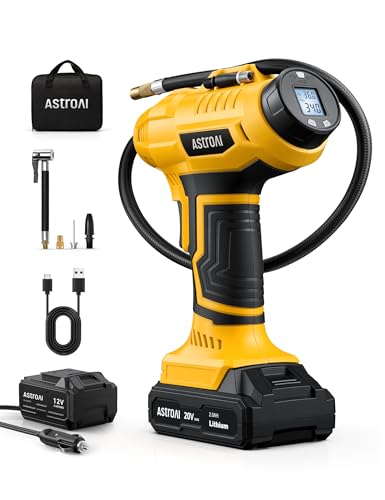
AstroAI Cordless Tire Inflator 160 PSI
The AstroAI Cordless Tire Inflator is a compact 160 PSI handheld air compressor featuring dual power via a 20V rechargeable battery and a 12V DC car adapter. Delivering digital auto shut-off and up to 20 minutes of continuous runtime, it is an ideal emergency tool for garage mechanics, commuters, and road-trippers.
Pros
- Dual-power versatility allows cordless battery operation at home or 12V DC vehicle plug-in on the road
- Reaches up to 160 PSI with automatic shut-off to prevent accidental tire over-pressurization
- Compact 2.54-pound footprint provides effortless trunk or glove-box storage for emergency readiness
- Backlit digital LCD screen provides clear readouts in PSI, BAR, and KPA units
- Integrated front LED light illuminates tire valve stems during dark roadside emergencies
Cons
- Includes a USB-C charging cable but requires an external USB power block to recharge the battery
- Designed specifically for tire and sports inflation rather than driving pneumatic workshop air tools
- Continuous runtime is limited to 20 minutes before requiring a cool-down pause
AstroAI 12V DC Portable Air Compressor Tire
The AstroAI 12V DC Portable Tire Inflator delivers a listed 25 L/min flow rate for fast roadside top-offs, featuring an auto-shutoff digital gauge and an 11.1-foot total reach. Powered strictly via 12V automotive sockets, it offers dependable emergency inflation for drivers, garage hobbyists, and compact vehicle owners.
Pros
- Quick roadside top-offs with manufacturer-rated 25 L/min pump speed
- Accurate digital display with auto-stop prevents over-pressurizing tires
- Long 11.1-foot combined cord and hose reaches all four vehicle tires
- Compact, sub-1.5-pound chassis with built-in cord and nozzle storage
- Integrated LED work light for roadside emergencies at night
Cons
- Restricted to 12V DC automotive sockets only with no direct 120V AC household plug included
- Requires a cool-down pause after 15 minutes of continuous run time
- Tankless design cannot operate pneumatic nailers, air ratchets, or automotive shop air tools
AstroAI AIRUN H 12V DC Portable Air Compressor
The AstroAI AIRUN H is a compact 12V DC tire inflator delivering up to 35 L/min airflow with automatic shut-off and digital pressure presets. It is an ideal portable emergency compressor for drivers, commuters, and garage hobbyists seeking fast tire top-offs.
Pros
- Automatic shut-off stops pumping reliably once target PSI is reached
- High-airflow 120W motor provides rapid top-offs for daily driver tires
- Long 9.84-foot power cord reaches all passenger vehicle wheels with ease
- Bright built-in LED flashlight and backlit display assist during night repairs
- Lightweight 2.2-pound form factor stores neatly in glove boxes and trunks
Cons
- Requires a 12V DC vehicle outlet and does not include a 120V AC household plug
- Mandates a 10-minute cool-down interval after 15 minutes of continuous operation
- Not intended for high-volume inflatables like large pool floats or air mattresses
AstroAI 160 PSI Cordless Tire Inflator
Delivering up to 160 PSI with both a 20V battery and a 12V car adapter, this handheld compressor provides versatile roadside and garage tire maintenance. Its auto shut-off feature and integrated LED light make pressure adjustments straightforward in any condition.
Pros
- Dual power options via 20V battery and 12V adapter
- Automatic shut-off stops inflation at preset targets
- Durable metal cylinder supports 20 minutes continuous use
- Built-in LED light improves visibility in the dark
- Includes storage bag and multiple valve adapters
Cons
- Relatively heavy for a handheld unit at 4.14 pounds
- Continuous runtime capped at twenty minutes
- Battery capacity limited to four tires per full charge
AstroAI L7S 150 PSI Cordless Tire Inflator
Weighing just over a pound, the AstroAI L7S combines a 150 PSI compressor, emergency power bank, and multi-mode LED work light into a pocketable tool. It offers convenient on-the-go inflation for passenger cars, bicycles, and sports gear without taking up valuable cargo space.
Pros
- Extremely compact and lightweight at roughly one pound
- Protective silicone sleeve guards against drops and scrapes
- Preset auto shut-off prevents over-inflation
- Doubles as a backup power bank and flashlight
Cons
- Incompatible with heavy-duty trucks, RVs, and trailers
- Limited continuous battery capacity for large volume inflatables
AstroAI Portable Tire Inflator Air Compressor
The AstroAI Dual Power Tire Inflator combines a 12V DC vehicle plug and 120V AC household cord, delivering up to 150 PSI for car tires and a 350 L/min high-volume mode for rafts and mattresses. It is a dependable, compact choice for garage mechanics, road-trippers, and homeowners wanting versatile inflation without needing a bulky air tank.
Pros
- Dual 12V DC and 120V AC power cords offer genuine versatility for garage benches, driveways, and roadside emergencies
- Two dedicated inflation modes handle high-pressure tires up to 150 PSI as well as high-volume camping gear at 350 L/min
- Digital auto-shutoff stops pumping once target pressure is reached, preventing accidental over-inflation
- Integrated cord and air hose storage compartments maintain a clean, compact footprint in vehicle trunks
- Dual metal motor build provides reliable output with up to 15 minutes of continuous run time per cycle
Cons
- Not designed to support heavy-duty commercial truck tires or high-volume commercial vehicle applications
- Requires a mandatory 10-minute cooling rest after 15 minutes of continuous high-pressure pumping
- Tankless electric inflator design cannot drive pneumatic air tools such as brad nailers or impact wrenches
AstroAI 100 PSI Tire Inflator Gauge
Built with durable brass and stainless steel parts, this analog unit combines tire pressure measurement, inflation, and deflation in one tool. It is well suited for drivers and home mechanics who need a straightforward Schrader-compatible gauge for their garage air compressor.
Pros
- Durable brass and stainless steel internal parts
- Combines inflation, deflation, and pressure checks
- Standard 1/4-inch NPT compressor quick-connect fitting
- Accurate analog dial rated to ANSI B40.1
Cons
- Requires an external air compressor to inflate tires
- Max 100 PSI cap limits heavy commercial use
- Analog dial lacks precise digital decimal readouts
AstroAI L7 Cordless Tire Inflator Portable Air
The AstroAI L7 is a lightweight, handheld cordless air compressor delivering up to 150 PSI with an integrated 4000mAh rechargeable battery and precise auto-shutoff. It provides dependable, pocket-sized inflation performance for motorists, cyclists, and DIYers needing quick roadside tire top-offs.
Pros
- Weighs only 0.96 pounds for effortless storage in vehicle consoles, toolbags, or cycling packs
- High-speed digital sensor samples tire pressure at 200 times per second to prevent over-inflation
- Internal 4000mAh battery provides cordless freedom without tangling 12V cigarette lighter cords
- Versatile secondary utility as an emergency LED flashlight and portable USB power bank
Cons
- Not intended for heavy-duty truck tires or commercial tires larger than 25 inches in diameter
- Duty cycle requires allowing the unit to cool for 10 minutes after 15 minutes of continuous run time
- Tankless micro-compressor design cannot power workshop pneumatic air tools
Evaluating AstroAI Tire Inflators for Everyday Drivers and Emergency Roadside Use
Determining whether an AstroAI portable compressor meets practical driving needs depends largely on matching motor capabilities to specific vehicle tire volumes. The brand manufactures several distinct product lines, ranging from ultralight battery-powered handheld tools to heavy-duty dual-motor home garage compressors. Answering is astroai tire inflator good requires looking past basic convenience marketing to examine real flow rates, duty cycles, and electrical demands. Drivers who understand these mechanical parameters can select an inflator that reliably solves low-pressure alerts without risking motor overheating or blown vehicle fuses.
Airflow Output and Real Inflation Speeds
Inflation speed directly impacts how long a motorist remains exposed on an active highway shoulder during a tire emergency. Basic twelve-volt corded models such as the AstroAI AIRUN H utilize a 120-watt motor generating approximately 35 liters per minute of airflow. Under ideal conditions, this throughput allows a standard 195/65 R15 passenger car tire to climb from 30 to 36 PSI in under one minute. Even the smaller twelve-volt models producing 25 liters per minute can elevate a tire from 29 to 36 PSI in roughly sixty seconds.
Filling an entirely flat tire from zero PSI demands considerably more volume and creates higher mechanical resistance inside the pump cylinder. High-capacity configurations such as the AstroAI MC3 dual-motor unit and the H2 Pro require approximately four to five minutes to inflate a standard car tire from zero to 36 PSI. Cordless twenty-volt battery models deliver similar pacing, inflating a 195/65 R15 tire from completely flat in approximately four minutes while completing standard six-PSI top-offs in under forty seconds. These speed figures confirm that AstroAI models handle commuter tire maintenance rapidly, though large SUV tires naturally demand longer operational intervals.
Power Supply Architecture: Cordless Batteries, 12V Plugs, and AC Outlets
Compressor utility depends heavily on how the device receives electrical energy during routine maintenance and roadside emergencies. Dedicated twelve-volt direct-current plug-in models connect straight into a vehicle cigarette lighter socket, offering dependable runtimes without requiring advance battery charging. Dual-power inflators like the AstroAI H2 Pro and the twenty-volt cordless line combine rechargeable battery mobility with an auxiliary twelve-volt vehicle backup cable. This hybrid configuration prevents the frustration of retrieving a cordless inflator during a nighttime flat only to discover an exhausted lithium-ion cell.
Triple-power systems introduce household alternating-current support alongside automotive direct-current and rechargeable battery power. The AstroAI MC3 portable compressor accepts standard 110-volt household plugs, twelve-volt vehicle sockets, and dedicated removable battery packs. Dual-power garage models such as the AstroAI 12V/120V hybrid inflator let homeowners run the compressor off standard household wall outlets without running vehicle engines in closed driveways. These multi-power units also feature dual inflation modes, pairing a high-pressure mode for vehicle tires with a 350-liter-per-minute high-volume blower for inflatable mattresses and rafts.
Compact handheld models prioritize portable convenience through integrated internal lithium-ion power packs. The AstroAI L7 and L7S feature 4000mAh internal batteries charged via standard USB-C cables, delivering enough stored energy to top off up to eight standard car tires on a single charge. These pocket-sized units also integrate USB output ports, doubling as emergency backup power banks for mobile phones during roadside delays. Drivers exploring broader market formats can review our guide on selecting the right tire inflator to understand how dedicated vehicle cords compare to rechargeable handheld tools.
Motor Engineering, Cylinder Construction, and Duty Cycles
Operating longevity in portable compressors is largely governed by cylinder composition and thermal management. Inexpensive consumer inflators frequently rely on molded plastic internal gears that warp or shear when subjected to prolonged friction. AstroAI incorporates powder metallurgy manufacturing and integrated molding processes across key components, including the cylinder, drive gears, and connecting rod. This high-density metallic construction resists mechanical wear during repetitive compression cycles, providing greater structural durability than standard polymer assemblies. Drivers inflating multiple tires in succession benefit directly from these wear-resistant internal metal alloys.
Duty cycle limits define how long a compressor can operate continuously before thermal buildup damages internal seals. Most AstroAI portable models have a continuous runtime limit of fifteen to twenty minutes, followed by a mandatory ten-minute cooling period. Larger models utilize axial flow fan blades and specialized OmniVent dissipation ducts to evacuate motor heat faster and stabilize operating temperatures. Disregarding duty cycle cool-down recommendations can trigger internal thermal overload sensors or cause piston rings to degrade prematurely under extreme cylinder heat.
Digital Gauge Precision and Auto Shut-Off Accuracy
Accurate pressure monitoring is essential to prevent tire sidewall damage, irregular tread wear, and reduced fuel efficiency. AstroAI digital inflators integrate electronic pressure transducers that display real-time and preset target values simultaneously on backlit LCD screens. Specialized sensor technology in units such as the L7 samples line pressure at frequencies up to 200 times per second, filtering out active piston pulsations to deliver stable readouts. The digital interface allows users to switch between multiple pressure units, including PSI, Bar, kPa, and kilograms per square centimeter.
Automatic shut-off functionality eliminates guesswork by terminating airflow once the target pressure is achieved. Drivers simply dial in the cold inflation pressure specified on the vehicle door-jamb placard and initiate pumping. The compressor runs until the internal sensor registers the exact preset value and instantly cuts motor power to avoid accidental over-inflation. Following clear AstroAI inflator operating instructions ensures the preset is properly programmed before connecting the valve chuck, guaranteeing repeatable shut-off performance.
Hose Reach, Valve Chuck Design, and Air Loss Prevention
Physical reach determines whether a plug-in inflator can service all four wheels without awkward cable strain. Corded AstroAI compressors generally combine a twelve-volt vehicle lead and a flexible air hose to provide ten to eleven feet of total reach. This overall length allows the air chuck to reach both front and rear tires on standard sedans, hatchbacks, and compact crossovers from a central dashboard console. Owners of extended-wheelbase pickup trucks or three-row SUVs may need to utilize rear cargo twelve-volt outlets to avoid stretching the power cord taut against vehicle paint.
Valve interface engineering plays an equally critical role in maintaining accurate finished tire pressures. Many AstroAI portable units utilize threaded brass screw-on chucks that secure tightly onto standard Schrader valve stems without leaking during high-pressure cycles. The primary drawback of a screw-on fitting is slight pressure loss while unscrewing the brass collar after inflation stops. Setting the digital target one PSI above your desired placard pressure compensates for minor disconnection air bleed, ensuring the tire settles at the exact target value once detached.
Vehicle Compatibility and Practical Operating Boundaries
Matching inflator capabilities to appropriate tire volumes prevents motor strain and unrealistic roadside expectations. AstroAI portable compressors comfortably handle compact cars, midsize sedans, crossovers, minivans, and midsize SUVs. They are equally adept at inflating motorcycle tires, road and mountain bicycles, e-bikes, and sporting equipment using included adapter needles and brass Presta fittings. Handheld units such as the L7S provide dedicated inflation modes that adjust pressure bounds automatically for cars, bicycles, and balls. This broad compatibility makes them practical multi-sport tools for households managing both family vehicles and weekend recreational gear.
Clear physical limits apply when evaluating high-volume commercial or heavy-duty automotive applications. These compact portable compressors are not engineered for heavy-duty commercial truck tires, large dual-axle RVs, or tractor equipment requiring massive air volumes. The internal reciprocating metal cylinders generate up to 150 or 160 PSI for high-pressure bicycle tires, but their air delivery volume is insufficient for high-volume commercial tires. Portable inflators also lack the sudden burst volume required to seat tire beads on rims, which requires a stationary shop air compressor with an accumulator tank.
Electrical Safety, Amperage Draw, and Vehicle Battery Preservation
Operating a twelve-volt compressor requires understanding the electrical demands placed on a vehicle auxiliary socket. Most AstroAI corded models draw between ten and fifteen amperes during continuous compression strokes against tire backpressure. The manufacturer equips its twelve-volt accessory plugs with replaceable glass fuses to protect vehicle wiring harnesses against current spikes. Motorists should always verify that their vehicle auxiliary power outlet is rated for at least fifteen amperes to prevent blowing the vehicle dashboard fuse.
Vehicle engine management during inflation is another vital operational consideration. Running the vehicle engine at idle while operating a twelve-volt compressor stabilizes system voltage around 13.8 to 14.4 volts. This elevated voltage provides consistent motor speed, prevents compressor stalling against high tire pressures, and safeguards the vehicle starter battery from deep discharge. Attempting to fill four severely underinflated tires with the vehicle engine switched off can rapidly deplete an aging starter battery, leaving the motorist stranded with full tires but a dead vehicle.
Storage Durability and Thermal Care Across Seasons
Trunk storage exposes automotive emergency gear to punishing temperature extremes throughout the year. Battery-powered inflators built with lithium-ion cells require sensible thermal management to preserve storage life and cell stability. AstroAI twenty-volt systems are specified to operate across temperatures ranging from minus four degrees Fahrenheit to 131 degrees Fahrenheit. However, prolonged exposure to scorching summer vehicle interiors can degrade lithium-ion battery capacity over time, reducing the total runtime available during emergency top-offs. Drivers in sunbelt climates should avoid leaving internal-battery pumps directly on sun-baked parcel shelves or uninsulated rear hatches.
Sub-freezing winter weather similarly reduces temporary lithium battery discharge output and slows LCD screen responsiveness. Storing cordless handheld inflators inside the passenger cabin or bringing them inside during extreme winter cold snaps helps maintain maximum battery readiness. Corded twelve-volt models remain immune to chemical battery degradation, making them an exceptionally dependable choice for permanent trunk emergency kits in regions with severe seasonal climate swings. Checking internal chuck O-rings periodically ensures the rubber seals have not dried out or cracked from prolonged heat exposure.
Operational Checklist for Safe Field Inflation
Executing a safe roadside tire top-off requires following a systematic process that protects both the driver and the equipment. Begin by positioning the vehicle safely away from active traffic and activating hazard lights on dark shoulders. Locate the cold inflation pressure specification on the driver-side door-jamb placard rather than reading the maximum sidewall pressure molded on the tire. Tire pressure must always be measured when tires are cold, meaning the vehicle has been driven less than one mile or parked for at least three hours.
Start the vehicle engine before inserting the twelve-volt power plug to avoid inrush current surges that could blow interior fuses. Thread the brass chuck firmly onto the Schrader valve stem until the LCD screen illuminates with a stable resting pressure reading. Program your desired target pressure, initiate inflation, and remain near the unit to monitor operation without leaving it unattended. After the automatic shut-off triggers, carefully unscrew the chuck collar, noting that the metal connection near the compressor hose can become warm after extended running cycles.
Practical Selection Principles and Verdict
AstroAI tire inflators offer a dependable balance of metallic motor construction, rapid passenger-tire airflow, and accurate digital controls for the vast majority of drivers. Their dual-power and cordless handheld units solve seasonal tire pressure drops efficiently, eliminating reliance on broken or coin-operated service station air pumps. Powder metallurgy gears and integrated thermal cutoffs provide substantial durability advantages over entry-level plastic inflators when duty cycle cooling intervals are respected. Selecting between their ultra-compact USB-C handhelds, versatile twenty-volt dual-power models, or direct twelve-volt plug-in compressors depends entirely on whether your priority is glovebox portability or unlimited corded runtime.
Motorists managing standard passenger cars, crossovers, minivans, or light-duty household fleets will find AstroAI inflators well suited for routine maintenance and roadside emergency security. Verifying that your vehicle auxiliary ports support fifteen-amp loads and observing mandatory cool-down periods ensures years of trouble-free pneumatic service. By confirming target pressures against vehicle door placards and pairing the compressor with a standalone mechanical gauge, drivers can maintain optimal tire safety and tire longevity across every season.
About the author
Tom Scalisi brings more than two decades of experience in construction, building maintenance, contracting, and hands-on tool use. His practical understanding of power tools, automotive work, repairs, and jobsite equipment helps readers evaluate compressors based on real workloads rather than specifications alone.