
What Are the Best Portable Tire Inflators: Practical Guide for 2026
Understanding what are the best portable tire inflators helps you solve seasonal pressure drops and roadside emergencies quickly with reliable inflation gear in November 2026.
 By Tom Scalisi
Updated October 8, 2026

Freezing morning temperatures frequently trigger an unexpected dashboard tire pressure monitoring alert before a daily commute. A seasonal ambient drop of just ten degrees Fahrenheit typically lowers tire pressure by roughly one pound per square inch, leaving tires underinflated and prone to uneven tread wear. Drivers searching for what are the best portable tire inflators need compact equipment that restores correct tire pressures quickly without requiring a detour to an out-of-order gas station air pump. Investing in a dependable inflator ensures your vehicle stays safe and road-ready during sudden winter temperature swings. When comparing the most reliable tire inflators, drivers usually balance inflation speed against portability and convenient power hookups.
Modern tire pumps range from dedicated 12V DC cigarette lighter plug-in inflators to cordless units powered by rechargeable lithium-ion battery cells. Built-in digital pressure transducers with automatic shut-off prevent dangerous over-inflation by terminating airflow the moment tires hit manufacturer placard specifications. Dual-power options provide additional peace of mind because they operate wirelessly on internal battery packs while offering a vehicle plug backup when charge levels run low. Keeping a quality compressor stowed inside a glove compartment or trunk spare tire well eliminates stressful roadside emergencies caused by slow bead leaks or small tread punctures.
| Award | Product | ACR Score About ACR ScoreThe ACR Score is our own rating from 0 to 10, based on performance, design and build, ease of use, and value. It reflects independent research and is never influenced by manufacturers, retailers, or affiliate commissions. Learn more › | |
|---|---|---|---|
| Best Overall |
 CRAFTSMAN 12V Portable Tire Inflator with |
9.2/10 | Buy |
| Best Budget |
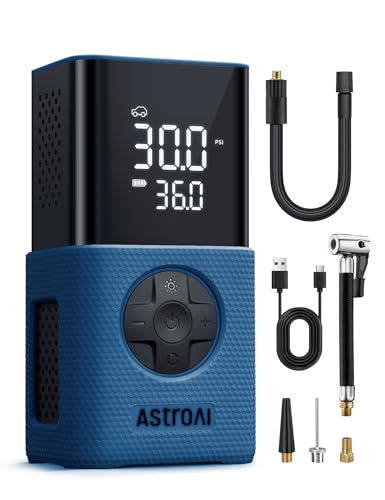 AstroAI L7S 150 PSI Cordless Tire Inflator |
8.9/10 | Buy |
| Best Premium |
 Ipflin 160 PSI Portable Tire Inflator and Air |
8.9/10 | Buy |
 Craftsman 150 PSI Cordless Tire Inflator |
8.9/10 | Buy | |
 QYQBOON Portable Tire Inflator 150 PSI Cordless |
8.8/10 | Buy | |
| Best Value |
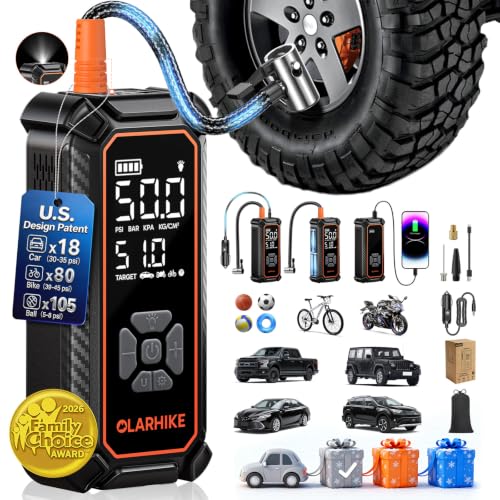 OlarHike Portable Tire Inflator Air Compressor |
8.8/10 | Buy |
 CARSUN 12V DC Portable Tire Inflator |
8.6/10 | Buy | |
 AstroAI 12V DC Portable Air Compressor Tire |
8.4/10 | Buy | |
 AstroAI AIRUN H 12V DC Portable Air Compressor |
8.4/10 | Buy | |
 Airmoto 120 PSI Portable Tire Inflator |
8.3/10 | Buy |
CRAFTSMAN 12V Portable Tire Inflator with
The CRAFTSMAN 12V Portable Tire Inflator is an ultra-compact 1.9-pound roadside unit delivering up to 150 PSI with digital auto shut-off and built-in cord storage. Powered via a standard 12V car accessory plug, it offers fast tire top-offs and dependable emergency inflation without crowding trunk space.
Pros
- Weighs only 1.9 pounds for effortless glove box, under-seat, or trunk storage during road trips
- Digital auto shut-off prevents accidental over-inflation without requiring constant manual gauge monitoring
- Bright three-mode LED light provides critical illumination during nighttime roadside emergencies
- Comes fully equipped with multi-valve adapters, a replacement fuse, and a tailored carry pouch
Cons
- Requires a 12V DC vehicle accessory socket and does not include a 120V AC household outlet adapter
- Compact tankless pump is built strictly for tire inflation and cannot drive pneumatic nailers or air tools
- The 2.17-foot air hose length means the compressor must sit on the ground adjacent to the wheel valve stem
AstroAI L7S 150 PSI Cordless Tire Inflator
Weighing barely a pound, the AstroAI L7S delivers portable inflation up to 150 PSI alongside a shock-absorbing silicone sleeve and power bank utility. Five smart presets and automatic shut-off make it a practical roadside companion for passenger cars, bicycles, and sports gear.
Pros
- Pocketable design weighing just 1.01 pounds
- Protective silicone sleeve dampens vibration and drops
- Hands-free operation with automatic shut-off
- Built-in power bank charges mobile devices
- Clear digital display with five smart presets
Cons
- Incompatible with heavy-duty truck and RV tires
- Not suitable for off-road vehicle tires or trailers
Ipflin 160 PSI Portable Tire Inflator and Air
The Ipflin portable air compressor provides up to 160 PSI and 30 L/min airflow with a built-in 9600mAh battery and 12V DC vehicle backup. It is an ideal emergency inflator for motorists, garage DIYers, and cyclists who need quick tire pressure adjustments without hauling a heavy air tank.
Pros
- True dual-power flexibility allows cordless battery operation or direct 12V DC automotive corded power during roadside emergencies
- High 160 PSI maximum pressure rating handles high-pressure bike tires, trailer tires, and passenger vehicle inflation
- Automatic shutoff system prevents over-inflation by stopping airflow as soon as the preset pressure target is reached
- Built-in 9600mAh battery eliminates the need for separate external power tool batteries or standalone chargers
Cons
- High-pressure tire inflator design is strictly intended for inflation and cannot operate pneumatic tools like brad nailers or air ratchets
- Cordless lithium-ion battery requires periodic top-off charging during storage to maintain emergency readiness
- Continuous inflation runtime is capped at 30 minutes before requiring a short cool-down period
Craftsman 150 PSI Cordless Tire Inflator
Built for roadside emergencies and quick top-ups, this compact 1.28-pound Craftsman inflator combines a 6000mAh rechargeable battery with a 12V DC car adapter. Its real-time digital gauge and automatic shut-off make tire maintenance straightforward for daily commuters and road trippers.
Pros
- Operates cordlessly or via 12V car socket
- Automatic shut-off prevents accidental over-inflation
- Clear digital display shows live pressure readings
- Doubles as an emergency light and power bank
- Lightweight and easy to store in vehicles
Cons
- USB output port is limited to 5V/1A
- Battery runtime is tailored primarily for tire top-ups
QYQBOON Portable Tire Inflator 150 PSI Cordless
The QYQBOON portable cordless tire inflator provides up to 150 PSI and a listed 35 L/min airflow with dual internal battery and 12V DC car cord power options. It is a compact, dependable roadside solution for drivers, cyclists, and DIYers seeking quick tire top-offs with automatic pressure shutoff.
Pros
- Dual-power design works via cordless battery or standard 12V DC vehicle plug so you are never stranded without power
- Automatic shutoff system reliably stops inflation at your chosen target pressure
- Extremely compact 1-pound footprint fits easily in a glove compartment, door pocket, or tool bag
- Integrated LED work light and USB power bank add valuable roadside emergency functionality
Cons
- Tankless mini pump design cannot operate workshop air tools or pneumatic finish nailers
- The 35 L/min airflow rate is intended for passenger tires and top-offs rather than rapid inflation of large commercial truck tires
- Does not include a 120V AC household wall adapter for running directly from standard residential wall outlets
OlarHike Portable Tire Inflator Air Compressor
The OlarHike Portable Tire Inflator combines dual-power versatility via a 12V DC vehicle plug or built-in rechargeable battery with an automatic shut-off digital display. It provides dependable roadside tire top-offs and inflation for passenger cars, crossovers, motorcycles, and bicycles.
Pros
- Dual-power design allows cordless field operation or continuous power through any standard vehicle 12V DC port
- Automatic shut-off technology stops the motor precisely at preset pressure to prevent over-inflation
- Integrated 6000mAh battery reserve doubles as an emergency phone charger and includes an LED work light
- Pocket-sized footprint weighs well under two pounds for convenient transport in center consoles or backpacks
Cons
- Maximum vehicle pressure rating of 51 PSI is not suitable for heavy-duty commercial trucks, RVs, or high-pressure trailer tires
- Compact tankless inflator mechanism cannot power workshop pneumatic tools such as nail guns or air ratchets
- Recharging requires a standard 5V 2A or 5V 3A adapter and is not compatible with high-wattage fast chargers
CARSUN 12V DC Portable Tire Inflator
The CARSUN 12V DC portable tire inflator delivers a listed 35 L/min airflow with automatic digital shut-off up to 150 PSI. It is an ideal, budget-friendly roadside emergency pump for passenger car owners, cyclists, and weekend campers.
Pros
- Automatic shut-off prevents accidental tire over-inflation by cutting power at the preset target pressure
- Lightweight 1.9-pound frame and compact dimensions fit neatly into vehicle trunks or roadside emergency kits
- Capable 35 L/min air volume airs up standard passenger tires quickly during routine seasonal pressure top-offs
- Bright integrated LED lighting assists with safe valve connection along dark roadways and unlit driveways
- Four included adapter nozzles expand utility across bicycles, sporting balls, and recreational air mattresses
Cons
- Powered exclusively via 12V DC vehicle sockets and does not include a 120V AC household electrical plug
- Manufacturer explicitly notes the unit is not suitable for heavy commercial trucks or large motor lorries
- Tankless high-pressure inflator design is not engineered to operate pneumatic workshop air tools
AstroAI 12V DC Portable Air Compressor Tire
The AstroAI 12V DC Portable Tire Inflator delivers a listed 25 L/min flow rate for fast roadside top-offs, featuring an auto-shutoff digital gauge and an 11.1-foot total reach. Powered strictly via 12V automotive sockets, it offers dependable emergency inflation for drivers, garage hobbyists, and compact vehicle owners.
Pros
- Quick roadside top-offs with manufacturer-rated 25 L/min pump speed
- Accurate digital display with auto-stop prevents over-pressurizing tires
- Long 11.1-foot combined cord and hose reaches all four vehicle tires
- Compact, sub-1.5-pound chassis with built-in cord and nozzle storage
- Integrated LED work light for roadside emergencies at night
Cons
- Restricted to 12V DC automotive sockets only with no direct 120V AC household plug included
- Requires a cool-down pause after 15 minutes of continuous run time
- Tankless design cannot operate pneumatic nailers, air ratchets, or automotive shop air tools
AstroAI AIRUN H 12V DC Portable Air Compressor
The AstroAI AIRUN H is a compact 12V DC tire inflator delivering up to 35 L/min airflow with automatic shut-off and digital pressure presets. It is an ideal portable emergency compressor for drivers, commuters, and garage hobbyists seeking fast tire top-offs.
Pros
- Automatic shut-off stops pumping reliably once target PSI is reached
- High-airflow 120W motor provides rapid top-offs for daily driver tires
- Long 9.84-foot power cord reaches all passenger vehicle wheels with ease
- Bright built-in LED flashlight and backlit display assist during night repairs
- Lightweight 2.2-pound form factor stores neatly in glove boxes and trunks
Cons
- Requires a 12V DC vehicle outlet and does not include a 120V AC household plug
- Mandates a 10-minute cool-down interval after 15 minutes of continuous operation
- Not intended for high-volume inflatables like large pool floats or air mattresses
Airmoto 120 PSI Portable Tire Inflator
Weighing just 1.2 pounds, this compact cordless compressor delivers up to 120 PSI with automatic shutoff for routine top-offs on cars, bikes, and sports gear. Its pocket-sized form factor stores neatly in a glove box, serving as a convenient roadside backup.
Pros
- Extremely compact and lightweight design
- Auto shut-off prevents accidental over-inflation
- Clear digital LCD display with real-time pressure reading
- Integrated LED light aids night roadside repairs
- Internal hose storage keeps accessories organized
Cons
- Not suitable for heavy-load tires or large inflatables
- Cold temperatures and large tires drain battery quickly
- Requires frequent recharging before heavy usage

Evaluating Portable Tire Inflator Performance and Design Architecture
Selecting an automotive tire pump requires balancing raw airflow capacity, thermal endurance, power flexibility, and pressure accuracy. Compact inflators must perform reliably during freezing winter mornings when tire pressure plummets as well as during scorching summer road trips. Rather than relying solely on peak pressure ratings that reach up to 150 or 160 PSI, drivers should evaluate how quickly a pump delivers air under realistic backpressure. Understanding these core mechanical and electrical differences ensures you choose an emergency tool that will never leave you stranded with a flat tire.
Power Delivery Systems: Dedicated 12V DC Corded vs Cordless Lithium Battery vs Dual Power
Dedicated 12V DC corded inflators draw continuous electrical current directly from a vehicle auxiliary cigarette lighter outlet. Units such as the CRAFTSMAN 12V inflator, the CARSUN digital compressor, and the AstroAI AIRUN H rely completely on vehicle electrical systems to spin their direct-drive motors. This corded architecture guarantees that the pump will never run out of battery power during a lengthy roadside emergency, provided the vehicle battery remains healthy. Drivers who prioritize zero maintenance often choose corded models because they can remain tucked away inside a trunk for years without requiring periodic recharging.
Cordless battery-powered pumps provide unmatched freedom of movement around a vehicle without trailing long wires through slush or mud. Handheld inflators like the AstroAI L7S and the compact Airmoto house internal lithium-ion battery cells ranging from 2000mAh to 4000mAh. These pocket-sized tools allow drivers to top off tire pressures rapidly on sedans, motorcycles, and bicycles without opening vehicle doors or wrestling with tangled cords. Cordless designs do have runtime limitations, however, meaning that depleted batteries must be recharged via USB ports before tackling multiple low tires.
Dual-power hybrid inflators bridge the gap between corded dependability and cordless convenience. Models manufactured by Ipflin, CRAFTSMAN, QYQBOON, and OlarHike combine high-capacity internal batteries with a detachable 12V DC vehicle power cord. If the internal lithium battery cells deplete after airing up two or three tires, the user simply connects the twelve-volt cord into the vehicle console and finishes the job. This dual-source flexibility represents one of the most practical configurations for family road trips where multiple low tires might overwhelm a standalone battery.
Airflow Volume, Motor Power, and Inflation Speed Benchmarks
Inflation speed depends directly on compressor displacement and motor airflow output measured in liters per minute. Compact pumps typically deliver airflow rates between 25 and 35 liters per minute under open-air or light backpressure conditions. For instance, an inflator delivering 35 liters per minute can elevate a standard 195/65 R15 passenger tire from 30 to 36 PSI in roughly sixty seconds. Models operating at 25 liters per minute perform the same task in just over a minute, making both speeds completely adequate for routine morning top-offs.
A major distinction exists between topping off low tires and inflating a completely flat tire from zero pressure. Raising tire pressure by five or six pounds requires minimal air volume, allowing even pocket-sized pumps to complete the job swiftly. Inflating a tire from zero PSI forces the small cylinder to compress several cubic feet of air against rising internal resistance. Standard passenger tires can take anywhere from four to five minutes to fill from flat, while larger SUV sizes like 235/65 R17 demand considerably more time and compressor stamina.
When researching options for finding the best portable tire inflator on the market, buyers should align compressor airflow with their vehicle class. Subcompact cars, sedans, and light crossovers match the output curves of portable 120-watt motors exceptionally well. Full-size pickup trucks and commercial vans equipped with heavy load range tires hold massive air volumes that challenge small emergency pumps. While portable inflators can top off truck tires by a few PSI, filling oversized off-road tires from scratch generally requires heavy-duty dual-cylinder compressors.
Duty Cycle Realities and Compressor Thermal Management
Portable air compressors generate substantial internal friction and thermal energy inside their miniature reciprocating piston chambers. Compressing ambient air into high-pressure streams creates intense heat at the cylinder head, valve plate, and metal air hose connector. Most consumer-grade portable inflators operate on a limited duty cycle, often rated for ten to fifteen minutes of continuous runtime before requiring rest. Exceeding these runtime boundaries without allowing heat to dissipate can soften internal seals, degrade motor lubricants, and trigger permanent mechanical failure.
Quality inflators integrate thermal protection safeguards to keep high temperatures from damaging critical internal components. Advanced models incorporate powder metallurgy gears, reinforced connecting rods, and smart temperature sensors that cut power if the motor exceeds safe operating thresholds. Designs like the Ipflin inflator utilize ventilated hollow handles to promote convective airflow and keep the grip cool during operation. Other manufacturers, including AstroAI on the L7S model, install shock-resistant silicone sleeves that reduce vibration while insulating user hands from hot motor housings.
Managing duty cycles effectively requires adopting a methodical multi-tire inflation workflow. Drivers servicing all four tires on a driveway should pause the compressor for a brief moment between each wheel to check resting pressures. If a single tire requires an extensive fill from flat, the operator should let the unit cool down for ten minutes before moving to the next tire. Observing these mandatory cooling pauses protects internal piston seals and guarantees your inflator lasts for many seasons of routine vehicle care.
Vehicle Auxiliary Socket Safety: Managing Amperage and Inrush Current
Plugging a 12V portable compressor into a vehicle auxiliary outlet requires an understanding of vehicle electrical limits. Most automobile accessory circuits and cigarette lighter sockets are protected by internal ten-ampere or fifteen-ampere fuses. Compressors powered by 120-watt electric motors draw close to ten to twelve amps during normal operation under moderate tire pressures. If electrical current spikes beyond the fuse rating, the vehicle circuit protection trips, instantly cutting power to the console socket.
Fuse blowouts frequently occur due to high inrush current when an electric motor starts against closed pneumatic backpressure. If a driver screws the brass chuck tightly onto a pressurized tire valve before turning on the power switch, the piston immediately encounters resistance. The stationary motor must draw a sudden surge of electrical current to break past that initial air pressure barrier. To prevent blowing vehicle fuses, many manufacturers include replacement glass fuses with their 12V cords and recommend starting the motor before latching the chuck when dealing with high backpressures.
Running the vehicle engine while using a 12V DC inflator is an essential practice that protects both the pump and the car battery. An idling engine drives the alternator, providing a stable system voltage near 13.8 volts rather than a resting battery voltage of 12.2 volts. This higher operating voltage allows the compressor motor to run faster, cooler, and with lower total amperage draw. Operating a high-draw compressor solely on a vehicle starter battery with the engine switched off can quickly drain the car battery, leaving the driver stranded.
Digital Pressure Transducer Accuracy and Auto-Shutoff Calibration
Digital pressure gauges have largely replaced mechanical analog dials on modern portable inflators, offering clearer visibility and higher precision. High-contrast LCD screens allow drivers to read current tire pressures easily in bright daylight or pitch-black roadside conditions. Most modern digital displays provide simultaneous readouts showing both real-time pressure and the user-selected target pressure. Drivers can also switch between standard measurement units, including PSI, BAR, KPA, and kilograms per square centimeter, to match foreign vehicle specifications.
A subtle distinction exists between dynamic line pressure during active pumping and static resting pressure. When the piston strokes forward, air rushes through the narrow Schrader valve core, creating localized friction that makes the digital sensor read slightly high. Sophisticated auto-shutoff controllers account for this pneumatic pressure differential by pulsing airflow or sampling pressure during brief pauses. Once the internal microprocessor detects that the tire has reached the preselected target value, it instantly cuts motor power to eliminate accidental over-inflation.
Proper auto-shutoff calibration depends on setting the target value to match the cold tire pressure listed on your driver-side door jamb placard. Tire sidewall markings indicate only the maximum permissible pressure for the tire casing, which is almost always much higher than recommended vehicle inflation levels. When using an AstroAI tire inflator or similar digital pump, you program the placard specification into memory before initiating inflation. After the automatic shut-off triggers, uncoupling the chuck and verifying pressure with a standalone gauge ensures optimal handling and tread life.
Chuck Interfaces and Reach: Threaded Brass vs Quick-Connect Thumb Latches
The mechanical connection between the air hose and the tire valve stem dictates both user convenience and pressure retention. Threaded brass screw-on chucks provide an airtight, robust lock that will never blow off the valve stem under high operating pressures. The trade-off with threaded brass fittings is that unscrewing the collar can bleed off one to two PSI if the driver struggles with tight wheel clearance. Quick-connect thumb-lock levers attach in a fraction of a second and release instantly, though worn internal rubber seals can cause small leaks if misaligned.
Total operating reach represents another critical physical specification when evaluating portable inflators for larger vehicles. Standard corded models pair a nine to eleven foot power cable with a high-pressure rubber hose measuring two to three feet in length. An overall reach of twelve to fourteen feet easily spans from a center dashboard socket to all four wheels on compact sedans and midsize hatchbacks. Owners of three-row SUVs or extended wheelbase pickup trucks must ensure the power cord can access rear wheels without placing heavy physical tension on the air hose.
Versatile inflators also supply dedicated nozzle adapters to expand utility beyond standard automotive Schrader valve stems. Brass Presta valve adapters allow road cyclists, gravel riders, and mountain bikers to inflate high-pressure bicycle tubes effortlessly. Narrow steel inflation needles handle basketballs, soccer balls, and athletic equipment without stretching delicate rubber bladders. Tapered plastic cones inflate beach toys, pool floats, and camping air cushions, transforming an automotive emergency pump into an all-around household utility tool.
Cold Weather Storage and Lithium-Ion Battery Longevity
Storing a cordless tire inflator inside a vehicle cabin exposes sensitive lithium-ion battery cells to extreme environmental fluctuations. Freezing winter temperatures reduce chemical activity inside lithium cells, causing sudden voltage drop when the motor demands high current. In sweltering summer months, trunk temperatures can easily exceed 120 degrees Fahrenheit, accelerating long-term battery degradation. Drivers relying on battery-powered inflators should store their tools in insulated carry bags or keep them inside climate-controlled vehicle areas during extreme weather seasons.
Lithium-ion cells naturally undergo self-discharge over months of storage, gradually depleting their stored electrical reserves. An inflator stored with eighty percent charge in autumn may show only thirty percent capacity after months of freezing winter storage. Routine quarterly maintenance schedules, where the owner tops off the battery pack via USB-C charging, guarantee that the tool remains ready for unexpected punctures. Dual-power inflators soften this concern significantly because their backup twelve-volt car cables bypass a dead internal battery completely.
Emergency utility features add substantial real-world value when handling low tire pressures beside busy highways at night. High-output multi-mode LED work lights illuminate dark valve stems and provide flashing amber or red SOS warning beacons for passing motorists. Many cordless inflators also feature integrated USB-A output ports that function as portable power banks during roadside crises. Having the ability to recharge a dead smartphone from your tire pump ensures you can call for roadside assistance if tire damage exceeds what an inflator can resolve.
Practical Guidance for Selecting the Right Tire Inflator
Choosing the right portable tire inflator ultimately comes down to matching power delivery, storage habits, and vehicle tire volumes to your daily driving routine. Daily commuters and highway road trippers benefit immensely from dual-power hybrid units that provide wireless convenience alongside corded twelve-volt reliability. Garage mechanics and fleet owners managing multiple household vehicles may lean toward dedicated 12V corded compressors that deliver continuous runtime without battery degradation. By prioritizing verified airflow ratings, auto-shutoff precision, and sensible duty-cycle habits, you will enjoy dependable tire pressure maintenance and lasting peace of mind on every journey.
About the author
Tom Scalisi brings more than two decades of experience in construction, building maintenance, contracting, and hands-on tool use. His practical understanding of power tools, automotive work, repairs, and jobsite equipment helps readers evaluate compressors based on real workloads rather than specifications alone.