
What Is the Best Air Hose for Air Compressor: A Practical Guide for 2026
Learn what is the best air hose for air compressor setups in November 2026 with practical advice on hybrid polymer lines, diameter sizing, and fittings.
 By Glenda Taylor
Updated October 8, 2026

Pneumatic tools require a steady flow of clean, pressurized air to drive fasteners, spray finishes, and run impact wrenches efficiently. Determining what is the best air hose for air compressor setups depends largely on hose material, inner diameter, total run length, and operational flexibility under load. Standard vinyl lines often turn stiff and unruly in cold garages, whereas premium hybrid polymer or reinforced polyurethane options lay flat and resist kinking. If you are outfitting a full workshop setup alongside new pneumatic tools, exploring our air compressor combo kits guide can help clarify broader equipment pairings.
A poorly matched air line causes dynamic pressure drop, starving high-demand pneumatic tools right when maximum torque or CFM is needed. Finding the right balance between internal airflow capacity and overall hose weight keeps daily workshop tasks running smoothly without fatiguing your arms. Reviewing our dedicated air compressor hose selection guide offers further perspective on managing line restriction and working pressure ratings. Matching your compressor output to an appropriate hose diameter and connection type ensures dependable performance for both light trim nailing and heavy automotive maintenance.
| Award | Product | ACR Score About ACR ScoreThe ACR Score is our own rating from 0 to 10, based on performance, design and build, ease of use, and value. It reflects independent research and is never influenced by manufacturers, retailers, or affiliate commissions. Learn more › | |
|---|---|---|---|
| Best Overall |
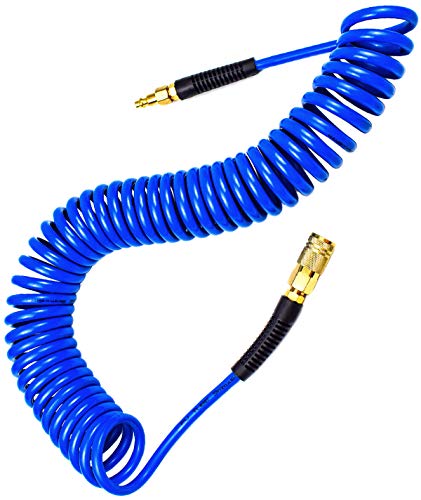
YOTOO 1/4-Inch x 25-Foot Polyurethane Recoil Air
|
9.2/10 | Buy |
| Best Budget |
 Flexzilla 1/4-Inch x 25-Foot Air Compressor Hose |
9.1/10 | Buy |
 JASTIND Industrial Air Blow Gun Kit |
8.8/10 | Buy | |
| Best Value |
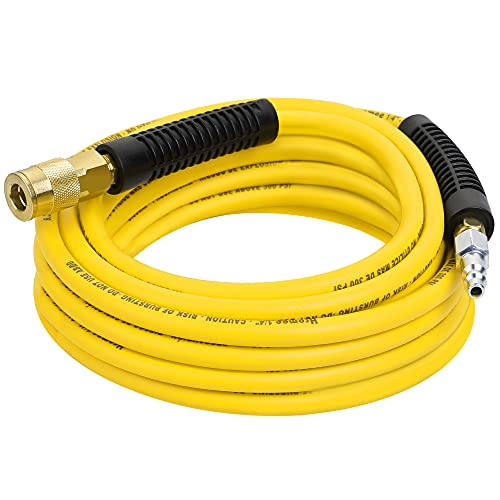 Hromee 1/4-Inch x 25-Foot Hybrid Air Compressor |
8.6/10 | Buy |
| Best Premium |
 YOTOO 3/8-Inch x 50-Foot Hybrid Air Hose |
8.6/10 | Buy |
 Flexzilla 3/8 in. x 50 ft. Hybrid Polymer Air Hose |
8.6/10 | Buy | |
 JOROY 3/8-Inch x 3 FT Hybrid Air Hose |
8.4/10 | Buy | |
 Hromee 3/8-In x 6-Ft Hybrid Lead-In Air Hose |
8.4/10 | Buy | |
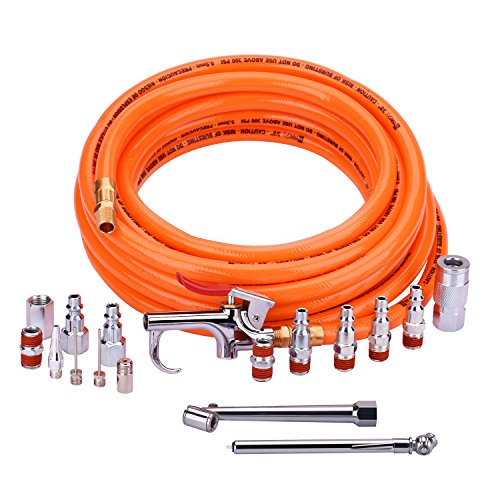 WYNNsky 3/8-Inch x 25ft PVC Air Hose Kit |
8.4/10 | Buy | |
 RainBello 25-Ft 1/4-Inch Polyurethane Air Hose |
8.3/10 | Buy |
YOTOO 1/4-Inch x 25-Foot Polyurethane Recoil Air
The YOTOO 1/4-inch by 25-foot polyurethane recoil air hose provides a lightweight, tangle-resistant pneumatic connection rated for up to 150 PSI. Equipped with pre-installed 1/4-inch industrial quick-connect fittings and flexible operation down to -40 degrees Fahrenheit, it is a convenient, space-saving accessory for garage hobbyists, trim carpenters, and workbench setups.
Pros
- Self-retracting coil design eliminates manual hose winding and prevents messy shop floor clutter
- Comes ready to work with factory-installed 1/4-inch industrial quick-connect coupler and plug
- Retains pliability in freezing conditions down to -40 degrees Fahrenheit
- Durable bend restrictors protect high-wear junction points from premature cracking or kinking
- Lightweight polyurethane build significantly minimizes hand and wrist fatigue during detailed tool work
Cons
- 1/4-inch inner diameter restricts airflow volume required for continuous high-demand tools like dual-action sanders or spray guns
- Coil tension increases when stretched near the full 25-foot reach, which can pull back against lightweight pneumatic tools
- Not intended for severe rough-framing jobsite abuse where heavy-duty reinforced rubber hoses are typically preferred
Flexzilla 1/4-Inch x 25-Foot Air Compressor Hose
The Flexzilla 1/4-inch by 25-foot air hose features a premium hybrid polymer blend that stays pliable from -40 to 140 degrees Fahrenheit without kinking under pressure. Built with crush-resistant aircraft aluminum fittings and a 300 PSI working rating, it offers lightweight, zero-memory convenience for trim carpenters, tire inflation, and home workshops.
Pros
- Extreme all-weather flexibility keeps the hose manageable even in sub-freezing garages down to -40 degrees Fahrenheit
- Zero-memory material lays flat instantly and coils effortlessly for quick end-of-day cleanup
- Crush-resistant aircraft aluminum fittings include molded bend restrictors to prolong connection life
- Lightweight design dramatically reduces tool drag during overhead trim work and detailed finish carpentry
Cons
- 1/4-inch inner diameter creates friction loss that may restrict high-CFM continuous tools like rotary sanders or impact wrenches
- Signature high-visibility green color easily shows grease and grime in automotive shop environments
- 25-foot working length can feel short for expansive workspaces or outdoor vehicle maintenance without an extension line
JASTIND Industrial Air Blow Gun Kit
The JASTIND Industrial Air Blow Gun delivers powerful workshop blow-off performance with a durable chromed zinc alloy body, an adjustable brass airflow nozzle, and two protective-tipped extensions. It is an affordable, metal-built pneumatic accessory ideal for DIYers, mechanics, and woodworkers needing versatile cleanup reach.
Pros
- Solid all-metal zinc alloy and copper construction resists cracking compared to plastic blow guns
- Adjustable brass nozzle provides convenient airflow throttling right at the tool tip
- Protective rubber tips on extension wands help prevent scratching delicate finishes and sensitive components
- Integrated top hook makes bench and wall storage simple and accessible
Cons
- Does not state OSHA safety relief bypass compliance, so line pressure should be regulated safely before use
- All-metal zinc alloy body can transfer cold to the hand during extended continuous blowing sessions
- Specific quick coupler interchange style is not detailed in specifications, requiring fit verification for some shop air lines
Hromee 1/4-Inch x 25-Foot Hybrid Air Compressor
The Hromee 1/4-Inch x 25-Foot Hybrid Air Compressor Hose provides a flexible, lightweight pneumatic connection with a 300 PSI working pressure, bend restrictors, and pre-attached industrial fittings. Rated for -40°F to 150°F, it is well-suited for trim carpenters, home mechanics, and DIYers seeking kink-resistant hose handling.
Pros
- Pliable hybrid polymer stays flexible in cold weather down to -40°F without severe memory coils
- Comes ready to use out of the box with pre-connected brass coupler and industrial steel plug
- Integrated bend restrictors minimize strain and kink points near the MNPT fittings
- Lightweight two-pound design makes overhead nailing and portable trim work easy on user arms
Cons
- The 25-foot length provides limited reach across larger garages or multi-room jobsite setups without an extension
- A 1/4-inch inner diameter creates higher airflow restriction than 3/8-inch hoses when supplying high-CFM continuous tools
- Bright yellow exterior easily shows garage grime, motor oil, and jobsite dirt over time
YOTOO 3/8-Inch x 50-Foot Hybrid Air Hose
The YOTOO 3/8-inch by 50-foot hybrid air hose combines rubber flexibility with lightweight PVC durability, handling up to 300 PSI for high-demand shop tools. Equipped with pre-installed 1/4-inch brass fittings and bend restrictors, it is an ideal upgrade for DIYers, garage mechanics, and woodworkers looking to minimize line pressure drop.
Pros
- 3/8-inch inner diameter supplies greater air volume to impact wrenches, inflators, and nailers than narrower hoses
- Comes ready to use straight from the box with pre-installed brass coupler and industrial plug fittings
- Hybrid construction resists kinks and coils flatter than rigid PVC air hoses
- Bend restrictors protect the hose ends from bending fatigue near tool connections
Cons
- Hybrid polymer can still experience slight stiffness in near-freezing winter garage temperatures compared to premium 100% rubber hoses
- Factory-installed 1/4-inch standard industrial couplers may need replacement if your shop runs dedicated high-flow V-style fittings
- At 50 feet, it requires thoughtful coiling or an air hose reel to prevent workshop floor clutter
Flexzilla 3/8 in. x 50 ft. Hybrid Polymer Air Hose
The Flexzilla 3/8 in. x 50 ft. air hose combines an all-weather hybrid polymer build with a 300 PSI working pressure rating, remaining completely flexible from -40°F to 140°F. It is an exceptional upgrade for woodworkers, trim carpenters, auto mechanics, and DIY homeowners seeking kink-free pneumatic performance.
Pros
- Lays flat immediately with zero memory, making uncoiling and end-of-day cleanup effortless
- Maintains full flexibility in sub-freezing temperatures down to -40 degrees Fahrenheit without cracking or stiffening
- Larger 3/8-inch internal diameter reduces line restriction compared to common 1/4-inch hoses
- Aircraft-grade aluminum fittings resist crushing and feature durable protective bend restrictors
Cons
- Vibrant green exterior readily shows oil, grease, and shop grime over extended garage use
- Aluminum threads require careful hand-threading to avoid cross-threading compared to traditional heavy brass
- Requires separate quick-connect couplers and plugs to connect to an air compressor and pneumatic tools
JOROY 3/8-Inch x 3 FT Hybrid Air Hose
Designed as a durable link between compressors and nearby tools, this three-foot lead-in hose combines rubber flexibility with PVC abrasion resistance. Its wide 3/8-inch inner core supports high air volume while factory-installed brass couplers make setup instantaneous.
Pros
- Flexible hybrid material handles cold weather reliably
- Pre-installed brass fittings allow immediate use
- Three-layer build rated for 300 PSI working pressure
- Integrated bend restrictors protect ends from kinking
Cons
- Short three-foot length limits standalone operation
- 1/4-inch fittings partially restrict 3/8-inch airflow capacity
Hromee 3/8-In x 6-Ft Hybrid Lead-In Air Hose
Built to bridge compressors and hose reels, this hybrid whip hose absorbs tool vibration and minimizes user fatigue. Its lightweight rubber-PVC construction and pre-attached brass coupler make it a dependable connection for garage setups.
Pros
- Stays flexible in extreme temperatures down to -40°F
- Pre-attached brass quick coupler saves setup time
- Built-in bend restrictors reduce kinking at connection points
- Lightweight hybrid build prevents user fatigue
Cons
- Short six-foot length limits use strictly to connector applications
- Steel plug is more prone to rust than full brass fittings
WYNNsky 3/8-Inch x 25ft PVC Air Hose Kit
Equipped with a lightweight PVC hose and a 17-piece accessory bundle, this package delivers the essential fittings needed for home workshop DIY projects. Solid brass connections ensure dependable seals, supported by a 300 PSI maximum working pressure.
Pros
- Solid brass fittings resist corrosion and seal reliably
- Complete accessory set provides essential starter fittings
- Lightweight hose design allows easy transport and handling
- Handles up to 300 PSI maximum working pressure
Cons
- 25-foot length provides limited reach across larger workshops
- PVC construction is typically less flexible than rubber hoses
RainBello 25-Ft 1/4-Inch Polyurethane Air Hose
The RainBello 25-foot 1/4-inch reinforced polyurethane air hose delivers high flexibility and a 300 PSI working pressure rating for garage workshops and trim jobs. Equipped with factory brass swivel fittings and quick-connect hardware, it provides a reliable, kink-resistant connection for DIYers and finish carpenters.
Pros
- Braided polyurethane outer jacket resists scuffing, kinking, and twisting
- Factory-installed 1/4-inch brass swivel fittings and quick-connect couplers save setup time
- Substantial 300 PSI working pressure rating handles common pneumatic tasks
- Remains pliable in sub-freezing temperatures down to -40°F
Cons
- A 1/4-inch internal diameter restricts airflow volume for continuous high-CFM tools like dual-action sanders
- The 25-foot length may limit reach across larger multi-bay automotive garages without an additional extension
Evaluating Air Compressor Hose Selection for Workshop and Jobsite Demands
Direct Recommendation: Matching Hose Build to Pneumatic Tasks
Selecting the ideal air line requires identifying how your specific pneumatic tools consume air volume and how much mobility your workspace demands. For general garage tasks, automotive impact work, and continuous air tool operation, a 3/8-inch inner diameter hybrid polymer hose rated at 300 PSI provides an effective balance of high airflow, low kinking, and all-weather flexibility. Finish carpenters and mobile trim installers, however, often benefit more from a lightweight 1/4-inch polyurethane line that reduces wrist strain during repetitive nailing. No single hose fits every application, but matching material characteristics to air delivery needs prevents frustrating pressure drops.
Pneumatic systems rely on consistent pressure delivered directly to the tool intake port without restriction. When a compressor cycles on, air pushes through the regulator, downstream fittings, and the entire length of the flexible line before reaching the motor or piston assembly. Choosing an undersized diameter or excessively long run introduces internal friction that lowers working pressure at the trigger. Understanding these fundamental mechanical demands allows you to configure an efficient air delivery line suited to your daily workload.
Hose Materials Compared: Hybrid Polymer, Polyurethane, PVC, and Rubber
Air hose materials dictate flexibility, overall weight, abrasion resistance, and memory when uncoiled on the floor. Hybrid polymer blends combine the lightweight, abrasion-resistant traits of PVC with the supple, memory-free handling of traditional rubber. Hoses like the Flexzilla series and YOTOO hybrid models utilize this blended technology to stay pliable down to -40 degrees Fahrenheit without developing permanent coils. Operators in unheated winter workshops benefit substantially from hybrid construction because the hose lays flat instead of fighting the user.
Reinforced polyurethane offers an exceptional alternative for users prioritizing low weight and high abrasion resistance. Models such as the RainBello reinforced line incorporate an internal braided polyester mesh that enables a 300 PSI working pressure while maintaining a slim profile. Polyurethane resists scuffing across rough concrete shop floors and sliding against finished wood surfaces without leaving black rubber marks. The primary trade-off with standard polyurethane is a tendency to remain somewhat springy compared to heavier rubber blends, though braided reinforcement helps mitigate tight coiling.
Standard PVC remains a common entry-level material favored for basic utility and general DIY setups. Kits like the WYNNsky PVC assembly provide a rigid, durable exterior that resists grease, chemicals, and outdoor weathering. However, PVC materials become noticeably stiff in cooler temperatures and possess substantial coil memory that can create tripping hazards across a busy garage floor. While PVC functions reliably for intermittent inflation or warm-weather yard work, daily workshop users often migrate toward hybrid polymers or polyurethane for easier handling.
Inner Diameter Dynamics: 1/4-Inch Versus 3/8-Inch Flow Volume
The internal diameter of an air hose directly governs the volume of air, measured in cubic feet per minute, that can travel through the line. A 1/4-inch inner diameter hose works well for light-demand, intermittent tools such as brad nailers, pin nailers, and tire inflators. These tools consume brief bursts of air and operate effectively without depleting the line internal volume. Using a slender 1/4-inch line also cuts down overall hose weight, making it much easier to drag across ladders or staging.
High-demand pneumatic equipment requires a 3/8-inch inner diameter hose to prevent severe dynamic pressure drops under load. Automotive impact wrenches, dual-action orbital sanders, die grinders, and HVLP paint sprayers draw continuous CFM that quickly overwhelms 1/4-inch lines. Even if a compressor regulator reads 90 PSI at rest, pulling the trigger on a continuous rotary tool through a narrow hose can drop active line pressure below 70 PSI. Installing a 3/8-inch line expands internal cross-sectional area significantly, maintaining sustained tool speed and torque output during heavy automotive servicing.
Line Length Friction Loss and Managing Pressure Drop
Hose length directly impacts the pneumatic resistance experienced between the tank manifold and your air tool. Air traveling through internal hose walls encounters friction that steadily robs dynamic pressure as distance increases. A 25-foot hose produces minimal pressure drop and keeps the workspace tidy for benchtop assembly, small tire stations, and light garage maintenance. Compact 25-foot runs also coil faster and take up less storage space on wall hooks or mobile carts.
Extending your reach to 50 feet or beyond allows you to leave a loud compressor in a corner while working around an entire vehicle or room. However, running 50 feet of line magnifies friction losses, making proper diameter selection critical. When using a 50-foot run, opting for a 3/8-inch inner diameter helps counteract pressure loss that would otherwise stall high-CFM tools. To preserve tool performance over long runs, operators frequently avoid electrical extension cords on compressors and instead rely on extended air hoses to bridge distance safely.
Pressure Thresholds: Working Limits and Safety Margins
Working pressure ratings establish the maximum continuous air pressure a hose is designed to handle safely under normal operating conditions. Most standard workshop compressors operate with tank pressures between 125 PSI and 175 PSI, though line regulators generally deliver 90 PSI to tools. Hoses rated for 300 PSI working pressure, such as those from Flexzilla and Hromee, provide a generous safety margin above standard regulated outputs. Operating well below the maximum working pressure rating prevents premature wall fatigue and ensures dependable long-term line containment.
Burst pressure ratings reflect the ultimate structural limit where the hose jacket and inner tube will rupture under extreme stress. Quality hybrid and braided polyurethane hoses frequently list a burst pressure rating of 900 PSI, representing a 3-to-1 safety factor over their 300 PSI working limit. Lighter coil lines, such as compact polyurethane recoil hoses, often feature a lower working pressure threshold around 150 PSI. Always verify that your compressor regulator cannot deliver line pressures exceeding the lowest-rated component in your air distribution setup.
Couplers, Plugs, Swivel Fittings, and Bend Restrictors
Fittings and connectors play an equally critical role in maintaining airtight delivery and preventing annoying air leaks. Solid brass and heat-treated steel quick-connect couplers resist corrosion, thread galling, and mechanical damage when dropped on concrete floors. Some premium hybrid lines incorporate crush-resistant aircraft aluminum fittings to shed weight without sacrificing thread strength. Equipping lines with standard 1/4-inch industrial NPT connectors ensures broad compatibility across common workshop couplers, blow guns, and nailers.
Bend restrictors installed at hose ends are essential features that safeguard lines against severe bending stress right behind the crimped fitting. Repeated sharp bending during tool maneuvering often causes premature cracking, hose pinching, and eventual blowouts near rigid connectors. Molded rubber or heavy-duty polyurethane bend restrictors distribute bending forces over a gradual curve rather than a sharp kink point. Swivel fittings further enhance durability by permitting free rotation, preventing frustrating hose tangling and wrist strain during detailed assembly work.
The Mechanical Function of Lead-In Whip Lines
Short lead-in whip hoses, typically measuring three to six feet in length, serve as vital shock absorbers between compressors, reels, and rigid air lines. Products like the JOROY 3-foot hybrid whip or Hromee 6-foot lead-in hose absorb pulsating vibration produced by reciprocating compressor pumps. Connecting a reel directly to a compressor manifold using rigid pipe or standard long hoses often transmits heavy vibration that loosens fittings and damages seals over time. A flexible whip hose dampens these mechanical pulses, protecting expensive regulator manifolds and hose reel swivels.
Whip lines also improve ergonomics when attached directly between an air tool and the main distribution hose. Hanging a heavy 3/8-inch coupler directly from an impact gun or orbital sander adds awkward weight and exerts continuous bending force on the tool intake port. Placing a lightweight, flexible whip line between the tool handle and the primary supply line isolates the operator from coupler drag. This arrangement reduces wrist fatigue, limits accidental coupler disconnects, and prolongs the service life of both tool threads and primary hose ends.
Recoil Tubing Versus Straight Lines for Garage Workspaces
Self-coiling recoil hoses, such as the YOTOO 25-foot polyurethane recoil model, excel in compact work areas where floor clutter presents a safety hazard. Recoil lines snap back automatically when released, keeping excess tubing off garage floors, away from vehicle tires, and clear of moving equipment. They are particularly well suited for dedicated assembly benches, clean electronics cleanup stations, and tire inflation bays. The self-storing nature of recoil tubing eliminates the need for manual hose coiling after completing small, repetitive tasks.
Straight hoses remain superior for general workshop mobility, floor coverage, and high-volume pneumatic tasks. Recoil lines generate constant spring tension that pulls backward against your hand when stretched across long distances, increasing forearm fatigue over extended sessions. Furthermore, the tight spiral coils of a recoil hose create minor flow resistance and can easily snag on table corners or car bumpers. For broad jobsite mobility or painting where smooth line trailing is mandatory, a straight hybrid polymer hose lays flat and pulls effortlessly.
All-Weather Flexibility and Cold Climate Operation
Ambient shop temperature dramatically affects how pneumatic hoses behave during daily use. Traditional rubber hoses remain flexible across wide temperature ranges but add considerable carry weight and soil easily when dragged through grease. Cheap PVC lines become remarkably brittle and stiff when temperatures dip below freezing, resisting uncoiling and cracking under sudden bending stress. In contrast, modern hybrid materials maintain reliable suppleness from -40 degrees up to 140 or 150 degrees Fahrenheit, ensuring hassle-free deployment throughout harsh winter months.
Maintaining operational flexibility in unheated environments also safeguards internal compressor mechanics during startup. When dealing with cold weather compressor operation, reviewing our guide on compressor pump oil maintenance helps prevent motor stalling and excessive inrush current on cold garage circuits. Stiff, unyielding air lines create unnecessary leverage against manifold regulators and tank outlet ports when dragged in sub-freezing conditions. Flexible hybrid hoses absorb movement smoothly, allowing safe pneumatic operation regardless of seasonal temperature swings.
Tailoring Air Lines to Specific Applications and Daily Maintenance
Matching your hose setup to your primary pneumatic tasks prevents airflow bottlenecks and enhances tool ergonomics. Finish carpenters and trim installers generally achieve the best results using lightweight 1/4-inch polyurethane lines paired with compact nailers. The featherweight profile prevents accidental scuffs on finished trim work and minimizes drag across staging. For mobile woodworkers running small, quiet pumps, pairing your line with reliable oil-free air compressors ensures clean air delivery that will not contaminate wood stains or paint finishes.
Automotive technicians and metal fabricators require the expanded air capacity of 3/8-inch hybrid lines. Running high-torque impact wrenches on 1/4-inch lines starves the motor of instantaneous CFM, significantly diminishing breakaway torque on stubborn lug nuts. High-volume cleanup operations also benefit from larger lines when paired with high-flow accessories like the JASTIND industrial blow gun to deliver powerful debris clearing. Selecting the proper inner diameter guarantees that your air tools operate at their full engineered mechanical capacity.
Proper storage habits and regular inspection substantially extend the usable lifespan of any pneumatic line. Depressurize the compressor tank completely and purge residual line pressure after every work session to protect internal reinforcement layers and quick-connect seals. Inspecting brass threads and wiping away abrasive metal shavings prevents premature fitting leaks and reduces unexpected pump cycling. Maintaining a clean, well-regulated air line setup safeguards your equipment investment and ensures dependable performance whenever you power up your workshop compressor.
About the author
Glenda Taylor has extensive experience in residential construction, remodeling, home improvement, and tool use. Her practical approach to equipment evaluation focuses on usability, performance, safety, and value—helping DIYers and workshop users make better-informed decisions about compressors and related tools.