
What Is the Best Air Compressor Hose: Practical Workshop Guide for 2026
Delivering dependable airflow requires the right line. Learn what is the best air compressor hose options, materials, and fittings in this October 2026 guide.
 By Bob Beacham
Updated October 8, 2026
By Bob Beacham
Updated October 8, 2026
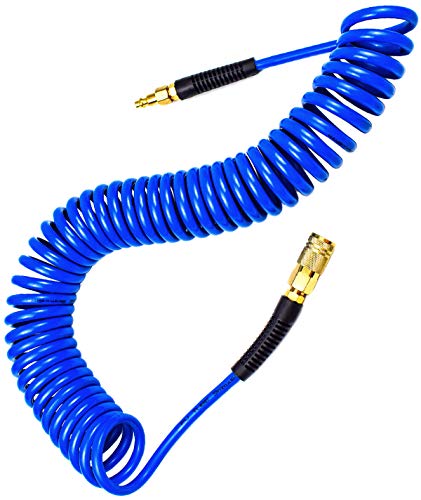
Compressed air systems lose efficiency rapidly when air lines restrict volume or develop stubborn kinks during a project. Air tools demand consistent CFM delivery and stable working pressure at ninety PSI to drive fasteners, spin impact wrenches, or spray finishes evenly. Determining what is the best air compressor hose depends on your shop layout, air tool demands, and temperature conditions. Even robust single-stage and two-stage air compressors suffer performance drops when connected to an undersized or rigid pneumatic line. Selecting an air line engineered with flexible hybrid polymer or reinforced polyurethane preserves dynamic airflow from the regulator directly to your tool intake.
Stiff vinyl lines often fight user movement in cold garages, while heavy rubber hoses can cause severe wrist fatigue during overhead framing or finish nailing. Connecting smaller pneumatic setups, such as compact portable air compressors, requires lightweight hoses that coil smoothly without creating tripping hazards across the workspace. Modern hybrid polymer blends and braided polyurethane designs offer high working pressure ratings up to 300 PSI while maintaining all-weather flexibility down to sub-zero temperatures. Examining hose inner diameter, core materials, crush-resistant brass fittings, and bend restrictors ensures your pneumatic tools receive reliable power without unnecessary pressure loss.
| Award | Product | ACR Score About ACR ScoreThe ACR Score is our own rating from 0 to 10, based on performance, design and build, ease of use, and value. It reflects independent research and is never influenced by manufacturers, retailers, or affiliate commissions. Learn more › | |
|---|---|---|---|
| Best Overall |
YOTOO Polyurethane Recoil Air Hose
|
9.2/10 | Buy |
| Best Value |
 RainBello Hybrid Air Hose 3/8-Inch by 25-Feet Air
|
9.2/10 | Buy |
| Best Budget |
 Flexzilla Air Compressor Hose, 1/4 in. x 25 ft.
|
9.1/10 | Buy |
 JASTIND Industrial Air Blow Gun with Brass
|
8.8/10 | Buy | |
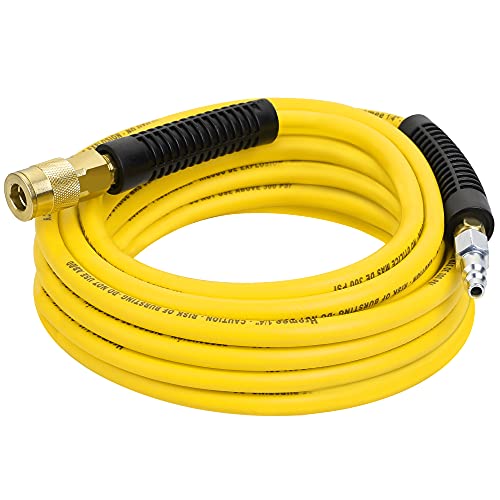 Hromee Air Compressor Hose 1/4 Inch x 25 Feet
|
8.6/10 | Buy | |
| Best Premium |
 YOTOO Hybrid Air Hose 3/8-Inch by 50-Feet 300 PSI
|
8.6/10 | Buy |
 Flexzilla Air Compressor Hose, 3/8 in. x 50 ft.
|
8.6/10 | Buy | |
 JOROY Hybrid Lead In Air Hose
|
8.4/10 | Buy | |
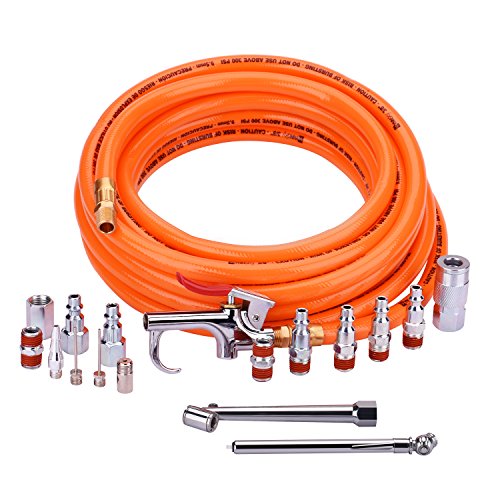 WYNNsky 3/8" X 25ft PVC Air Compressor Hose Kit
|
8.4/10 | Buy | |
 RainBello 25FT 1/4 Inch Air Hose Reinforced
|
8.3/10 | Buy |
Evaluating Air Compressor Hose Construction, Sizing, and Performance
Finding the right pneumatic line requires balancing inner diameter, material flexibility, working pressure, and overall weight. A well-matched air hose delivers the volume your tools require without creating cumbersome coils or severe pressure drop between the compressor regulator and the tool intake. Understanding how hose materials interact with ambient temperatures and pneumatic tool CFM demands helps you choose a reliable configuration for your workspace. Evaluating these mechanical characteristics ensures your equipment operates efficiently through demanding automotive or construction projects.
Material Composition: Hybrid Polymers, Polyurethane, Rubber, and PVC
Hose materials dictate how an air line handles daily abrasions, shop floor debris, and temperature shifts. Traditional rubber offers substantial flexibility and abrasion resistance, but its heavy weight can become burdensome across large jobsites. Standard PVC lines provide an affordable, lightweight alternative, though they tend to stiffen dramatically when ambient temperatures fall. Hybrid polymer blends, such as those found on the Flexzilla Air Compressor Hose, 3/8 in. x 50 ft., combine rubber flexibility with PVC weight savings.
Hybrid polymer hoses remain pliable across extreme temperature ranges, operating reliably from -40 degrees Fahrenheit up to 140 or 160 degrees Fahrenheit. These lines lay completely flat on workshop floors because the material does not retain coiled memory under pressure. Operators avoid the constant tripping hazards and snagging risks that commonly plague budget vinyl hoses. The RainBello Hybrid Air Hose 3/8-Inch by 25-Feet Air and YOTOO Hybrid Air Hose 3/8-Inch by 50-Feet 300 PSI also utilize blended rubber and PVC compounds to resist kinking and twisting under heavy garage use.
Reinforced polyurethane represents another popular category for mobile framing and automotive maintenance. Products like the RainBello 25FT 1/4 Inch Air Hose Reinforced feature braided polyurethane construction that pairs extreme lightweight handling with smooth exterior jacket durability. Polyurethane resists oil, chemicals, and shop scuffs without adding noticeable drag as you pull the line around vehicles. Self-coiling designs like the YOTOO Polyurethane Recoil Air Hose use memory-retentive polyurethane to retract automatically after tire inflation or workbench cleanup, saving valuable floor space in tight quarters.
Sizing Inner Diameter: Airflow Volume and Dynamic Pressure Drop
Inner diameter directly controls the volume of compressed air that reaches your tools per minute. Standard portable hoses typically feature either a 1/4-inch or 3/8-inch inner diameter. A 1/4-inch line is significantly lighter and easier to maneuver, making it popular for trim carpenters running light-duty brad nailers or staple guns. However, narrower internal pathways create higher friction against the moving air column, leading to noticeable pressure loss across long distances.
High-demand pneumatic tools require larger internal diameters to maintain sufficient dynamic pressure under continuous operation. Tools like half-inch pneumatic impact wrenches, dual-action rotary sanders, and paint sprayers can consume six to fifteen CFM at ninety PSI. Supplying these continuous tools through a 1/4-inch line frequently causes the tool motor to stall or lose torque, even when the compressor tank holds adequate pressure. Upgrading to a 3/8-inch inner diameter provides more than double the internal cross-sectional area of a 1/4-inch hose, dramatically reducing airflow restriction.
Workshops operating high-capacity systems, including stationary vertical workshop air compressors, rely on 3/8-inch lines to deliver uninterrupted CFM across the garage floor. Hoses like the YOTOO Hybrid Air Hose 3/8-Inch by 50-Feet 300 PSI maintain high volume delivery so that pneumatic tools operate at peak efficiency. When line friction is minimized, your compressor cycles less erratically and maintains stable regulator pressure. Selecting the appropriate diameter prevents unnecessary strain on both the tool motor and the compressor pump mechanism.
Hose Length, Friction Loss, and Lead-In Whip Hose Utility
Total hose length introduces another critical factor in pneumatic line efficiency. While a longer hose expands your working radius, every additional foot adds internal friction and increases potential pressure loss. A 25-foot line, such as the Flexzilla Air Compressor Hose, 1/4 in. x 25 ft. or Hromee Air Compressor Hose 1/4 Inch x 25 Feet, minimizes pressure drop while providing adequate reach for garage maintenance. When greater range is required, a 50-foot hose delivers extended coverage but requires proper diameter matching to prevent tool starvation.
Using an excessively long extension cord to bring the compressor closer to your work can cause electrical issues, such as motor stalling or breaker tripping. Running a longer 50-foot air hose from a dedicated outlet is far safer for compressor electrical motors than using an undersized extension cord. The primary pneumatic drawback of longer runs remains minor pressure drop, which you can easily offset by adjusting the line regulator slightly higher. Keeping the hose length matched to your actual workspace footprint prevents messy hose tangles and reduces unnecessary friction.
Short lead-in whip hoses serve a specific protective role in pneumatic setups. The JOROY Hybrid Lead In Air Hose provides a three-foot 3/8-inch bridge between your compressor manifold, hose reel, or vibrating air tool. This short line absorbs heavy mechanical vibration from impact guns and protects expensive regulator fittings from metal fatigue. Whip lines also make connecting bulky main lines to ceiling reels or wall mounts much easier. Installing a reinforced lead-in hose extends the working life of primary lines and reduces strain on delicate brass couplers.
Working Pressure Ratings and Safety Burst Margins
Every pneumatic air line features an engineered maximum working pressure rating measured in pounds per square inch. Most premium hybrid and braided polyurethane hoses, including models from RainBello, Flexzilla, and Hromee, carry a maximum working pressure rating of 300 PSI. This rating provides an ample safety margin over typical consumer and prosumer compressor cut-out pressures, which usually range from 125 to 175 PSI. Self-coiling recoil lines like the YOTOO Polyurethane Recoil Air Hose are typically rated for 150 PSI, which suits light-duty tasks perfectly.
Beyond standard working pressure, quality air hoses are engineered with a substantial burst pressure threshold. Reinforced construction, such as the three-layer polyester braiding on the Hromee Air Compressor Hose 1/4 Inch x 25 Feet, provides a 900 PSI burst rating. This high burst threshold ensures the hose can absorb sudden pressure spikes when tools cycle on and off rapidly. Operating well below the maximum working pressure prevents hose ballooning, layer separation, or fitting blowout during heavy use.
Maintaining safety requires inspecting hose jackets regularly for signs of exterior blistering or deep cuts. A damaged hose under high pressure presents serious safety hazards to operators and nearby equipment. Always verify that your regulator output stays within the specified working pressure limits of your connected hose and air tools. Releasing tank pressure through bottom drain valves after shutting down the motor also relieves standing pressure inside connected lines.
Couplers, Fittings, Swivel Ends, and Bend Restrictors
Fittings and end connections are just as crucial as the hose core material itself. Weak or poorly threaded connections introduce constant air leaks that force the compressor pump to cycle continuously. High-quality hoses feature solid brass male NPT fittings that resist corrosion and seal reliably against coupler threads. Solid brass connections, such as those found on the WYNNsky 3/8″ X 25ft PVC Air Compressor Hose Kit and Hromee kits, offer superior durability compared to softer aluminum or zinc alternatives.
Swivel fittings provide an essential ergonomic advantage for mechanics and carpenters who move frequently around workpieces. The RainBello Hybrid Air Hose 3/8-Inch by 25-Feet Air and RainBello 25FT 1/4 Inch Air Hose Reinforced include built-in swivel ends that rotate freely under pressure. This rotation prevents the line from twisting into stubborn loops as you pivot around an automobile chassis or framing project. Operators experience far less wrist strain because the hose does not exert rotational resistance against the tool grip.
Bend restrictors positioned at each hose end protect the most vulnerable section of the pneumatic assembly. The crimped junction where the flexible line meets the rigid metal fitting experiences intense bending stress during daily operation. Heavy-duty molded bend restrictors distribute bending forces across a wider curve, preventing acute kinks and internal core punctures. Models from YOTOO, Flexzilla, and Hromee incorporate these protective sleeves on both ends to extend operational hose longevity significantly.
Matching Hose Types to Specific Workshop and Jobsite Tasks
Choosing an ideal air hose requires looking closely at the primary pneumatic tools you plan to operate. Dedicated auto repair bays utilizing high-torque impact wrenches and ratchets benefit most from 3/8-inch hybrid lines. These hoses supply ample airflow volume while resisting garage floor grease, oil, and aggressive workshop abrasions. Pairing robust lines with durable oil-lubricated workshop compressors guarantees steady air delivery for prolonged grinding, sanding, and lug nut removal.
Finish carpenters and cabinetmakers often prioritize lightweight mobility over high CFM capacity. Maneuvering around delicate trim molding requires a flexible 1/4-inch polyurethane or hybrid polymer line that will not scuff finished surfaces. The Flexzilla Air Compressor Hose, 1/4 in. x 25 ft. lays flat instantly, allowing smooth movement without knocking over ladders or marring stained woodwork. Low-CFM fastener tools operate reliably on these narrower lines without encountering noticeable pressure drops.
General shop cleanup and tire inflation tasks demand convenient storage and rapid deployment. A self-coiling recoil line or a comprehensive accessory bundle, like the WYNNsky kit, provides immediate utility for daily maintenance tasks. Combining versatile hoses with dedicated cleaning tools, such as the JASTIND Industrial Air Blow Gun with Brass, allows operators to clear chips and debris from machinery quickly. Having the proper fittings ready ensures seamless tool changes without interrupting your workflow.
Proper Care, Depressurization, and Storage Practices
Extending the lifespan of your pneumatic equipment requires consistent care and safe handling habits. Leaving air lines pressurized under full tank pressure for extended periods accelerates fitting fatigue and stresses internal braiding. After finishing work, always shut down the compressor, bleed remaining line pressure using a blow gun or tool trigger, and disconnect quick-connect couplers. Storing hoses in a relaxed state prevents micro-fractures from forming inside the inner core material.
Environmental factors also influence hose durability over multiple seasons of shop use. Storing pneumatic lines in direct sunlight exposes synthetic polymers to ultraviolet radiation, which degrades outer jackets over time. Extreme heat inside unventilated metal sheds can also soften hose walls and weaken crimped fitting bonds. Hanging hoses in broad, loose loops on curved wall brackets preserves material integrity much better than tight winding around sharp hooks.
Routine inspection catches minor air leaks before they cause major disruptions or motor overheating. Apply a mild soapy water solution around threaded NPT connections and quick-connect plugs to identify bubbling leaks. If a leak appears at the threaded joint, remove the fitting, clean old residue, and reapply fresh PTFE thread sealant tape. Keeping fittings sealed and jackets clean ensures reliable pressure delivery whenever you power up your pneumatic tools.
Practical Principles for Choosing Your Next Pneumatic Line
Selecting the best air compressor hose ultimately involves aligning line specifications with your specific operating conditions. If cold-weather flexibility and kink-free handling are your highest priorities, premium hybrid polymer lines deliver outstanding results. For overhead work, bench assembly, or finish carpentry, lightweight braided polyurethane offers unmatched maneuverability and surface protection. Automotive mechanics and heavy tool users should always prioritize 3/8-inch inner diameters to satisfy high CFM tool requirements.
Investing in durable brass fittings, robust bend restrictors, and appropriate working pressure ratings protects your workshop from unexpected failures. By balancing inner diameter, overall length, material composition, and ergonomic swivel features, you can assemble an efficient pneumatic air delivery setup. A well-chosen air hose keeps your tools performing at full power while making daily shop tasks safer and far more manageable.
About the author
Bob Beacham is an experienced tools and workshop writer with deep knowledge of power equipment, mechanical systems, and practical DIY applications. His coverage of air compressors, welding equipment, saws, and workshop tools helps translate technical specifications into useful guidance for homeowners and serious DIYers.