
What Is a Good Cfm for an Air Compressor: Practical Sizing Guide for 2026
Learn what is a good cfm for an air compressor to run pneumatic tools smoothly without pressure drops in this November 2026 guide.
 By Kenny Koehler
Updated October 8, 2026


Stalling air tools, sudden pressure drops, and overheated pump motors usually trace back to inadequate volumetric airflow. Selecting the proper volume requires matching the cubic feet per minute output to the specific pneumatic equipment running in your garage or shop. Many DIYers ask what is a good cfm for an air compressor before realizing that continuous tools demand vastly different air delivery than intermittent fasteners. Assessing your highest-consumption tool provides the baseline volume necessary to prevent tool starvation during demanding projects.
Pneumatic air delivery is measured at standard working pressure ratings, typically 90 PSI for mechanical tools and 40 PSI for paint spraying systems. If you plan to run multiple fasteners, sanders, or sprayers, reviewing our guide on sizing compressors for air tools helps clarify total system air consumption. Understanding the relationship between delivered CFM, storage tank capacity, and motor horsepower guarantees steady pressure at the regulator. Reliable airflow keeps workshop pneumatic equipment operating at peak torque and prevents premature pump motor fatigue.
| Award | Product | ACR Score About ACR ScoreThe ACR Score is our own rating from 0 to 10, based on performance, design and build, ease of use, and value. It reflects independent research and is never influenced by manufacturers, retailers, or affiliate commissions. Learn more › | |
|---|---|---|---|
| Best Overall |
Mazot 8-Gallon Quiet Air Compressor
|
9.2/10 | Buy |
| Best Budget |
 Limodot 8-Gallon Quiet Air Compressor |
9.1/10 | Buy |
| Best Premium |
 Schulz 50 CFM Refrigerated Air Dryer |
9.1/10 | Buy |
| Best Value |
 Schulz 35 CFM Refrigerated Air Dryer |
8.9/10 | Buy |
 Schulz 35 CFM Refrigerated Air Dryer |
8.9/10 | Buy | |
 VEVOR 4.8-Gallon Oil-Free Air Compressor |
8.6/10 | Buy | |
 Uharbour 12V 12.35 CFM Air Compressor |
8.6/10 | Buy | |
 VEVOR 2.1 Gallon Portable Air Compressor |
8.4/10 | Buy | |
 Stealth SAQ-11215 12-Gallon Air Compressor |
8.4/10 | Buy | |
 Schulz 50 CFM Refrigerated Air Dryer System |
8.1/10 | Buy |
Mazot 8-Gallon Quiet Air Compressor
Built with an enclosed noise-reduction housing, this 8-gallon oil-free compressor delivers 3.45 CFM at 90 PSI for indoor garages and workshops. Dual gauges and integrated safety valves make it a practical choice for painting, trim nailing, and tire inflation.
Pros
- Low-noise enclosed housing suitable for indoor work
- Strong 3.45 CFM airflow at 90 PSI
- Oil-free pump eliminates routine lubrication maintenance
- Dual pressure gauges allow easy output monitoring
- Generous two-year manufacturer warranty
Cons
- Airflow drops significantly to 1.94 CFM at 100 PSI
- Maximum pressure tops out at 120 PSI
- Bulky steel tank requires dedicated storage space
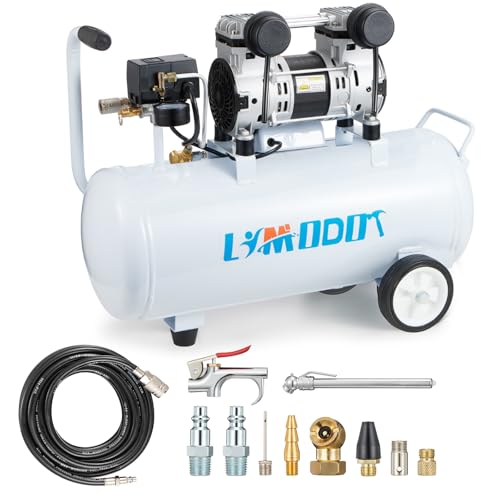
Limodot 8-Gallon Quiet Air Compressor
Limodot pairs an 8-gallon capacity with a quiet 68-decibel motor, keeping noise disruption low during indoor trim or workshop jobs. Delivering 2.8 CFM at 90 PSI alongside a quick 30-second recovery time, it provides steady airflow for DIY pneumatic tools without messy oil maintenance.
Pros
- Low 68 dB output prevents loud workshop disruption
- Fast 30-second pressure recovery keeps projects moving
- Oil-free pump eliminates messy oil changes
- Comprehensive 11-piece accessory kit included out of the box
- Integrated wheels make moving the 8-gallon tank easy
Cons
- 2.8 CFM output limits high-demand continuous tools
- Included PVC hose is stiffer than rubber alternatives
Schulz 50 CFM Refrigerated Air Dryer
The Schulz 50 CFM refrigerated air dryer delivers a reliable 41-degree Fahrenheit pressure dew point at 100 PSI using standard 115V power. It provides continuous moisture removal for 10HP and 15HP workshop compressors, making it an excellent choice for auto body painters and commercial shops needing clean, dry air.
Pros
- Maintains a stable 41-degree Fahrenheit dew point to prevent moisture downstream
- Runs on standard 115V single-phase electrical supply using 14-gauge wiring
- Handles up to 220 PSI inlet pressure from two-stage stationary pumps
- Generous 50 CFM rating matches demanding 10HP and 15HP compressor setups
Cons
- Requires a separate mandatory 1-micron particulate and oil pre-filter before the inlet
- At 70 pounds, the standalone cabinet requires dedicated bench or floor space
- Plumbing bypass valves and pre-filter canisters are not included with this standalone unit
Schulz 35 CFM Refrigerated Air Dryer
Engineered for 7.5 hp and 10 hp compressors, this non-cycling refrigerated unit delivers clean air for mid-sized workshop systems. It maintains a stable 41-degree Fahrenheit dew point to prevent moisture damage in pneumatic tools.
Pros
- Maintains an effective 41-degree Fahrenheit dew point
- High 220 PSI maximum inlet pressure rating
- Runs on standard 115V single-phase power
- Compact footprint fits easily alongside shop compressors
Cons
- Requires a separate pre-filter to maintain warranty
- Heavy 62-pound build requires sturdy mounting
- Requires dedicated 10-gauge wiring for installation
Schulz 35 CFM Refrigerated Air Dryer
Built for 7.5 HP and 10 HP shop compressors, this Schulz refrigerated unit combines non-cycling drying with dual-stage pre-filtration to extract water and oil. It delivers a reliable 41-degree dew point for pneumatic equipment requiring clean, moisture-free airflow.
Pros
- Comprehensive dual-stage filtration removes moisture and residual oil.
- Maintains a consistent 41-degree pressure dew point.
- Automatic internal float drains minimize manual maintenance tasks.
- Directly compatible with 7.5 HP and 10 HP compressors.
Cons
- Pre-filters restrict maximum input pressure to 175 PSI.
- Substantial 62-pound weight requires sturdy mounting support.
- Necessary compressed air piping is not included.
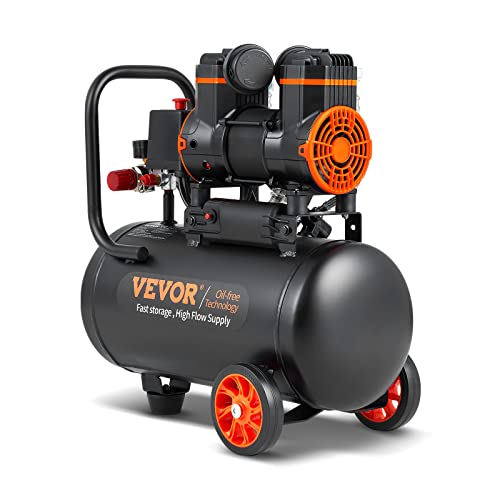
VEVOR 4.8-Gallon Oil-Free Air Compressor
Designed for garage maintenance and light workshop tasks, this 4.8-gallon compressor delivers 2.2 CFM at 90 PSI with a relatively quiet 70-decibel operation. Its oil-free dual-cylinder motor and automatic thermal protection make it well-suited for tire inflation, brad nailing, and intermittent spraying.
Pros
- Low 70 dB noise level suitable for indoor workshops
- Maintenance-free oil-free dual cylinder design
- Durable steel tank with multi-layer rust-resistant coating
- Built-in thermal overload and auto shut-off protection
Cons
- Maximum 116 PSI is lower than many competing tanks
- 2.2 CFM rating limits continuous high-demand air tools
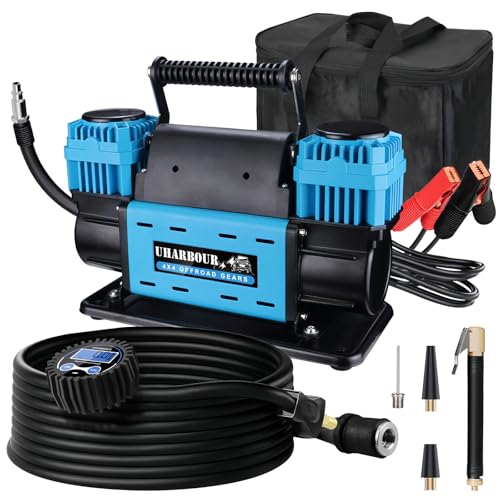
Uharbour 12V 12.35 CFM Air Compressor
Equipped with dual motors, this heavy-duty compressor delivers a high 12.35 CFM airflow to reinflate off-road tires quickly after trail rides. An integrated digital gauge provides accurate pressure readings, though its 26-pound weight makes transport noticeably hefty.
Pros
- High 12.35 CFM output from dual motors
- Digital gauge provides clear, precise pressure control
- Rugged build designed for harsh trail environments
- Included storage bag keeps gear organized
Cons
- Heavy weight at over 26 pounds to haul
- Bulky dual-motor body requires substantial cargo room
VEVOR 2.1 Gallon Portable Air Compressor
Delivering 2.2 CFM at 90 PSI with a 116 PSI maximum operating threshold, the VEVOR 2.1 Gallon Air Compressor combines a 1.2 HP oil-free dual-cylinder motor with a compact 27-pound steel chassis. It serves DIY homeowners, finish carpenters, and garage hobbyists seeking a dependable, low-maintenance air supply for brad nailing, stapling, and tire inflation.
Pros
- Maintenance-free oil-free pump design eliminates messy fluid changes and allows spill-free transport
- Dual-cylinder intake setup delivers a solid 2.2 CFM at 90 PSI in a portable 27-pound frame
- Dual cooling fans and thermal overload protection safeguard motor longevity during heavy garage sessions
- Dual intake silencers help reduce harsh operating noise compared to unshielded high-RPM pumps
Cons
- Maximum operating pressure of 116 PSI provides less stored air buffer than standard 150 PSI contractor units
- 2.1-gallon air reservoir is not sized to sustain continuous high-draw tools like rotary sanders or paint sprayers
- The 3500 RPM motor runs fast, making regular cooling cycles necessary during warm weather work
Stealth SAQ-11215 12-Gallon Air Compressor
Designed for quiet garage use, this 12-gallon compressor delivers 4 CFM at 90 PSI while keeping sound levels at an unobtrusive 68 decibels. Its oil-free induction motor and wheeled steel construction offer reliable, low-maintenance pneumatic power.
Pros
- Exceptionally quiet 68 dB operating noise
- Maintenance-free oil-free motor design
- Solid airflow delivery of 4 CFM at 90 PSI
- Durable steel tank with sturdy transport wheels
Cons
- Heavy 95-pound weight makes lifting difficult
- Short 6-foot power cord limits placement options
Schulz 50 CFM Refrigerated Air Dryer System
The Schulz 50 CFM Refrigerated Air Dryer kit combines a non-cycling refrigeration system with a 5-micron water separator and 0.01-micron coalescing filter to achieve a 41-degree dew point. Designed for 10HP to 15HP compressor setups, it provides reliable moisture and oil removal for automotive paint shops and industrial pneumatic equipment.
Pros
- Comprehensive air treatment package combining refrigerated cooling with dual-stage particulate and coalescing filtration
- Low 41-degree dew point prevents moisture from condensing downstream inside airlines and pneumatic tools
- Automatic float drains reduce daily maintenance routines by purging collected moisture autonomously
- High 50 CFM flow rating at 100 PSI supports multi-tool commercial garage and manufacturing workloads
Cons
- Compressor output must be regulated to a maximum of 175 PSI to avoid damaging the stage 1 and stage 2 filter assemblies
- Substantial 75-pound dry weight requires dedicated floor or bench space in the workshop
- Interconnecting compressed air piping between the compressor and dryer kit is not included
Understanding Air Compressor CFM and Tool Requirements
Determining what is a good cfm for an air compressor depends entirely on the specific pneumatic tools you intend to operate in your workspace. An air delivery rate of 2 to 3 CFM at 90 PSI suffices for intermittent tasks like tire inflation, finish nailing, and light stapling. Demanding tools such as rotary sanders, continuous paint sprayers, and commercial impact wrenches require 5 to 10 CFM or higher to prevent rapid pressure depletion. Calculating your pneumatic equipment requirements beforehand ensures you choose a machine capable of sustaining the necessary volumetric airflow under heavy workloads.
Defining CFM, SCFM, and Operating Pressure at 90 PSI
Cubic feet per minute represents the physical volume of compressed air that a pump head delivers directly to the air tank or discharge port. Most pneumatic tool manufacturers specify consumption specifically at 90 PSI because that represents the standard operating threshold for mechanical air tools. If a manufacturer only advertises displacement volume measured at zero backpressure, it creates an inflated and misleading impression of actual working capabilities. Verifying the certified delivery rating at 90 PSI confirms whether the pump mechanism can sustain working pressure against continuous tool resistance.
Standard cubic feet per minute refines basic volume measurements by correcting for ambient air temperature, relative humidity, and sea-level atmospheric barometric pressure. This standardized metric provides an objective baseline so mechanics and woodworkers can accurately compare different compressor models across varying operating conditions. Air compressors operate less efficiently in high-altitude environments or hot, humid workshops because thinner air reduces the mass displaced per cylinder stroke. Relying on certified delivered CFM at 90 PSI remains the most reliable method for matching pneumatic machinery with realistic shop demands.
Intermittent Versus Continuous Tool Air Consumption
Pneumatic fastening equipment operates on an intermittent air cycle because each trigger depression discharges a discrete, brief volume of compressed air. Brad nailers, narrow-crown staplers, and framing nailers consume small fractions of a cubic foot per cycle, averaging under 1 to 2 CFM under typical operating tempos. A portable compressor featuring modest airflow delivery can easily replenish the tank between successive nail cycles without placing undue stress on the electric motor. The storage tank functions as an immediate buffer that absorbs these rapid pressure drops without causing tool hesitation.
Continuous pneumatic tools present a far more demanding air delivery challenge because their motors draw compressed air uninterruptedly during operation. Rotary orbital sanders, die grinders, needle scalers, and high-volume low-pressure spray guns consume constant airflow that rapidly empties smaller storage reservoirs. When a pneumatic tool consumes 6 CFM continuously while the pump only generates 3 CFM, line pressure rapidly plummets below acceptable operating thresholds. Matching pump output directly to the sustained CFM requirement of continuous tools is mandatory to avoid frequent pauses while waiting for tank pressure recovery.
Automotive impact wrenches represent a hybrid air consumption profile because mechanics trigger them in short, high-torque bursts rather than continuous runs. Breaking stubborn suspension fasteners or rusted lug nuts requires high instantaneous air volume and line pressure to generate rated breakaway torque. If you regularly handle vehicle maintenance or tire rotations, our guide on impact wrench air compressor requirements outlines the exact airflow volume required for heavy automotive ratchets. Maintaining adequate tank buffer volume ensures high-torque pneumatic mechanisms hit with full impact force when breaking free seized hardware.
Recommended CFM Thresholds for Common Shop Tasks
Light household maintenance and DIY hobby projects require minimal continuous volumetric airflow to operate successfully. Inflating passenger vehicle tires, clearing workshop dust with pneumatic blow guns, and driving 18-gauge brad nails require between 0.5 and 2.5 CFM at 90 PSI. Compact portable air compressors with storage tanks between 2 and 6 gallons handle these domestic chores comfortably without occupying valuable garage floor space. Homeowners tackling occasional trim carpentry and seasonal tire maintenance rarely need the physical bulk or high electrical draw of stationary workshop units.
General garage repair and serious carpentry work demand moderate airflow delivery to support medium-demand pneumatic equipment. Powering 3/8-inch air ratchets, pneumatic grease guns, framing nailers, and small touch-up paint guns generally requires between 3.0 and 4.5 CFM at 90 PSI. Mid-size compressors equipped with 8 to 12-gallon storage reservoirs provide an ideal balance of fast pressure recovery and portable convenience for these tasks. A pump delivering roughly 4 CFM at 90 PSI gives DIY mechanics enough versatility to complete structural framing, suspension work, and general vehicle upkeep.
Demanding auto body restoration, industrial fabrication, and continuous sanding operations demand substantial air volume that exceeds portable compressor capacities. Dual-action orbital sanders, abrasive blast cabinets, cut-off tools, and full-size spray painting guns frequently consume between 6.0 and 12.0 CFM at 90 PSI. Attempting to power these high-draw tools with an undersized portable pump leads to severe pressure drops, uneven paint atomization, and dangerous motor overheating. Dedicated production workshops running continuous tools require stationary two-stage cast-iron compressors or industrial multi-cylinder systems connected to dedicated electrical circuits.
The Role of Tank Capacity and Pressure Buffers
The compressed air receiver tank functions as an energy reservoir rather than a continuous producer of volumetric airflow. A larger receiver tank stores a substantial volume of compressed air that allows high-draw pneumatic tools to operate briefly beyond the continuous output of the pump. A compact compressor delivering 2.5 CFM can run a high-demand tool for several seconds because the storage tank supplies the immediate volume difference. Once stored pressure drops below the cut-in limit, the pump motor must run continuously until operating pressure is fully restored.
Factory cut-in and cut-out pressure switch thresholds dictate the usable volume of air available before the pump restarts. When an air compressor reaches its upper cut-out limit, typically between 115 and 150 PSI, the pressure switch unloads head pressure and turns off the motor. As pneumatic tools consume stored air, tank pressure decreases until reaching the cut-in threshold, which is typically set 25 to 30 PSI lower. Tank recovery time depends directly on the ratio between the pump volumetric displacement and the physical capacity of the receiver tank.
Undersized storage tanks cause electric compressor motors to cycle repeatedly, accelerating wear on internal switch contacts, unloader valves, and start capacitors. When powering continuous pneumatic sanders, a tiny tank empties within seconds, forcing the pump into an uninterrupted running cycle. Continuous operation generates significant thermal heat within the cylinder heads, which can activate the thermal overload protection switch and stall the motor. Choosing a generous tank volume cushions high-demand tools, prevents rapid motor cycling, and maintains steady regulated output pressure during extensive projects.
Motor Horsepower and Electrical Circuit Constraints
Evaluating true running horsepower helps equipment buyers avoid deceptive marketing labels frequently stamped on consumer air compressors. Manufacturers historically highlighted peak surge horsepower, which only reflects the brief instantaneous electrical spike when the motor rotor is locked. A genuine continuous running motor produces sustained mechanical torque to drive compression pistons against elevated backpressure inside the receiver tank. Authentic electric motor output rarely exceeds 1.5 to 2.0 running horsepower when plugged into standard residential alternating current branch circuits.
Standard 120-volt residential electrical branch circuits impose hard mechanical limits on the volume of compressed air an electric pump can produce. A typical 15-amp or 20-amp household circuit can safely sustain an electric pump delivering roughly 4.0 to 5.0 CFM at 90 PSI without tripping circuit breakers. Generating higher volumetric airflow, such as 10 to 18 CFM at 90 PSI, requires a dedicated 240-volt electrical circuit to supply sufficient motor wattage. Garage woodworkers and mechanics must evaluate their electrical breaker capacity before investing in high-volume stationary compressor equipment.
High electrical inrush current during cold-weather startup represents a common problem for unheated garage workshops. Thickened crankcase oil or stiff mechanical seals cause electric induction motors to draw heavy amperage spikes during initial startup rotation. Running an air compressor through light-gauge household extension cords creates substantial voltage drops, stalling the motor and tripping the internal thermal overload reset. Connecting the compressor directly to a dedicated wall receptacle and utilizing longer pneumatic hoses protects electrical components and ensures reliable motor startup.
Pump Mechanism Design and Noise Considerations
Pump mechanism engineering directly impacts long-term operational lifespan, routine maintenance schedules, and workspace environment cleanliness. Oil-free dual-piston compressors feature Teflon-lined cylinder sleeves and permanently lubricated sealed bearings that eliminate the need for manual oil monitoring. These modern oil-free systems start effortlessly in freezing weather and eliminate oil aerosols that can ruin automotive paint jobs or fine woodworking finishes. For an in-depth evaluation of pump longevity, our guide on oil-free air compressor durability explains operational trade-offs across modern pneumatic pumps.
Operating sound output varies substantially across compressor mechanisms, heavily influencing operator comfort in attached residential garages and basement workshops. Traditional direct-drive universal motors operate at high rotational speeds around 3,400 RPM, producing harsh mechanical noise levels exceeding 80 decibels. Modern ultra-quiet compressors utilize low-RPM induction motors running around 1,750 RPM with dual-cylinder heads, keeping operational noise between 60 and 70 decibels. Reduced decibel ratings allow normal conversation in enclosed workspaces, prevent severe ear fatigue, and eliminate disturbance to nearby family members.
Routine maintenance for oil-free pumps centers on preserving intake air quality and inspecting external mechanical fittings for air leaks. Blocked or dust-clogged intake air filters restrict cylinder breathing, which reduces delivered CFM volume and elevates internal operating temperatures. Durable intake muffler assemblies containing replaceable foam or paper elements prevent airborne wood dust and abrasive particles from scouring internal cylinder sleeves. Inspecting and cleaning intake filters every few months ensures the compressor pump maintains its rated volumetric delivery and maximizes operating lifespan.
Moisture Separation and Downstream Air Quality
Compressing ambient atmosphere inherently concentrates suspended water vapor, which precipitates into liquid condensation inside the cool steel storage tank. High relative humidity accelerates water accumulation, creating internal tank corrosion risks and spraying moisture droplets through air hoses into pneumatic tools. Daily moisture draining through the underside tank drain valve preserves tank wall thickness and protects sensitive pneumatic tool internals from internal rust. Upgrading to an accessible quarter-turn brass ball valve ensures effortless daily draining compared to stiff threaded petcock valves that often seize.
High-capacity commercial compressed air installations delivering 35 to 50 CFM require standalone refrigerated air dryers to remove moisture before distribution. Refrigerated dryers lower compressed air temperatures to approximately 41 degrees Fahrenheit, condensing water vapor into an automatic float drain before air enters workshop piping. Removing entrained humidity from delivery lines is crucial for automated manufacturing tools, plasma cutting torches, and automotive body refinishing booths. Clean, dry air prevents pneumatic cylinder corrosion, eliminates tool motor seizure, and stops paint surface defects like fish-eyes and blistering.
Dedicated multi-stage filtration systems installed between the regulator and the working air hose provide essential downstream protection for specialized tools. Standard 5-micron particulate water separators capture bulk liquid droplets and loose scale, while 0.01-micron coalescing filters eliminate microscopic oil aerosols. Positioning these filtration stages immediately before spray painting apparatus or delicate pneumatic instrumentation guarantees pure, moisture-free airflow. Investing in proper air drying and filtration safeguards expensive pneumatic machinery and delivers consistent, professional finishing results in any workshop.
Sizing Formulas and Practical Equipment Matching
Calculating the ideal compressor volume for your workshop begins with identifying the highest individual CFM rating among your primary pneumatic tools. After establishing that base air consumption requirement, apply a 1.25 to 1.5 safety multiplier to determine your target compressor delivery rating. If a continuous dual-action sander requires 6 CFM at 90 PSI, multiplying that figure by 1.25 indicates you need an output of at least 7.5 CFM at 90 PSI. This practical safety margin compensates for air hose friction, minor fitting leaks, and pump duty cycle recovery pauses.
Factoring in simultaneous tool usage is necessary when multiple operators or pneumatic tools draw air from the same distribution manifold. When two carpenters run framing nailers concurrently on a construction site, their individual air consumption rates must be combined to avoid pressure drop. If total air consumption approaches the continuous output of the pump mechanism, selecting a larger receiver tank provides an essential buffer against pressure dips. Maintaining steady line pressure ensures every pneumatic nailer consistently drives fasteners flush without requiring manual hammer strikes.
Selecting the right air delivery volume ultimately balances available electrical power, physical transportability, and the specific pneumatic tools in your collection. Homeowners focused on finish carpentry and seasonal tire maintenance can rely on compact units delivering 2 to 3 CFM at 90 PSI. Automotive hobbyists and serious woodworkers running high-draw sanders or sprayers should seek higher-volume machines producing 4 to 8 CFM or more. Evaluating your actual tool demand before buying guarantees steady performance and prevents the frustration of tool starvation.
About the author
Kenny Koehler is a power-tool specialist with more than a decade of hands-on evaluation experience and a science-based approach to product testing. His expertise in repeatable testing, tool performance, impact wrenches, and professional equipment brings a practical, data-focused perspective to compressor and pneumatic-tool comparisons.