
What Size Compressor Is Needed for Air Tools: Practical Sizing Guide for 2026
Find out what size compressor is needed for air tools by matching tool CFM and tank volume. Review air delivery and pressure needs for October 2026.
 By Tony Carrick
Updated October 8, 2026
By Tony Carrick
Updated October 8, 2026

Pneumatic tools rely on a steady volume of compressed air to generate mechanical power, but undersized compressors lead to frustrating tool stalls and rapid pressure drops. Determining what size compressor is needed for air tools requires looking past basic tank capacity to evaluate air volume delivery, measured in cubic feet per minute (CFM) at specific operating pressures. When an air pump cannot keep pace with the continuous airflow demanded by a pneumatic motor, pressure plunges below working thresholds and forces the operator to stop while the pump recovers. Reviewing our single-stage or two-stage air compressor guide clarifies how compression architecture influences sustained pressure output across different garage setups.
Matching an air compressor to your specific equipment lineup prevents common workshop headaches, such as tripped breakers and overheated pump motors. Light pneumatic tools like brad nailers and tire inflators consume short bursts of air, allowing compact portable compressors to perform reliably. In contrast, rotary sanders, paint sprayers, and heavy impact wrenches demand uninterrupted airflow that quickly overwhelms small consumer tanks. By analyzing working pressure ratings, tank reservoir buffers, and electrical circuit limitations, you can select an air delivery system that keeps your pneumatic tools operating at peak torque and speed.
| Award | Product | ACR Score About ACR ScoreThe ACR Score is our own rating from 0 to 10, based on performance, design and build, ease of use, and value. It reflects independent research and is never influenced by manufacturers, retailers, or affiliate commissions. Learn more › | |
|---|---|---|---|
| Best Overall |
CRAFTSMAN Portable 12V Tire Inflator with
|
9.2/10 | Buy |
| Best Value |
 DEWALT Tire Inflator, Portable Air Compressor
|
9.1/10 | Buy |
| Best Premium |
 California Air Tools CAT-4610S Ultra Quiet
|
9.1/10 | Buy |
 CRAFTSMAN Tire Inflator Portable Air Compressor
|
8.9/10 | Buy | |
| Best Budget |
 JASTIND Industrial Air Blow Gun with Brass
|
8.8/10 | Buy |
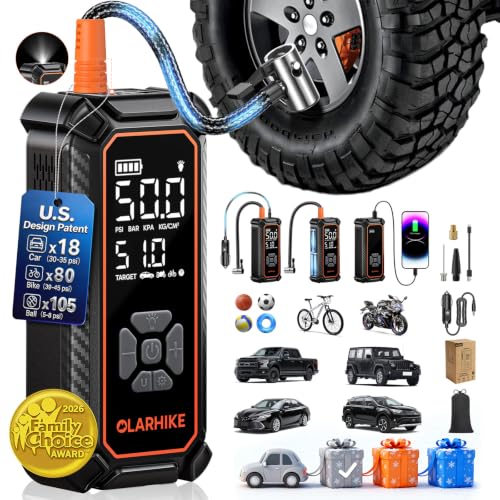 OlarHike Tire Inflator Portable Air
|
8.8/10 | Buy | |
 LEZZYRUCK Cordless Air Compressor for Makita 18V
|
8.6/10 | Buy | |
 WYNNsky Air Compressor Kit
|
8.3/10 | Buy | |
 OlarHike 12000mAh Heavy Duty Tire Inflator
|
8.3/10 | Buy | |
 SARDVISA 20 Pcs Air Compressor Tool Kit
|
8.1/10 | Buy |
Sizing an Air Compressor for Pneumatic Power Tools: Sizing, Volume, and Demand
Selecting the right compressor size starts with understanding that pneumatic tools operate on airflow volume rather than tank capacity alone. Many buyers mistakenly assume that a larger tank automatically powers heavier air tools, only to discover that the pump cannot sustain sufficient air volume. The fundamental metric for sizing any pneumatic system is delivered cubic feet per minute at 90 pounds per square inch (CFM at 90 PSI). Once you calculate the real airflow demands of your equipment, you can balance tank volume, motor horsepower, and electrical requirements to find a reliable match.
The Airflow Equation: Understanding CFM at 90 PSI versus Working Pressure
Air pressure and air volume perform two completely different jobs inside a pneumatic system. Working pressure, measured in pounds per square inch (PSI), provides the mechanical force required to actuate pistons, valves, and motor rotors. Air volume, measured in cubic feet per minute (CFM), represents the actual quantity of compressed air the pump delivers over time. Most pneumatic air tools operate at an industry standard of 90 PSI, which is why manufacturers rate air delivery specifically at that pressure level.
A compressor with high maximum tank pressure cannot compensate for an inadequate CFM output rating. For instance, a compact jobsite unit may store air at 150 PSI, but if the pump only produces 2.0 CFM at 90 PSI, high-demand tools will quickly drain the reservoir. Standard compressor specifications also list standard cubic feet per minute (SCFM), which factors in ambient temperature and humidity conditions. When sizing your setup, always focus on delivered CFM at 90 PSI to ensure the pump can support your tool under real working conditions.
A reliable sizing rule recommends choosing a compressor that delivers at least 1.25 to 1.5 times the CFM rating of your highest-demand tool. This safety margin accounts for routine friction loss across hoses, minor coupler leaks, and pump duty cycle limitations. If your primary air tool requires 4.0 CFM at 90 PSI, your compressor should ideally deliver between 5.0 and 6.0 CFM at that same pressure. Operating without this safety buffer forces the compressor pump to run continuously, which accelerates mechanical wear and leads to thermal shutdown.
Fasteners versus Rotary Air Tools: Intermittent and Continuous Demand Profiles
Pneumatic tools fall into two distinct operational categories: intermittent firing tools and continuous running tools. Intermittent tools include finish nailers, framing guns, staplers, and manual tire chucks. These tools consume air in brief, isolated bursts lasting only a fraction of a second per cycle. Because the tool pauses between fastener drives, the air compressor pump has ample time to replenish the storage tank before the next cycle begins.
Compact compressors handle intermittent fastening tasks with remarkable efficiency even when their pump output is modest. A light brad nailer consumes roughly 0.3 to 0.5 CFM per fastener cycle, while a framing nailer consumes around 1.5 to 2.5 CFM during rapid work. Battery-powered jobsite compressors, such as the LEZZYRUCK cordless unit with its 1.6-gallon tank and 116 maximum PSI, provide plenty of capacity for mobile trim work. As long as the operator works at a moderate cadence, a small reservoir provides all the stored air necessary for reliable nail driving.
Continuous air tools present a completely different set of mechanical demands on your air delivery system. Rotary tools such as dual-action sanders, die grinders, cut-off tools, and paint spray guns pull compressed air without pause. A standard high-speed die grinder or orbital sander can easily demand 6 to 12 CFM at 90 PSI continuously. Connecting these tools to a compact portable compressor drains the storage tank within fifteen seconds, causing immediate RPM loss and leaving the tool underpowered.
Tank Reservoir Volume: Buffer Capacity, Recovery Cycles, and Pressure Drop
The air tank serves as a pressurized storage buffer between the mechanical pump and your pneumatic air tools. When an air tool demands more instantaneous airflow than the pump can produce, the storage tank supplies the difference. As air leaves the tank, internal pressure drops until it reaches the cut-in pressure threshold on the pressure switch. At that moment, the electric motor starts, running until the tank reaches its cut-out pressure limit.
Tanks ranging from 1 to 6 gallons excel at portability and light intermittent workshop tasks. Pancake, hot dog, and twin-tank configurations allow contractors and DIYers to transport compressed air directly to the work area. The California Air Tools CAT-4610S utilizes a 4.6-gallon steel twin tank to provide a steady buffer for trim carpentry, tire maintenance, and cleaning operations. However, smaller tanks have limited reserve capacity, meaning high-draw tools cause steep, rapid pressure drops that trigger frequent motor restarts.
Mid-sized tanks between 20 and 30 gallons provide the air reserve needed for general garage tasks and automotive repairs. These horizontal or upright tanks hold enough stored air to buffer ratchets, impact wrenches, and short grinding passes without causing immediate pump cycling. For continuous production tools like sandblasters or HVLP paint sprayers, stationary 60-gallon vertical tanks are necessary to maintain steady pressure. A larger reservoir smooths out line pressure fluctuations, ensuring consistent torque output and preventing motor overheating.
Motor Horsepower, Electrical Supply, and Breaker Overload Risks
Motor horsepower ratings on consumer air compressors can be confusing due to aggressive marketing practices. Manufacturers frequently advertise peak surge horsepower, which only reflects the momentary spike in power as the motor starts. True continuous running horsepower is significantly lower, typically ranging from 0.75 to 2.0 HP on standard residential 120-volt electrical circuits. A genuine 2.0 continuous running horsepower electric motor draws approximately 15 running amps on a standard household line.
Compressor startup inrush current frequently trips standard 15-amp residential circuit breakers, especially in cold garages. When an electric motor starts under load, it requires up to three times its normal running current for a split second. Units with low electrical draw, such as the California Air Tools CAT-4610S pulling only 8.5 amps, start smoothly on standard household 110-volt outlets without tripping breakers. Connecting high-draw compressors to long, light-gauge extension cords causes severe voltage drop, which overheats the motor and damages the pressure switch contacts.
Dedicated 20-amp branch circuits provide the electrical headroom necessary for larger single-stage portable compressors. If you run compressors rated for 3.5 to 5.0 CFM at 90 PSI, plugging into a dedicated 120-volt 20-amp circuit eliminates nuisance tripping during cold weather cycling. For stationary workshop compressors requiring true 3.0 to 5.0 running horsepower, dedicated 240-volt single-phase wiring is mandatory. Higher voltage halves the operating amperage draw, allowing heavy cast-iron dual-stage pumps to generate 15 to 25 CFM efficiently.
Pump Architecture: Oil-Free Dual-Piston versus Oil-Lubricated Durability
The pump mechanism directly dictates compressor duty cycle limits, maintenance demands, and operational lifespan. Modern consumer compressors frequently utilize oil-free dual-piston pump designs equipped with self-lubricating PTFE piston rings. These pumps eliminate messy crankcase oil changes, allow cold-weather starts down to freezing temperatures, and deliver clean air free from oil mist. Examining a detailed oil-free air compressor comparison shows how maintenance convenience balances against continuous industrial runtime.
Operating noise represents another major advantage of modern oil-free dual-piston pump configurations. Traditional universal motor compressors run at 3,400 RPM and generate loud noise levels exceeding 80 to 85 decibels, creating extreme ear fatigue in enclosed spaces. In contrast, low-RPM dual-piston pumps run at roughly 1,680 RPM, lowering sound levels to a quiet 60 decibels. Researching reliable oil-free air compressor manufacturers highlights how precision engineering reduces motor wear while maintaining exceptionally low operating noise.
Heavy-duty automotive shops and commercial workshops still depend on splash-lubricated cast-iron pump systems for extreme durability. Cast-iron cylinders and aluminum heads with deep cooling fins dissipate compression heat far more effectively than compact oil-free assemblies. These oil-lubricated pumps feature duty cycle ratings of 70 to 100 percent, meaning they can run almost continuously without overheating. However, they require routine oil sight-glass inspections, seasonal non-detergent synthetic oil changes, and level operating surfaces to prevent oil starvation.
Air Distribution Plumbing: Hose Diameters, Couplers, and Pressure Drop
Selecting the right compressor size is only half the battle; restrictive air delivery plumbing can choke even the most capable pump. Compressed air experiences friction as it travels through hoses, fittings, and manifolds, resulting in dynamic pressure drop under load. A pressure gauge at the compressor tank might read 90 PSI, but restrictive delivery lines can cause pressure to plunge to 65 PSI at the tool trigger. To get full power from your pneumatic tools, your delivery system must match your compressor capacity.
Hose internal diameter plays a decisive role in preserving airflow volume across standard workshop working distances. Standard 1/4-inch inside diameter (ID) air hoses, such as the recoil hoses found in WYNNsky accessory kits, work wonderfully for light inflation and brad nailers. However, running a 1/2-inch impact wrench or paint gun through a 50-foot 1/4-inch hose causes severe airflow restriction. Upgrading to a 3/8-inch ID rubber or hybrid polymer hose dramatically reduces friction loss, delivering maximum CFM straight to the tool.
Fittings, couplers, and moisture traps also influence airflow efficiency and tool longevity. Most standard workshop setups use 1/4-inch industrial NPT brass couplers, such as those included in SARDVISA tool kits, which handle up to 200 PSI working pressure. Wrapping threaded joints with PTFE tape prevents persistent leaks that force the compressor to cycle when no tools are running. Furthermore, draining tank moisture daily through the bottom drain valve prevents internal corrosion and stops water from spraying into delicate pneumatic motor mechanisms.
Sizing Recommendations for Specific Workshop Tasks
Matching your compressor to your actual workflow prevents spending money on excess capacity or struggling with an underpowered machine. For basic household tire maintenance, sports equipment inflation, and seasonal dust blowing with a JASTIND brass blow gun, a dedicated 12-volt inflator or 1-to-2-gallon portable compressor is ideal. These compact units require minimal storage space, pull negligible electrical power, and provide fast air delivery up to 150 PSI for car tires and small inflatables.
Home woodworkers, trim carpenters, and DIY hobbyists achieve excellent results with a 3-to-6-gallon portable oil-free compressor. A unit delivering 2.0 to 3.0 CFM at 90 PSI easily handles finish nailers, pin nailers, narrow-crown staplers, and air blow guns. The relatively small tank keeps total carry weight under 60 pounds, making it simple to move between job sites and home workshops. The low decibel output of modern dual-piston designs also allows comfortable operation in residential basements and attached garages without disturbing family members.
Automotive enthusiasts performing brake jobs, tire rotations, and general mechanical repairs require a mid-sized setup. A 20-to-30-gallon compressor delivering 4.5 to 6.5 CFM at 90 PSI provides the sustained power needed for 1/2-inch impact wrenches, pneumatic ratchets, and air chisels. While smaller portable compressors can remove a few lug nuts before pausing to refill, a 30-gallon reservoir enables uninterrupted mechanical work without sudden torque drops.
Contractors and serious fabricators running continuous air tools like sanders, cut-off wheels, or HVLP paint sprayers must invest in large stationary equipment. These demanding tools require a minimum of 10 to 15 CFM at 90 PSI, which generally necessitates a 60-gallon vertical tank powered by a 240-volt single-phase or three-phase motor. Choosing a commercial two-stage cast-iron pump ensures the unit maintains 100 percent duty cycles during heavy production days. Accurately assessing your most air-hungry tool guarantees your pneumatic investment will deliver reliable power for years to come.
About the author
Tony Carrick is an experienced product researcher and writer specializing in tools, home improvement, automotive maintenance, and consumer equipment. With extensive experience reviewing tools and tackling hands-on renovation projects, he brings a buyer-focused perspective to compressor performance, usability, and overall value.