
What Size Air Compressor Do I Need for Car Tires: Practical Sizing Guide for 2026
Wondering what size air compressor do i need for car tires? Learn the required PSI, CFM, and tank size for fast inflation in this November 2026 guide.
 By Tom Scalisi
Updated October 8, 2026


Dropping morning temperatures frequently trigger dashboard pressure monitoring sensors, leaving drivers to decide how much pneumatic machinery is necessary to restore proper inflation. Matching the right equipment to your vehicle comes down to understanding the critical balance between maximum operating pressure and delivered airflow volume. Many drivers mistakenly assume that inflating standard passenger vehicle tires demands a massive stationary workshop tank. Evaluating what size air compressor do i need for car tires reveals that you do not need an industrial setup just to handle routine tire maintenance and seasonal pressure drops. Evaluating compressor weight and portability helps drivers determine whether a compact trunk-ready unit or a wheeled garage tank best matches their maintenance habits.
Standard passenger car tires typically require between thirty and thirty-five pounds per square inch, which any capable pump can easily exceed. The real distinction lies in whether you prioritize instant filling speed through a pressurized air tank or compact storage convenience through a direct-drive 12V DC portable inflator. Dedicated portable units from brands like AstroAI, CARSUN, and ETENWOLF deliver sufficient airflow to top off tires within minutes while stowing away neatly inside a trunk or glove compartment. Understanding how air tank capacity, continuous duty cycles, and power source versatility interact will ensure your vehicle stays road-ready without overloading your storage space or garage circuits.
| Award | Product | ACR Score About ACR ScoreThe ACR Score is our own rating from 0 to 10, based on performance, design and build, ease of use, and value. It reflects independent research and is never influenced by manufacturers, retailers, or affiliate commissions. Learn more › | |
|---|---|---|---|
| Best Overall |
AstroAI H2 Pro Cordless Tire Inflator 150 PSI
|
9.2/10 | Buy |
| Best Budget |
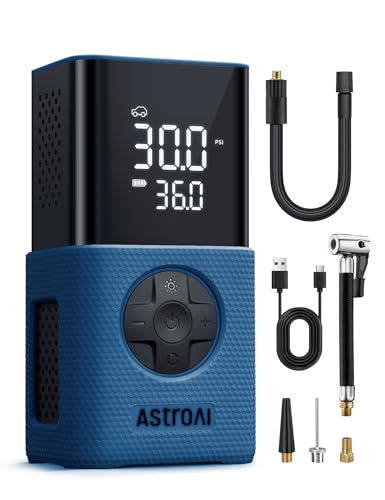 AstroAI L7S 150 PSI Cordless Tire Inflator |
8.9/10 | Buy |
| Best Premium |
 AstroAI Dual Power 110V/12V Tire Inflator |
8.9/10 | Buy |
| Best Value |
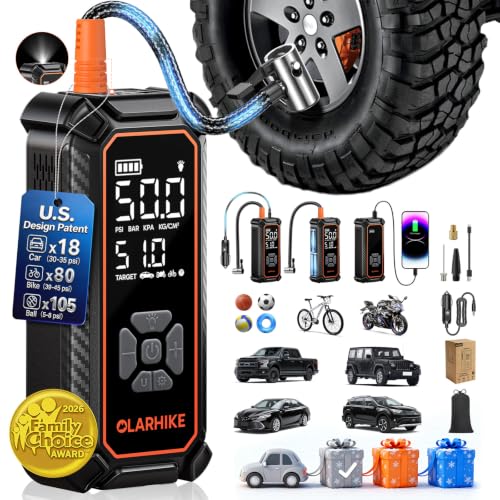 OlarHike Portable Tire Inflator Air Compressor |
8.8/10 | Buy |
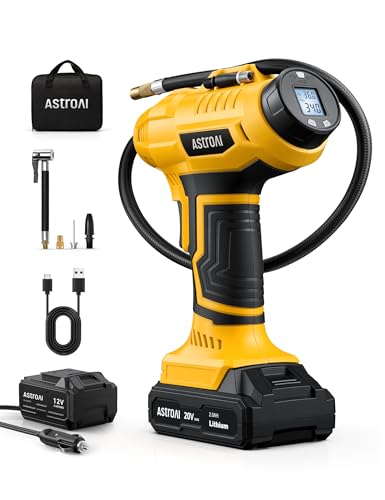 AstroAI Cordless Tire Inflator 160 PSI |
8.8/10 | Buy | |
 Inzeetor 150 PSI Portable Tire Inflator 12V DC |
8.6/10 | Buy | |
 CARSUN 12V DC Portable Tire Inflator |
8.6/10 | Buy | |
 AstroAI AIRUN H 12V DC Portable Air Compressor |
8.4/10 | Buy | |
 ETENWOLF Vortex S6 Cordless Tire Inflator |
8.1/10 | Buy | |
 AstroAI L7 Cordless Tire Inflator Portable Air |
8.0/10 | Buy |
AstroAI H2 Pro Cordless Tire Inflator 150 PSI
The AstroAI H2 Pro is a versatile dual-power portable tire inflator delivering up to 150 PSI via an internal rechargeable lithium battery or 12V DC vehicle plug. Featuring digital auto shut-off, accurate dual pressure displays, and onboard accessory storage, it is an ideal roadside emergency and garage solution for vehicle owners and cyclists.
Pros
- Dual power supply provides cordless convenience with a 12V DC vehicle fallback for roadside emergencies.
- Automatic shut-off and dual digital display prevent overinflation and eliminate manual pressure monitoring.
- ToughUltra internal components improve mechanical durability compared to standard plastic gear assemblies.
- Integrated nozzle storage compartment keeps bicycle adapters and ball needles organized inside the unit.
Cons
- Tankless high-pressure inflator design is not compatible with pneumatic workshop air tools like nailers or impact wrenches.
- Cordless runtime is limited to approximately 18 minutes before requiring a recharge or switching to the 12V DC vehicle cord.
- Direct-drive high-pressure pump requires cool-down pauses during continuous multi-tire inflation tasks.
AstroAI L7S 150 PSI Cordless Tire Inflator
Weighing barely a pound, the AstroAI L7S delivers portable inflation up to 150 PSI alongside a shock-absorbing silicone sleeve and power bank utility. Five smart presets and automatic shut-off make it a practical roadside companion for passenger cars, bicycles, and sports gear.
Pros
- Pocketable design weighing just 1.01 pounds
- Protective silicone sleeve dampens vibration and drops
- Hands-free operation with automatic shut-off
- Built-in power bank charges mobile devices
- Clear digital display with five smart presets
Cons
- Incompatible with heavy-duty truck and RV tires
- Not suitable for off-road vehicle tires or trailers
AstroAI Dual Power 110V/12V Tire Inflator
Versatile dual-power support lets this lightweight inflator run from either a garage wall outlet or a vehicle cigarette lighter. An automatic shutoff and onboard cord storage make routine tire top-offs straightforward for any driver.
Pros
- Flexible dual AC and DC power options
- Automatic shutoff prevents over-inflation
- Compact and lightweight at 2.2 pounds
- Integrated cord and nozzle storage
Cons
- Requires a 10-minute cooldown after 15 minutes of runtime
- Must be plugged into a power source to operate
OlarHike Portable Tire Inflator Air Compressor
The OlarHike Portable Tire Inflator combines dual-power versatility via a 12V DC vehicle plug or built-in rechargeable battery with an automatic shut-off digital display. It provides dependable roadside tire top-offs and inflation for passenger cars, crossovers, motorcycles, and bicycles.
Pros
- Dual-power design allows cordless field operation or continuous power through any standard vehicle 12V DC port
- Automatic shut-off technology stops the motor precisely at preset pressure to prevent over-inflation
- Integrated 6000mAh battery reserve doubles as an emergency phone charger and includes an LED work light
- Pocket-sized footprint weighs well under two pounds for convenient transport in center consoles or backpacks
Cons
- Maximum vehicle pressure rating of 51 PSI is not suitable for heavy-duty commercial trucks, RVs, or high-pressure trailer tires
- Compact tankless inflator mechanism cannot power workshop pneumatic tools such as nail guns or air ratchets
- Recharging requires a standard 5V 2A or 5V 3A adapter and is not compatible with high-wattage fast chargers
AstroAI Cordless Tire Inflator 160 PSI
The AstroAI Cordless Tire Inflator is a compact 160 PSI handheld air compressor featuring dual power via a 20V rechargeable battery and a 12V DC car adapter. Delivering digital auto shut-off and up to 20 minutes of continuous runtime, it is an ideal emergency tool for garage mechanics, commuters, and road-trippers.
Pros
- Dual-power versatility allows cordless battery operation at home or 12V DC vehicle plug-in on the road
- Reaches up to 160 PSI with automatic shut-off to prevent accidental tire over-pressurization
- Compact 2.54-pound footprint provides effortless trunk or glove-box storage for emergency readiness
- Backlit digital LCD screen provides clear readouts in PSI, BAR, and KPA units
- Integrated front LED light illuminates tire valve stems during dark roadside emergencies
Cons
- Includes a USB-C charging cable but requires an external USB power block to recharge the battery
- Designed specifically for tire and sports inflation rather than driving pneumatic workshop air tools
- Continuous runtime is limited to 20 minutes before requiring a cool-down pause
Inzeetor 150 PSI Portable Tire Inflator 12V DC
The Inzeetor 150 PSI Portable Tire Inflator is a lightweight 12V DC air compressor featuring digital auto shut-off and a durable zinc-alloy motor. Designed for rapid vehicle tire top-offs and sports gear, it offers dependable roadside utility for drivers and garage DIYers.
Pros
- Automatic digital shut-off eliminates manual monitoring and over-inflation risks
- Zinc-alloy motor allows continuous top-offs across four passenger tires without mandatory cooling breaks
- Weighs less than two pounds, making it effortless to stash in a trunk emergency kit
- Low-vibration chassis prevents the compressor from skittering across pavement during operation
- Comes equipped with versatile Presta and sports ball adapters alongside the standard Schrader chuck
Cons
- Requires a 12V DC vehicle cigarette lighter outlet and does not include a 120V AC wall plug
- The 1.97-foot air hose means the unit must sit on the ground or be held near the valve stem
- Engineered strictly for tire and recreation inflation rather than driving pneumatic workshop tools
CARSUN 12V DC Portable Tire Inflator
The CARSUN 12V DC portable tire inflator delivers a listed 35 L/min airflow with automatic digital shut-off up to 150 PSI. It is an ideal, budget-friendly roadside emergency pump for passenger car owners, cyclists, and weekend campers.
Pros
- Automatic shut-off prevents accidental tire over-inflation by cutting power at the preset target pressure
- Lightweight 1.9-pound frame and compact dimensions fit neatly into vehicle trunks or roadside emergency kits
- Capable 35 L/min air volume airs up standard passenger tires quickly during routine seasonal pressure top-offs
- Bright integrated LED lighting assists with safe valve connection along dark roadways and unlit driveways
- Four included adapter nozzles expand utility across bicycles, sporting balls, and recreational air mattresses
Cons
- Powered exclusively via 12V DC vehicle sockets and does not include a 120V AC household electrical plug
- Manufacturer explicitly notes the unit is not suitable for heavy commercial trucks or large motor lorries
- Tankless high-pressure inflator design is not engineered to operate pneumatic workshop air tools
AstroAI AIRUN H 12V DC Portable Air Compressor
The AstroAI AIRUN H is a compact 12V DC tire inflator delivering up to 35 L/min airflow with automatic shut-off and digital pressure presets. It is an ideal portable emergency compressor for drivers, commuters, and garage hobbyists seeking fast tire top-offs.
Pros
- Automatic shut-off stops pumping reliably once target PSI is reached
- High-airflow 120W motor provides rapid top-offs for daily driver tires
- Long 9.84-foot power cord reaches all passenger vehicle wheels with ease
- Bright built-in LED flashlight and backlit display assist during night repairs
- Lightweight 2.2-pound form factor stores neatly in glove boxes and trunks
Cons
- Requires a 12V DC vehicle outlet and does not include a 120V AC household plug
- Mandates a 10-minute cool-down interval after 15 minutes of continuous operation
- Not intended for high-volume inflatables like large pool floats or air mattresses
ETENWOLF Vortex S6 Cordless Tire Inflator
The ETENWOLF Vortex S6 is a dual-cylinder cordless portable tire inflator delivering 1.5 CFM at 0 PSI up to 160 PSI max, powered by an integrated 19,200 mAh lithium battery with 45W USB-C charging. It is an excellent choice for truck owners, off-road drivers, and DIYers wanting rapid tire top-offs without dragging power cords.
Pros
- Dual-cylinder pump design provides brisk 1.5 CFM airflow at 0 PSI up to 160 PSI max
- Large 19,200 mAh internal battery delivers substantial cordless run-time without vehicle 12V plug cords
- Rated for 100% duty cycle to handle heavy inflation demands without overheating shutdowns
- Integrated 1,000-lumen emergency LED light offers clear visibility during nighttime roadside repairs
- Versatile 45W bi-directional USB-C port charges the pump rapidly and recharges mobile electronics
Cons
- Tankless mobile inflator architecture cannot operate pneumatic shop air tools such as nail guns or die grinders
- Internal non-removable battery pack cannot be swapped out for standard 18V or 20V power-tool batteries
- Manufacturer explicitly notes the pump is not designed for inflating high-pressure stand-up paddleboards (SUPs)
AstroAI L7 Cordless Tire Inflator Portable Air
The AstroAI L7 is a lightweight, handheld cordless air compressor delivering up to 150 PSI with an integrated 4000mAh rechargeable battery and precise auto-shutoff. It provides dependable, pocket-sized inflation performance for motorists, cyclists, and DIYers needing quick roadside tire top-offs.
Pros
- Weighs only 0.96 pounds for effortless storage in vehicle consoles, toolbags, or cycling packs
- High-speed digital sensor samples tire pressure at 200 times per second to prevent over-inflation
- Internal 4000mAh battery provides cordless freedom without tangling 12V cigarette lighter cords
- Versatile secondary utility as an emergency LED flashlight and portable USB power bank
Cons
- Not intended for heavy-duty truck tires or commercial tires larger than 25 inches in diameter
- Duty cycle requires allowing the unit to cool for 10 minutes after 15 minutes of continuous run time
- Tankless micro-compressor design cannot power workshop pneumatic air tools
Comprehensive Sizing and Selection Guide for Car Tire Compressors
Selecting the appropriate compressor size for car tires requires looking beyond simple horsepower numbers to understand the specific mechanical needs of automotive pneumatic tires. Passenger vehicles operate within a moderate pressure window, yet the physical volume of air needed to inflate a tire creates distinct mechanical demands. Whether you need a dedicated garage tank or a compact roadside inflator depends on how quickly you want to add air and where you plan to use the machine. Exploring these technical factors guarantees that you invest in equipment that reliably handles daily commutes, unexpected punctures, and seasonal temperature changes.
The Fundamental Physics: Pressure Versus Air Volume in Car Tires
Tire inflation differs fundamentally from operating pneumatic nail guns or paint sprayers because tires represent a closed vessel with substantial internal volume. Most pneumatic workshop tools rely on a high-pressure burst or continuous high-volume air delivery measured in cubic feet per minute at ninety pounds per square inch. Automotive tires, by contrast, demand moderate working pressure combined with steady displacement to expand the tire carcass safely. A standard commuter sedan tire requires between thirty and thirty-six pounds per square inch, while light trucks may call for forty-five to fifty pounds per square inch.
Understanding this distinction prevents buyers from overspending on massive stationary compressors that exceed their practical needs. A compressor rated for high maximum pressure does not necessarily push air quickly if its volumetric displacement remains low. Conversely, a large reservoir tank can dump several cubic feet of pre-compressed air into a tire in seconds, eliminating motor strain during the fill. Balancing working pressure against delivered air volume forms the foundation of smart equipment sizing.
Minimum Pressure and Airflow Requirements for Passenger Vehicles
Every practical vehicle tire compressor must produce an output pressure that comfortably exceeds the target tire pressure to maintain continuous airflow. If a compressor only manages forty pounds per square inch at its pump head, the rate of air entering a thirty-five pound tire will slow to a crawl as pressures equalize. For this reason, compact portable inflators such as the AstroAI H2 Pro Cordless Tire Inflator Portable Air and the CARSUN Digital Air Compressor for Car Auto Pump deliver maximum pressure ratings of one hundred fifty pounds per square inch. This high ceiling ensures a strong pressure differential that drives air into the tire efficiently until the auto shut-off engages.
Airflow delivery dictates actual inflation speed and is commonly measured in liters per minute or cubic feet per minute at zero pressure. Compact direct-drive pumps commonly deliver between twenty-five and thirty-five liters per minute under initial load conditions. At thirty-five liters per minute, a standard compact car tire sizing around 195/65R15 can top off from thirty to thirty-six pounds per square inch in less than one minute. High-output units like the ETENWOLF VORTEX S6 Tire Inflator Portable Air reach forty-two liters per minute or 1.5 CFM, filling larger tires even faster without straining the motor.
Air Tank Size Comparison: Tankless Inflators Versus Garage Tanks
One of the most common questions drivers ask is whether a compressed air storage tank is strictly necessary for passenger car tires. Tankless inflators rely entirely on continuous piston stroke action to deliver air directly through the hose and into the valve stem. These direct-drive units feature zero stored air reserves, meaning the electric motor must spin continuously throughout the entire inflation cycle. Because there is no heavy steel vessel to store pressurized air, tankless models remain remarkably light and easy to stow inside a spare tire well.
By contrast, garage-based air compressors utilize steel receiver tanks ranging anywhere from one gallon to six gallons or more. A six-gallon pancake compressor stores air pressurized up to one hundred fifty or one hundred sixty pounds per square inch before you even attach the chuck. When you trigger the tire inflator wand, this stored reservoir transfers directly into the tire almost instantaneously. However, carrying a heavy tank to the driveway is cumbersome, making tankless portable pumps the preferred choice for dedicated tire maintenance.
Power Supply Tradeoffs: Cordless Battery, 12V DC, and 110V AC
The power source behind your compressor determines where and when you can safely perform tire pressure corrections. Traditional workshop compressors draw alternating current from standard one hundred ten volt or one hundred twenty volt household wall outlets. Dual-power models like the AstroAI Tire Inflator Portable Air Compressor incorporate both AC and DC inputs, allowing users to plug into a garage wall receptacle or a vehicle accessory socket. Drawing power from household current provides steady electrical amperage without placing any load on the vehicle battery.
Twelve-volt direct current adapters offer exceptional reliability during cross-country road trips because they draw directly from your vehicle accessory outlet. Models like the AstroAI AIRUN H Tire Inflator Portable Air draw ten to fifteen amps through a fused connection, ensuring continuous operation as long as the engine idles. Meanwhile, cordless battery units like the AstroAI L7S Tire Inflator Portable Air provide total mobility without power cords. Combining cordless convenience with twelve-volt backup cables offers the ideal compromise between quick driveway adjustments and roadside dependability.
Duty Cycle Limits and Thermal Protection During Multi-Tire Inflation
Duty cycle represents the percentage of time an air compressor can actively compress air within a given time block before requiring rest. Small, high-RPM direct-drive inflators generate considerable friction and compression heat inside their miniature cylinder sleeves. As a result, standard consumer inflators often carry a duty cycle rating requiring ten minutes of cooling after every fifteen minutes of continuous operation. Failing to respect these thermal limits can degrade piston cup seals, soften connecting rods, and lead to premature motor failure.
Thermal overload protection circuits are built into quality compressors to prevent catastrophic heat damage by cutting power automatically when internal temperatures peak. Advanced models engineered with ToughUltra manufacturing or zinc-alloy motor housings dissipate heat more effectively through integrated cooling fins and airflow channels. Premium units like the ETENWOLF Vortex S6 even feature dual-cylinder pump heads and dedicated cooling systems that achieve a one hundred percent duty cycle on truck tires. For standard four-tire top-offs, an inflator that runs continuously for fifteen minutes will finish the task comfortably.
Gauge Accuracy and Auto Shut-Off Mechanisms
Accurate pressure readings are critical because driving on underinflated or overinflated tires degrades fuel economy, accelerates tread wear, and compromises braking stability. Traditional analog needle dials on inexpensive inflators can be notoriously difficult to read in dim light and are vulnerable to calibration drift when bumped. Modern digital tire compressors incorporate high-precision pressure transducers that display current and preset values clearly on backlit screens. Many modern digital sensors sample line pressure multiple times per second to provide readings accurate within one pound per square inch.
Automatic shut-off functionality eliminates guesswork and prevents dangerous overpressurization by halting pump action the moment your target pressure is reached. Drivers simply enter their manufacturer-recommended cold tire pressure using intuitive plus and minus buttons and initiate the cycle. Once the sensor registers target equalization, internal switches cut electrical power to the drive motor immediately. This hands-free operation allows the user to monitor other vehicle components or step away from roadside traffic while inflation completes safely.
Sizing Adjustments for SUVs, Crossovers, and Light Truck Tires
Vehicle size dramatically alters the volume of air required to achieve standard operating pressure. While a compact sedan tire holds roughly ten to twelve gallons of free air volume, an all-terrain tire on a full-size pickup holds more than double that volume. Compact pocket inflators like the AstroAI L7 or OlarHike Tire Inflator Portable Air handle sedan and crossover tires effortlessly but are explicitly rated for pressures within fifty-one pounds per square inch. Attempting to use miniature commuter inflators on heavy-duty commercial truck tires or multi-axle trailers will quickly overheat the motor and trigger thermal shutdowns.
Light truck owners running load range E tires requiring sixty-five to eighty pounds per square inch require compressors engineered with heavier internal metallurgy. These high-volume applications benefit from dual-piston inflators or larger three-gallon to six-gallon garage units capable of maintaining steady displacement under heavy backpressure. The ETENWOLF Vortex S6 represents a rare cordless exception capable of handling thirty-one inch pickup tires across multiple consecutive fills due to its high-output battery architecture. Verifying your vehicle placard inside the driver door jamb ensures you select a compressor rated for both your required pressure and tire volume.
Pump Mechanics, Lubrication, and Cold-Weather Operation
The mechanical design of your tire compressor dictates how much preventative maintenance it requires throughout its operating life. Most portable tire pumps utilize oil-free PTFE piston cups and permanently sealed motor bearings to eliminate routine lubrication chores. While traditional workshop pumps require specific air compressor oil types to prevent pump wear, most compact vehicle inflators utilize oil-free Teflon piston mechanisms that function reliably in varied orientations. This oil-free design prevents oil mist from contaminating tire valve stems and eliminates messy fluid leaks inside vehicle trunks.
Cold weather presents unique challenges for pneumatic equipment because sub-freezing temperatures stiffen rubber seals and slow battery discharge chemistry. Quality tire compressors incorporate high-grade copper wiring and synthetic piston seals rated to start reliably down to sub-zero temperatures. Storing cordless battery units inside a heated home rather than a freezing trunk during winter months preserves lithium-ion capacity and ensures full output during morning emergencies. Inspecting rubber air hoses periodically for weather cracking or stiffening will prevent sudden pressure leaks during winter inflation cycles.
Practical Takeaways for Selecting the Right Compressor Setup
Determining the right compressor size for your vehicle ultimately depends on where and how you plan to use the tool. If your main goal is maintaining proper tire pressure in your home driveway while supporting household pneumatic tasks, a three-gallon to six-gallon oil-free pancake compressor provides unbeatable filling speed and versatility. However, if your priority is emergency preparedness, road trips, and effortless monthly pressure checks, a dedicated 12V DC or cordless portable tire inflator is the superior choice.
Look for units delivering at least thirty liters per minute of airflow, one hundred fifty pounds per square inch maximum pressure, and automatic shut-off capabilities to handle standard passenger cars. Drivers owning light trucks or large three-row SUVs should prioritize high-output dual-cylinder models or larger battery platforms capable of sustained duty cycles. By aligning your compressor choice with your tire volume, target pressure, and preferred power source, you will maintain optimal tire safety, maximize fuel economy, and enjoy worry-free driving through every season.
About the author
Tom Scalisi brings more than two decades of experience in construction, building maintenance, contracting, and hands-on tool use. His practical understanding of power tools, automotive work, repairs, and jobsite equipment helps readers evaluate compressors based on real workloads rather than specifications alone.