
How Big of an Air Compressor to Run Air Tools: Practical Guide for 2026
Learn how big of an air compressor to run air tools with our practical sizing guide covering CFM, tank storage, and tool demands for November 2026.
 By Clint DeBoer
Updated October 8, 2026


Matching pneumatic equipment to compressor output often turns frustrating when a tool rapidly loses torque or stalls during active use. Selecting how big of an air compressor to run air tools requires evaluating both continuous air consumption and tank storage capacity rather than focusing solely on peak pressure numbers. Low-draw intermittent tools like brad nailers operate easily on compact tanks, but high-demand tools quickly outpace small motors. Anyone planning framing or structural carpentry can explore our framing nailer compressor sizing guide to see how cycle rates influence tank recovery. Understanding your specific tool demands early prevents costly equipment mismatches in the workshop.
Air delivery is measured primarily through cubic feet per minute at operating pressure, with ninety pounds per square inch serving as the standard baseline for most garage and jobsite gear. When a compressor cannot supply sufficient continuous volume, the air pressure drops quickly and forces the pump into a punishing continuous cycle. Factors like tank volume, pump staging, and electrical draw dictate whether a machine can support impact wrenches, paint guns, or rotary sanders without overheating. Evaluating these operational parameters helps ensure reliable shop productivity and extends the service life of both your compressor and your pneumatic tools.
| Award | Product | ACR Score About ACR ScoreThe ACR Score is our own rating from 0 to 10, based on performance, design and build, ease of use, and value. It reflects independent research and is never influenced by manufacturers, retailers, or affiliate commissions. Learn more › | |
|---|---|---|---|
| Best Overall |
ALL-TOP Dual Cylinder 12V Air Compressor
|
9.2/10 | Buy |
| Best Value |
 WYNNsky 20-Piece 1/4-Inch Air Tool Kit |
9.1/10 | Buy |
| Best Budget |
 SARDVISA 9-Piece 1/4-Inch NPT Blow Gun Kit |
8.6/10 | Buy |
 DEWALT DXCM024-0443 21-Piece Accessory Kit |
8.6/10 | Buy | |
 WYNNsky 7-Piece Air Blow Gun Accessory Kit |
8.4/10 | Buy | |
 WYNNsky 20-Piece Air Compressor Accessory Kit |
8.3/10 | Buy | |
| Best Premium |
 California Air Tools CAT-4710W 4.7-Gal Compressor |
8.3/10 | Buy |
 DEWALT 30-Gallon Vertical Portable Electric Air |
8.3/10 | Buy | |
 LUMITECO 2-Pack Closed Flow Ball Foot Air Chuck |
8.1/10 | Buy | |
 SARDVISA 20-Piece Air Compressor Tool Kit |
8.1/10 | Buy |
ALL-TOP Dual Cylinder 12V Air Compressor
Built for rapid tire inflation on large trucks and off-road rigs, this dual-cylinder pump pushes an impressive 12.35 CFM flow rate up to 150 PSI. The rugged metal frame, integrated thermal safeguards, and extended 26-foot hose provide reliable utility for heavy-duty vehicle recovery.
Pros
- High 12.35 CFM output swiftly inflates large tires
- Dual aluminum cylinder construction helps dissipate heat
- Generous 26-foot hose reaches all corners of large vehicles
- Equipped with automatic thermal and over-current safety switches
Cons
- Heftier 24-pound build demands extra carrying effort
- Third-party gauges require built-in over-pressure protection
WYNNsky 20-Piece 1/4-Inch Air Tool Kit
This starter package bundles a 15-foot recoil hose, blow gun, and essential fittings into a compact carrying case. It provides the core accessories needed for basic tire inflation, surface dusting, and standard pneumatic tool hookups.
Pros
- Broad 20-piece assortment of standard pneumatic fittings
- Blow gun includes five swappable nozzle attachments
- Self-coiling hose design stores away neatly
- Dedicated case keeps all small adapters organized
Cons
- 120 PSI working limit excludes high-pressure pneumatic tools
- 15-foot hose length limits overall work radius
SARDVISA 9-Piece 1/4-Inch NPT Blow Gun Kit
SARDVISA provides a versatile pneumatic accessory kit centered on a chrome-plated blow gun with dual connection methods. It gives home mechanics and workshop users a practical set for cleaning machinery and inflating sports equipment.
Pros
- Durable all-metal build with corrosion-resistant finish
- Versatile attachment kit for cleaning and inflation
- Includes Teflon tape and quick-connect fitting
- Protective rubber tip prevents surface marring
Cons
- Thumb-lever actuation can tire hands during long sessions
- Lacks an integrated air pressure regulator
- Restricted to standard 1/4-inch NPT fittings
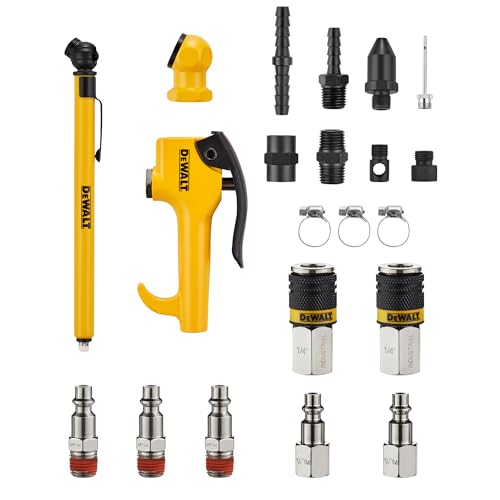
DEWALT DXCM024-0443 21-Piece Accessory Kit
Equipped with essential pneumatic fittings, this starter set pairs an OSHA-compliant blowgun with standard industrial couplers and tire inflation accessories. It is well suited for workshop owners and DIYers needing basic connection and maintenance hardware.
Pros
- OSHA-compliant venturi tip enhances blowgun safety
- Broad compatibility with 1/4-inch industrial connections
- Includes hardware for quick air hose repairs
- Versatile assortment covers cleaning and basic inflation
Cons
- Pencil pressure gauge limited to 60 PSI
- Does not include a main air hose
WYNNsky 7-Piece Air Blow Gun Accessory Kit
Equipped with five interchangeable nozzles and an extension tube, this pneumatic kit handles detailed cleaning and inflation around workshops and garages. The trigger-operated air gun includes a soft rubber tip that safeguards finished surfaces while clearing dust from narrow gaps.
Pros
- Versatile nozzle set handles varied inflation and cleaning needs
- Soft rubber tip prevents scratching delicate surfaces
- Extended tube reaches recessed spaces easily
- Extremely lightweight construction reduces hand fatigue
Cons
- Maximum working pressure capped at 90 PSI
- Not suited for high-pressure industrial compressor setups
WYNNsky 20-Piece Air Compressor Accessory Kit
The WYNNsky 20-piece accessory kit pairs with portable pancake air compressors to provide basic tire inflation, blow-off cleaning, and pneumatic connections. Featuring a 25-foot recoil nylon hose rated up to 200 PSI, it offers an economical starter package for DIY homeowners and garage hobbyists.
Pros
- Complete 20-piece starter bundle covers basic inflation, blow-off cleaning, and pneumatic air line setup
- 25-foot recoil hose retracts automatically to keep garage floors clear around compact pancake compressors
- Nylon air hose is rated for up to 200 PSI maximum working pressure for compatibility with standard 150 to 165 PSI compressor tanks
- Supplied with multiple inflation adapters for everyday household, sports, and vehicle utility
Cons
- Recoil nylon hoses tend to pull back under tension and can resist uncoiling in cold garage conditions
- Pencil tire pressure gauge provides basic reference readings rather than high-precision dial measurements
- Designed strictly for light-duty inflation and cleanout rather than demanding continuous pneumatic air tools
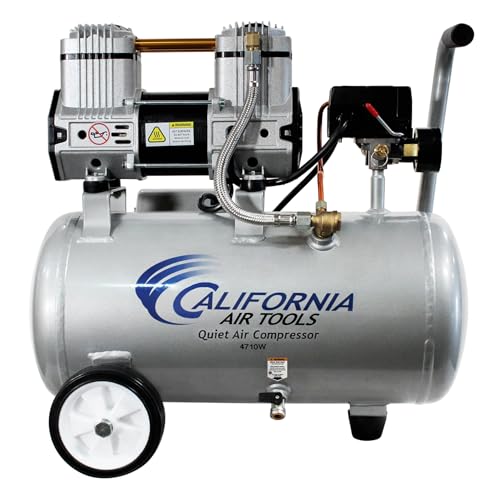
California Air Tools CAT-4710W 4.7-Gal Compressor
Built for garage workshops and DIY tasks, this mobile unit features an oil-free dual-piston pump that fills its 4.7-gallon steel tank in 78 seconds. Its low 7.5-amp motor draw ensures smooth startups on standard household circuits without tripping breakers.
Pros
- Fast 78-second tank fill time from empty
- Low 7.5-amp draw prevents tripped breakers
- Low-maintenance oil-free pump operation
- Wheels and pull handle ease transport at 35 pounds
Cons
- Delivers only 2.2 CFM at 90 PSI for demanding tools
- Steel tank construction is heavier than aluminum alternatives
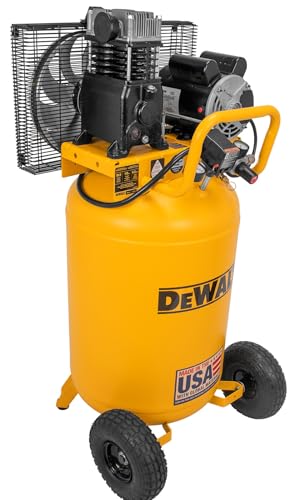
DEWALT 30-Gallon Vertical Portable Electric Air
Delivering 6.2 SCFM at 90 PSI with a high-capacity 175 PSI max pressure rating, the DEWALT DXCM303 30-Gallon Electric Air Compressor offers substantial air reserves for demanding workshop tools. Featuring rugged pneumatic wheels and a factory high-flow regulator, it is an outstanding mobile solution for garage mechanics and serious DIY woodworkers.
Pros
- Substantial 175 PSI maximum pressure provides longer run time between motor recovery cycles
- Solid airflow output of 6.2 SCFM at 90 PSI supports a wide variety of pneumatic garage tools
- High-flow regulator supplies up to 65% more usable operating pressure to connected hoses
- Heavy-duty pneumatic wheels make rolling this 196-pound upright compressor around the garage practical
Cons
- Substantial 196-pound total weight makes vehicle loading and transport between jobsites difficult without ramps or assistance
- Large vertical shop profile is designed for roll-around floor use rather than hand-carry punch-list applications
LUMITECO 2-Pack Closed Flow Ball Foot Air Chuck
The LUMITECO 2-Pack Ball Foot Air Chuck Set features a closed-flow internal shut-off valve rated up to 300 PSI, making it an excellent addition to tire inflator gauges and shop air drops. Designed with standard 1/4-inch FNPT threads and supplied with quick-connect plugs, this kit provides a dependable, leak-resistant solution for automotive enthusiasts and garage DIYers.
Pros
- Internal closed-flow valve prevents air discharge when disconnected, conserving compressor tank pressure
- Rated up to 300 PSI maximum pressure for wide versatility across passenger cars and light commercial vehicles
- Complete installation kit includes two male quick-disconnect plugs and thread sealing Teflon tape
- Standard 1/4-inch FNPT threads ensure straightforward compatibility with aftermarket inflator gauges and hose whips
Cons
- Closed-flow design is unsuitable for direct connection to small portable 12-volt inflators that lack an integrated pressure switch or trigger
- Compact ball-foot profile can be difficult to position on deeply recessed dually truck wheels compared to extended straight-foot chucks
- Base metal alloy is not explicitly listed, requiring careful alignment during threading to avoid cross-threading over time
SARDVISA 20-Piece Air Compressor Tool Kit
This 20-piece air compressor accessory set from SARDVISA bundles standard 1/4-inch NPT fittings, an air blow gun, tire chucks, and pre-applied thread sealant for basic garage maintenance. It serves as an accessible starter kit for DIY homeowners and hobbyists setting up everyday pneumatic lines.
Pros
- Wide selection of essential air line fittings, adapters, and inflation attachments in one package
- Standard 1/4-inch NPT threading fits standard U.S. home shop air tools and compressors
- Pre-applied thread sealant and included PTFE tape assist with leak-free installation
- Solid brass ball air chuck provides dependable durability at the valve stem connection
- Lightweight total set weight of approximately 1.21 pounds stores easily in portable toolboxes
Cons
- Light-duty chrome-plated hardware is best suited for home hobbyists rather than heavy commercial fabrication shops
- Manufacturer does not specify maximum working PSI or continuous CFM flow ratings
- Air blow gun and nozzles do not have documented OSHA safety pressure-relief certifications
Sizing an Air Compressor for Pneumatic Tools
Selecting the proper compressor size begins by recognizing how pneumatic tools consume compressed air under actual working conditions. Peak pressure ratings often dominate marketing labels, but continuous volume delivery determines whether your tools run efficiently or repeatedly stall. When an air tool consumes more air than the pump can compress, the tank empties and operating pressure plunges. Understanding the relationship between airflow volume, working pressure, and storage reserve allows you to choose an air compressor that matches your specific tools without wasting money or workshop space.
Understanding CFM at 90 PSI Versus Maximum Tank Pressure
Air flow volume is calculated in cubic feet per minute, commonly designated as CFM or standard cubic feet per minute. Most pneumatic power tools operate at a standardized pressure of ninety pounds per square inch, making the CFM rating at 90 PSI the most crucial benchmark on any specification sheet. A compressor displaying a high maximum pressure like 150 PSI or 175 PSI can store significant air volume inside its tank, but that stored pressure does not indicate how rapidly the pump replenishes used air. If a tool demands five CFM at 90 PSI while the pump only generates two CFM, the tool will quickly deplete the stored air regardless of maximum tank pressure.
Manufacturers also publish CFM figures at forty pounds per square inch for low-pressure applications like tire inflation or touch-up paint guns. For instance, a compact unit like the California Air Tools CAT-4710W provides 3.00 CFM at 40 PSI and 2.20 CFM at 90 PSI from its 1.0 HP motor. Comparing tool requirements against compressor output at the exact operating pressure of that tool is essential. Evaluating air delivery at the correct operating pressure prevents the frustration of buying an undersized compressor that looks capable on paper but falls short under mechanical load.
Intermittent Versus Continuous Air Tool Consumption
Pneumatic equipment generally falls into two distinct functional categories based on air consumption profiles: intermittent tools and continuous tools. Intermittent tools consume a brief burst of compressed air per operation and then sit idle while the user positions the workpiece or fastener. Common examples include finish nailers, framing guns, tire inflators, and pneumatic staplers, which generally require modest air volumes between 0.5 and 2.5 CFM. Because these tools operate in quick pulses, a smaller compressor with modest air delivery and a compact tank can easily keep up with standard work cycles.
Continuous tools operate uninterrupted for extended durations, creating a non-stop drain on the compressed air reserve. Tools in this category include dual-action orbital sanders, die grinders, needle scalers, cutoff tools, and high-volume low-pressure paint spray guns that draw between six and twelve CFM at 90 PSI. If an operator attempts to run continuous tools on a small portable pump, the tank pressure drops within thirty seconds and stalls the tool. Impact wrenches occupy a middle ground, requiring modest tanks for brief lug nut removal but demanding substantial continuous airflow for heavy equipment disassembly.
Calculating Required Air Delivery with a Sizing Buffer
Calculating the compressor capacity you need requires tallying the air requirements of the most demanding tool you intend to operate. Start by locating the CFM rating listed on the data plate or user manual of your highest-consumption tool. For instance, if you operate an automotive impact wrench that requires 5.0 CFM at 90 PSI, that number establishes your minimum operational baseline. Running multiple tools simultaneously requires adding their individual CFM demands together, though single-user home garages rarely power two tools at the exact same moment.
Standard pneumatic practice advises adding a safety multiplier of twenty-five to fifty percent above your tool rating. Multiplying your tool CFM requirement by 1.25 or 1.50 accounts for tool wear, minor air line friction, and pump duty cycle limits. For a tool demanding 5.0 CFM, a compressor delivering between 6.25 and 7.5 CFM at 90 PSI provides an ideal operating cushion. This additional headroom prevents the pump from running continuously, which protects mechanical seals and ensures the pump cycles off regularly to dissipate heat.
The Role of Tank Capacity as an Air Storage Buffer
Air receiver tanks do not generate airflow, but they serve as essential storage reservoirs that absorb sudden pneumatic surges. A larger air tank stores a reserve of pressurized air that allows short bursts of high-demand tool operation exceeding the continuous output of the pump. For example, a heavy 1/2-inch impact wrench might consume eight CFM for several seconds while breaking loose a stubborn axle nut. A modest compressor pump producing four CFM can handle that quick task if connected to a twenty or thirty gallon tank that absorbs the sudden volume drain.
Tank size becomes less critical when powering continuous tools like sanders or grinders over extended runtimes. Once the stored air drops below operating threshold, the tool depends entirely on the pump’s real-time CFM output. If the pump produces 6.2 SCFM at 90 PSI, like the DEWALT 30-Gallon vertical compressor, it can sustain tools drawing up to that volume while the tank buffers minor fluctuations. Vertical tank orientations also save valuable floor space in home workshops, whereas wheeled horizontal configurations offer better portability across jobsites.
Electrical Constraints and Garage Circuit Demands
Compressor performance is directly tied to the electrical supply available in your workspace. Standard 120-volt household branch circuits in residential garages are typically protected by fifteen-amp or twenty-amp circuit breakers. Electric induction motors require substantial electrical power, drawing considerable inrush current during the initial two seconds of pump startup. If you are configuring a workshop, reviewing our garage compressor voltage guide can help you evaluate whether your existing wiring can support higher motor horsepower.
Electric motors rated above two continuous running horsepower generally require dedicated 240-volt electrical circuits to operate reliably. Units with modest power draws, such as the California Air Tools 1.0 HP pump drawing just 7.5 amps, plug safely into standard 15-amp outlets without overloading shared circuits. Extension cords present a major hazard by causing voltage drop, which starves the motor and triggers premature thermal overloads or capacitor failure. Leaving the compressor plugged directly into the wall and using longer air hoses to reach work areas avoids electrical issues and preserves full motor torque.
Noise Levels and Oil-Free Pump Mechanisms
Operating noise represents a major factor for woodworkers, homeowners, and technicians working in enclosed spaces. Traditional direct-drive, oil-free compressors operate at high rotational speeds around 3,400 RPM, producing harsh noise levels often exceeding eighty-five decibels. Prolonged exposure to that level of noise causes hearing fatigue and creates severe disturbances in attached garages or basements. In contrast, modern low-RPM dual-piston designs operate around 1,750 RPM, substantially cutting operational sound down to seventy-five decibels or lower.
Pump lubrication also influences maintenance requirements and long-term operating durability. Oil-free pumps utilize Teflon-coated piston rings that eliminate crankcase oil, delivering clean air for painting and finish carpentry while requiring zero oil changes. Conversely, oil-lubricated cast-iron pumps use splash lubrication to dissipate heat and resist cylinder wear across thousands of hours in heavy commercial shops. Choosing between oil-free convenience and oil-lubricated longevity depends on whether you prioritize zero maintenance and clean air over industrial operating endurance.
Air Hose Diameter, Quick Couplers, and Flow Restrictions
Generating adequate air volume at the pump means very little if downstream plumbing restricts airflow before it reaches your tools. The air delivery system encompasses the pressure regulator, manifold couplers, air hose, and pneumatic tool fittings. Many starter accessory packages, such as the 20-piece sets from WYNNsky or SARDVISA, utilize standard 1/4-inch NPT threaded connections and 1/4-inch industrial quick-connect couplers. These standard fittings work wonderfully for nailers, blow guns, and tire chucks, but they can throttle high-draw tools.
Air hose internal diameter directly dictates the volume of air delivered over distance and influences dynamic pressure drop. A 1/4-inch internal diameter hose creates significant friction and pressure drop when powering tools that consume more than six CFM. Upgrading to a 3/8-inch internal diameter rubber or hybrid hose ensures that air tools receive full volume without starving under load. Quality brass quick-connect couplers, like closed-flow tire chucks from LUMITECO and threaded plugs sealed with Teflon tape, prevent nuisance air leaks that waste compressor energy.
Moisture Management and Routine Tank Maintenance
Compressing ambient atmospheric air naturally squeezes out airborne moisture, which condenses and pools at the bottom of the steel receiver tank. If left unmanaged, this accumulated water leads to internal tank rust, line contamination, and ruined pneumatic tool seals. Learning why water accumulates and how to prevent damage is detailed in our tank moisture condensation guide. Purging this moisture daily after each work session is vital to protect your investment and maintain equipment safety.
Tank drain valves are located on the underside of the receiver and vary significantly in convenience and durability. Basic compressors often feature threaded thumb petcocks that are difficult to turn and prone to seizing over time. High-quality compressors incorporate accessible quarter-turn brass ball valves that allow quick, effortless draining in just seconds. Always depressurize the tank partially before opening the drain valve, and inspect the ASME safety relief valve periodically to ensure it releases cleanly if internal pressure spikes.
Recommended Compressor Sizes by Workshop Task
Matching compressor capacity to specific tasks simplifies the buying decision and ensures you do not overspend on unneeded capacity. For home hobbyists focused on tire maintenance, sports equipment inflation, and seasonal dust blowing, compact inflators or small 1 to 6 gallon portable units provide more than enough capability. Portable 12V dual-cylinder units, like the ALL-TOP air compressor kit, offer specialized high volume for truck and off-road tires without requiring shop electricity. These portable setups deliver outstanding convenience for basic maintenance without cluttering storage areas.
Woodworkers and finish carpenters benefit most from quiet 2 to 6 gallon compressors delivering two to three CFM at 90 PSI for nailers and staplers. For automotive enthusiasts running 1/2-inch impact wrenches and air ratchets, a 20 to 30 gallon compressor delivering five to six CFM at 90 PSI serves as the ideal benchmark. Production shops running continuous orbital sanders and paint sprayers require 60 to 80 gallon stationary systems producing ten to fifteen CFM or higher. Evaluating your current pneumatic tool inventory and anticipating future shop expansion will guide you to the right compressor size.
Selecting the right air compressor size ultimately comes down to calculating your tool air demand and providing an adequate CFM safety margin. Prioritizing cubic feet per minute at 90 PSI over raw tank pressure ensures your tools receive the continuous volume they need to operate at full power. Combining proper pump output with an appropriately sized receiver tank, quality air hoses, and routine moisture drainage creates a reliable pneumatic setup that handles your projects with ease. Matching your compressor to your most demanding tool today will keep your workshop running smoothly for years to come.
About the author
Clint DeBoer is an experienced tool-industry specialist with decades of involvement in technical media, hands-on product evaluation, and testing methodology. His focus on performance, practical usability, and data-driven comparisons makes his expertise highly relevant to professional air compressors, pneumatic tools, and workshop equipment.