
What Size Air Compressor for Changing Tires: Sizing and Pressure Guide for 2026
Determine what size air compressor for changing tires to run impact wrenches and fill tires safely. Here is your pneumatic sizing guide for October 2026.
 By Tony Carrick
Updated October 8, 2026
By Tony Carrick
Updated October 8, 2026

Loosening corroded lug nuts with a pneumatic impact wrench demands an immediate burst of high-volume airflow that smaller hobby compressors often struggle to deliver. Many home mechanics discover this limitation the hard way when their impact gun stalls halfway through removing a single wheel. Determining what size air compressor for changing tires requires balancing the intense, short-duration air consumption of impact tools against the steady pressure needed to seat tire beads and reach target inflation. If you want to understand how different pneumatic equipment matches up with garage power sources, exploring our general air tool compressor sizing guide provides essential baseline metrics for workshop planning.
Tire maintenance actually involves two very distinct mechanical operations that dictate your equipment needs. You might only need a compact, high-pressure inflator to top off passenger car tires in the driveway, or you may require a substantial air reserve tank to power a heavy-duty half-inch impact wrench across all four vehicle hubs. Understanding how cubic feet per minute, tank storage volume, and operating pressure interact ensures you choose a machine capable of completing seasonal rotations without frustrating motor delays. Selecting the appropriate setup keeps your tools operating at peak breakaway torque while preserving the service life of your compressor motor.
| Award | Product | ACR Score About ACR ScoreThe ACR Score is our own rating from 0 to 10, based on performance, design and build, ease of use, and value. It reflects independent research and is never influenced by manufacturers, retailers, or affiliate commissions. Learn more › | |
|---|---|---|---|
| Best Overall |
CRAFTSMAN Portable 12V Tire Inflator with
|
9.2/10 | Buy |
| Best Value |
 AstroAI Tire Inflator Portable Air Compressor
|
8.9/10 | Buy |
| Best Premium |
 CRAFTSMAN Tire Inflator Portable Air Compressor
|
8.9/10 | Buy |
| Best Budget |
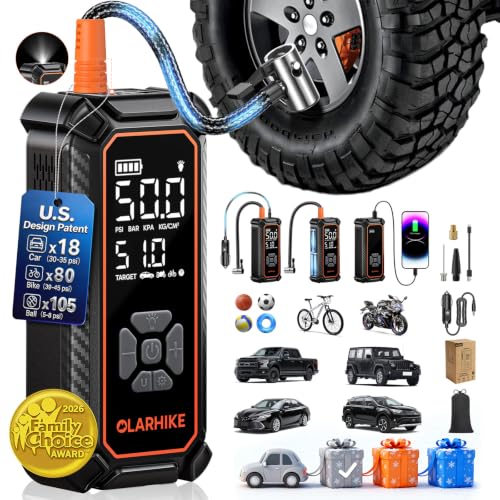 OlarHike Tire Inflator Portable Air
|
8.8/10 | Buy |
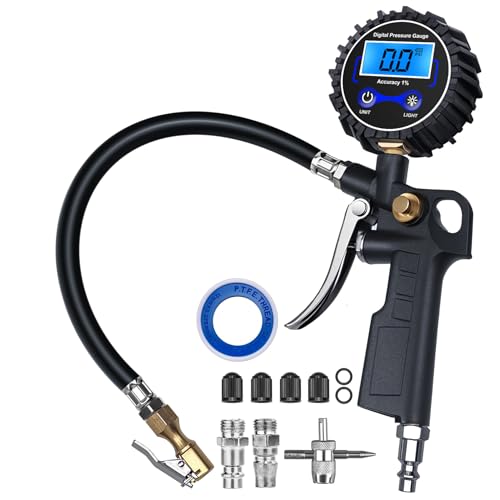 DigitPro Digital Tire Pressure Gauge with Inflator
|
8.4/10 | Buy | |
 AstroAI Tire Inflator Portable Air Compressor 12V
|
8.4/10 | Buy | |
 AstroAI AIRUN H Tire Inflator Portable Air
|
8.4/10 | Buy | |
 OlarHike 12000mAh Heavy Duty Tire Inflator
|
8.3/10 | Buy | |
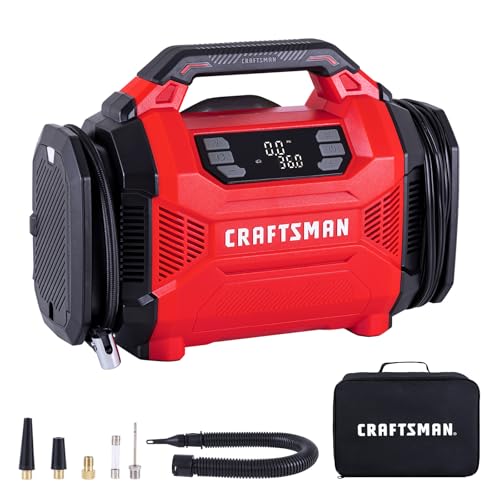 CRAFTSMAN Dual Power Tire Inflator with
|
8.1/10 | Buy | |
 Spurtar 10-120 PSI Tire Pressure Gauge
|
8.0/10 | Buy |
Compressor Sizing Guide for Vehicle Tire Maintenance and Air Tools
A complete tire-changing job demands far more pneumatic capability than simple tire pressure inflation. Basic tire inflation only requires a machine capable of delivering 35 to 50 PSI, including compact 12-volt portable inflators. However, running a standard half-inch pneumatic impact wrench to remove lug nuts requires a compressor delivering at least 4.0 to 5.0 CFM at 90 PSI paired with a minimum 20-gallon air storage tank. While a smaller 6-gallon pancake compressor can break loose a few lug nuts in short bursts, it quickly depletes its air reserve and forces you to wait through long recovery cycles.
Distinguishing Between Tire Inflation and Pneumatic Lug Nut Removal
Automotive wheel service breaks down into two entirely different pneumatic workloads. The first workload is tire inflation, which requires moderate pressure but relatively low air volume to bring a passenger tire from 28 to 35 PSI. The second workload involves running pneumatic impact wrenches to spin lug nuts off wheel studs, which demands massive instantaneous air volume. Confusing these two functions is the primary reason DIY mechanics purchase undersized compressors that stall mid-project.
Portable tire inflators and mini compressors focus exclusively on pressure delivery rather than sustained tool volume. Compact units like the CRAFTSMAN portable 12V inflator or the AstroAI dual-power tire inflator produce maximum pressures up to 150 PSI, yet their airflow output remains under 1 CFM. These compact devices excel at roadside emergencies, sports equipment inflation, and seasonal tire top-offs because they connect directly to vehicle accessory outlets. However, their miniature displacement cylinders and lack of an air storage receiver make them completely incapable of driving any pneumatic impact mechanism.
Pneumatic impact wrenches rely on high air volume expanding rapidly across an internal air motor to spin an anvil and hammer mechanism. This rapid expansion consumes between 4 and 6 cubic feet of air every minute of continuous operation at 90 PSI. Without a pressurized storage tank acting as an energy reservoir, an air tool cannot generate the rotary torque necessary to overcome rusted or over-torqued lug nuts. Sizing an air compressor requires deciding whether your workflow includes running air-powered wrenches or simply inflating rubber tires after manual wheel removal.
Air Volume and CFM Demands for Half-Inch Impact Wrenches
The standard tool for automotive wheel service is the half-inch drive pneumatic impact wrench. Manufacturers rate these tools based on their air consumption at 90 PSI, which typically ranges from 4.0 to 5.5 CFM under continuous trigger pull. Because technicians use impact wrenches in short two-second bursts rather than continuous runs, the instantaneous draw can temporarily exceed the continuous output of the compressor pump. A compressor that delivers only 2.0 to 2.6 CFM at 90 PSI will starve the wrench if the air storage tank depletes.
When an impact wrench suffers from air starvation, the internal motor slows down and the impacting frequency drops dramatically. The tool loses its breakaway torque rating, turning a 600 foot-pound wrench into a sluggish tool that cannot loosen stubborn lug nuts. Continued operation under starved conditions causes excessive mechanical drag and wastes shop time as you wait for the air lines to recharge. Matching your compressor output to the sustained rating of your impact gun prevents premature tool wear and operator frustration.
Professional automotive shops typically use a safety margin factor of 1.25 to 1.5 times the tool rating when selecting compressor air delivery. For a wrench demanding 4.5 CFM at 90 PSI, a compressor capable of supplying roughly 6.0 CFM provides seamless performance without tool hesitation. DIY mechanics working at a relaxed pace can manage with lower pump output if their tank reservoir is sufficiently large. Nevertheless, understanding the CFM metric remains the most reliable way to avoid pneumatic tool disappointment.
Tank Reservoir Sizing: Pancakes Versus Mid-Size Garage Tanks
Air tank capacity directly determines how many lug nuts you can remove before the compressor motor must kick on to replenish pressure. A 6-gallon pancake or hot dog compressor stores enough compressed air to remove roughly three to five lug nuts before pressure plummets below 90 PSI. Once line pressure drops below operating thresholds, the impact wrench loses torque, forcing you to pause while the small pump runs a recovery cycle. Removing all twenty lug nuts on a passenger vehicle with a 6-gallon unit turns into a slow, segmented chore.
A 20-gallon to 30-gallon horizontal or vertical air tank represents the practical sweet spot for residential garage tire changing. This capacity stores enough pressurized air volume to remove all lug nuts on a four-wheel vehicle with minimal pump cycling. The larger buffer ensures that the regulated line pressure feeding your wrench stays rock-solid at 90 PSI throughout each wheel removal. The motor also experiences fewer start-stop cycles, which reduces electrical wear and keeps operating temperatures under control.
For heavy-duty applications such as three-quarter-ton pickup trucks, commercial trailers, and dual-rear-wheel assemblies, even larger tanks prove advantageous. Heavy truck lug nuts often require torques exceeding 140 foot-pounds, requiring extended impact bursts that drain small tanks in seconds. A 60-gallon stationary compressor running a cast-iron pump provides virtually uninterrupted power for continuous heavy-vehicle wheel service. Home mechanics must weigh their available garage floor space against the specific vehicle classes they intend to service.
Operating Pressure Dynamics and Usable Air Buffer
Understanding the difference between storage tank pressure and regulated tool pressure reveals how compressors store mechanical energy. Most modern consumer compressors feature maximum tank pressures ranging between 135 PSI and 175 PSI. However, standard automotive air tools are calibrated to run at a regulated pressure of 90 PSI at the tool inlet. The pressure differential between the tank cut-out threshold and the regulated 90 PSI tool setting forms your usable air buffer.
A compressor with a 175 PSI cut-out threshold stores significantly more usable air volume in the same physical tank dimensions than an older 125 PSI unit. This high-pressure buffer allows a 15-gallon or 20-gallon tank to behave like a much larger reservoir during rapid tool use. When the tank pressure drops to the pressure switch cut-in point, typically around 100 to 110 PSI, the motor restarts to rebuild the reserve. Maintaining an adequate pressure margin above the 90 PSI regulator setting guarantees that your impact wrench receives full operating force until the last bolt spins off.
Pneumatic line pressure stability also depends heavily on proper hose connections and manifold seals. If you are setting up your workspace fittings for the first time, our guide on connecting an air hose properly explains how to prevent costly air leaks and coupling restrictions. Even a well-sized tank will underperform if restricted fittings drop your working pressure at the impact gun anvil. Verifying regulator output and eliminating fitting leaks maximizes the efficiency of your available air volume.
Air Hose Diameter and Flow Restriction Considerations
The inner diameter of your air delivery hose plays an enormous role in delivering proper CFM to heavy pneumatic tools. Many entry-level compressor kits ship with a standard 1/4-inch inner diameter PVC or hybrid air hose. While a 1/4-inch hose works fine for tire inflation and small finish nailers, it chokes the high instantaneous airflow demanded by half-inch impact wrenches. Running an impact gun on a 50-foot 1/4-inch hose can result in a dynamic pressure drop of 15 to 25 PSI during trigger pull.
Upgrading to a 3/8-inch inner diameter rubber or hybrid hose substantially reduces friction loss and delivers full compressor tank pressure directly to the tool. The larger cross-sectional area allows high CFM bursts to travel smoothly without starving the pneumatic motor. Pairing a 3/8-inch hose with high-flow quick-connect couplers further eliminates bottlenecks at the manifold and tool inlet. These simple plumbing upgrades can double the effective torque of an impact wrench running off a modest mid-size compressor.
During tire reinflation, precision pressure control becomes just as important as high-flow air delivery. Integrating specialized attachments like the DigitPro digital tire pressure gauge or the Spurtar dual-head inflator gauge ensures accurate pressure readings up to 120 or 250 PSI. These heavy-duty inflator chucks connect directly to standard 1/4-inch NPT compressor hoses, allowing seamless transition from tool operation to precise tire inflation. Built-in deflation valves and calibrated digital readouts help you dial in exact vehicle manufacturer tire specifications safely.
Pump Mechanisms, Electrical Supply, and Garage Circuits
Compressor pump construction directly influences maintenance demands, noise output, and duty cycle limits in a residential workspace. Oil-free dual-piston pumps feature Teflon-coated piston rings that require zero oil changes and start reliably in cold winter temperatures. However, universal motor oil-free compressors often generate high noise levels approaching 80 decibels and feature 50 percent duty cycle limitations. Splash-lubricated cast-iron pumps operate much more quietly and support heavier duty cycles, making them ideal for serious automotive restoration.
Maintaining an oil-lubricated compressor pump requires periodic oil checks and synthetic oil changes to avoid internal scoring and thermal breakdown. To keep your workshop machine running reliably through years of wheel maintenance, reviewing proper compressor pump lubrication practices will prevent premature pump head failure. Clean non-detergent compressor oil prevents carbon buildup on sensitive reed valves, preserving maximum CFM output over long service intervals. Neglecting pump lubrication degrades air compression efficiency and leads to costly motor replacements.
Electrical supply requirements represent another critical factor when sizing a garage air compressor. Most portable and mid-sized compressors run on standard 120-volt household electricity, drawing between 12 and 15 running amps. However, electric compressor motors draw high inrush startup current that can easily trip a standard 15-amp shared household breaker. Installing a dedicated 20-amp circuit with heavy-gauge wiring ensures that your compressor starts reliably under load without tripping garage lights or wall outlets.
The Role of 12V and Cordless Inflators in Mobile Tire Changes
While large garage compressors dominate workshop tire rotations, compact 12V and cordless tire inflators serve a vital role for roadside tire changes. Many drivers pair a manual lug wrench or cordless electric impact gun with a portable inflator like the CRAFTSMAN cordless tire inflator or the OlarHike dual-power unit. These compact devices weigh under two pounds and store neatly in the trunk or glove box for emergency travel. They eliminate the need to carry bulky air tanks when all you need is roadside tire pressure restoration.
Modern portable inflators incorporate intelligent microprocessors that offer digital pressure presets and automatic shut-off functionality. Users can program a specific target pressure, such as 32 PSI or 36 PSI, and the unit automatically ceases pumping once reached. Dual-power models like the AstroAI AC/DC inflator provide extra flexibility by operating off both a 12V car cigarette lighter and a standard 120V garage wall socket. Built-in LED work lights also improve safety when changing a flat tire along dark highways or in poorly lit parking structures.
High-capacity rechargeable battery models like the OlarHike 12000mAh heavy-duty tire inflator deliver impressive standalone performance for light trucks and SUVs. Their twin-cylinder mechanisms can top off passenger car tires in under one minute without dragging power cords around the vehicle. While these portable pumps cannot drive pneumatic impact tools, they offer unmatched convenience for seating tire beads and adjusting cold inflation pressures on the go. Blending a portable inflator for roadside duty with a dedicated garage air tank creates a balanced vehicle tire maintenance strategy.
Moisture Management and Tank Longevity for Tire Maintenance
Compressing atmospheric air naturally condenses airborne humidity into liquid water inside your compressor storage tank. If this accumulated moisture is not drained regularly, it travels through your air hoses directly into your pneumatic tools and vehicle tires. Water entering an impact wrench washes away vital lubricating oil and causes internal steel vanes to rust and seize. Moisture-laden air inside vehicle tires also causes erratic cold-weather pressure fluctuations and accelerates aluminum wheel bead corrosion.
Preventing moisture contamination requires opening the tank drain valve at the bottom of the receiver after every tire servicing session. Compressors equipped with quarter-turn brass ball valves make daily draining quick and painless compared to stiff threaded needle petcocks. Installing an inline moisture separator and particulate filter along your garage air line captures residual condensation before it reaches your tools. Keeping your compressed air clean and dry extends the lifespan of both your expensive air tools and your vehicle wheel assemblies.
Selecting the right air compressor size ultimately depends on matching your mechanical ambitions to your workspace power and storage limits. A 20-gallon compressor delivering 5.0 CFM at 90 PSI provides the ideal balance of power and versatility for changing tires and running common automotive tools. Keeping a digital inflator gauge and a compact 12V emergency inflator on hand guarantees complete tire pressure readiness both in the shop and on the highway. Careful pneumatic planning ensures your garage remains fully equipped to tackle any tire replacement job safely and efficiently.
About the author
Tony Carrick is an experienced product researcher and writer specializing in tools, home improvement, automotive maintenance, and consumer equipment. With extensive experience reviewing tools and tackling hands-on renovation projects, he brings a buyer-focused perspective to compressor performance, usability, and overall value.