
How Big an Air Compressor Do I Need: Sizing Guide for 2026
Learn how big an air compressor do i need for pneumatic tools, sprayers, and tire inflation in this October 2026 sizing guide.
 By Kenny Koehler
Updated October 8, 2026
By Kenny Koehler
Updated October 8, 2026

Continuous pneumatic tools like paint sprayers, rotary sanders, and die grinders will quickly stall when an undersized motor cannot keep up with high air consumption. Determining how big an air compressor do i need starts with calculating your actual air delivery demand rather than looking strictly at the size of the air tank. While tank storage provides a temporary pressurized buffer, sustained output depends directly on delivered volume measured in cubic feet per minute at operating pressure. Matching your pneumatic equipment to the proper compressor prevents frustrating pressure drops, excessive pump heat, and constant motor cycling during heavy garage or jobsite tasks.
Most shop mechanics and finish woodworkers find that intermittent tools like brad nailers and tire chucks demand far less air than continuous rotary equipment. Sizing a machine correctly also requires balancing electrical circuit limitations, such as running amperage on standard household breakers, against the necessary storage capacity in gallons. Choosing an appropriate unit ensures that your tools operate with steady line pressure without tripping 15-amp breakers or causing premature pump wear. Reviewing realistic pneumatic demands will help you select the exact tank reserve and air volume needed for your specific work environment.
| Award | Product | ACR Score About ACR ScoreThe ACR Score is our own rating from 0 to 10, based on performance, design and build, ease of use, and value. It reflects independent research and is never influenced by manufacturers, retailers, or affiliate commissions. Learn more › | |
|---|---|---|---|
| Best Overall |
California Air Tools 2010A 1.0 HP Ultra Quiet
|
9.1/10 | Buy |
| Best Value |
 California Air Tools CAT-4610S Ultra Quiet
|
9.1/10 | Buy |
| Best Budget |
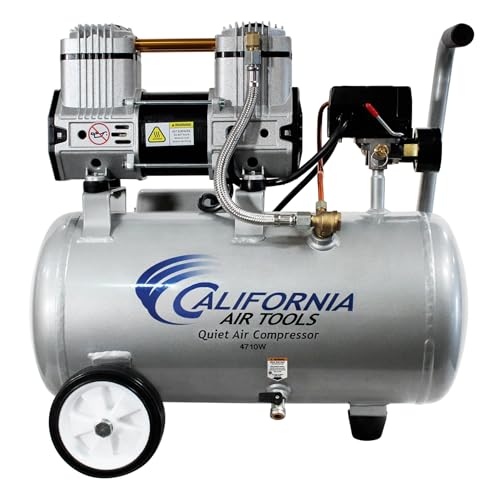 California Air Tools CAT-4710W 1.0 HP Quiet
|
8.3/10 | Buy |
 California Air Tools 4620AC Powerful 2.0 HP
|
8.1/10 | Buy | |
| Best Premium |
 California Air Tools 20015HP 1.5 HP Ultra Quiet
|
8.1/10 | Buy |
 BUNKER INDUST 12V Air Compressor
|
8.0/10 | Buy | |
 California Air Tools 20020 2.0 HP Ultra Quiet
|
7.8/10 | Buy |
Practical Air Compressor Sizing Guide: CFM, Tank Capacity, and Power Requirements
Choosing the correct compressor size requires evaluating how your specific tools consume pressurized air rather than focusing on marketing labels. Many buyers focus solely on tank gallon capacity, mistakenly assuming that a larger tank automatically powers heavier pneumatic equipment. In reality, compressor sizing involves three distinct measurements: air flow volume at working pressure, storage tank volume, and electric motor capacity. Balancing these three variables ensures your pneumatic system delivers consistent performance without stalling tools or overloading household electrical circuits.
Understanding CFM Versus Tank Gallons
Air flow volume is measured in cubic feet per minute, commonly abbreviated as CFM, and represents the true output generated by the compressor pump. Most pneumatic tools specify their air consumption at 90 pounds per square inch, or PSI, which represents standard operating pressure. A compressor pump delivering 2.20 CFM at 90 PSI produces air at a continuous rate determined strictly by motor horsepower and cylinder displacement. If your tool consumes more air than the pump produces, it drains stored pressure and stalls.
The storage tank acts as a temporary pressurized reservoir rather than a continuous power source. A compact two-gallon or four-gallon tank stores enough compressed air for brief bursts of activity, allowing a low-output pump to supply high-demand tools for several seconds. Once that stored volume drops below the tool’s required operating pressure, the tool loses performance until the motor catches up. A larger twenty-gallon tank provides a bigger air reserve, which smooths out pressure fluctuations during intermittent work.
Relying exclusively on tank capacity to compensate for an undersized pump creates significant operating problems during continuous work. While a large air receiver allows you to run high-draw equipment temporarily, an undersized pump must run continuously to refill that massive volume once depleted. Continuous running pushes oil-free pumps past their rated duty cycle, generating excessive friction and heat across cylinder sleeves and valve plates. Sizing an air compressor requires matching the pump’s CFM rating directly to tool demands, using tank volume only as a buffer.
Calculating Air Requirements for Intermittent Versus Continuous Tools
Pneumatic tools fall into two distinct operational categories: intermittent-use tools and continuous-use tools. Intermittent tools include finish nailers, brad nailers, framing guns, and tire inflation chucks that consume air in isolated pulses. A standard finish nailer requires less than one CFM at 90 PSI because it only draws a quick pulse of air per fastener. For these applications, a compact unit such as the California Air Tools 2010A 1.0 HP Ultra Quiet, delivering 2.20 CFM at 90 PSI from a 2.0-gallon aluminum tank, provides ample delivery.
Continuous tools operate under entirely different pneumatic demands, drawing uninterrupted air streams for minutes at a time. Rotary orbital sanders, die grinders, cut-off tools, and HVLP paint spray guns represent classic continuous-demand equipment. A typical paint sprayer or dual-action sander can easily consume six to twelve CFM at 90 PSI without pause. Running these tools on a low-output compressor causes line pressure to collapse within seconds, resulting in sputtering paint finishes or stalling sanding pads.
When calculating required compressor size, always apply the standard rule of multiplying your highest-demand tool’s rated CFM by 1.25. This twenty-five percent safety margin accounts for dynamic friction loss inside pneumatic hoses, minor fitting restrictions, and pump efficiency drops under heat. For example, if you plan to operate an air ratchet requiring 4.0 CFM at 90 PSI, choose a machine delivering at least 5.0 CFM at that same pressure. Units like the California Air Tools 4620AC Powerful 2.0 HP, which produces 5.30 CFM at 90 PSI, safely meet this threshold.
Evaluating Tank Capacity: Compact Tanks Versus Workshop Reservoirs
Tank capacity dictates how long you can operate a tool before the pressure switch triggers the motor to refill the tank. Compact tanks ranging from two to five gallons excel at jobsite portability, trim carpentry, and quick garage chores. The California Air Tools CAT-4610S Ultra Quiet features a 4.6-gallon steel twin tank configuration that balances manageable weight with enough stored volume for framing nailers. Similarly, the wheeled California Air Tools CAT-4710W 1.0 HP Quiet uses a 4.7-gallon tank to provide mobility across garage floors.
Larger reservoirs between ten and twenty gallons are engineered for demanding automotive and workshop environments. A larger tank significantly extends run and rest cycles, protecting pump components from rapid on-off switching. The California Air Tools 20020 2.0 HP Ultra Quiet integrates a substantial 20-gallon steel air receiver with an oil-free dual-piston pump. This generous storage volume absorbs high-demand air spikes from pneumatic impact wrenches, permitting multiple lug-nut removals before the pressure switch calls for the pump to start.
Tank geometry also influences everyday usability and physical workspace footprints. Twin-stack horizontal tanks place weight close to the ground, preventing tip-overs when pulled across rough jobsite floors or truck beds. Vertical tanks, such as twenty-gallon workshop models, maximize floor space in crowded home garages by storing pressurized volume upward. When selecting tank size, consider whether you need to transport the machine up stairs or whether it will remain stationary beside your workbench.
Single-Stage Versus Two-Stage Pressure Delivery
The mechanical compression architecture determines the maximum operating pressure a compressor can achieve. Single-stage compressors draw atmospheric air into a cylinder and compress it directly into the storage receiver in one stroke, typically reaching cut-out pressures between 120 and 135 PSI. Models like the California Air Tools 2010A operate on this single-stage principle, reaching a 120 PSI maximum that easily handles tire inflation, finish carpentry, and general air blowoffs.
Two-stage compressors utilize two distinct cylinder sizes connected by a finned intercooler tube to achieve significantly higher pressures. The first, larger cylinder compresses air to an intermediate pressure before sending it into a smaller secondary cylinder that compresses it to maximum pressure. The California Air Tools 20015HP 1.5 HP Ultra Quiet incorporates an oil-free two-stage pump delivering pressures from 145 to 175 PSI. Higher tank pressure compresses a greater volume of air into a twenty-gallon space, effectively doubling the usable buffer compared to lower-pressure tanks.
Storing air at 175 PSI provides distinct advantages when operating pressure-sensitive automotive tools or inflating commercial truck tires. A high-pressure system maintains regulated line pressure above 90 PSI for much longer periods before the motor must engage. Furthermore, the intermediate cooling process between compression stages lowers final discharge temperatures, which reduces moisture vapor condensation and minimizes thermal stress on internal pump components.
Motor Horsepower, Electrical Circuit Draw, and Breaker Limits
Motor horsepower ratings directly govern how rapidly a compressor pump can displace air and recover depleted tank pressure. However, buyers must distinguish between true continuous running horsepower and exaggerated peak surge ratings often used in retail advertising. A genuine 1.0 HP electric motor, such as the power plant on the California Air Tools CAT-4710W, draws around 7.5 amps under normal operating conditions. This modest electrical demand allows the machine to run safely on standard 110-volt, 15-amp household circuits without nuisance breaker trips.
Stepping up to a larger 2.0 HP motor, found on units like the California Air Tools 4620AC or California Air Tools 20020, increases output to 5.30 CFM at 90 PSI but increases electrical draw to 14 amps. Standard residential 15-amp branch circuits operate close to their thermal trip thresholds when powering a 14-amp motor under full load. Startup inrush current spikes momentarily when an electric motor begins turning against head pressure, which can trip a breaker if other appliances share that line.
To prevent electrical issues, larger 2.0 HP machines should be connected to dedicated 20-amp branch circuits equipped with proper commercial receptacles. Users should also avoid using light-gauge household extension cords, which cause severe voltage drops that overheat motor windings and trigger thermal overload protection switches. If extra reach is required around a workshop, it is far safer to connect fifty feet of quality 3/8-inch pneumatic air hose rather than extending the electrical power cord.
Evaluating Decibel Ratings for Indoor Workshops and Garages
Operating noise is one of the most critical yet frequently overlooked factors when choosing the right air compressor size. Traditional oil-free jobsite compressors utilize high-RPM universal motors that spin at 3,400 RPM or faster, producing deafening noise levels between 80 and 90 decibels. Working next to an 85-decibel machine in an enclosed garage or basement quickly causes ear fatigue and disrupts household members. Excessive noise often discourages hobbyists from using their air tools for evening projects.
Modern ultra-quiet compressors solve this problem by employing low-speed induction motors paired with dual-piston pump mechanisms. The California Air Tools 2010A and CAT-4610S operate at a gentle 1680 RPM, holding sound output down to an exceptionally quiet 60 decibels. At 60 decibels, the compressor produces about the same sound volume as a normal conversational voice, allowing you to converse comfortably while the pump is actively running. Even larger 2.0 HP units like the California Air Tools 4620AC maintain a quiet 70-decibel rating while pumping significant air volume.
In addition to lower decibel ratings, low-RPM dual-piston designs generate substantially less mechanical vibration and heat than high-speed consumer units. Reduced motor speed dramatically extends pump life, with dual-piston oil-free mechanisms often rated for over 3,000 hours of operation before wear occurs. For home workshops, attached garages, and craft studios, selecting an ultra-quiet model ensures productive work without requiring specialized hearing protection for brief compressor cycles.
Specialized Air Demands: High-Volume 12V Portable Inflation
Certain pneumatic applications require massive air volume without the bulky footprint of an electric stationary receiver tank. Off-road exploration, truck trail recovery, and multi-vehicle tire maintenance demand high air flow directly from a twelve-volt vehicle battery. The BUNKER INDUST 12V Air Compressor exemplifies this specialized approach, utilizing dual cylinders to deliver up to 12.3 CFM and 150 PSI directly through an Anderson-style power plug. This high-flow configuration can inflate large four-wheel-drive tires from trail pressure back to highway pressure in slightly over one minute.
Unlike workshop compressors that store air in a stationary tank, high-output 12V inflators pump air straight through delivery hoses into tires or inflatables. Features such as digital LCD pressure control, automatic target-pressure shutoff, and integrated thermal overload protection ensure safe, accurate inflation without constant manual monitoring. If your primary air requirement is mobile tire management rather than operating shop air tools, a dedicated high-volume 12V dual-cylinder inflator is far more practical and space-efficient than hauling an AC-powered receiver tank.
Daily Moisture Purging and Condensation Management
Every air compressor inherently draws ambient atmospheric moisture into its pump during the compression cycle. As hot compressed air cools inside the storage tank, water vapor condenses into liquid water that pools along the bottom of the vessel. If neglected, standing water leads to internal tank corrosion, reduces available air storage volume, and eventually sprays rusty moisture through air hoses into sensitive pneumatic tools. Aluminum receivers, like the 2.0-gallon tank on the California Air Tools 2010A, naturally resist rust, but steel tanks require diligent daily purging.
Proper maintenance requires opening the tank drain valve at the conclusion of every working session while the tank retains slight residual pressure. A quick burst of pressure forcefully clears accumulated liquid and sediment through the drain port, leaving the tank interior dry. Operators should also inspect the safety relief valve ring periodically to ensure the valve releases freely if an overpressure event occurs. Following simple daily condensation drainage habits preserves tank structural integrity and guarantees clean, dry air delivery for years of dependable service.
Summary of Sizing Rules for Your Pneumatic Equipment
Selecting the correct air compressor comes down to honestly identifying the tools you intend to operate and understanding their consumption profiles. For trim carpentry, brad nailing, and general tire maintenance, a compact 1.0 HP compressor with a two-gallon to five-gallon tank delivering around 2.20 CFM at 90 PSI provides great portability and quiet operation. If your plans include automotive maintenance with impact wrenches, moving up to a 2.0 HP motor with a twenty-gallon tank delivering over 5.0 CFM at 90 PSI gives you the required air buffer and sustained flow.
Always verify that your garage or workshop electrical supply can support your chosen machine’s amperage draw before making a purchase. Keeping your compressor within safe electrical boundaries, allowing adequate CFM headroom for your air tools, and choosing an appropriate tank size will eliminate pressure drops and pump overheating. With the right machine matched to your workspace and tool collection, you can complete pneumatic projects efficiently, quietly, and with reliable air delivery.
About the author
Kenny Koehler is a power-tool specialist with more than a decade of hands-on evaluation experience and a science-based approach to product testing. His expertise in repeatable testing, tool performance, impact wrenches, and professional equipment brings a practical, data-focused perspective to compressor and pneumatic-tool comparisons.