
How Many Watts Does a Portable Air Compressor Use: Power Guide for 2026
Find how many watts does a portable air compressor use to size generators and avoid breaker trips in October 2026. Review starting surge, running wattage, and electrical demands.
 By Bob Beacham
Updated October 7, 2026
By Bob Beacham
Updated October 7, 2026
Connecting a portable pneumatic setup to a garage outlet or mobile generator requires a solid understanding of power consumption. Operating an air tool or airing up vehicle tires relies on an electric motor that draws substantial energy from the circuit. Knowing how many watts does a portable air compressor use prevents unexpected circuit breaker trips and protects equipment from low-voltage motor damage. Everyday pneumatic tasks run much smoother when you match your power supply to the exact demands of your compressor pump.
Many users do not realize that electric motors pull significantly more power during initial startup than while sustaining continuous tank pressure. Portable units range from low-draw 12V DC emergency inflators to robust 120V pancake compressors demanding over a thousand watts. Evaluating the motor horsepower, operating amperage, and surge capacity ensures seamless operation across different jobsites. Taking a few moments to review these electrical ratings guarantees that your tools perform reliably without interruption.
| Award | Product | ACR Score About ACR ScoreThe ACR Score is our own rating from 0 to 10, based on performance, design and build, ease of use, and value. It reflects independent research and is never influenced by manufacturers, retailers, or affiliate commissions. Learn more › | |
|---|---|---|---|
| Best Overall |
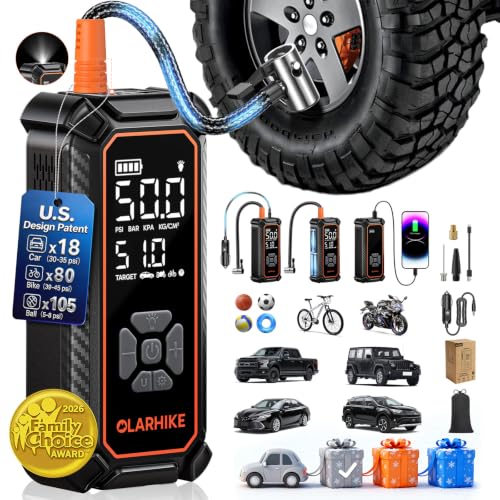
OlarHike Portable Tire Inflator Air Compressor
|
8.8/10 | Buy |
| Best Premium |
 Metabo HPT 6-Gallon Pancake Air Compressor Review
|
8.6/10 | Buy |
 DEWALT DWFP55130 2.5-Gallon 200 PSI Quiet Trim Air
|
8.4/10 | Buy | |
| Best Value |
 OlarHike 12000mAh Cordless Tire Inflator
|
8.3/10 | Buy |
| Best Budget |
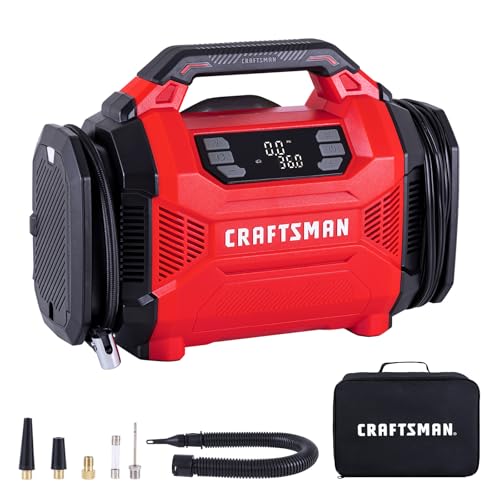 CRAFTSMAN Dual Power Tire Inflator
|
8.1/10 | Buy |
 CRAFTSMAN 6 Gallon 150 PSI Portable Oil-Free
|
8.1/10 | Buy |
OlarHike Portable Tire Inflator Air Compressor
The OlarHike Portable Tire Inflator combines dual-power versatility via a 12V DC vehicle plug or built-in rechargeable battery with an automatic shut-off digital display. It provides dependable roadside tire top-offs and inflation for passenger cars, crossovers, motorcycles, and bicycles.
Pros
- Dual-power design allows cordless field operation or continuous power through any standard vehicle 12V DC port
- Automatic shut-off technology stops the motor precisely at preset pressure to prevent over-inflation
- Integrated 6000mAh battery reserve doubles as an emergency phone charger and includes an LED work light
- Pocket-sized footprint weighs well under two pounds for convenient transport in center consoles or backpacks
Cons
- Maximum vehicle pressure rating of 51 PSI is not suitable for heavy-duty commercial trucks, RVs, or high-pressure trailer tires
- Compact tankless inflator mechanism cannot power workshop pneumatic tools such as nail guns or air ratchets
- Recharging requires a standard 5V 2A or 5V 3A adapter and is not compatible with high-wattage fast chargers
Metabo HPT 6-Gallon Pancake Air Compressor Review
The Metabo HPT EC711S is a portable 6-gallon pancake air compressor delivering 2.8 CFM at 90 PSI with a 165 PSI tank ceiling and an operating sound level of 73 dB. With its quick 46-second recovery cycle and dual quick couplers, it is an excellent choice for finish carpenters, punch-list contractors, and DIYers running pneumatic nailers.
Pros
- 73 dB operational sound rating is substantially quieter than standard job-site pancake units
- 165 PSI maximum pressure provides ample air storage with a swift 46-second recovery cycle
- Two 1/4-inch universal quick couplers support multi-tool setups right out of the box
- Sturdy steel roll cage protects gauges and the manifold assembly against knocks and drops
- Oil-free 1.0 HP motor ensures low maintenance and reliable cold-weather motor startup
Cons
- At 38.5 lbs, it is slightly heavier than ultra-compact 1-to-3-gallon trim compressors
- Airflow of 2.8 CFM at 90 PSI is designed for intermittent fastening, not continuous rotary tools or paint sprayers
- Bare-tool configuration means air hoses and pneumatic fastening tools must be purchased separately
DEWALT DWFP55130 2.5-Gallon 200 PSI Quiet Trim Air
The DEWALT DWFP55130 delivers a capable 3.0 SCFM at 90 PSI with a 200 max PSI 2.5-gallon tank, running at a quiet 71.5 dBA on an efficient 12-amp motor. It is an ideal pneumatic power source for trim carpenters, punch-list contractors, and DIYers working on residential circuits.
Pros
- Delivers 3.0 SCFM at 90 PSI with a high 200 max PSI ceiling for rapid pressure recovery during sequential fastening
- Quiet 71.5 dBA sound output makes indoor trim carpentry and remodeling far less disruptive to homeowners
- Low 12-amp draw reduces breaker trips when running on shared 15-amp household circuits
- Integrated roll cage and console protect critical components while supporting horizontal or vertical operation
- Dual quick couplers allow two trim carpenters to connect and work off a single compressor
Cons
- Bare-tool configuration means you must supply your own air hoses, couplers, and pneumatic nail guns
- At 36 pounds, it is heavier to haul up flights of stairs than ultra-compact 1-gallon finish compressors
- Air output of 3.0 SCFM is built for intermittent finish fastening and will not support continuous tools like rotary sanders or sprayers
OlarHike 12000mAh Cordless Tire Inflator
The OlarHike Heavy Duty Tire Inflator is a compact 3.2-pound mobile air compressor featuring a twin-cylinder motor, integrated 12,000mAh battery, and 12V DC vehicle adapter. It provides rapid roadside inflation with auto-shutoff convenience, making it a dependable emergency tool for drivers, mechanics, and off-roaders.
Pros
- Twin-cylinder pump configuration delivers faster inflation times than typical single-piston mini inflators
- True dual-power flexibility prevents downtime by running via battery or vehicle 12V DC outlet
- Compact, lightweight 3.2-pound body offers exceptional portability without eating up cargo space
- 45W USB-C Power Delivery port provides practical utility beyond tire maintenance
- Auto-stop feature eliminates pressure guessing and prevents dangerous over-inflation
Cons
- Tankless mobile design is strictly intended for inflation and cannot operate continuous-draw pneumatic air tools
- Extended continuous runtime on large truck or RV tires will cause heat buildup that requires brief cool-down intervals
- Does not include a standard 120V AC household wall plug for direct residential outlet use
CRAFTSMAN Dual Power Tire Inflator
The CRAFTSMAN Dual Power Tire Inflator delivers versatile high-pressure air delivery up to 150 PSI using either a 120V AC home outlet or a 12V DC vehicle plug. Featuring digital auto shut-off presets and an integrated LED work light, it is an essential portable air solution for DIYers, garage mechanics, and road commuters.
Pros
- Dual 120V AC and 12V DC power inputs offer exceptional flexibility for both driveway maintenance and unexpected roadside flats
- Accurate digital pressure gauge with automatic shut-off prevents over-pressurizing vehicle and bicycle tires
- Capable of reaching 150 PSI, making it suitable for high-pressure road bike tires as well as passenger car tires
- Built-in LED work light enhances nighttime safety and visibility when working alongside highway traffic
- Complete package includes dedicated air hose, multiple nozzle adapters, spare fuse, and a zippered storage bag
Cons
- Tankless direct-drive mechanism is engineered for tire inflation and cannot power pneumatic air tools such as nailers or impact wrenches
- Takes longer to fill large volume leisure items like oversized air mattresses or rafts compared to dedicated high-volume blowers
- Lacks an onboard cordless tool battery dock, requiring access to an active 120V wall outlet or 12V vehicle socket
CRAFTSMAN 6 Gallon 150 PSI Portable Oil-Free
The CRAFTSMAN 6-Gallon 150 PSI Oil-Free Pancake Air Compressor delivers 2.6 SCFM at 90 PSI via a 1.0 HP low-voltage start motor with factory dual quick couplers. Weighing 30.8 pounds, it provides dependable air delivery for finish carpenters, DIY remodelers, and garage maintenance tasks.
Pros
- Delivers 2.6 SCFM at 90 PSI with a 150 PSI maximum tank ceiling for dependable finish fastening.
- Dual quick couplers allow two pneumatic tools to remain connected at the same time without splitters.
- Oil-free pump design ensures clean air delivery and zero periodic pump oil maintenance.
- Low-voltage start 1.0 HP motor supports reliable startups on standard 120V household outlets.
- Manageable 30.8-pound weight and integrated carry handle provide practical one-person jobsite transport.
Cons
- Air delivery rate of 2.6 SCFM at 90 PSI is not designed for continuous high-demand tools like rotary sanders or paint sprayers.
- Standard oil-free electric motor design generates typical high-pitch operational sound during tank recharge cycles.
- Sold as a bare compressor unit without included air hoses, couplers, or pneumatic nailers.
Understanding Wattage Demands and Electrical Consumption in Portable Air Compressors
Determining the exact power requirements of an air compressor begins with identifying its operating voltage and rated amperage draw. A typical 120V portable pancake compressor generally requires between 1,200 and 1,800 running watts, while smaller 12V DC inflators consume between 120 and 240 watts. However, running wattage tells only half of the story because electric induction motors create heavy electrical surges upon starting. Examining both continuous running watts and initial startup demands reveals exactly how much power you need from a wall outlet or portable generator.
The Core Electrical Formula: Calculating Running Watts from Amps and Volts
Electrical power is calculated through the fundamental formula where wattage equals operating voltage multiplied by active amperage. For standard household plug-in units operating on a nominal 120V alternating current line, a compressor rated at 10 running amps requires approximately 1,200 running watts. A unit pulling 12 amps, such as the DEWALT Air Compressor for Trim, 200-PSI Max, consumes around 1,440 continuous watts during active air compression. Multiplying these two electrical values provides the baseline wattage you must supply whenever the motor cycles on to rebuild tank pressure.
Direct current pneumatic tools follow this identical mathematical relationship under automotive battery setups. A portable 12V tire inflator drawing 10 amps from a vehicle accessory port consumes roughly 120 watts of direct current power. High-output emergency inflators pulling up to 15 or 19 amps demand between 180 and 228 watts during heavy pressure inflation. Understanding this basic formula helps you quickly assess whether a vehicle socket, auxiliary battery, or home wall receptacle can deliver adequate continuous power.
Running Watts Versus Startup Surge: The Peak Inrush Current Factor
Running wattage represents the power consumed while the pump operates at steady speed, but startup surge creates a significantly higher temporary spike. When an electric motor initially turns over from a complete standstill, it must overcome severe mechanical resistance and mechanical inertia inside the cylinder. This sudden surge in power consumption, often called locked rotor amperage or inrush current, typically requires two to three times the steady running wattage. Consequently, a portable air compressor that runs steadily on 1,400 watts can easily demand 3,000 to 4,000 peak starting watts for a brief fraction of a second.
Overlooking this initial surge spike is the primary reason why portable air tools frequently fail on undersized power sources. If an auxiliary generator or small inverter power station cannot deliver this high surge wattage, the compressor motor simply buzzes without spinning. This stalled state draws continuous locked-rotor current that can rapidly overheat the internal copper windings and damage motor insulation. Sizing your electrical supply with sufficient surge overhead ensures the pump starts instantly and avoids dangerous thermal overload shutdowns.
Standard 120V AC Jobsite Compressors: Pancake and Twin-Stack Demands
Most jobsite pancake compressors utilize 1.0 horsepower electric motors engineered to strike a practical balance between airflow output and electrical demand. The Metabo HPT Pancake Air Compressor and the CRAFTSMAN 6 Gallon 150 PSI Oil-Free Pancake Air both feature 1.0 HP motors optimized for dependable cold-weather starting on standard 120V branch circuits. These reliable motors typically draw between 10 and 12 continuous running amps, which translates directly to 1,200 to 1,440 running watts under load. Delivering up to 2.8 CFM at 90 PSI, these popular workshop units sit comfortably near the safe upper limit of common 15-amp residential circuits.
Modern trim compressors are frequently built with specialized low-amp motor packages to reduce circuit overload risks in residential settings. The DEWALT DWFP55130 trim compressor is specifically configured with an efficient 12-amp motor draw to minimize nuisance breaker trips during interior renovations. Pulling approximately 1,440 running watts, it delivers 3.0 SCFM at 90 PSI and easily supports multiple finish nailers fired in rapid succession. Choosing a compressor with a documented low amp draw gives trim carpenters and DIYers the flexibility to work in older buildings without constantly walking to the breaker panel.
Tank capacity also plays an important role in how frequently your electrical system must endure motor startup spikes throughout the day. A larger 6-gallon pressure vessel stores a greater buffer of compressed air, allowing finish carpenters to drive dozens of fasteners before the motor engages. Smaller 2.5-gallon tanks hold less reserve volume, requiring the pump to cycle on far more frequently during active trim installation. While both tank sizes consume similar wattage while running, the larger tank minimizes repetitive surge spikes on your electrical circuit.
Compact 12V DC and Battery-Powered Inflator Wattage Profile
Portable tire inflators operate on an entirely different electrical scale compared to traditional tank-equipped workshop compressors. Compact emergency tools like the OlarHike Tire Inflator Portable Air draw modest power from internal rechargeable lithium batteries or a standard 12V automotive cigarette lighter. Operating on low direct-current voltage, these handheld units typically consume between 60 and 120 watts during routine tire inflation. This modest power draw allows motorists to inflate passenger car tires without overloading automotive fuses or draining car batteries prematurely.
Heavier dual-cylinder portable inflators require slightly more electrical wattage to handle larger vehicle and trailer tires. The OlarHike 12000mAh Heavy Duty Tire Inflator incorporates internal battery management systems configured for loads up to 19 amps, demanding approximately 228 peak watts under heavy pressure. Versatile inflators such as the CRAFTSMAN Dual Power Tire Inflator with provide both 12V DC cords and 120V AC wall plugs for maximum user convenience. When connected to a standard home wall outlet, these dual-voltage inflators consume under 200 watts, making them remarkably gentle on home electrical panels.
Cordless jobsite compressors draw their electrical energy from removable lithium-ion tool batteries rated in voltage and amp-hours. Wattage consumption in battery platforms is often measured in total watt-hours, calculated by multiplying the pack voltage by its amp-hour capacity. A cordless compressor pulling 15 amps from an 18V or 20V battery pack consumes roughly 270 to 300 watts of electrical power while the motor runs. While cordless systems provide outstanding jobsite mobility, continuous pumping under heavy loads quickly drains smaller battery packs and requires fresh spares nearby.
Sizing Portable Generators and Inverter Power Stations
Operating a portable compressor away from grid power requires matching your generator or portable power station to the compressor surge rating. Many equipment owners mistakenly purchase a generator based solely on the compressor running wattage, resulting in immediate motor stalls. A standard 1.0 HP pancake compressor requiring 1,440 running watts cannot start reliably on an entry-level 1,500-watt generator because it lacks starting headroom. To ensure smooth and reliable off-grid operation, you should pair that compressor with a generator capable of delivering at least 3,000 starting watts.
Modern inverter generators and lithium power stations provide clean electricity, but they require strict attention to continuous and peak surge ratings. Pure sine wave inverters are strongly recommended because modified sine wave units can cause alternating current induction motors to run hot and lose torque. If you intend to operate a 120V jobsite compressor on remote projects, look for an inverter generator delivering at least 2,200 running watts and 3,200 peak surge watts. This extra headroom prevents the inverter overload protection from tripping every time the compressor pressure switch triggers a tank recovery cycle.
Sharing generator capacity with other jobsite equipment also impacts your available compressor wattage. If a compressor kicks on while jobsite floodlights, cordless tool chargers, or miter saws operate on the same power line, total demand spikes dramatically. Always tally the continuous running watts of all connected equipment and add the compressor startup surge to calculate your generator size. Providing plenty of electrical buffer prevents sudden voltage sags that can cause compressor motors to stall or damage sensitive electronics.
Why Portable Compressors Trip 15-Amp Household Breakers
Tripping a 15-amp circuit breaker in a home garage or workshop is one of the most common issues reported by compressor owners. A standard 15-amp, 120-volt residential circuit provides a theoretical maximum capacity of 1,800 watts before the breaker trips. Standard electrical safety codes recommend limiting continuous loads to 80 percent of circuit capacity, which establishes a practical limit of 1,440 watts. Because a standard 1.0 HP compressor running at 12 amps operates right at this 1,440-watt boundary, any other load on the same circuit will trip the breaker.
Cold winter weather in an unheated garage or outdoor jobsite significantly increases the likelihood of a tripped circuit breaker. Frigid temperatures cause mechanical lubricants, rubber O-rings, and piston cup materials to stiffen and resist movement. The compressor electric motor must generate maximum starting torque to overcome this stiff mechanical resistance, extending the duration of the startup surge spike. When that high inrush current persists for more than a split second, standard thermal-magnetic breakers heat up and disconnect the circuit.
A sticky or malfunctioning unloader valve is another mechanical issue that causes sudden circuit breaker trips. In normal operation, the unloader valve vents trapped high-pressure air from the pump cylinder head whenever the motor cuts off. If the unloader valve fails to purge this air, the motor must attempt to restart against full tank pressure, demanding massive locked-rotor current. Checking that the unloader valve makes a crisp hissing sound upon shutoff confirms that the pump head is depressurized and ready for a low-wattage restart.
Managing Line Voltage Drop and Extension Cord Selection
Using an undersized extension cord is a leading culprit behind excessive current draw, tripped breakers, and burned-out compressor motors. Lightweight 16-gauge and 14-gauge household extension cords create noticeable electrical resistance over longer distances. This resistance produces a severe voltage drop at the compressor motor terminals, starving the machine of the voltage required for efficient operation. When line voltage falls below acceptable levels, the motor draws excess amperage to compensate, which drives internal heat and wattage to dangerous levels.
To avoid severe voltage drops and motor strain, always choose heavy-duty 12 AWG or 10 AWG extension cords for electric compressors. In fact, seasoned tradespeople recommend keeping the electrical cord short and extending your pneumatic reach using extra air hose instead. Compressed air lines experience mild air pressure friction over long runs, which poses zero risk of electrical fire or motor failure. Running a 50-foot or 100-foot air hose from a wall-connected compressor keeps the electrical circuit stable while providing outstanding jobsite range.
Practical Operating Guidelines for Efficient Power Delivery
Routine maintenance on your portable air compressor directly contributes to lower electrical resistance and smoother daily operation. Draining moisture condensation from the tank daily through the drain petcock or brass ball valve prevents rust and preserves full air storage capacity. Water buildup reduces usable tank volume, forcing the motor to cycle on and off far more frequently and multiplying startup electrical surges. Keeping the air intake filter clean also allows the pump to breathe freely, reaching full shut-off pressure faster and shortening each motor run cycle.
Matching your pneumatic tools to the rated CFM delivery of your compressor ensures that the motor operates within reasonable duty cycles. Low-demand intermittent tools such as finish nailers, staplers, and tire chucks allow the motor to cool down between tank recovery cycles. High-consumption continuous tools like rotary sanders or paint sprayers consume air faster than small portable units can produce, causing non-stop motor operation. Operating within your compressor intended duty cycle keeps wattage draw predictable, prevents motor overheating, and guarantees long-term tool performance.
About the author
Bob Beacham is an experienced tools and workshop writer with deep knowledge of power equipment, mechanical systems, and practical DIY applications. His coverage of air compressors, welding equipment, saws, and workshop tools helps translate technical specifications into useful guidance for homeowners and serious DIYers.