
How Does a Pancake Air Compressor Work: Practical Guide for 2026
Understand how does a pancake air compressor work with this November 2026 guide covering pump mechanics, pressure switches, and airflow output.
 By Kenny Koehler
Updated October 7, 2026


Driving a continuous sequence of finish fasteners flush into trim lumber requires dependable pneumatic pressure that compact tools must generate on demand. Portable compressed air systems rely on a rapid mechanical cycle that captures ambient air, pressurizes it inside a reinforced reservoir, and discharges it at dialed working pressures. Understanding how does a pancake air compressor work helps trim carpenters, cabinetmakers, and homeowners diagnose sudden line pressure drops and prevent tool stalling during fastening projects. These portable machines pack an electric motor, an oil-free reciprocating piston, an automated pressure switch, and an output regulator into a stable, low-profile footprint.
While massive shop air compressors use belt-driven cast iron pumps and stationary vertical tanks, portable pancake units prioritize jobsite mobility and low maintenance. Typical 6-gallon platforms maintain maximum working pressures between 110 PSI and 175 PSI while weighing under 40 pounds for easy transportation between work areas. Matching tool air demands to delivered airflow ratings ensures that finish nailers, staplers, and inflation chucks operate smoothly without tripping circuit breakers or overheating the pump. Knowing the exact mechanical sequence behind intake, compression, pressure regulation, and tank storage helps users protect their pneumatic investment and maintain clean, reliable airflow.
| Award | Product | ACR Score About ACR ScoreThe ACR Score is our own rating from 0 to 10, based on performance, design and build, ease of use, and value. It reflects independent research and is never influenced by manufacturers, retailers, or affiliate commissions. Learn more › | |
|---|---|---|---|
| Best Overall |
ECOMAX 6-Gallon Pancake Air Compressor - 150 PSI
|
8.8/10 | Buy |
| Best Premium |
 ECOMAX 6-Gallon 150 PSI Portable Pancake Air |
8.8/10 | Buy |
| Best Budget |
 Ironton 3-Gallon Oil-Free Pancake Air Compressor |
8.6/10 | Buy |
| Best Value |
 Metabo HPT 6-Gallon Pancake Air Compressor Review |
8.6/10 | Buy |
 FORNAX 6-Gallon Pancake Air Compressor |
8.4/10 | Buy | |
 ECOMAX 6-Gallon 175 PSI Portable Pancake Air |
8.4/10 | Buy | |
 FORNAX 6-Gallon Pancake Air Compressor: 150 PSI |
7.8/10 | Buy |
ECOMAX 6-Gallon Pancake Air Compressor - 150 PSI
Delivering 2.6 SCFM at 90 PSI from a 6-gallon tank reaching up to 150 PSI, the ECOMAX pancake air compressor balances reliable pneumatic output with a portable 27.6-pound frame. Powered by an oil-free UMC motor engineered for cold-weather starting and equipped with dual quick couplers, it is a practical air supply for trim carpenters, punch-list contractors, and home garage users.
Pros
- Delivers 2.6 SCFM at 90 PSI with a 150 PSI maximum pressure ceiling, well suited for finish carpentry and general garage chores
- Compact 27.6-pound design with a rubberized carry handle allows easy one-handed carrying up stairs and into work vans
- Dual universal quick couplers allow two air lines to connect simultaneously for multi-tool efficiency
- Oil-free UMC motor provides low-maintenance operation with reliable cold-weather and low-voltage starting capability
- Q235b alloy steel tank build and wide rubber feet offer solid jobsite stability
Cons
- Airflow rating of 2.6 SCFM at 90 PSI is not designed for continuous high-consumption air tools like rotary sanders, die grinders, or HVLP sprayers
- Bare-tool configuration does not include pneumatic hoses, tire chucks, or finish nailers in the package
- The manufacturer does not list an official decibel (dBA) sound rating, making standard hearing protection advisable during indoor use
ECOMAX 6-Gallon 150 PSI Portable Pancake Air
The ECOMAX 6-Gallon 150 PSI Pancake Air Compressor delivers portable, low-maintenance pneumatic power with its 1.5 HP oil-free pump, dual quick-connect couplers, and bundled 10-piece accessory kit. Featuring cold-weather starting support and a flip-up handle, it is an accessible choice for DIYers, trim carpenters, and garage tire maintenance.
Pros
- Comes with a 10-piece accessory kit including an air hose, tire chuck, and blow gun ready out of the box
- Dual quick-connect couplers enable two operators to run pneumatic lines simultaneously
- Oil-free pump design requires zero motor oil maintenance and prevents oil discharge into air lines
- Low-voltage and cold-weather startup capability helps ensure reliable motor turnover in chilly garages
- Flip-up carrying handle and built-in cord bracket simplify transport and tidy storage
Cons
- PVC air hose included in the kit can become stiff and difficult to manage in freezing temperatures
- Not intended for continuous high-demand air tools such as rotary sanders or automotive paint sprayers
- Standard universal motor noise level makes hearing protection advisable during indoor use
Ironton 3-Gallon Oil-Free Pancake Air Compressor
The Ironton 3-Gallon Oil-Free Pancake Air Compressor combines a 0.3 HP motor and 110 PSI max pressure with an ultra-portable 20.6-pound frame and fold-down handle. It is a practical, low-maintenance option for DIY homeowners and hobbyists handling light brad nailing, stapling, and tire inflation.
Pros
- Lightweight 20.6-pound build with a fold-down carry handle makes one-handed portability nearly effortless
- Wide pancake base delivers outstanding stability with a low center of gravity to prevent tipping
- Zero-maintenance oil-free pump means clean discharge air and no messy oil changes
- Protective shroud includes convenient molded wraps for both the power cord and air hose
- Large regulator knob and quick-connect coupler allow fast, intuitive line adjustments
Cons
- Modest 0.3 HP motor and 110 PSI ceiling cannot support continuous high-CFM air tools like sanders or sprayers
- 3-gallon capacity requires occasional recovery pauses during rapid fastener firing
- Bare-tool setup does not include an air hose, tire chuck, or pneumatic nailer out of the box
Metabo HPT 6-Gallon Pancake Air Compressor Review
The Metabo HPT EC711S is a portable 6-gallon pancake air compressor delivering 2.8 CFM at 90 PSI with a 165 PSI tank ceiling and an operating sound level of 73 dB. With its quick 46-second recovery cycle and dual quick couplers, it is an excellent choice for finish carpenters, punch-list contractors, and DIYers running pneumatic nailers.
Pros
- 73 dB operational sound rating is substantially quieter than standard job-site pancake units
- 165 PSI maximum pressure provides ample air storage with a swift 46-second recovery cycle
- Two 1/4-inch universal quick couplers support multi-tool setups right out of the box
- Sturdy steel roll cage protects gauges and the manifold assembly against knocks and drops
- Oil-free 1.0 HP motor ensures low maintenance and reliable cold-weather motor startup
Cons
- At 38.5 lbs, it is slightly heavier than ultra-compact 1-to-3-gallon trim compressors
- Airflow of 2.8 CFM at 90 PSI is designed for intermittent fastening, not continuous rotary tools or paint sprayers
- Bare-tool configuration means air hoses and pneumatic fastening tools must be purchased separately
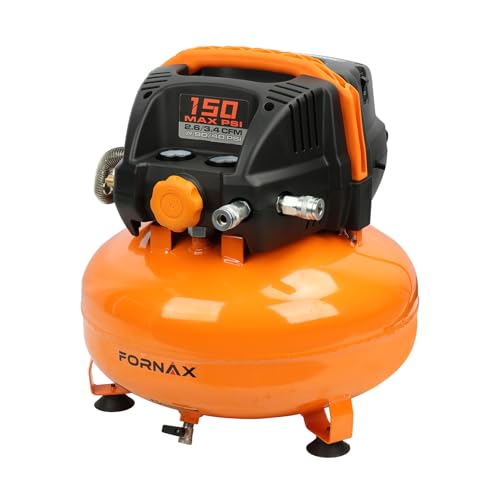
FORNAX 6-Gallon Pancake Air Compressor
The FORNAX 6-Gallon Pancake Air Compressor delivers 2.6 CFM at 90 PSI and up to 150 PSI of maximum pressure, featuring dual couplers and a lightweight 28.8-pound portable footprint. It is a practical pneumatic power source for DIY homeowners, finish carpenters, and garage hobbyists driving nailers or managing tire inflation.
Pros
- Dual quick-connect couplers allow two nailers to operate simultaneously without adding an external splitter manifold
- Generous 6-gallon air tank capacity with a 150 PSI maximum pressure ceiling provides a dependable air reserve
- Lightweight 28.8-pound profile simplifies one-handed carrying up stairs and transport into work vans
- Maintenance-free oil-free pump eliminates oil checks, oil changes, and mess around finished work surfaces
Cons
- Operating sound output rated at 95 dBA is loud and makes hearing protection necessary, especially in closed rooms
- Airflow output of 2.6 CFM at 90 PSI cannot support continuous-demand tools like sanders, grinders, or paint sprayers
- Supplied as a bare-tool compressor without an included air hose, tire inflator chuck, or pneumatic nailers
ECOMAX 6-Gallon 175 PSI Portable Pancake Air
The ECOMAX 6-Gallon Pancake Air Compressor delivers up to 175 PSI and 3 CFM at 90 PSI, providing dependable recovery and dual quick couplers for trim fastening and garage tasks. Weighing approximately 31.5 pounds and featuring cold-weather start capability, it suits DIY homeowners and punch-list contractors seeking a complete portable air setup.
Pros
- High 175 PSI maximum tank pressure provides substantial usable air volume in a compact 6-gallon footprint
- Rated 3 CFM at 90 PSI supports quick pressure recovery between fastening cycles and tire inflation tasks
- Dual quick-connect couplers support running two pneumatic hoses without adding aftermarket splitters
- Comes complete with a 25-foot hose and essential pneumatic accessories for immediate out-of-the-box utility
- Oil-free pump design ensures low ongoing maintenance with no oil levels to monitor or change
Cons
- Output of 3 CFM at 90 PSI is unsuited for continuous high-consumption air tools like sanders or grinders
- Included 25-foot PVC air hose can be stiff and retain tight coils in cold working environments
- Manufacturer does not publish an official dBA rating, and standard oil-free pancake pumps can be loud indoors
FORNAX 6-Gallon Pancake Air Compressor: 150 PSI
The FORNAX 6-gallon pancake air compressor delivers 2.6 CFM at 90 PSI and 150 max PSI with dual couplers and an oil-free pump, weighing in at an easy-to-carry 28.8 pounds. It is a practical setup for DIY homeowners and finish carpenters tackling trim nailing, tire inflation, and workshop blow-off tasks.
Pros
- Dual quick-connect couplers support running two pneumatic nailers simultaneously
- Solid airflow delivery with 2.6 CFM at 90 PSI and 3.4 CFM at 40 PSI
- Manageable 28.8-pound portable weight simplifies one-handed transport
- Maintenance-free oil-free pump eliminates messy oil checks and changes
- Comes with a 14-piece accessory kit for out-of-the-box pneumatic utility
Cons
- High operating noise level rated at 95 dBA makes hearing protection mandatory, especially indoors
- Limited CFM output is unsuitable for continuous-demand air tools like HVLP paint sprayers or orbital sanders
- Fast-spinning 3,550 RPM motor generates noticeable vibration during recharge cycles
A closely related question is covered in how many watts does a pancake air compressor use, which may help alongside this section.
The Engineering Mechanics, Component Systems, and Operating Dynamics of Pancake Compressors
A pancake air compressor operates on the mechanical principle of positive displacement, converting electrical energy into pressurized air stored under tension. Rather than relying on continuous rotary impellers, these portable machines draw ambient air into an enclosed cylinder bore and mechanically reduce its volume using a reciprocating piston. When you plug the compressor into a standard 120-volt electrical circuit and engage the power switch, an integrated assembly of mechanical, electrical, and pneumatic controls coordinates to charge the tank to its preset cut-out pressure. Understanding this sequence reveals why these compact tools excel at rapid, intermittent tasks while facing physical limitations during continuous high-volume air consumption.
The Intake and Compression Stroke: Positive Displacement in Motion
The mechanical cycle begins at the intake air filter, where the machine draws in ambient atmospheric air at standard atmospheric pressure. As the electric motor rotates, an eccentric journal on the drive shaft moves the connecting rod downward, pulling the piston down the cylinder bore. This downward motion creates a partial vacuum inside the cylinder chamber, forcing the flexible intake reed valve open while cylinder pressure holds the exhaust valve shut. Ambient air rushes through the intake port to fill the expanding cylinder volume until the piston reaches bottom dead center.
Once the piston reverses direction and begins its upward stroke, rising internal pressure immediately snaps the flexible intake reed valve back against its seat. Trapped inside the bore, the air molecules are forced into an increasingly confined space as the piston advances toward top dead center. This physical compression raises both the pressure and the internal temperature of the air according to basic thermodynamic gas principles. When internal cylinder pressure exceeds the pressure inside the transfer tube, the exhaust reed valve flexes open, discharging the compressed air charge toward the storage tank.
Inside the Oil-Free Pump: PTFE Piston Rings and Direct-Drive Motors
Unlike commercial shop compressors that lubricate internal cylinders with oil baths, pancake compressors rely on oil-free pump mechanisms for maintenance-free operation and clean transport. The piston assembly features a specialized piston ring or cup manufactured from a durable polytetrafluoroethylene (PTFE) compound blended with heat-resistant synthetic binders. This flexible cup maintains a tight, low-friction seal against the precision-machined aluminum cylinder sleeve without requiring liquid lubricating oil. Because no oil circulates inside the compression chamber, the compressed air discharged into the tank remains free of suspended oil mist that could ruin painted trim or clog nailer valves.
The drive assembly connects directly to the motor shaft via an eccentric bearing rather than utilizing an external drive belt and pulley system. Direct-drive universal or induction motors frequently spin at speeds exceeding 3,000 RPM, such as high-output 3,550 RPM configurations engineered for rapid recovery cycles. This high operational speed allows a relatively small piston displacement to generate useful airflow volumes, but it also produces distinct operating noise and rapid heat buildup. The absence of liquid oil enables operators to transport and store the compressor in any position, including trunk beds and sloped shelves, without risking messy fluid leaks.
Air Transfer and One-Way Check Valves: Protecting the Pump Head
After leaving the cylinder head during the exhaust stroke, compressed air travels through a finned aluminum or copper discharge tube toward the receiver tank. Before the air can enter the storage vessel, it must pass through a spring-loaded brass one-way check valve threaded directly into the tank manifold. The check valve allows incoming compressed air to push past an internal sealing poppet or rubber seat during active pump strokes. Once the motor shuts off, internal tank pressure presses the poppet firmly back against its seat, preventing high-pressure air from backflowing into the cylinder.
Protecting the cylinder head from tank back-pressure is vital for motor safety and smooth restarting reliability. If the check valve fails to seal completely due to wear, carbon residue, or tank corrosion debris, high-pressure air constantly bleeds back into the pump head. This condition places heavy mechanical resistance directly against the piston assembly, creating severe startup torque demands when the motor attempts to engage again. Consistent operational cycling depends heavily on this small brass fitting to maintain an airtight boundary between stored energy and mechanical pump components.
The Pressure Switch and Unloader Valve: Automated Cycling Mechanics
An electro-mechanical pressure switch monitors internal tank pressure to automate the motor run cycle without operator intervention. When the tank pressure drops below a factory-set cut-in threshold, internal switch contacts snap shut, directing electrical line voltage to start the motor. As the pump forces air into the tank, internal pressure rises against a responsive internal diaphragm balanced by heavy-duty steel springs. When pressure reaches the factory cut-out threshold, typically set between 110 PSI and 175 PSI, the diaphragm overcomes spring resistance and snaps the electrical contacts open, instantly stopping the motor.
At the exact moment the motor cuts out, an integrated component known as the unloader valve performs an essential pressure relief task. The unloader valve momentarily vents the small pocket of pressurized air trapped in the discharge tube between the cylinder head and the check valve. You can hear this process as a brief, sharp hiss of escaping air when the compressor motor stops running. By purging residual head pressure, the unloader valve ensures that the piston encounters zero head resistance during the next startup cycle, preventing motor stalls and electrical surges.
If this topic is part of a bigger decision, what is a pancake air compressor used for is a useful related read.
Pancake Tank Geometry: Pressure Storage and Jobsite Balance
The compressed air collects inside a welded steel pressure vessel distinguished by its round, flattened profile resembling a wide culinary pancake. This specific geometric profile provides a distinctly low center of gravity compared to tall vertical units or elongated hot dog tanks. When operating on uneven subfloors, sloped residential staircases, or busy workshop corridors, the broad base resists accidental tipping when workers tug on connected air lines. Heavy-gauge stamped steel, such as Q235b alloy metal, provides the structural tensile strength needed to withstand continuous pressure cycles up to 150 PSI or 175 PSI safely.
Tank capacity in these units generally ranges from 3 gallons on ultra-portable trim models to 6 gallons on versatile jobsite compressors. While a 6-gallon reservoir cannot sustain massive continuous air tools, it acts as an indispensable pneumatic buffer for intermittent firing cycles. When reviewing portable pancake air compressor options, buyers will notice that higher maximum storage pressures store greater usable air mass within the same physical container dimensions. A 6-gallon tank charged to 175 PSI holds substantially more standard cubic feet of air than an identical 6-gallon vessel pressurized to only 110 PSI, extending tool run duration before the motor recycles.
Regulating Line Pressure: How Dual Gauges Control Output
Stored tank pressure is almost always far too high to feed directly into standard pneumatic carpentry tools. Brad nailers, narrow crown staplers, and finish nailers typically require operating pressures between 70 PSI and 100 PSI, whereas the reservoir stores air at 110 PSI to 175 PSI. To manage this differential safely, pancake compressors incorporate an outlet manifold featuring an adjustable pressure regulator and two distinct dial gauges. The first gauge reads unregulated tank pressure, displaying how much stored energy remains inside the reservoir.
The second gauge displays regulated output pressure, which represents the exact line pressure delivered downstream to the air hose. Turning the oversized regulator knob clockwise compresses an internal spring against a flexible diaphragm, opening a regulating valve to increase working line pressure. Counter-clockwise rotation relaxes the spring, venting minor line pressure and restricting downstream flow to protect delicate pneumatic tool seals. Dual quick-connect couplers on the manifold manifold permit users to operate multiple fastening tools simultaneously, provided overall air volume demands remain within pump capabilities.
Air Delivery Ratings and Intermittent Duty Cycle Constraints
Airflow volume is measured in standard cubic feet per minute (SCFM), which quantifies the volume of expanded air delivered at specific operating pressures. Pancake compressors typically deliver between 2.6 SCFM and 3.0 SCFM at 90 PSI, alongside 3.4 SCFM to 3.7 SCFM at 40 PSI. These air volume metrics explain why pancake units excel with intermittent tools like 18-gauge brad nailers, 16-gauge finish nailers, and tire chucks. Each fastener shot consumes only a tiny fraction of a cubic foot of air, giving the pump ample time to recover between intermittent fastener shots.
Conversely, continuous pneumatic tools like rotary sanders, die grinders, and HVLP paint sprayers draw continuous streams exceeding 5.0 to 8.0 SCFM. When attached to a pancake compressor, a continuous tool drains the 6-gallon air reservoir in mere seconds. Once line pressure drops below the motor cut-in threshold (often around 85 PSI to 135 PSI), the pump runs continuously without ever catching up to the tool consumption rate. Pancake oil-free pumps are engineered for an intermittent 50 percent to 70 percent duty cycle, meaning continuous operation leads to rapid heat buildup, thermal overload shutdowns, and accelerated piston seal wear.
Electrical Power Dynamics: Startup Amperage and Extension Cords
The electric motors powering portable pancake compressors are designed to operate on standard 120-volt household alternating current circuits. Under normal running conditions, continuous electrical draw remains manageable, but starting the motor against mechanical inertia demands a substantial momentary current spike. Cold-weather conditions thicken the synthetic grease in bearings and increase mechanical resistance across the PTFE piston cup, pushing initial draw higher. High-efficiency motors and specialized low-voltage starting components help these units fire up without tripping standard 15-amp residential circuit breakers, even in unheated garage environments.
A common operational mistake involves connecting the compressor to long, lightweight electrical extension cords like standard 16 AWG utility cords. Undersized cords cause significant voltage drop over distance, starving the electric motor of operating voltage and causing running amperage to spike dangerously. This voltage starvation leads to motor humming, failed startups, and repeatedly tripped circuit breakers. The safest approach is plugging the compressor directly into a dedicated 120-volt wall receptacle and extending operating reach by adding a 50-foot or 100-foot rubber air hose instead.
Moisture Condensation Dynamics and Daily Tank Purging
The thermodynamic process of compressing ambient air naturally produces water condensation inside the steel storage reservoir. Ambient air contains suspended humidity, and when that air is compressed and subsequently cooled against cold steel tank walls, moisture condenses into liquid water. Over several hours of typical operation, multiple ounces of liquid water collect at the lowest point of the pancake reservoir. If this water is left inside the tank, it accelerates internal steel oxidation, resulting in rusty water spitting through your air tools and premature tank corrosion.
Every pancake compressor incorporates a bottom drain valve, typically configured as a thumb-twist petcock or a quarter-turn brass ball valve. Draining this collected condensation after every work session is the single most vital maintenance task for any portable compressor operator. To drain the unit safely, reduce tank pressure below 30 PSI, disconnect the power cord, place a catch tray beneath the tank, and slowly open the drain valve. Allowing the remaining air pressure to expel moisture and scale keeps the internal tank shell dry, prolongs tank structural integrity, and ensures clean, dry air delivery to your pneumatic nailers.
A pancake air compressor functions as a balanced mechanical ecosystem where positive displacement pumping, automated pressure switching, and line regulation work in unison. By matching your pneumatic tool consumption to the machine’s delivered SCFM at 90 PSI and respecting duty cycle boundaries, you can achieve clean fastener placement and reliable inflation year after year. Routine condensation drainage and proper electrical supply connections protect both the steel vessel and the oil-free motor, ensuring dependable portable air power whenever your projects demand it.
A closely related question is covered in hdc pancake air compressor parts, which may help alongside this section.
About the author
Kenny Koehler is a power-tool specialist with more than a decade of hands-on evaluation experience and a science-based approach to product testing. His expertise in repeatable testing, tool performance, impact wrenches, and professional equipment brings a practical, data-focused perspective to compressor and pneumatic-tool comparisons.